When I was living back in South-West England, in the Totnes area, I had plenty of time to get to know Neil K. Neil has the most wonderful sense of humour and an ability to look at the world rather differently than the rest of us. I offer this tribute in acknowledgement of the great items that Neil passes to me for inclusion in Learning from Dogs. This one is no exception.
——————–
The Story of Adam & Eve’s Pets
Adam and Eve said, ‘Lord, when we were in the garden, you walked with us every day. Now we do not see you any more. We are lonesome here, and it is difficult for us to remember how much you love us.’
And God said, I will create a companion for you that will be with you and who will be a reflection of my love for you, so that you will love me even when you cannot see me.
Regardless of how selfish or childish or unlovable you may be, this new companion will accept you as you are and will love you as I do, in spite of yourselves.’
And God created a new animal to be a companion for Adam and Eve.
And it was a good animal and God was pleased.
And the new animal was pleased to be with Adam and Eve and he wagged his tail.
And Adam said, ‘Lord, I have already named all the animals in the Kingdom and I cannot think of a name for this new animal.’
And God said, ‘I have created this new animal to be a reflection of my love for you, his name will be a reflection of my own name, and you will call him DOG.’
And Dog lived with Adam and Eve and was a companion to them and loved them.
And they were comforted.
And God was pleased.
And Dog was content and wagged his tail.
After a while, it came to pass that an angel came to the Lord and said, ‘Lord, Adam and Eve have become filled with pride. They strut and preen like peacocks and they believe they are worthy of adoration. Dog has indeed taught them that they are loved, but perhaps too well.’
And God said, I will create for them a companion who will be with them and who will see them as they are. The companion will remind them of their limitations, so they will know that they are not always worthy of adoration.’
And God created CAT to be a companion to Adam and Eve.
And Cat would not obey them. And when Adam and Eve gazed into Cat’s eyes, they were reminded that they were not the supreme beings.
A chance dip into the BBC News website a few days ago allowed me to come across an article about the vanishing glaciers in the Himalayas. It just about broke my heart. Here’s what it said,
Rivers of ice: Vanishing glaciers
Stunning images from high in the Himalayas – showing the extent by which many glaciers have shrunk in the past 80 years or so – have gone on display at the Royal Geographical Society in central London.
Between 2007 and 2010, David Breashears retraced the steps of early photographic pioneers such as Major E O Wheeler, George Mallory and Vittorio Sella – to try to re-take their views of breathtaking glacial vistas.
The mountaineer and photographer is the founder of GlacierWorks – a non-profit organisation that uses art, science and adventure to raise public awareness about the consequences of climate change in the Himalayas.
Rivers of Ice: Vanishing Glaciers of the Greater Himalaya can be seen at the RGS in London until 11 November 2011. Admission free.
All photos courtesy GlacierWorks and Royal Geographical Society. Map copyright Jay Hart. All images subject to copyright.
Music courtesy KPM Music. Audio slideshow production by Paul Kerley. Publication date 11 October 2011.
Then follows a 3:59 film made by David Breashears that is so beautiful as well as so upsetting. I don’t have a way of linking to the film directly but it’s easy to watch, just click here and be very moved.
David Breashears has his own website, from where one can learn that,
David Breashears is an accomplished filmmaker, adventurer, author, mountaineer, and professional speaker. Since 1978, he has combined his skills in climbing and filmmaking to complete more than forty film projects.
In 1983, Breashears transmitted the first live television pictures from the summit of Mount Everest, and in 1985 became the first American to reach the summit of Mount Everest twice.
In the spring of 1996, Breashears co-directed and co-produced the first IMAX film shot on Mount Everest. When the now infamous blizzard of May 10, 1996 hit Mount Everest, killing eight climbers, Expedition Leader Breashears and his team were in the midst of making this historic film. In the tragedy that soon followed, Breashears and his team stopped filming to provide assistance to the stricken climbers. After returning to Base Camp, Breashears and his team then regrouped and reached the summit of the mountain on May 23, 1996, achieving their goal of becoming the first to record IMAX film images at Earth’s highest point. Breashears has said that if there is a lesson to be learned from the May 1996 tragedy, it is that for him, success that year was not to be found in reaching the summit, it was that everyone on his team returned safely. The film, titled EVEREST, premiered in March 1998.
As was written in that BBC item, David is the founder of GlacierWorks which is full of beautiful, albeit tinged with sadness, images of the glaciers featured in that BBC item. As the GlacierWorks website explains on the home page,
The Mighty Himalayan Glaciers are Vanishing.
The rate of recession is unprecedented, accelerating and, without some remedy to the problem of climate change, unstoppable. GlacierWorks is a non-profit organization that uses art, science, and adventure to raise awareness about the consequences of climate change in the Greater Himalaya.
Read that first sentence again, “The rate of recession is unprecedented, accelerating and, without some remedy to the problem of climate change, unstoppable.” [my emphasis]
There are a number of videos on YouTube if you search for David Breashears, none up to the beauty of the slide show in the BBC item so don’t miss that at all. However, the following is also worth watching,
OK, a change of topic but one that connects with the underlying message about the disappearing glaciers. This was an article in the American The Nation newspaper written by Naomi Klein, following her speech to the demonstrators at Occupy Wall Street. The article really should be read in full but I wanted to highlight just the following words from Naomi,
The point is, today everyone can see that the system is deeply unjust and careening out of control. Unfettered greed has trashed the global economy. And it is trashing the natural world as well. We are overfishing our oceans, polluting our water with fracking and deepwater drilling, turning to the dirtiest forms of energy on the planet, like the Alberta tar sands. And the atmosphere cannot absorb the amount of carbon we are putting into it, creating dangerous warming. The new normal is serial disasters: economic and ecological.
We all know, or at least sense, that the world is upside down: we act as if there is no end to what is actually finite—fossil fuels and the atmospheric space to absorb their emissions. And we act as if there are strict and immovable limits to what is actually bountiful—the financial resources to build the kind of society we need.
The task of our time is to turn this around: to challenge this false scarcity. To insist that we can afford to build a decent, inclusive society—while at the same time, respect the real limits to what the earth can take.
Thanks to Bill Mitchell of Billy Blog for linking me to the Naomi Klein speech.
We can afford to build a decent, inclusive society and we must – not tomorrow but now. Start with your local community, think about transition. Some of our grandchildren will be mountaineers – let them see the beautiful rivers of ice.
The ways of our carbon-consuming past & present cannot be continued into the future.
In many ways that sub-heading above is not controversial for millions of citizens of Planet Earth. The challenge is in changing behaviours, ending old habits of energy use, and working towards a truly sustainable relationship with the only planetary home we have!
Like many others, Jean and I are of the view that the Keystone XL Pipeline is not required. Last week there was an update from EPI about this subject illustrating how the pipeline is not required. That update is published in full, as follows,
Plan B Updates
OCTOBER 06, 2011
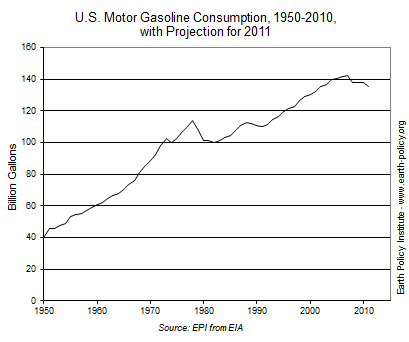
U.S. Gasoline Use Declining: Keystone XL Pipeline Not Needed
Lester R. Brown
As the debate unfolds about whether to build a 1,711-mile pipeline to carry crude oil from the tar sands in Canada to refineries in Texas, the focus is on the oil spills and carbon emissions that inevitably come with it. But we need to ask a more fundamental question. Do we really need that oil?
The United States currently consumes more gasoline than the next 16 countries combined. Yes, you read that right. Among them are China, Japan, Russia, Germany, and Brazil. (See data.)
But now this is changing. Not only is the affluence that sustained this extravagant gasoline consumption eroding, but the automobile-centered lifestyle that was considered part of the American birthright is fading as well. U.S. gasoline use has dropped 5 percent in four years.
Four key developments are set to further reduce U.S. gasoline use: a shrinking car fleet, a decline in the miles driven per car, dramatic mandated future gains in new car fuel efficiency, and the shift from gasoline to electricity to power our cars.
The U.S. fleet appears to have peaked at 250 million vehicles in 2008. From 1994 through 2007, new-car sales were in the range of 15–17 million per year. Since then they have totaled 10–13 million per year, and they are unlikely to top 14 million again. Retirees likely will exceed sales of new cars throughout this decade.
The contraction that began when the fleet dropped from 250 million in 2008 to 248 million in 2010 is likely to continue. Sales of new cars are not matching those of earlier years in part because the economic prospect has dimmed and in part because we are still urbanizing. Today 82 percent of us live in urban areas where cars are becoming less essential.
On top of urbanization, we also have a change in the manner in which young people socialize. For teenagers in rural communities a half century ago, getting a driver’s license and something to drive—a car, a pickup, or even a farm truck—was a rite of passage. That’s what everyone did.
This too is changing. Today’s teenagers, most of whom grew up in an urban setting, socialize through smartphones and the Internet. For many of them, a car is of little interest. The number of licensed teenage drivers in this country—the car owners of the future—has dropped from a peak of 12 million in 1978 to 10 million today.
Cities are also being redesigned for people. Among other things, this means cities are becoming pedestrian- and bicycle-friendly, with ready access to public transit.
Many cities are building a cycling infrastructure of bicycle trails, dedicated bike lanes, and bike racks for parking. Bike-sharing programs are showing up, too. In Washington, D.C., the Capital Bikeshare program that began in 2010 has expanded to 116 stations with 1,100 bicycles. Within the first year, some 16,000 riders signed up for annual membership in the program. Denver and Chicago have similar bike share programs. And New York City is about to launch a huge program of its own.
The second reason that gasoline use is falling is the decline in miles driven per car. This is partly in response to economic uncertainty and the high price of gasoline. When gas costs nearly $4 a gallon, people think twice before jumping in a car and using a gallon of gasoline to pick up a half-gallon of milk.
A third trend that is reducing gasoline use is the rising fuel efficiency of the U.S. automobile fleet. New cars sold in 2008 averaged 27 miles per gallon. But in early 2009, President Obama raised the average fuel efficiency standard so that those sold in 2016 will get 36 miles per gallon. Additional standards announced in 2011 mean that new cars sold in 2025 will use less than half as much gasoline as the 2008 models.
The game changer in reducing gasoline use is going to come as drivers shift from gasoline to electrically powered vehicles, including plug-in hybrids and all-electric cars. General Motors recently introduced the Chevrolet Volt, designed to run largely on electricity, and Nissan unveiled the Leaf, an all-electric vehicle. Beyond these, Toyota is accepting orders for the plug-in version of its Prius hybrid, the pacesetter in fuel efficiency. It will be followed by a steady flow of new plug-in hybrid and all-electric car models coming to market.
Although these electrically powered vehicles are typically more costly to buy, the day-to-day cost of operating them is extraordinarily low. An analysis by Professor Michael McElroy at Harvard indicates that running a car on wind-generated electricity could cost less than the equivalent of 80-cent-a-gallon gasoline.
With the auto fleet shrinking, with the average car being driven less, with the fuel use of new cars to be cut in half by 2025, and with electricity starting to replace gasoline as a fuel, why do we need to build a pipeline to bring crude oil from Canada’s tar sands to oil refineries in Texas? The answer is we don’t.
Lester R. Brown is president of the Earth Policy Institute and author of World on the Edge.
There’s a footnote that I would like to add from the Center for Biological Diversity (great website!) that came out in a recent newsletter.
Here it is,
Lawsuit Seeks to Halt Work on Controversial Keystone XL Pipeline
Keystone Pipeline
The hotly contested Keystone XL pipeline hasn’t been approved for construction, but federal officials don’t seem to care; they’ve allowed the pipeline company to mow down 100 miles of native prairie grasslands in Nebraska to clear the way — before any public hearings were held on whether Keystone XL should move forward at all.
The Center for Biological Diversity and Friends of the Earth filed a lawsuit in federal court in Omaha Wednesday to halt that work. Specifically, we’re challenging decisions by the State Department and U.S. Fish and Wildlife Service to allow work to begin before a decision’s been made on the pipeline or the public hearings, which look like little more than a sham at this point.
If approved, TransCanada’s 1,700-mile pipeline would carry up to 35 million gallons of oil a day from tar sands in Canada to refineries in Texas. Not only will this project add fuel to the global climate crisis, but the pipeline will cut across Nebraska’s legendary Sandhills, hundreds of rivers and streams, and the Ogallala Aquifer, which provides drinking water for millions of people. TransCanada’s existing pipeline, called Keystone 1, has reportedly leaked 14 times since it started operating in June 2010.
Big thanks to Cynthia S. for forwarding this to me.
Before writing about Brutus, did you read yesterday’s item about George, the rescue dog, and the wonderful effort to raise funds for more life-saving efforts? If not, read it here. Whatever you can spare, please donate to this super cause.
Now to Cynthia’s item, that has been fairly widely spread across the internet.
How to hug a baby
Brutus
Thought you might like to know about this dog and his history, I especially like the ending, Cynthia.
The dog above is Brutus, a military dog at McChord.. . He’s huge, part Boxer and part British Bull Mastiff, and tops the scales at 200 lbs. His handler took the picture and explains, “Brutus is running toward me because he knows I have some Milk Bone treats, so he’s slobbering away! I had to duck around a tree just before he got to me in case he couldn’t stop, but he did.”
Brutus was the recipient of the Congressional Medal of Honor last year from his tour in Iraq. His handler and four other soldiers were taken hostage by insurgents. Brutus and his handler communicate by sign language and he gave Brutus the signal that meant ‘go away but come back and find me’. The Iraqis paid no attention to Brutus. He came back later and quietly tore the throat out of one guard at one door and another guard at another door. He then jumped against one of the doors repeatedly (the guys were being held in an
old warehouse) until it opened. He went in and untied his handler and they all escaped. Brutus is the first dog to receive this honor, the Congressional Medal of Honor. If he knows you’re ok, he’s a big old lug and wants to sit in your lap. Enjoys the company of cats..
Instructions for properly hugging a baby with Brutus
(A quick Google search found that the words accompanying the same pictures on Daniela’s website, The Daily Tail, were perfect, thus they have been used.)
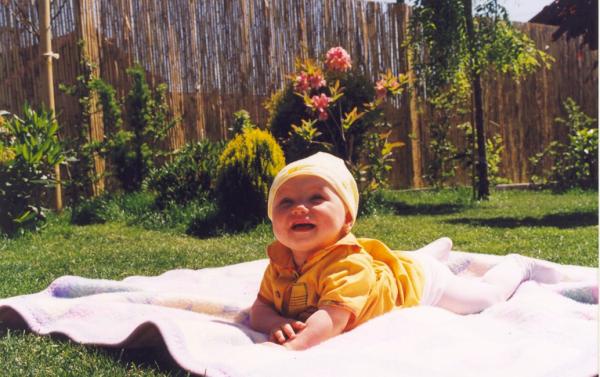
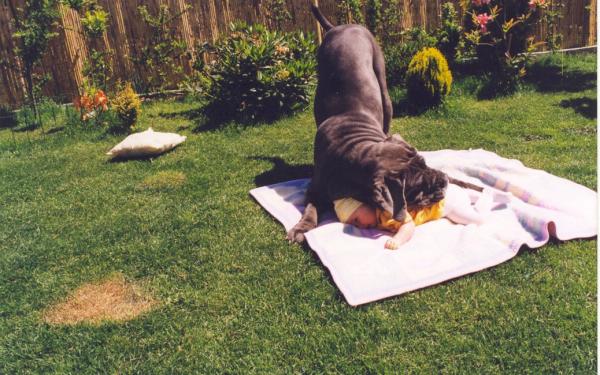
Step One – Place the baby on a flat, uncluttered surface. Important: Do not attempt this without the assistance of a qualified parent.
Step One
Step Two – Conduct a sniff test to verify the specimen is actually a baby. The scent of baby powder is usually sufficient evidence.
Step Two
Step Three – Carefully adjust the baby’s position until its head faces the mother’s camera. Note: Babies have two ends. The end covered with a hat or hair is the head. The end covered with a diaper is the butt. Babies do not have tails.
Step Three
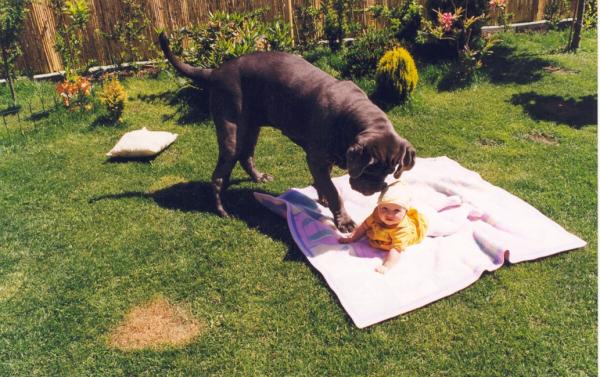
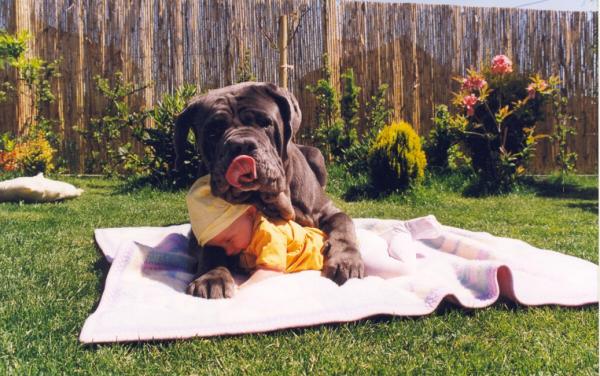
Step Four – Lay your body down over baby. Do not apply pressure. While gently placing your paws around the baby’s body, lick your lips to condition them for the kiss (essential part of the hug).
Step Four
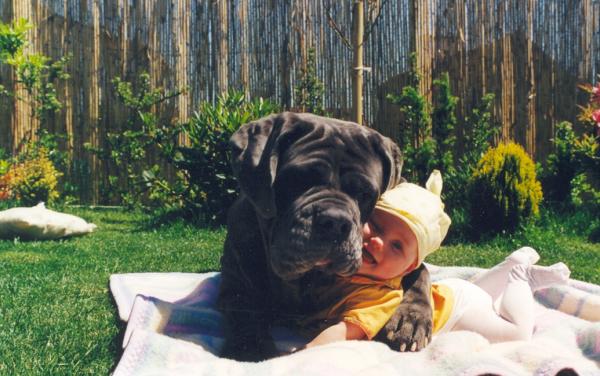
Step Five – Lean in toward the baby and let your heart melt. Repeat as necessary until the parent finds the camera and takes a perfect picture.
A canine charitable opportunity that deserves wide support.
The details that follow strike a chord with me, strike a chord in a big way. When I first came to live with Jean back in 2008 it was clear that this wasn’t going to be a normal relationship. Why? Because, at that time Jean had 12 dogs living with her in San Carlos, Mexico and my arrival, together with my Shepherd dog, Pharaoh (see home page for a picture of him), took that number to 13. Jean’s dogs were all Mexican rescues; she also ran her own local humane society in San Carlos and over the years had found homes for literally dozens of dogs.
One of those Mexican rescues was a dog called Loopy, who had been terribly treated by local Mexicans. The consequence when I arrived, a stranger in the middle of Loopy’s life with Jean, was that Loopy was very aggressive towards me; my hands have small scars to bear witness to the number of nips Loopy launched in my direction.
It took over a year before I was able to just let my hand ‘accidentally’ brush her side. Slowly Loopy’s trust in me built up until now I can press my face to her face and cuddle her for ages. (To underline the love that Loopy bestows on me, I will get Jean to take a picture and publish that before the end of the week.) So with that in mind, let me turn to the details recently sent to me by friend and colleague, Dapinder Singh, from England.
———————
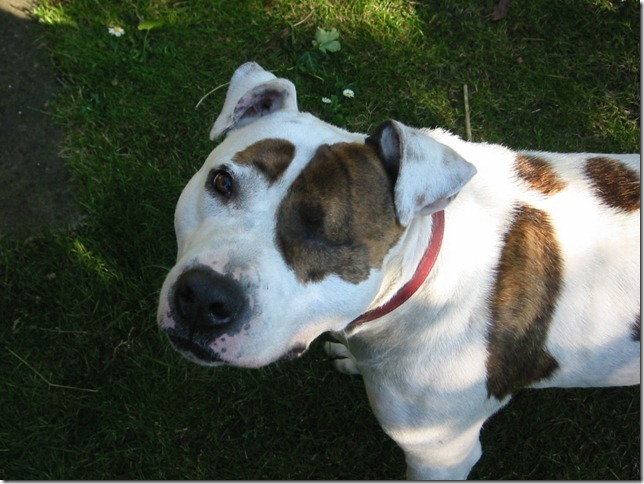
George and loving owner, Ian.
This is George. He was in an English dog pound and condemned to death.
He had been very badly abused, one eye blinded by what was thought to be a kick, he trusted no-one and had rejected all human contact. He was desperate and in despair.
After an exhaustive search for anyone who take on the rescue of George, we (as in Doris Banham) took him into our care just a day before he was due to be euthanased. His veterinary problems were easier to deal with than the mental ones. His eye was damaged beyond repair causing him constant pain so it had to be removed, teaching George to trust again was much harder.
That journey back to trusting humans was long, George had suffered severe and terrible abuse, but there was no question of giving up on him and slowly but surely he began to live again as we fought to undo the wrongs that had been done to him. After some months with us, a wonderful family came to the rescue and offered George his ‘forever’ home where he found the love that he so deserved. His family are completely devoted to him.
His story, however, could have been a very different one were it not for the work of the team at Doris Banham’s. Below is an extract written by the lovely family who adopted him and from our fantastic volunteer, Sheila, who helped bring George back to life again.
“Hi, Sheila. Here is a shot of George in his new garden. He is settling down very well and seems to be very happy. I will keep you posted as to his progress. All the best Liz and Ian.”
There were a number of photographs sent to Sheila, however I have taken editor’s liberty and moved them to the foot of the article – I want you to stay with this to the point where you can see how to help. Here’s Sheila’s reply,
“WELL THESE BOUGHT ME TO TEARS , OUR GEORGE , THIS IS TRUE RESCUE , THIS IS ALL DOWN TO YOU DORIS BANHAM NOTHING ELSE TO SAY …” SHEILA X.
Are there other Georges out there? You bet! Far too many of them, right across the world. So let’s all do something to help these special creatures, who show us humans just what unconditionally love feels like.
Friday 4th November, 7.30pm – Come to the Hellaby Hall Hotel, Old Hellaby, Maltby, Yorkshire, S66 8SN
Call for tickets now to the Pound Dog Ball telephone number (UK) 07772 538513 or email pogpublications@yahoo.com Full details here.
Please help all the Georges out there by supporting this Charity Fundraising Event: Black Tie, Dinner/Dance at Hellaby Hall, Rotherham, 7.30pm, on Friday 4th November. It’s a don’t miss night…..3 course meal, live entertainment all night and dancing ’til late!!!! It’s going to be a great night.
If you can’t make the Ball but would like to send in a donation then please post a cheque, made out to Pound Dog Ball, to the following address:
c/o Jennifer Smith
Clumber Lodge,
50 Hemingfield Road
Wombwell, S73 0LY.
Or if you prefer an electronic donation, further details are:
Pound Dog Ball
A/C 31542265
Sort 40-45-29 (HSBC)
The account is a charity account, set up only for this event. Once the money has been paid to the charities the account will be closed.
I know that Dapinder, and everyone else involved in helping these precious animals, sends you their heartfelt thanks.
Finally, more photos of George enjoying life as all dogs should. What a wonderful story, an honour to be able to publish it, and promote the Ball, on Learning from Dogs. Please help.
Three guest posts from Martin Lack of Lack of Environment, today the concluding Part Three
Hope you have been following the previous two parts of this essay from Martin. Part One can be read here; Part Two here.
————————-
Can modernisation be “ecological”? – Part 3
This is the third and final part of my mini-critique of the school of environmental thought known as Ecological Modernisation.
——————-
Newsflash: Today [Sept. 27th.] isEarth Overshoot Day for 2011. This was a genuine coincidence (i.e. I did not know this when I decided to do this 3-part story). See paragraph 2 below…
——————-
Where are we now?
In his seminal 1968 article on ‘The Tragedy of the Commons’, Garrett Hardin had observed that it was not possible to achieve Jeremy Bentham’s hedonistic goal of “the greatest good for the greatest number” because, at the level of the individual, to do so would require food and/or energy to be used for subsistence purposes only (Hardin 1968: 1243). In 1977, William Ophuls agreed that the optimum population is not the maximum possible, which appears to imply that, if necessary, artificial limits to growth should be imposed. Furthermore, he explicitly stated that, “…this optimum level… may be as little as fifty percent of the theoretical maximum…” (Ophuls 1977: 28).
Mathis Wackernagel et al have recently provided “…evidence that human activities have exceeded the biosphere’s capacity since the 1980s. This overshoot can be expressed as the extent to which human area demand exceeds nature’s supply. Whereas humanity’s load corresponded to 70% of the biosphere’s capacity in 1961; this percentage grew to 120% by 1999.” However, the authors also pointed out that, if… “12% of the bioproductive area was set aside to protect other species; the demand line crosses the supply line in the early 1970s rather than the 1980s” (Wackernagel et al 2002: 9268-9)(emphasis mine).
In laboratory-controlled studies, the size of a population of, say, fruit flies can be shown to depend on the scarcity or abundance of food; and the presence or absence of predators. However, in 2005, Meadows et al pointed out that a growing population “…will slow and stop in a smooth accommodation with its limits… only if it receives accurate, prompt signals telling it where it is with respect to its limits, and only if it responds to those signals quickly and accurately” (Meadows et al 2005: 157).
This pursuit of the resulting “S-curve” is sometimes referred to as the demographic transition of an increasingly affluent society through three stages: (1) high birth and death rates; (2) high birth rate but low death rate; and (3) low birth and death rates. However, in a section entitled ‘Why Technology and Markets Alone Can’t Avoid Overshoot’, Meadowset al also pointed out that if we put off dealing with limits to growth we are more likely to come up against several of them simultaneously (ibid: 223).
Even though no-one seems to want to talk about population control today, neither Hardin nor Malthus was the first to raise this contentious subject because, as Philip Kreager has pointed out, this dubious honour goes to Aristotle’s treatise on Politics within which, “…population is a recurring topic, extensively discussed and integral to the overall argument…” (Kreager 2008: 599). Furthermore, according to Theodore Lianos, although Aristotle was thinking at the scale of a city rather than a country, the great philosopher recognised that there was an optimum population size, which depended on the land area controlled by the city (for food production purposes), which could be determined by, “the land-population ratio that produces enough material goods so that the citizens can live a wise and generous life, comfortable but not wasteful nor luxurious” (Lianos 2010: 3).
Conclusions
It has been demonstrated that dematerialisation alone cannot deal with the problem of resource depletion unless the increase in unit efficiency is greater than the increase in scale of production (i.e. something that cannot be sustainable indefinitely).
Furthermore, whereas it may be possible to partially decouple environmental degradation from economic growth, pursuit of this as a sole objective is a dangerous strategy. This is because to do so is to remain ambivalent about the existence and significance of limits to growth; indeed it is to deny that growth itself may be the problem.
In the final analysis, the only thing that will be sustainable is progression towards the steady-state economy proposed by Daly and others; combined with qualitative development instead of quantitative growth. Therefore, the only form of modernisation that could be ecological is one that places the intrinsic value of vital resources such as clean air and clean water – and the inherent value of a beautiful landscape – well above the instrumental value of money or precious metals.
——————-
References:
Hardin, G. (1968), ‘The Tragedy of the Commons’, Science, 168, pp.1243-8.
Kreager, P. (2008), ‘Aristotle and open population thinking’, Population and Development Review 14(34), pp.599-629.
Lianos, T. (2010), ‘Aristotle’s Macroeconomic Model of the City-State’.
Meadows D, et al (2005), Limits to Growth: the 30-Year Update, London: Earthscan.
Ophuls, W. (1977), Ecology and the Politics of Scarcity, San Francisco: Freeman and Co..
Wackernagel, M. et al (2002), ‘Tracking the ecological overshoot of the human economy’,Proc. of the National Academy of Sciences [USA], 99(14), pp.9266-9271.




 Learning from Dogs