Year: 2011

A new British passport.

Another smile for the week-end.

This is a real British passport application letter!!

Dear Minister,

I’m in the process of renewing my passport but I am a total loss to understand or believe the hoops I am being asked to jump through.

How is it that Bert Smith of T.V. Rentals Basingstoke has my address and telephone number and knows that I bought a satellite dish from them back in 1994, and yet, the Government is still asking me where I was born and on what date?

How come that nice West African immigrant chappy who comes round every Thursday night with his DVD rentals van can tell me every film or video I have had out since he started his business up eleven years ago, yet you still want me to remind you of my last three jobs, two of which were with contractors working for the government?

How come the T.V. detector van can tell if my T.V. is on, what channel I am watching and whether I have paid my licence or not, and yet if I win the government run lottery they have no idea I have won or where I am and will keep the bloody money to themselves if I fail to claim in good time.

Do you people do this by hand?

You have my birth date on numerous files you hold on me, including the one with all the income tax forms I’ve filed for the past 30-odd years. It’s on my health insurance card, my driver’s licence, on the last four passports I’ve had, on all those stupid customs declaration forms I’ve had to fill out before being allowed off the planes and boats over the last 30 years, and all those insufferable census forms that are done every ten years and the electoral registration forms I have to complete, by law, every time our lords and masters are up for re-election.

Would somebody please take note, once and for all, I was born in Maidenhead on the 4th of March 1957, my mother’s name is Mary, her maiden name was Reynolds, my father’s name is Robert, and I’d be absolutely astounded if that ever changed between now and the day I die!

I apologise Minister. I’m obviously not myself this morning. But between you and me, I have simply had enough! You mail the application to my house, then you ask me for my address. What is going on? Do you have a gang of Neanderthals working there? Look at my damn picture.

Do I look like Bin Laden? I don’t want to activate the Fifth Reich for God’s sake! I just want to go and park my weary backside on a sunny, sandy beach for a couple of week’s well-earned rest away from all this crap.

Well, I have to go now, because I have to go to back to Salisbury and get another copy of my birth certificate because you lost the last one. AND to the tune of 60 quid! What a racket THAT is!!

Would it be so complicated to have all the services in the same spot to assist in the issuance of a new passport the same day? But nooooo, that’d be too damn easy and maybe make sense. You’d rather have us running all over the place like chickens with our heads cut off, then find some tosser to confirm that it’s really me on thegoddamn picture – you know… the one where we’re not allowed to smile in case we look as if we are enjoying the process!

Hey, you know why we can’t smile? ‘Cause we’re totally jacked off!

I served in the armed forces for more than 25 years including over ten years at the Ministry of Defence in London . I have had security clearances which allowed me to sit in the Cabinet Office, five seats away from the Prime Minister while he was being briefed on the first Gulf War and I have been doing volunteer work for the British Red Cross ever since I left the Services. However, I have to get someone ‘important’ to verify who I am — you know, someone like my doctor… who, before he got his medical degree 6 months ago WAS LIVING IN PAKISTAN…

Yours sincerely,

An Irate British Citizen.

An answer to Britain’s economic issues.

A wonderful letter, purported to be real, showing some of the crazier aspects of UK life.

FROM: Nigel Johnson-Hill Esq.,
Park Farm,
Rake Road,
Milland,
Liphook,
Surrey,
GU30 7JT

TO: Rt Hon David Miliband MP,
Secretary of State,
Department for Environment,
Food and Rural Affairs (DEFRA),
Nobel House,
17 Smith Square,
London,
SW1P 3JR

Dear Secretary of State,

My friend, who is in farming at the moment, recently received a cheque for £3,000 from the Rural Payments Agency for not rearing pigs.

I would now like to join the “not rearing pigs” business.

In your opinion, what is the best kind of farm not to rear pigs on, and which is the best breed of pigs not to rear? I want to be sure I approach this endeavour in keeping with all government policies, as dictated by the EU under the Common Agricultural Policy.

I would prefer not to rear bacon pigs, but if this is not the type you want not rearing, I will just as gladly not rear porkers. Are there any advantages in not rearing rare breeds such as Saddlebacks or Gloucester Old Spots, or are there too many people already not rearing these?

As I see it, the hardest part of this programme will be keeping an accurate record of how many pigs I haven’t reared. Are there any Government or Local Authority courses on this?

My friend is very satisfied with this business. He has been rearing pigs for forty years or so, and the best he ever made on them was £1,422 in 1968. That is – until this year, when he received a cheque for not rearing any.

If I get £3,000 for not rearing 50 pigs, will I get £6,000 for not rearing 100? I plan to operate on a small scale at first, holding myself down to about 4,000 pigs not raised, which will mean about £240,000 for the first year. As I become more expert in not rearing pigs, I plan to be more ambitious, perhaps increasing to say, 40,000 pigs not reared in my second year, for which I should expect about £2.4 million from your department. Incidentally, I wonder if I would be eligible to receive tradable carbon credits for all these pigs not producing harmful and polluting methane gases?

Another point: These pigs that I plan not to rear will not eat 2,000 tonnes of cereals. I understand that you also pay farmers for not growing crops. Will I qualify for payments for not growing cereals to not feed the pigs I don’t rear?

I am also considering the “not milking cows” business, so please send any information you have on that too. Please could you also include the current Defra advice on set aside fields? Can this be done on an e-commerce basis with virtual fields (of which I seem to have several thousand hectares)?

In view of the above you will realise that I will be totally unemployed, and will therefore qualify for unemployment benefits. I shall of course be voting for your party at the next general election.

Yours faithfully,

Nigel Johnson-Hill
16 July 2009

Enjoy the week-end.

and it’s so insignificant!

Yesterday’s post It’s all we have showing the famous Earthrise picture taken from Apollo 8 generated a lovely follow-up.

One of the comments was from Mike Turner who wrote,

It’s all we have and it’s so insignificant!

The Pale Blue Dot

Mike included a link to an entry on WikiPedia about the tiny, small dot of light in the universe that is Earth, shown in a photograph taken by spaceship Voyager 1 from the edge of the Solar System on February 14th, 1990.  Here’s that photograph,

Planet Earth from 3,762,136,324 miles

Can you see our planet home?  Earth appears as a tiny dot (the blueish-white speck approximately halfway down the brown band to the right) within the darkness of deep space. In a 2001 article by Space.comSTScI‘s Ray Villard and JPL‘s Jurrie Van der Woude selected this photograph as one of the top ten space science images of all time.

Carl Sagan later wrote about his deep feelings about this photograph.  That was almost 20 years ago and, as I reflected just a few days ago, human insanity still seems alive and well; it’s about time that the majority of us recognised the fragility and vulnerability of where we live.

Sagan’s words are reproduced here and should be read by every inhabitant of this planet.

From this distant vantage point, the Earth might not seem of particular interest. But for us, it’s different. Look again at that dot. That’s here, that’s home, that’s us. On it everyone you love, everyone you know, everyone you ever heard of, every human being who ever was, lived out their lives. The aggregate of our joy and suffering, thousands of confident religions, ideologies, and economic doctrines, every hunter and forager, every hero and coward, every creator and destroyer of civilization, every king and peasant, every young couple in love, every mother and father, hopeful child, inventor and explorer, every teacher of morals, every corrupt politician, every “superstar,” every “supreme leader,” every saint and sinner in the history of our species lived there – on a mote of dust suspended in a sunbeam.The Earth is a very small stage in a vast cosmic arena. Think of the rivers of blood spilled by all those generals and emperors so that, in glory and triumph, they could become the momentary masters of a fraction of a dot. Think of the endless cruelties visited by the inhabitants of one corner of this pixel on the scarcely distinguishable inhabitants of some other corner, how frequent their misunderstandings, how eager they are to kill one another, how fervent their hatreds.

Our posturings, our imagined self-importance, the delusion that we have some privileged position in the Universe, are challenged by this point of pale light. Our planet is a lonely speck in the great enveloping cosmic dark. In our obscurity, in all this vastness, there is no hint that help will come from elsewhere to save us from ourselves. [my italics, Ed]

The Earth is the only world known so far to harbor life. There is nowhere else, at least in the near future, to which our species could migrate. Visit, yes. Settle, not yet. Like it or not, for the moment the Earth is where we make our stand.

It has been said that astronomy is a humbling and character-building experience. There is perhaps no better demonstration of the folly of human conceits than this distant image of our tiny world. To me, it underscores our responsibility to deal more kindly with one another, and to preserve and cherish the pale blue dot, the only home we’ve ever known.

You may also wish to watch this video.

Thanks Mike for prompting this piece.

It’s all we have!

A bit tight on time for today’s Post so just feast your eyes on this image.


Earthrise, from the cabin of Apollo 8


This view of the rising Earth greeted the Apollo 8 astronauts as they came from behind the Moon after the lunar orbit insertion burn. The photo is displayed here in its original orientation, though it is more commonly viewed with the lunar surface at the bottom of the photo. Earth is about five degrees left of the horizon in the photo. The unnamed surface features on the left are near the eastern limb of the Moon as viewed from Earth. The lunar horizon is approximately 780 kilometers from the spacecraft. Height of the photographed area at the lunar horizon is about 175 kilometers.

The Apollo 8 mission was the first time man had left the orbit of the Earth.

The photograph was taken on the 24th December 1968 by NASA astronaut William Anders.  Within 18 months of this image being published, the environmental movement had started. Wilderness photographer Galen Rowell called it “the most influential environmental photograph ever taken.”


Group human insanity

In individuals, insanity is rare; but in groups, parties, nations, and epochs it is the rule.Friedrich Nietzsche

I was minded to select this quote because an item in the UK Independent newspaper brought to light a new book from Lester R Brown, founder and President of Earth Policy Institute, called World on the Edge.  Here’s what The Independent wrote (selected extracts by me, the full article is here ):

Like many environmentalists, Lester Brown is worried.

In his new book “World on the Edge,” released this week, Brown says mankind has pushed civilization to the brink of collapse by bleeding aquifers dry and overplowing land to feed an ever-growing population, while overloading the atmosphere with carbon dioxide.

If we continue to sap Earth’s natural resources, “civilizational collapse is no longer a matter of whether but when,” Brown, the founder of Worldwatch and the Earth Policy Institute, which both seek to create a sustainable society, told AFP.

“We’ve got to get our act together quickly. We don’t have generations or even decades – we’re one poor harvest away from chaos,” he said.

Global warming is also impacting the global supply of grain, which Brown calls the foundation of the world food economy.

Every one-degree-Celsius rise above the normal temperature results in a 10 percent fall in grain yields, something that was painfully visible in Russia last year, where a seven-week heatwave killed tens of thousands and caused the grain harvest to shrink by 40 percent.

Food prices soared in Russia as a result of the poor harvest, and Russia – which is one of the top wheat exporters in the world – cut off grain exports.

Different grains are staple foods in most of the world, and foods like meat and dairy products are “grain-intensive.”

It takes seven pounds (3.2 kilograms) of grain fed to a cow to produce a pound of beef, and around four pounds (1.8 kilograms) of grain to produce a pound of cheese, Brown told AFP.

In “World on the Edge”, Brown paints a grim picture of how a failed harvest could spark a grain shortage that would send food prices sky-rocketing, cause hunger to spread, governments to collapse and states to fail.

Regular readers of Learning from Dogs will understand, because I bang on about it, how the behaviour of dogs over thousands and thousands of years gives us so many metaphors that we can use to rethink how we live, before it’s too late.

(Of course, it’s not just dogs, there are many ‘higher order’ pack animals such as horses, lions and dolphins. to name but a few, that instinctively live in harmony with their surroundings and also we shouldn’t forget some of the earlier human inhabitants of this planet; Eskimos, native North American Indians, Australian Aborigines, that lived similarly in balance with their environment.)

Anyway, back to the theme of this article.

Read a little about Lester, his biography is here.  It starts:

Lester Brown

The Washington Post called Lester Brown “one of the world’s most influential thinkers.” The Telegraph of Calcutta refers to him as “the guru of the environmental movement.” In 1986, the Library of Congress requested his personal papers noting that his writings “have already strongly affected thinking about problems of world population and resources.”

Brown started his career as a farmer, growing tomatoes in southern New Jersey with his younger brother during high school and college. Shortly after earning a degree in agricultural science from Rutgers University in 1955, he spent six months living in rural India where he became intimately familiar with the food/population issue. In 1959 Brown joined the U.S. Department of Agriculture’s Foreign Agricultural Service as an international agricultural analyst.

Brown earned masters degrees in agricultural economics from the University of Maryland and in public administration from Harvard. In 1964, he became an adviser to Secretary of Agriculture Orville Freeman on foreign agricultural policy. In 1966, the Secretary appointed him Administrator of the department’s International Agricultural Development Service. In early 1969, he left government to help establish the Overseas Development Council.

As I said, that was just the start; read the full biography here.

Having recently signed up to the EPI mailing list, this morning an email arrived talking further about Lester Brown’s latest book, World on the Edge.  Here’s what was in that email.

World on the Edge: Quick Facts

JANUARY 25, 2011

We are facing issues of near-overwhelming complexity and unprecedented urgency. Can we think systemically and fashion policies accordingly? Can we change direction before we go over the edge? Here are a few of the many facts from the book to consider:

  • In Sana’a, the capital of Yemen—home to 2 million people—water tables are falling fast. Tap water is available only once every 4 days; in Taiz, a smaller city to the south, it is once every 20 days.
  • The indirect costs of gasoline, including climate change, treatment of respiratory illnesses, and military protection, add up to $12 per gallon. Adding this to the U.S. average of $3 per gallon brings the true market price closer to $15 per gallon.
  • Between 2007 and 2010, U.S. coal use dropped 8 percent. During the same period,300 new wind farms came online, adding 21,000 megawatts of U.S. wind-generating capacity.

“We can get rid of hunger, illiteracy, disease, and poverty, and we can restore the earth’s soils, forests, and fisheries. We can build a global community where the basic needs of all people are satisfied—a world that will allow us to think of ourselves as civilized.” –Lester R. Brown

World on the Edge: How to Prevent Environmental and Economic Collapse is available online at www.earth-policy.org.

In a very real sense it’s a book we should all be reading and if so minded you can buy it directly from the EPI here.  But there is a health warning, so to speak.  That is that each and every one of us has to take a stand to protect the world we live on, to preserve it for our children’s children, and to start the long haul towards sustainability.

Think about one small thing you can do this week to make a positive difference, and do it!

“By the inch it’s a cinch, by the yard it’s hard!”

Afghanistan and truth!

“But better to be hurt by the truth than comforted with a lie.”

The quote is from the film, The Kite Runner, which was based on the book  of the same name written by Khaled Hosseini.

This Post is not about taking a position, at any level, about the West’s involvement in the war in Afghanistan – far too dangerous territory!  But it is a reflection on what truth means.

At first that proposition might appear bizarre, of course we know what truth means. My Thesaurus offers three meanings: Correspondence with fact or truth; Freedom from deceit or falseness; The quality of being actual or factual.  Clear?  H’mmm not really in this instance.

OK, to the motivation behind this article.

Last Sunday two outwardly disconnected actions came together, as often seems to happen, to cause me to ponder on how my opinions are formed.  The actions concerned Afghanistan.

The first was that a friend from the congregation gave me his copy of TIME Magazine for January 17th.  In it was an article about a Black Hawk Medevac unit in Afghanistan.  From the TIME website:

The Birds Of Hope: With A Black Hawk Medevac Unit In Afghanistan

By James Nachtwey Monday, Jan. 17, 2011

General William Tecumseh Sherman got it right. War is hell. But even within the cruelty of war, there exists mercy.

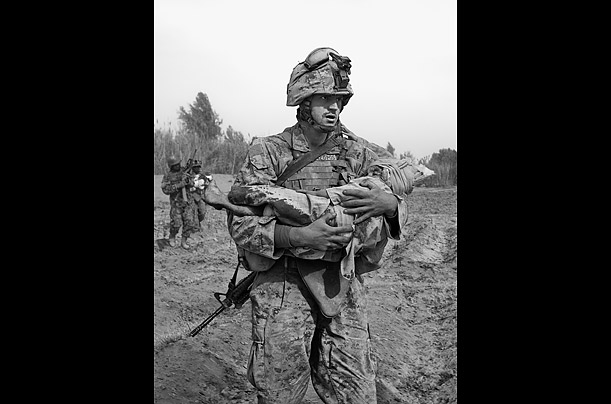
Across a dusty field, two U.S. Marines walk toward a helicopter, each carrying a bloodied and bandaged child. They hold the children as if they were their own. Although at this moment they appear as saviors, a few minutes earlier, they had called in air support in response to enemy fire. The shooter was among children, however (a fact that I have to believe was not known to the Marines), and two were seriously wounded by fragments from machine-gun rounds.

Innocent people are caught in the cross fire in all wars. That’s reality. The two Marines never signed up to hurt kids, and in the shock and confusion, their default reaction was to be protective of the children they indirectly had a hand in wounding. The kids were not left to die, as they might have been in another time and another place by other armies. Instead, a U.S. Army air-ambulance medevac crew was dispatched to fly them to the same medical facility that treats American casualties. If the shooter had survived, he too would have been helped.

Read more: http://www.time.com/time/magazine/article/0,9171,2041191,00.html#ixzz1Byu1S0xj

The article in TIME Magazine contained some emotionally powerful pictures, such as the one below.


A Marine carries an Afghan child.

The full description of the photograph, taken by James Nachtwey for TIME , is Helping Hand
A Marine carries an Afghan child, one of two wounded by coalition aircraft during an air support mission.

My reaction on reading the gruelling story was confused and difficult to articulate clearly but certainly not complimentary! Something along the lines of big and powerful nations, such as the USA, Russia and the United Kingdom, playing out their global strategies with no real insight into the pain and suffering caused by their big ‘war games’.

The second action was that Jean had returned a rental film to the local Blockbuster store and returned with another one that had caught her eye for us to watch on Sunday evening.  That film was The Kite Runner based on the book of the same name by Khaled Hosseini.

There’s a good summary of the plot of the film at WikiPedia.  Here’s a flavour.

In Kabul, prior to the Soviet invasion of Afghanistan, well-to-do young boy Amir and his loyal young Hazara servant Hassan are best of friends. Amir enjoys writing and literature, reading stories to the eager but illiterate Hassan. Amir’s Baba (father), is contemptuous of Amir’s writing and privately regards him as a weakling for letting Hassan protect him from bullies. Baba’s friend Rahim Khan demonstrates interest and encouragement to Amir. Assef, a bully with rancor towards Hazaras, and two accomplices confront Hassan and Amir, but Hassan prevents the attack with a slingshot, a birthday gift from Amir. Assef swears revenge, ridiculing their relationship as mere master and servant. .

Soon the Soviets invade Afghanistan; forcing Baba, a known anti-communist, to flee the country leaving Rahim Khan as property caretaker. En route to Pakistan, Baba bravely risks his life defending a female refugee from a Soviet soldier who demands to rape her in return for safe passage for all. Baba and Amir eventually reach the United States as humble refugees in Fremont, California. Baba tends a gas station while Amir attends community college and vends at a weekly flea market. There, Amir meets Soraya Taheri; Soraya is interested in Amir’s writing although her father, the ex-General Taheri, a proud traditional Pashtun, is contemptuous. Baba is stricken mortally ill but manages to obtain General Taheri’s permission for Amir to marry Soraya. Although Soraya feels bound to confess her previous relationships, they are happily married despite an inability to conceive children. As foreshadowed in the movie’s first scene, Amir’s debut novel is published, dedicated to Rahim Khan who encouraged his writing.

It was a fabulous film, one of the more thought-provoking films seen in many years.  If you haven’t seen it, do so.

So to the point of this article.

The film demonstrated to me that my rather black-and-white opinion of the West’s involvement in Afghanistan was based much more on my instincts that ‘war is bad’ and that the USA tends to throw its military weight around, than having a clue as to the enormous complexities, both at the level of a family and of the nation, that these conflicts entail.

The film showed a much more compassionate aspect to the activities of the USA, specifically in getting involved in Afghanistan and, more generally, in a policy of offering a new home and new hope to those from afar.

And for me, the realisation that while it may be said, ‘There is only one truth’, knowing what that truth is is something very much more challenging!

The first casualty when war comes is truth“. (Hiram W Johnson, senator for California, 1917)

What is the dog?

Time to attempt an answer to this fundamental, well for this Blog, question!


Like wolves, the Dingo is smarter than pet dogs.

(The above photograph comes from an article on ImpactLab – see foot of Post for more details.)

When putting together the Blog ahead of the publication of the very first Post on July 15th, 2009, some 820 Posts ago, I prepared some additional material that set out to justify the Raison d’être for the venture.  Included was a piece regarding Dogs and integrity.  There I wrote:

Dogs are part of the Canidae, a family including wolves, coyotes and foxes, thought to have evolved 60 million years ago.  There is no hard evidence about when dogs and man came together but dogs were certainly around when man developed speech and set out from Africa, about 50,000 years ago.  See an interesting article by Dr. George Johnson.

Anyway, I revisited the article written by Dr Johnson and thought it worthy of being published in full, as a separate article in Learning from Dogs.  I requested permission to reproduce the article in full and Dr. George Johnson was very gracious in quickly coming back to me giving his agreement.  Thank you.  The original article can be read here, the ONSCIENCE home page is here and Dr. Johnson’s details are here.

Evolution of the family dog

I first suspected that Boswell would have a short life when he bit my wife on our nuptial bed.

Boswell was my dog, a feisty Toto-like terrier who shared my bachelor bed and resented the intrusion of a woman where he felt a dog — Boswell — ought to be. As it turns out, my suspicion was correct, and he did not live out the year, which was 1982. Staying with others while I and my bride were overseas, Boswell resented being denied chicken bones, ate them anyway, and died of the consequences. To this day I miss him.

This week I found myself wondering about Boswell’s origins. From what creature did the domestic dog arise? Darwin suggested that wolves, coyotes, and jackals — all of which can interbreed and produce fertile offspring– may all have played a role, producing a complex dog ancestry that would be impossible to unravel. In the 1950s, Nobel Prize-winning behaviorist Konrad Lorenz suggested some dog breeds derive from jackals, others from wolves.

Based on anatomy, most biologists have put their money on the wolf, but until recently there was little hard evidence, and, as you might expect if you know scientists, lots of opinions.

The issue was finally settled in 1997 by an international team of scientists led by Robert Wayne of the University of California, Los Angeles. To sort out the evolutionary origin of the family dog, Wayne and his colleagues used the techniques of molecular biology to compare the genes of dogs with those of wolves, coyotes and jackals.

Wayne’s team collected blood, tissue, or hair from 140 dogs of sixty-seven breeds, and 162 wolves from North America, Europe, Asia, and Arabia. From each sample they extracted DNA from the tiny organelles within cells called mitochondria.

While the chromosome DNA of an animal cell derives from both parents, the mitochondrial DNA comes entirely from the mother. Biologists love to study mitochondrial DNA because of this simple line of descent, female-to-female-to-female. As changes called mutations occur due to copying mistakes or DNA damage, the mitochondrial DNA of two diverging lines becomes more and more different. Ancestors can be clearly identified when you are studying mitochondrial DNA, because clusters of mutations are not shuffled into new combinations like the genes on chromosomes are. They remain together as a particular sequence, a signature of that line of descent.

When Wayne looked at his canine mitochondrial DNA samples, he found that wolves and coyotes differ by about 6% in their mitochondrial DNA, while wolves and dogs differ by only 1%. Already it smelled like the wolf was the ancestor.

Wayne’s team then focused their attention on one small portion of the mitochondrial DNA called the control region, because it was known to vary a lot among mammals. Among the sixty seven breeds of dogs, Wayne’s team found a total of 26 different sequences in the control region, each differing from the others at one or a few sites. No one breed had a characteristic sequence — rather, the breeds of dogs share a common pool of genetic diversity.Wolves had 27 different sequences in the control region, none of them exactly the same as any dog sequence, but all very similar to the dog sequences, differing from them at most at 12 sites along the DNA, and usually fewer.

Coyote and jackal were a lot more different from dogs than wolves were. Every coyote and jackal sequence differed from any dog sequence by at least 20 sites, and many by far more.

That settled it. Dogs are domesticated wolves.

Using statistical methods to compare the relative similarity of the sequences, Wayne found that all the dog sequences fell into four distinct groups. The largest, containing 19 of the 26 sequences and representing 3/4 of modern dogs, resulted from a single female wolf lineage. The three smaller groups seem to represent later events when other wolves mated with the now-domesticated dogs. Domestication, it seems, didn’t happen very often, and perhaps only once.

The large number of different dog sequences, and the fact that no wolf sequences are found among them, suggests that dogs must have been separated from wolves for a long time. The oldest clear fossil evidence for dogs is 12,000 – 14,000 years ago, about when farming arose. But that’s not enough time to accumulate such a large amount of mitochondrial DNA difference. Perhaps dogs before then just didn’t look much different from wolves, and so didn’t leave dog-like fossils. Our species first developed speech and left Africa about 50,000 years ago. I bet that’s when dogs came aboard, when our hunter-gatherer ancestors first encountered them. They would have been great hunting companions.

I think Boswell would be happy to know his ancestor was a wolf. I doubt, however, I will ever be able to get my wife to overlook the biting as “wolf genetic baggage” inherited from nobel ancestors. In my house, science only stretches so far. © Txtwriter Inc

As so often happens, for reasons quite beyond me, when I am pursuing an article idea something else crops up that is highly relevant to my musings.  This was no exception.

A recent article in the Christian Science Monitor describes finding a fragment of dog bone in North America dating back some 9,400 years.  Here’s a flavour of that article.

By Associated Press / January 19, 2011

PORTLAND, MaineNearly 10,000 years ago, man’s best friend provided protection and companionship — and an occasional meal.

That’s what researchers are saying after finding a bone fragment from what they are calling the earliest confirmed domesticated dog in the Americas.

University of Maine graduate student Samuel Belknap III came across the fragment while analyzing a dried-out sample of human waste unearthed in southwest Texas in the 1970s. A carbon-dating test put the age of the bone at 9,400 years, and a DNA analysis confirmed it came from a dog — not a wolf, coyote or fox, Belknap said.

Because it was found deep inside a pile of human excrement and was the characteristic orange-brown color that bone turns when it has passed through the digestive tract, the fragment provides the earliest direct evidence that dogs — besides being used for company, security and hunting — were eaten by humans and may even have been bred as a food source, he said.

Belknap wasn’t researching dogs when he found the bone. Rather, he was looking into the diet and nutrition of the people who lived in the Lower Pecos region of Texas between 1,000 and 10,000 years ago.

The article then, a little later, goes on to say:

Dogs have played an important role in human culture for thousands of years.

There are archaeological records of dogs going back 31,000 years from a site in Belgium, 26,000 years in the Czech Republic and 15,000 years in Siberia, said Robert Wayne, a professor of evolutionary biology at UCLA and a dog evolution expert. But canine records in the New World aren’t as detailed or go back nearly as far.

Darcy Morey, a faculty member at Radford University who has studied dog evolution for decades, said a study from the 1980s dated a dog found at Danger Cave, Utah, at between 9,000 and 10,000 years old. Those dates were based not on carbon-dating or DNA tests, but on an analysis of the surrounding rock layers.

“So 9,400 years old may be the oldest, but maybe not,” Morey said in an e-mail.

Morey, whose 2010 book, “Dogs: Domestication and the Development of a Social Bond,” traces the evolution of dogs, said he is skeptical about DNA testing on a single bone fragment because dogs and wolves are so similar genetically.

My last extract is as follows:

Darcy Morey, a faculty member at Radford University who has studied dog evolution for decades, said a study from the 1980s dated a dog found at Danger Cave, Utah, at between 9,000 and 10,000 years old. Those dates were based not on carbon-dating or DNA tests, but on an analysis of the surrounding rock layers.

“So 9,400 years old may be the oldest, but maybe not,” Morey said in an e-mail.

Morey, whose 2010 book, “Dogs: Domestication and the Development of a Social Bond,” traces the evolution of dogs, said he is skeptical about DNA testing on a single bone fragment because dogs and wolves are so similar genetically.

Fascinating.

Finally, going back to the photograph at the top of the page, this came from an article here in ImpactLab.  It’s well worth a read.