Just found this in my email inbox a few moments ago (it’s 8am here in Payson, Arizona). Not only another lovely example of Neil’s creative mind, there might be a number of readers who can vote for this project. Voting details here.
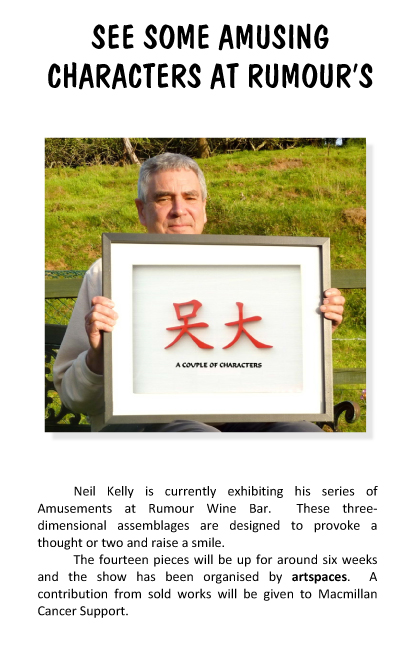
Chance to spotlight the very creative work of Neil Kelly
I have had the pleasure of knowing Neil for a good number of years. I can’t recollect how and when we met but, these days, that applies to so much that slips away from the memory cells! Neil has been a great friend of my sister, Corinne, and brother-in-law, John, who like Neil, have lived in South Devon for many years. Pretty sure that it was through John and Corinne that I first met Neil.
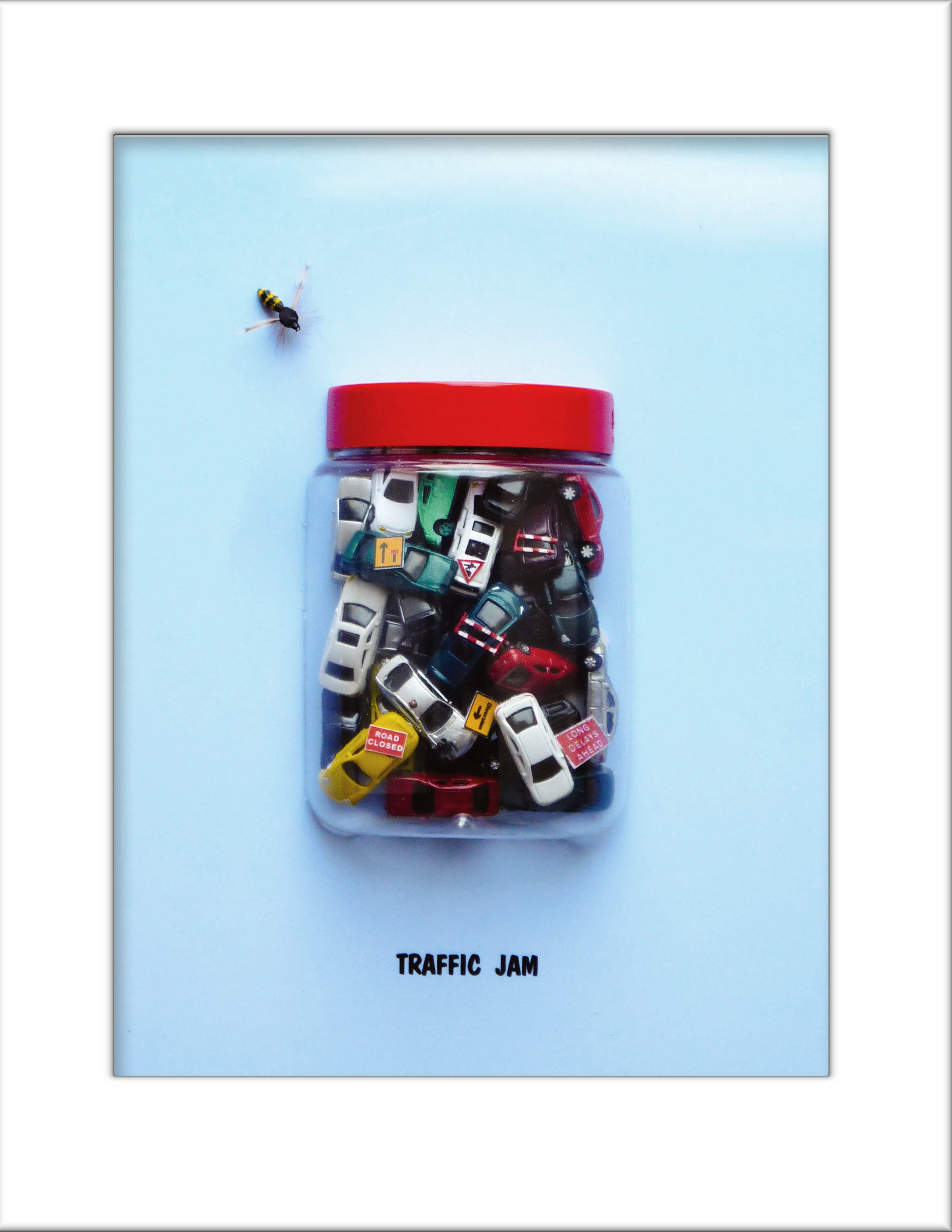
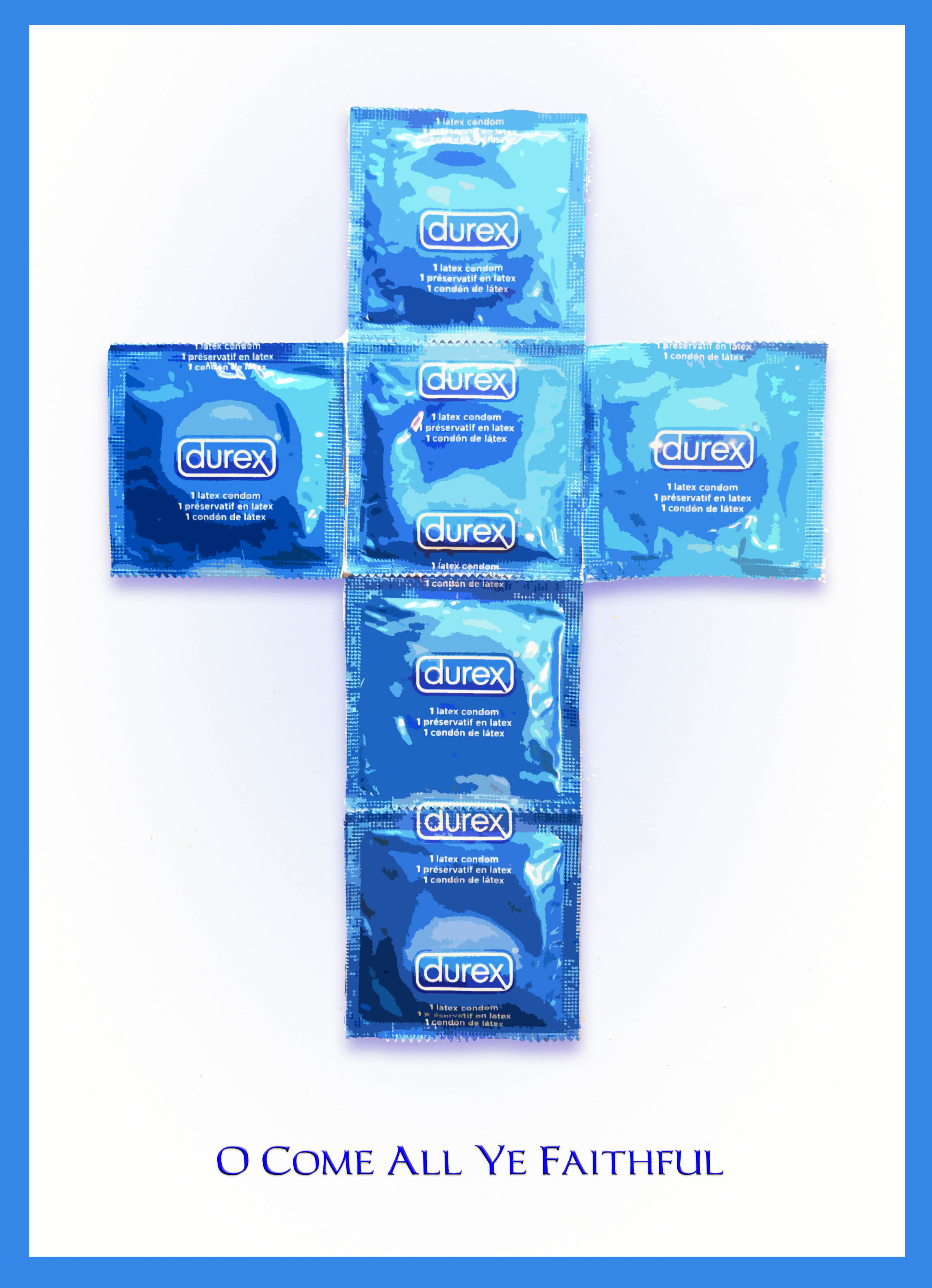
Anyway, Neil’s wonderful, slightly askew sense of humour comes out in his art. Rest is obvious. Enjoy!
Finally, if you are within reach of Totnes and want to see Neil’s work, details of Rumour’s Wine Bar are here.
Acceptance of what has happened is the first step to overcoming the consequences of any misfortune.
William James, January 11th, 1842 - August 26th, 1910
The above is a quotation attributed to the late American philosopher, William James, comprehensively written about on the Stanford Encyclopaedia of Philosophy.
When drafting this post last Wednesday, I used the quotation and reference to William James to soften, as it were, me reproducing an item on Yves Smith’s fabulous blog, Naked Capitalism.
I did have second thoughts about including the video below and the summary of what was written by Yves. The second thoughts were around me not wanting Learning from Dogs to stray into sensationalism or hot pop topics.
The reason I did publish this post was that maybe, just maybe, young Mr. Alessio Rastani is saying it how it really is. How we all have been lulled over the years into believing so much rubbish from so many movers and shakers in the world of power and politics. Whereas, in truth, most people who stop and reflect on the world we are presently living in, intuitively sense, that something has broken.
The good news that may be interpreted from Mr. Rastani’s predictions is that we are now living through a period of change, the end of an era, and that the opportunity for a better, more caring world is wide open.
Introduced on the Naked Capitalism site, as follows,
This segment on BBC may not go viral, but it seems to be getting traction, based on the e-mails (hat tip readers Paul S and Marcus) and alerts in the comments section.
This is not an entertaining Rick Santelli-style rant, it’s a cool assessment of how the Euromarket crisis is likely to end, which he thinks is very badly. The flummoxed reaction of the BBC host suggests that the trader, Alessio Rastani, was a booking mistake.
But consider his second message: that Goldman and people rule the world and like him don’t care about what happens to the real economy. A depression is just a great investment opportunity if you see it coming and position yourself accordingly. Rastani is the bland, reasonable face of predatory capitalism.
But in the best interests of scepticism and balance, I also reproduce what was published in the UK’s Telegraph newspaper on the 27th September,
The soundbites won Mr Rastani instant fame. He became a viral hit and was trending on Twitter. BBC business editor Robert Peston was among the fans. “A must watch if you want to understand the euro crisis and how markets work,” he told his army of 82,000 followers on Twitter on Tuesday.
The interview contained such gems as “Governments don’t rule the world, Goldman Sachs rules the world [and] Goldman Sachs does not care about the rescue package.”
But on Tuesday night the BBC was left facing questions about just how qualified Mr Rastani is to speak about the markets.
In the interview Mr Rastani described himself as an independent trader. Elsewhere he claims he’s an “investment speaker”. Instead of operating from a plush office in Canary Wharf Mr Rastani works and lives with his partner Anita Eader in a £200,000 semi in Bexleyheath, south London. The house, complete with a mortgage from Royal Bank of Scotland, belongs to her not him.
He is a business owner, a 99pc shareholder in public speaking venture Santoro Projects. Its most recent accounts show cash in the bank of £985. After four years trading net assets are £10,048 – in the red.
How a man who has never been authorised by the Financial Services Authority and has no discernible history working for a City institution ended up being interviewed by the BBC remains a mystery.
The incongruity led to some commentators speculating Mr Rastani was a professional hoaxer. The BBC denied the allegation: “We’ve carried out detailed investigations and can’t find any evidence to suggest that the interview with Alessio Rastani was a hoax.”
However, the BBC declined to comment on what checks, if any, it had done prior to the interview.
Mr Rastani was a little more forthcoming.
“They approached me,” he told The Telegraph. “I’m an attention seeker. That is the main reason I speak. That is the reason I agreed to go on the BBC. Trading is a like a hobby. It is not a business. I am a talker. I talk a lot. I love the whole idea of public speaking.”
So he’s more of a talker than a trader. A man who doesn’t own the house he lives in, but can sum up the financial crisis in just three minutes – a knack that escapes many financial commentators.
“I agreed to go on because I’m attention seeker,” he said on Tuesday. “But I meant every word I said.”
Readers may recall that John H. and I went to the nearest Moving Planet event in Phoenix, as posted on Monday. Now 350.org have released a video of the event as seen from a global perspective.
2000+ events. 180+ countries. A single day to Move Beyond Fossil Fuels. 350.org’s 2011 day of action, Moving Planet, brought together Moving Together.
Photos and Videos submitted by thousands of organizers and activists around the world — THANK YOU!
I know that expression from my days as a private pilot. It makes such obvious sense, especially in a single-engined light aircraft with one pilot on board. It’s all about risk.
Frederick Herzberg, the famous American psychologist, coined the term ‘hygiene factor’. It was the second part of a two-factor approach to the management of people. According to Herzberg’s theory, people are influenced by two sets of factors, motivation factors and hygiene factors. More background on this aspect here.
To me, as I reflect on the messages offered in the Sceptical Voices article, Part One and Part Two, the concepts of risk and hygiene seem totally appropriate to the topic of AGW, Anthropogenic Global Warming.
Whether or not AGW is a valid theory behind the rapid change in global warming is utterly irrelevant. It is the risk to humanity that matters. There is absolutely no harm done from assuming that AGW is happening and that feedback processes run a grave risk of tipping planetary conditions out of control, and getting that wrong.
On the other hand, assume that AGW is such an uncertain concept that it really isn’t wise to adjust our life styles, and getting that wrong would endanger the human species.
Think of being on a commercial airline flight and you become aware that one of the two pilots in the cockpit is incapacitated through food poisoning. No doubt that you, with all your fellow passengers, would vote for an immediate diversionary landing. It’s to do with risk.
From the perspective of Herzberg, a co-ordinated program by the world’s leading governments to tackle AGW might also improve the overall motivation of their peoples in a whole manner of ways.
Yes, question all we want, yes, there are other important issues to resolve in the world, but WHAT IF “Climate Change/Global Warming“ is for real, what then?
Dan wrote also in that Part One piece,
And by “peel-back-the-onion”, I mean that any ardent, independent researcher should publish both sides of the story as a matter of course. Especially in regards to global warming.
But publishing both sides of the story is not the argument. The argument is the risk to humanity of doing nothing, and getting it wrong.
That well-respected weekly newspaper The Economist had a recent article about the melting of Arctic ice, from which is quoted,
Arctic sea ice is melting far faster than climate models predict. Why?
Sep 24th 2011 - from the print edition
ON SEPTEMBER 9th, at the height of its summertime shrinkage, ice covered 4.33m square km, or 1.67m square miles, of the Arctic Ocean, according to America’s National Snow and Ice Data Centre (NSIDC). That is not a record low—not quite. But the actual record, 4.17m square km in 2007, was the product of an unusual combination of sunny days, cloudless skies and warm currents flowing up from mid-latitudes. This year has seen no such opposite of a perfect storm, yet the summer sea-ice minimum is a mere 4% bigger than that record. Add in the fact that the thickness of the ice, which is much harder to measure, is estimated to have fallen by half since 1979, when satellite records began, and there is probably less ice floating on the Arctic Ocean now than at any time since a particularly warm period 8,000 years ago, soon after the last ice age.
That Arctic sea ice is disappearing has been known for decades. The underlying cause is believed by all but a handful of climatologists to be global warming brought about by greenhouse-gas emissions. Yet the rate the ice is vanishing confounds these climatologists’ models. These predict that if the level of carbon dioxide, methane and so on in the atmosphere continues to rise, then the Arctic Ocean will be free of floating summer ice by the end of the century. At current rates of shrinkage, by contrast, this looks likely to happen some time between 2020 and 2050.
Re-read the sentence, “The underlying cause is believed by all but a handful of climatologists to be global warming brought about by greenhouse-gas emissions.” In particular, “by all but a handful of climatologists” Think of risk.
That article, which should be read in full, concludes thus,
A warming Arctic will bring local benefits to some. The rest of the world may pay the cost.
Indeed, the rest of the world may pay the cost! As I wrote, it’s all about risk.
So whether or not one wants to believe every word of that Economist article is irrelevant. Or whether one should have believed, or not, the article in New York’s The Sun newspaper back in 2007,
By SETH BORENSTEIN, Associated Press | December 12, 2007
WASHINGTON — An already relentless melting of the Arctic greatly accelerated this summer, a warning sign that some scientists worry could mean global warming has passed an ominous tipping point. One even speculated that summer sea ice would be gone in five years.
Greenland’s ice sheet melted nearly 19 billion tons more than the previous high mark, and the volume of Arctic sea ice at summer’s end was half what it was just four years earlier, according to new NASA satellite data obtained by the Associated Press.
“The Arctic is screaming,” a senior scientist at the government’s snow and ice data center in Boulder, Colo., Mark Serreze, said.
Last year, two scientists surprised their colleagues by projecting that the Arctic sea ice was melting so fast that it could disappear entirely by the summer of 2040. This week, after reviewing his own new data, a NASA climate scientist, Jay Zwally, said: “At this rate, the Arctic Ocean could be nearly ice-free at the end of summer by 2012, much faster than previous predictions.”
So scientists in recent days have been asking themselves these questions: Was the record melt seen all over the Arctic in 2007 a blip amid relentless and steady warming? Or has everything sped up to a new climate cycle that goes beyond the worst case scenarios presented by computer models? “The Arctic is often cited as the canary in the coal mine for climate warming,” Mr. Zwally, who as a teenager hauled coal, said. “Now as a sign of climate warming, the canary has died. It is time to start getting out of the coal mines.” [My emphasis, PH]
So, in conclusion, scepticism is healthy and is an important aspect of open debate within an open society, part of determining truth, however challenging that simple concept might be.
But eventually one needs to take a position, to take a stand on the really important issues in life and in the case of climate change the risk of being too sceptical, too cautious is to put the lives of future generations at stake. For me, and I guess for tens of thousands of others, that is a risk too far.
Why should such an obvious concept, that of truth, be so very difficult to define?
Who in the world whose native tongue is English isn’t familiar with the words of the oath, “I swear to tell the truth, the whole truth and nothing but the truth,” often with the phrase, “so help me God.” It is the fundamental foundation of a working justice system. Probably the most famous of oaths is the American Presidential oath upon taking up office, “I do solemnly swear (or affirm) that I will faithfully execute the Office of President of the United States, and will to the best of my Ability, preserve, protect and defend the Constitution of the United States.”
Then just the other day I was exploring the blog Lack of Environment written by Martin Lack who made himself known to Learning from Dogs from a comment to the post Sceptical voices, part two, published on the 23rd. Martin’s blog carried an article about scientific scepticism (outcome being very little) in global warming being caused by man. There was reference to the book Climate Cover-Up written by James Hoggan and an extract from that book on the Desmogblog website, as follows,
Democracy is utterly dependent upon an electorate that is accurately informed. In promoting climate change denial (and often denying their responsibility for doing so) industry has done more than endanger the environment. It has undermined democracy. There is a vast difference between putting forth a point of view, honestly held, and intentionally sowing the seeds of confusion. Free speech does not include the right to deceive. Deception is not a point of view. And the right to disagree does not include a right to intentionally subvert the public awareness.
The sentence highlighted by me is fundamental to this essay. Perhaps the crux of why it feels so difficult to determine the truth is that the vast 24-hour output of news and information, the 24-hour fear machine as John H. calls it, carries no means of distinguishing the reliability of the source, no details of any affiliations that the person offering the information to that particular media outlet may have, and so on and so on. I wrote a piece on the 12th July called What Exactly is the Truth where I concluded that,
Despite my chest-beating on the subject of politicians and leaders deliberately lying in that recent piece about Juncker, there’s something much more fundamental. What defines lying is really not that important. It’s whether or not we trust that our leaders are doing their best for their constituents, to the best of their abilities.
Whether you support left-leaning or right-leaning policies is unimportant; indeed political differences and the ability to vote for one’s beliefs is at the heart of an open democracy.
But if we don’t trust that our leaders are doing their best for our country then that causes the destruction of faith. If we do not have faith in those that lead us then the breakdown of a civilised social order becomes a very real risk.
So examining the essence of the word ‘truth’ creates a conflict, well it does in my mind. A conflict between the idea that truth is a very simple concept and that peeling back the meaning of the word truth reveals many, many layers. Let me quote from the Stanford Encyclopaedia of Philosophy,
Truth is one of the central subjects in philosophy. It is also one of the largest. Truth has been a topic of discussion in its own right for thousands of years. Moreover, a huge variety of issues in philosophy relate to truth, either by relying on theses about truth, or implying theses about truth.
It would be impossible to survey all there is to say about truth in any coherent way. Instead, this essay will concentrate on the main themes in the study of truth in the contemporary philosophical literature. It will attempt to survey the key problems and theories of current interest, and show how they relate to one-another. A number of other entries investigate many of these topics in greater depth. Generally, discussion of the principal arguments is left to them. The goal of this essay is only to provide an overview of the current theories.
The problem of truth is in a way easy to state: what truths are, and what (if anything) makes them true. But this simple statement masks a great deal of controversy. Whether there is a metaphysical problem of truth at all, and if there is, what kind of theory might address it, are all standing issues in the theory of truth. We will see a number of distinct ways of answering these questions.
“Truth has been a topic of discussion in its own right for thousands of years.” So I’m not the first and certainly won’t be the last to ponder on how one gets to know the truth.
Do I have any answers? None! Except, perhaps, to muse that if truth can be so difficult to pin down then adopting a rigid stance based on assumptions of truth will carry risk. And, of course, to reflect that dogs don’t lie.
I’ll close with the quote from Oscar Wilde, “Truth is rarely pure and never simple.” Quite so.
My apologies but the demands on my time are a little challenging this week. All as a result of the creative writing course that is being undertaken at our local Gila Community College, a course that I am loving, by the way!
Last Saturday, John H. and I went down to Tempe, Phoenix to attend the nearest Moving Planet event. It was well-attended especially by people the right side of 40 years-old! After all it is the succeeding generation that is going to cope with the consequences of the present abuse of the planet’s resources.
The leader of the event down in Tempe was Doug Bland of Arizona Interfaith Power and Light and it was very encouraging to see such a strong ecumenical involvement.
Later this week, I want to respond to the views that came out in the first part of the Sceptical voices piece last week but for now let me just leave you with a 4-minute video that was shown to the group down in Tempe last Saturday. It is called Try not to Make Connections.
A fascinating point of view of the relationship between humans and animals.
Jean and I were at our regular gardening college class yesterday. It was all about the growing of vegetables. OK, I can hear you thinking, what on earth does that have to do with today’s topic? Simply because the tutor, Cayci V., mused at the start of her lesson how gardeners were great animal lovers and then proceeded to list all the animals she and her husband kept at their home in Globe, about an hour from Payson, Arizona. Cayci admitted to having 5 dogs, 15 cats, 2 emus, 2 llamas, numerous chickens. She also had 2 bison that recently died having been poisoned by Oleander cuttings. Anyway, to the article.
A recent article on the BBC News Magazine was about the need for humans to have contact with animals. It was presented by John Gray who is a political philosopher and author of the book False Dawn: The Delusions of Global Capitalism which argues that free market globalization is unstable and is in the process of collapsing! H’mmm. John is also the author of the book Straw Dogs: Thoughts on Humans and Other Animals, a book that was described by the British Observer newspaper thus,
There is unlikely to be a more provocative or more compelling book published this year than Straw Dogs. A long-time scourge of the delusions of global capitalism, John Gray is one of the most consistently interesting and unpredictable thinkers in Britain. He is unpredictable because, unlike most political commentators, he never ceases to question the underlying assumptions of his own beliefs and prejudices.
Anyway, I’m at risk of digressing, as many of you will regularly notice! The article by John Gray on the BBC News website was published over a couple of weeks ago and, therefore, I feel it not too great a copyright sin to reproduce it in full on Learning from Dogs. It’s a fascinating article.
Why does the human animal need contact with something other than itself, asks John Gray.
Many years ago an eminent philosopher told me he’d persuaded his cat to become a vegan. To begin with I thought he was joking. Knowing a bit about cats, I couldn’t take seriously the idea that they’d give up their predatory ways.
“You must have provided the cat with some pretty powerful arguments,” I said jokingly. “It wasn’t as difficult as you may think,” he replied rather sternly.
He never explained exactly how the transformation was achieved. Was his cat presented with other cats that had converted to veganism – feline role models, so to speak? Had he prepared special delicacies for his cat – snacks that looked like mice but were made of soya, perhaps?
Beginning to suspect that the philosopher might after all be serious, I asked if the cat went out. He told me it did. That answered a part of my puzzlement. Evidently the cat was supplementing its vegan diet by hunting, natural behaviour for cats after all.
I was still a little perplexed though. Cats tend to bring their hunting trophies back home and I wondered how the philosopher had missed seeing them. Had the cat hidden them out of sight? Or were the cat’s trophies prominently displayed but disregarded by the philosopher, marks of atavistic feline behaviour that would eventually disappear as the cat progressed towards a new kind of meat-free life?
The conversation tapered off and I never did get to the bottom of the mystery. The dialogue did set me thinking. Evidently the philosopher thought of the cat as a less evolved version of himself that, with a lot of help, could eventually share his values. But the idea that animals are inferior versions of humans is fundamentally misguided.
Each of the millions of species that evolution has thrown up is different and particular, and the animals with which we share the planet aren’t stages on the way to something else – ourselves. There’s no evolutionary hierarchy with humans perched at the top. The value of animals – or as I’d prefer to say other animals – comes from being what they are. And it’s the fact that they are so different from humans that makes contact with them so valuable to us.
Human qualities
Some philosophers – not many it must be admitted – have in the past understood this. The 16th Century French essayist, Michel de Montaigne, loved cats because he knew he would never be able to enter their minds. “When I play with my cat,” he asked, “how do I know she is not amusing herself with me rather than I with her?”
Montaigne didn’t want his animal companions to be mirrors of himself, he wanted them to be a window from which he could look out from himself and from the human world.
Never more than partly domesticated, cats are never fundamentally humanised. Montaigne found them lovable for precisely this reason, it wasn’t that he was suggesting we should emulate cats. Wiser than the philosopher who believed he’d converted his cat to veganism, he understood that the good life means different things for animals with different natures. What he questioned was the idea that one kind of life, the kind humans alone can live, is always best.
It’s true that cats don’t have some of the capacities we associate with morality. They seem to lack empathy, the capacity of identifying with the emotions of others. This may explain what has often been described as cruelty in their behaviour, toying with captured mice for example. Attributing cruelty to cats seems a clear case of anthropomorphism – the error of projecting distinctively human qualities onto other species.
Cats are not known to display compassion, but neither do they inflict pain and death on each other in order to gratify some impulse or ideal of their own. There are no feline inquisitors or suicide bombers. Pedants will say that this is because cats lack the intellectual equipment that is required to formulate an idea of truth or justice. I prefer to think that they simply decline to be enrolled in fanaticism, another peculiarly human trait.
Dogs seem to be capable of showing human-like emotions of shame, but though they are more domesticated they still remain different from us. And I think it’s their differences from us, as much as their similarities, that makes them such good companions.
Whatever you feel about cats and dogs, it seems clear that the human animal needs contact with something other than itself. For religious people this need may be satisfied by God, even if the God with whom they commune seems too often all-too-human. For many landscape gives a sense of release from the human world, even if the land has been groomed and combed by humans for generations, as it has in England.
The contemplation of field, wood and water intermingling with wind and sky still has the power to liberate the spirit from an unhealthy obsession with human affairs. Poets such as Edward Thomas and Ted Hughes have turned to the natural world in an attempt to escape a purely human view of things. Since they remained human and used human language in the attempt, it’s obvious that they couldn’t altogether succeed. It’s also obvious that searching for a way of looking at the world that’s not simply human expresses a powerful human impulse.
The most intense example of this search I know is that recorded by John Baker in his book The Peregrine. First published in 1967 and recently reissued, the book is seemingly a piece of nature writing which slowly reveals itself as the testament of someone struggling to shed the point of view of a human observer.
Renewed humanity
Baker records his pursuit of two pairs of peregrines, which had arrived to hunt in the part of East Anglia where he lived. Alone he followed the birds for over 10 years. Concentrating the decade-long quest into a single year in order to recount it in the book, he writes of the peregrine: “Wherever he goes, this winter, I will follow him. I will share the fear, and the exaltation, and the boredom of the hunting life.”
He tells us that he came late to the love of birds. “For years I saw them only as a tremor on the edge of vision. They know suffering and joy in simple states not possible for us. Their lives quicken and warm to a pulse our hearts can never reach. They race to oblivion.”
In time the human observer seemed to be transmuted into the inhuman hawk. “In a lair of shadow,” Baker writes, “the peregrine was crouching, watching me… We live, in these days in the open, the same ecstatic fearful life. We shun men.”
Note how Baker switches suddenly from describing the hawk watching him to describing how “we” flee from humans. Baker found a sensation of freedom in the feeling that he and the hawk were fused into one. Sharing in the “exaltation and serenity” of the birds’ life he could imagine that he’d shed his human identity, at least for a time, and could view the world through hawks’ eyes.
Of course he didn’t take this to be literal truth. He knew he couldn’t in the end be anything other than human. Yet he still found the pursuit of the peregrine deeply rewarding, for it opened up a temporary exit from the introspective human world.
John Baker’s devotion to the peregrine hadn’t enabled him to see things as birds see them. What it had done was to enable him to see the world through his own eyes, but in a different way. His descriptions of the landscape of East Anglia are exact and faithful to fact. But they reveal that long-familiar countryside in a light in which it looks as strange and exotically beautiful as anything in Africa or the Himalayas. The pursuit of a bird had revitalised his human perceptions.
What birds and animals offer us is not confirmation of our sense of having an exalted place in some sort of cosmic hierarchy, it’s admission into a larger scheme of things, where our minds are no longer turned in on themselves. Unless it has contact with something other than itself, the human animal soon becomes stale and mad. By giving us the freedom to see the world afresh, birds and animals renew our humanity.
A fascinating, beautiful and incredibly thought-provoking essay.




 Learning from Dogs