Year: 2011

The ballad of a burnt biscuit

Striving to be better is a key lesson of life!

I’m normally pretty cautious about promoting the sorts of emails that circulate around the virtual globe carrying universal lessons for all and sundry but this one is an exception.  It was sent to me last Monday by my dear friend, Dan G. from Southern California, with whom I have had the great honour and pleasure to be close friends for forty years.  Here it is.

Burned Biscuits-author unknown

When I was a kid, my Mom liked to make breakfast food for dinner every now and then. And I remember one night in particular when she had made breakfast after a long, hard day at work. On that evening so long ago, my Mom placed a plate of eggs, sausage and extremely burned  biscuits in front of my dad. I remember waiting to see if  anyone noticed! Yet all
my dad did  was reach for his biscuit, smile at my Mom and ask me how my day was at school. I don’t remember what I told him that night, but I do remember watching him smear butter and jelly on that  biscuit and eat every bite!

When I got up from the table that evening, I remember hearing my Mom apologize to my dad for burning the biscuits. And I’ll never forget what he said: “Honey, I love burned biscuits.” Later that night, I went to kiss Daddy good night and I asked him if he really liked his biscuits burned. He wrapped me in his arms and said, “Your Momma put in a hard day at work today and she’s real tired. And besides – a  little burned biscuit never hurt anyone!”

Life is full of imperfect things and imperfect people. I’m not the best at hardly anything, and I forget birthdays and anniversaries just like everyone else. But what I’ve learned over the years is that learning to accept each others faults – and choosing to celebrate each others differences – is one  of the most important keys to creating a healthy, growing, and lasting relationship.

And that’s my prayer for you today. That you will learn to take the good, the bad, and the ugly parts of your life and lay them at the feet of God.  Because in the end, He’s the only One who will be able to give you a relationship where a burnt biscuit isn’t a deal-breaker!

We could extend this to any relationship. In fact, understanding is the base of any relationship, be it a husband-wife or parent-child or friendship!

Don’t put the key to your happiness in someone else’s pocket – keep it in your own.

So, please pass me a biscuit, and yes, the burned one will do just fine. Be kinder than necessary because everyone you meet is fighting some kind of battle.

Thanks Dan for sharing that.

Solar Impulse

Just enjoy this.

Solar Impulse

From Wired Magazine,

“In a world dependent on fossil energies, Solar Impulse is a paradox, almost a provocation.”

Press release gobbledygook? Absolutely. But you’ve got to give it up for any company with the guts to try designing and building a true solar airplane.

We’ve written about Solar Impulse — it’s a consortium of European financial and technology parters led by the Federal Institute of Technology in Lausanne, Switzerland. The group is working on a solar-powered plane that can take off under its own power without generating any emissions at all. The general idea is that sunlight would not only power the plane during the day but would also charge its lithium batteries, allowing it to fly around the clock pollution free.

That was written May 12th, 2008.  This is now!  Landing at Brussels International Airport, May 2011.

And here’s the Solar Impulse website.

50 years; just like that!

A memorable event fifty years ago, this day!

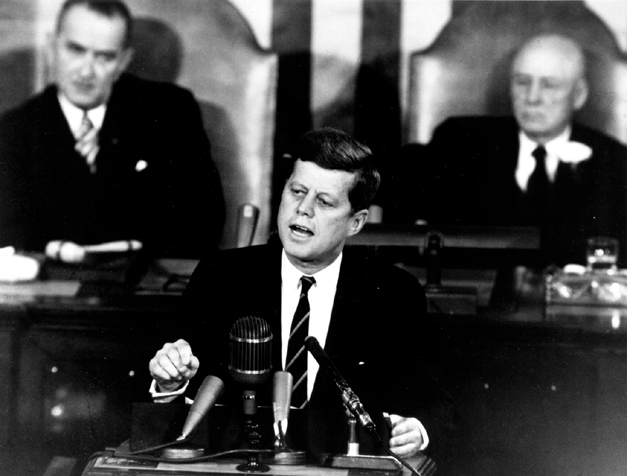
President John F. Kennedy's May 25, 1961 Speech before a Joint Session of Congress

On the 25th May, 1961, President John Kennedy summoned a joint session of Congress and asked America to commit itself to a goal – that of landing a man on the moon and returning him safely to Earth before the decade was out.

There’s a good link on the NASA site to the speech.

Plus a very good analysis of these 50 years in the Lexington column in last week’s The Economist.  As Lexington’s Notebook blog puts it,

That Kennedy speech plus 50

May 19th 2011, 15:47 by Lexington

MY print column this week notes that it is half a century next week since John Kennedy called for sending a man to the moon and returning him safely to Earth. The bottom line, I think:

If we can send a man to the moon, people ask, why can’t we [fill in the blank]? Lyndon Johnson tried to build a “great society”, but America is better at aeronautical engineering than social engineering. Mr Obama, pointing to competition from China, invokes a new “Sputnik moment” to justify bigger public investment in technology and infrastructure. It should not be a surprise that his appeals have gone unheeded. Putting a man on the moon was a brilliant achievement. But in some ways it was peculiarly un-American—almost, you might say, an aberration born out of the unique circumstances of the cold war. It is a reason to look back with pride, but not a pointer to the future.

A fascinating period!

Mandelbrot and fractals

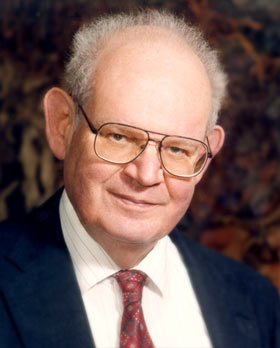
Concluding article on the great Benoit Mandelbrot.

Yesterday, I wrote about Benoit Mandelbrot but wanted to save some additional information for today.

There’s a very comprehensive review of Benoit’s life on a website called NNDB.  In that review, it mentions his association with the IBM Thomas J. Watson Research Center where he worked for 32 years.  It was while working for IBM that he published the paper that established his credentials world-wide.  Taken from the IBM website is this extract,

The father of fractals, Dr. Benoit Mandelbrot, passed away from pancreatic cancer on October 16, 2010. He was 85.

Benoit, IBM Fellow Emeritus, joined the IBM Thomas J. Watson Research Center in 1958 where he worked for 32 years. His 1967 article published in Science, How Long Is the Coast of Britain? Statistical Self-Similarity and Fractional Dimension, introduced the concept that a geometric shape can be split into pieces that are smaller copies of the whole. It wasn’t until 1975 that he defined the mathematical shapes as fractals.

Here is another website that has fractal images taken from the Mandelbrot set.  An example.

Just stunningly beautiful!

Finally, if you go to this website there is a slideshow of stunning images of fractals in honour of the great man.

Benoit Mandelbrot and the roughness of life.

There is so much about the lives of humans that is astoundingly beautiful.

Before I get started on this article, a few words about the Blog in general.  In recent times, the readership of Learning from Dogs has increased, frankly, to quite amazing levels.  Not really sure why but grateful, nonetheless.

Readers will recognize that articles written specifically about dogs are in the minority.  Even using dogs as a metaphor would still limit what could be published.  But as is written elsewhere on the Blog, ‘The underlying theme of Learning from Dogs is about truth, integrity, honesty and trust in every way.’  Dogs are integrous creatures; that’s all the example required.

We are at a point in the history of man where truth, integrity, honesty and trust are critically important (they have always been important but the economic and ecological pressures bearing down on us all make these values critical to mankind’s survival).  Thus the aspiration of Learning from Dogs is to offer insights on truth from as many perspectives as possible – and to make your experience as a reader sufficiently enjoyable that you will wish to return!

OK!  On to the topic for today!

There are many aspects of the world in which we live that are mysterious beyond our imagination.  Take the circle.  Practically everyone is aware that to calculate either the area or the circumference of a circle one needs to use a mathematical constant π or ‘pi’.  As a mathematician would put it,  π (sometimes written pi) is a mathematical constant whose value is the ratio of any circle’s circumference to its diameter; this is the same value as the ratio of a circle’s area to the square of its radius. π is approximately equal to 3.14159.

Note the word ‘approximately’!  Now read this,

(PhysOrg.com) — A computer scientist in France has broken all previous records for calculating Pi, using only a personal computer. The previous record was approximately 2.6 trillion digits, but the new record, set by Fabrice Bellard, now stands at almost 2.7 trillion decimal places.

Bellard, of Paris Telecom Tech, made and checked the calculation by running his own software algorithms for 131 days. The previous record calculation, set by Daisuke Takahashi at the University of Tsukuba in Japan in August 2009, took only 29 hours to complete, but used a super-computer costing millions of dollars, and running 2000 times faster than Bellard’s PC.

Full article is here.

Apart from the wonderful aspect of the need of a human being to go on determining the n’th value of π there is a deeper and more beautiful aspect (well to me there is!) and that is the acknowledgement that something as simple as, say, that round coin in your hand is an expression of the infinite.

Now to Benoit Mandelbrot, who died a little over six months ago, but in his lifetime also explored the wonder and magic of the infinite.

Here’s a video of Mandelbrot recorded in February 2010 in what would be his last year of his life on earth.

If you found that video fascinating then try this series of six videos presented by the one and only Arthur C. Clarke.

Benoit Mandelbrot died on the 14th October, 2010, a little over a month before his eighty-sixth birthday (born 20th November, 1924).  Here’s a nice tribute from the The New York Times.

Tomorrow, some more insights into the mysterious beauty of fractals.

Benoit Mandelbrot

Amazing man!