Year: 2010

The Greenwich Meridian

Don’t know what time it is?  Hardly surprising in Spring and Autumn.

Today is exactly one month before the United Kingdom ‘moves’ its clocks forward and enters British Summer Time; 1am (UTC) on Sunday 28th March 2010.  Is that date the same across the world?  One would think so because it makes life, especially international air transport, so much easier.

But no!  In fact the way that time zones are applied and changed for Daylight Saving is a complete hotch-potch.

In the United States of America, daylight saving starts at 2am on March 14th, 2010.  And just three years ago that start time would have been the first Sunday in April.  Changes were made in the US Energy Policy Act of 2005.

From this geographic site comes the following:

Other parts of the world observe Daylight Saving Time as well. While European nations have been taking advantage of the time change for decades, in 1996 the European Union (EU) standardized an EU-wide “summertime period.” The EU version of Daylight Saving Time runs from the last Sunday in March through the last Sunday in October. During the summer, Russia’s clocks are two hours ahead of standard time. During the winter, all 11 of the Russian time zones are an hour ahead of standard time. During the summer months, Russian clocks are advanced another hour ahead. With their high latitude, the two hours of Daylight Saving Time really helps to save daylight. In the southern hemisphere where summer comes in December, Daylight Saving Time is observed from October to March. Equatorial and tropical countries (lower latitudes) don’t observe Daylight Saving Time since the daylight hours are similar during every season, so there’s no advantage to moving clocks forward during the summer.

Of course, someone had to create a web-site to track all these various time zones and changes.  Here it is.

Last year, the BBC News website published an interesting article about the Greenwich Meridian aka The Prime Meridian.  The setting of the Prime Meridian was done just over 125 years ago, in October 1884.  When one thinks of the importance in having a standard meridian, both for time keeping and navigation, I would have guessed that it went back much further in time.

The other aspect that was news to me was that the conference had been convened at the request of the American President Chester Arthur.

From that BBC article:

Until the 19th Century, many countries and even individual towns kept their own local time based on the sun’s passage across the sky and there were no international rules governing when the day would start or finish.

Maps with multiple meridians were confusing

However, with the rapid expansion of the railways and communications networks during the 1850s and 1860s, setting a standard global time soon became essential.

“The world was in a very big mix-up,” explains Dr Avraham Ariel, author of Plotting the Globe. “People had lots of prime meridians. Earlier in Europe there were 20 prime meridians. The Russians had two or three, the Spanish had their own and so on.”

Thus that famous line in the grounds of the National Maritime Museum at Greenwich, London is not as old as many might have thought.

Prime Meridian, Greenwich

By Paul Handover

The Toyota Fiasco

Toyota – How not to do business!

Learning from Dogs was created by a few people who felt compelled to promote the values of “integrity”, which is often in short supply in the modern world, though perhaps it always has been to some extent in all civilisations. Is dishonesty an eternal part of Human Nature? We like to think not …..

Well, “Integrity” includes being honest, open and dedicated to the truth, even if this is personally inconvenient. It may seem a somewhat forlorn hope to promote something that for an important minority of people is and will probably remain an alien concept, these being people who put self above group. However, the recent Toyota fiasco reminds me that perhaps integrity’s time has indeed arrived, for this is THE INFORMATION AGE. It is NO LONGER easy to hide the truth, which tends to come out now with greater frequency due to a variety of factors including most importantly the Internet. But there are other reasons, too. To take Britain, for example, we now have the “Freedom of Information Act”, which – despite some limitations – has done wonders in allowing the free press (another essential ingredient of course, and sadly lacking in so many countries) to reveal wrong-doing, principally by appallingly-incompetent governments.

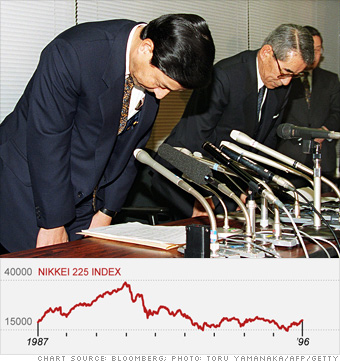
Toyota chief Akio Toyoda

As for Toyota, what has staggered me is that the company KNEW of these accelerator & brake problems several years ago. Indeed, people began having crashes as far back as 2006. Yet only recently has it done anything serious about putting things right.  One has to wonder what on earth possessed the Toyota bosses to think that they could get away with it, which on the face of it seems to be exactly what they were trying to do. Who was advising them? It seems to me to have been INEVITABLE that the truth about their cars’ problems  would come out, so even from a cynical and selfish point of view they should have recalled the defective cars at least two years ago. But quite APART from the wisdom of doing that in practical, business terms (the result of delay being to devastate the company’s image to a far greater extent than would otherwise have been the case) there was a MORAL aspect to the problem, too. By ALLOWING the problems to go unresolved they put people at risk. And not just ANY people, but their customers! As has been said before, but sadly with all too much frequency, “You couldn’t make this up.”

How could the world’s number one car manufacturer get it so utterly and totally wrong, both from a moral and practical point of view? I am wondering if Toyota can recover from this. Yes, I know they are big, but there are PLENTY OF CHOICES for people seeking to buy a vehicle. Who in their right mind is now going to buy a car from a company which A) made defective cars (and MILLIONS of them) and B) HID THE TRUTH while people were dying in crashes?

One reason may again be the Japanese obsession with “face”. It was probably difficult for the world’s number one company, which seemed capable of nothing but success, to admit publicly that it had got things badly wrong. The Chairman is now admitting this, but to be frank it reminds me of the old expression about getting blood out of a stone, or being dragged kicking and screaming to the confessional.  And from what I read today he seems to be blaming the troubles on the fact that “the company may have grown too quickly.” I could describe this utterance with an extremely rude word or two but as this is a family site I will refrain. Let’s just say that the company WASN’T HONEST.

I remember as a kid growing up in the shattered London of the1950s the lessons I got from teachers and parents. One of those which stuck in my mind was “Honesty is the best policy.” This has never been more true as it is now. For the Brave New World we dream of honesty is a sine qua non. We must be honest with ourselves, our friends, families, companies and the public. There is no other way to happiness. Will Toyota’s disaster be a lesson for other companies?  NOBODY can get it right all the time and there is no dishonour in the occasional failure, only in the lies involved in trying to cover it up. How many times has this been demonstrated? Had Nixon come clean at once about Watergate he might have survived, but the cover-up was worse than the deed.

On a practical note, I sincerely hope that the families of those killed or maimed in Toyota accidents will sting the company for every yen they can; that is no more than the company deserves.

By Chris Snuggs

[BBC News had an item on the 24th that makes interesting watching. Ed.]

Predicting lost decades for Britain

…. and most likely other ‘Western’ nations

This Post is taken in its entirety from the website Contrary View. Contrary view number 73 has just been published, as follows.  Please see note after signature. [The Japanese Nikkei 225 index was 10352 at the time of writing this Post – 0800 MT, 23rd Feb.]

There is plenty of evidence from Japan about lost decades for investments. Japan has now lost two decades in equity and property investment, during which time only Government Bonds provided any sanctuary. All policy options failed, because none tackled the real problem, which is that there is already too much debt. What lessons can be drawn for Britain?

Lost decades

Shares here [in Britain] have certainly had a lost decade. On the Japanese evidence, they may well suffer another lost decade. Property has only hit minor bumps, so the Japanese experience suggests that property may suffer a long decline for two decades. In the UK, the Bank of England’s support for mortgages will be withdrawn over the next two years, which itself threatens prices. Why, though, the hysteria about Government debt?

It is questionable whether pundits appreciate the extent of the private sector debt problem, which explains why two groups of economists can offer totally contradictory remedies. In a world with no Gold standard and therefore no anchor to the monetary system, Government debt is relatively safe. The global economy is perched on a knife edge, with a permanent loss of output that must cause income loss and therefore restrict the capacity of households to service their debts. Seeing the commercial risks, banks are still restricting lending, which means there can be no sustained recovery.

There is a misconceived demographic argument being touted at present, which completely ignores the real driver of the post-1945 expansion, namely increased credit. That credit growth has simply gone too far and now brings its own problems. For those people who neither saw the credit crunch nor the long fall in interest rates and inflation coming, to now be credible in predicting a lost decade for bonds, is itself unbelievable.

By Paul Handover

Note: Until very recently, the author was a client of Kauders Portfolio Services, the publisher of the Contrary View website.  Please see the warning about these views posted on that site.

Entrepreneurship – Jason Calacanis

Rice picker or samurai? You choose!

There are many people who might represent the subject of entrepreneurship. It is likely that a calm analysis of the candidates would select someone with a broad range of characteristics which had been identified as generally accepted as typical. But this would be to fly in the face of the nature of entrepreneurship itself!

How can the sense of the personal distortion of reality required to see a different path be communicated by someone identified as a “typical” entrepreneur?

With that in mind, the following video captures such a motivational performance that any selection process that might have been used has been abandoned in selecting Jason Calacanis, the controversial and abrasive founder of multiple “dot com” ventures, mainly in the broad area of web publishing.

Say what you like about his activities during his various ventures, and who knows whether it is as unprepared as it appears to be, his performance in this video is pure gold in the annals of motivational presentations for entrepreneurs. He starts slowly, sets the scene, describes his story and steadily builds momentum and intensity. As the stakes increase, so does the passion. Balanced by a substantial level of self-analysis, this is a gripping personal story. If you are interested in entrepreneurship, set aside the next half hour or so, sit back and enjoy this:

Calacanis’ own channel, TWiST (This Week in Start Ups), provides further description of the event portrayed in the video.

While many factors arise in describing entrepreneurs, the one issue that comes up time and again is the simple choice between two different paths. He captured that!

By John Lewis

Now this IS smart!

A very good idea from the Canadians

Read this quote:

“Time and again we see behaviour by people – we are talking highly educated, high income people – who are making less than ideal financial decisions for themselves and their families,” said one source. “Other countries that have developed a strategy have focused on education in high schools. This task force has come to the early conclusion that, while enhanced financial education is vital over the long term, it is insufficient.”

The first sentence is so important, to my mind, that it is worth repeating, “Time and again we see behaviour by people – we are talking highly educated, high income people – who are making less than ideal financial decisions for themselves and their families,

This comes from a piece published by the Canadian newspaper, The Globe and Mail, about a Canadian taskforce that is

Group will be headed by Sun Life's Don Stewart

looking into ways of making Canadians “more savvy” about their personal finances.

The financial industry is very adept at producing complex financial products that are almost beyond the limits of the understanding of good common people.  We, the people, need to be much smarter and that’s why this initiative from the Canadians seems, on the surface, to be such an excellent idea.

By Paul Handover

Managing in a mad world.

Even in the midst of great pain, we must think through our choices

The last week has been really mad.  I have been working in different companies and organisations and having to be part of redundancies, power struggles and people rebuilding their lives.

For example, I was in a company that had just let its second lot of people go in as many months. It’s gone past losing ‘dead wood’ and now people with valuable skills needed for recovery are going. I’ve noticed previously that good, employable people with key skills start to get concerned and will often take voluntary redundancy rather than hanging around to see how things pan out.

End of job!

It’s the shocking way that it’s done as well that’s unbelievable. No warning, just a phone call to attend a meeting, no hint as to what the meeting is about, then an envelope slid across the table and then a rapid escort off site. All done and dusted in 5 minutes.

Having been through this myself some years ago, it’s not something you forget in a hurry. Lots of feelings of rejection and feeling unvalued and unwanted are what I remember. Perhaps its part of being bought up in a job-for-life culture and then having that illusion shattered.

Working with people in this situation is literally quite shocking and traumatic because it clearly affects them and their lives and the lives of their families, and it affects me because the work we started comes to an abrupt end usually with little or no warning, and so does a source of income to be brutally honest. I don’t even have chance to say good-bye in many cases.

Every Thursday I become a trainee psychotherapist and work with people who mostly struggle to hold down any sort of job. The reasons for this are generally because of upbringings that are awful beyond description. The shock and trauma that is in the air when working with these people is amazing, and so scary for them that the idea of being present in the room with me and is virtually impossible.

So that brings us to managing in a world where lots of mad and non-integrous things happen. I believe that mindfulness can provide a key to these situations; being present for another does more than any instruction manual!

Being present means we make ourselves available at many levels to someone who is suffering. By avoiding the subtle invitation to join someone in their shock and trauma but by being there for them, to the best of our ability and listening to them at depth, we can provide an environment where real reflection can take place. Then options may be chosen which are not born of panic and reaction but come from reflection and response.

I believe that this approach gets us out of the ‘noise machine in our heads‘ (that is forever churning and worrying, in my case) that we have no control over, and creates space for more subtle things to come through the quiet and calm.

Most people I’ve met in my engineering work like to assume that they think their way out of tight situations but I’m not convinced that this process is actually effective. I have heard and practised many times the activity of ‘sleeping on something’ and then being able to decide on a course of action the following morning with relative ease. My psychotherapy clients can’t think their way out the awfulness because thinking about things has got them into a spiral

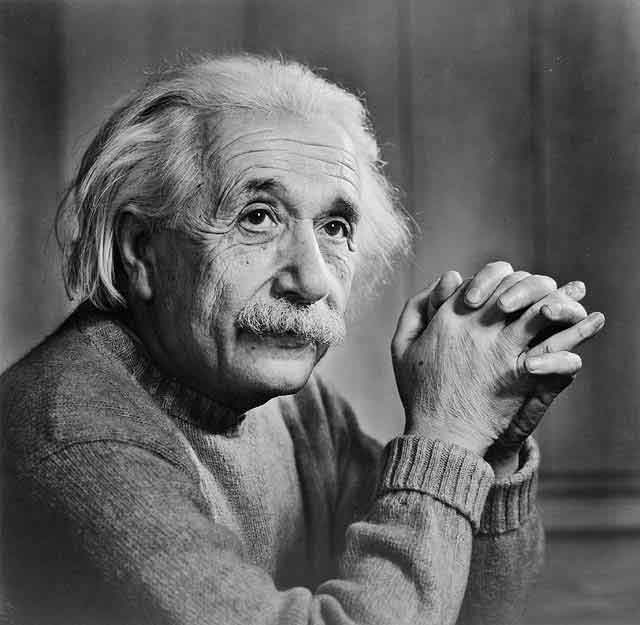
Albert Einstein

process which is highly addictive, predictable and virtually impossible to break without the intervention of a higher level of awareness. I think it was Einstein who said something like, “you can’t use the same intelligence that created a problem to solve it“!  In other words, a different approach or level must be used.

I believe that this different approach or level can be used to solve most problems we have. By bringing a different level of awareness to a challenge, whether it is redundancy or some other sort of deeper problem always gives different results and provides more options. It’s just that initially it needs to be facilitated, until we can do it under our own steam. I am heartened that even in the depths of a recession that there are still companies out there that support this approach and the work I do.

By Jon Lavin [This article from the BBC is worth reading in conjunction with Jon’s excellent Post. Jon may be contacted via learningfromdogs (at) gmail (dot) com]

Fed Funds Rate and Consumer/Business Costs

Looking more closely at the implications of changes in the Fed rate

Fed funds rate chart_img
Fed Funds rate influences consumer and business interest costs

Does the Fed Funds Rate, the rate charged by the Federal Reserve to make short-term loans to banks, directly influence the interest rate consumers and businesses pay on credit cards, mortgages, and consumer and business loans?  If you took the word of the average business news commentator, you would think not.  But the answer, of course, is yes.

One way to view the market rate of interest, although certainly not the only correct or useful way, is to think of it as a base rate that represents the risk-free rate, a rate that compensates the population for its impatience to consume the goods it would have consumed had it not lent the funds out in the first place. This risk-free rate is also influenced by the efficiency and functioning of the capital markets that bring borrowers and lenders together.

A risk premium is then added to this base rate of risk-free interest, one that varies depending on the degree of uncertainty of the lender getting repaid.  The risk of default, the risk of prepayment, the risk of political uprising, exchange rate risk, and many other sources of uncertainty — including the risk of inflation — raise the level of the risk premium commanded by lenders in the market.  As an example, over the last 100 years or so, the average annual risk-free rate in the U.S. has been about 4%, and the average annual risk premium for equity securities has been about 8%, bringing the average annual observed interest rate or rate of return to about 12% on these securities.

So what happens to the interest rate charged to consumers and businesses when the Fed raises the fed funds rate?  Basically, the level of the risk-free rate in the economy rises and, as debt contracts expire or new lending takes place, this higher base rate gets factored into the market rate of interest charged.

Overall, the demand for loanable funds falls, the aggregate demand curve for the economy falls, and equilibrium output and employment fall, RELATIVE to where they would have been without the rate increase. The bright side is that a reduction in the money supply that accompanies an increase in the fed funds rate is absolutely essential to curtailing inflation, which drives the risk premium, and represents a much greater cost to the economy.

By Sherry Jarrell

Not your average airport!

The world’s 18 strangest airports

The American magazine Popular Mechanics had an interesting piece on some of the more bizarre airports around the world.  As the article says,

Engineers tasked with building an airport are faced with countless challenges: The ideal location needs ample space, endless flat ground, favorable winds and great visibility. But spots in the real world are rarely ideal, and engineers are forced to work with what they have, making sure that the end product is the safest possible structure for pilots. A survey of airports around the world turns up a mixed bag, ranging from dangerous and rugged landing strips to mega-size facilities that operate like small cities.

Apart from the general interest in these airports, there is also a personal resonance as three of them are in my aviation log-book: Barra; Gibralter; Courchevel.  Indeed my experiences of flying into Barra were the subject of a Post on this Blog a few months ago.

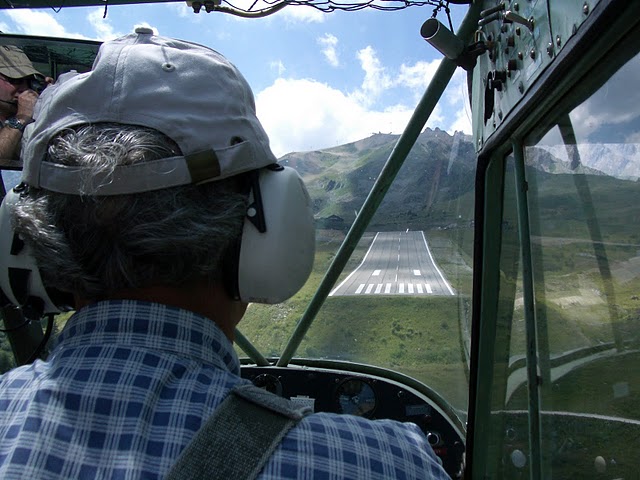
Courchevel in the French Alps is, for all pilots, one of the most amazing, butt-clenching arrivals one could ever imagine.

As Wikipedia puts it:

Courchevel’s airport also has a certain degree of infamy in the aviation industry as home to one of the shortest runways in the world, with a length of 525 metres and a gradient of 18.5% in order to help slow landing aircraft. The airport has a dangerous approach through deep valleys which can only be performed by specially certified pilots. On landing there is no go-around procedure, as most of the worlds airports have – there is merely a very steep hill which has seen a few accidents since the airport first opened.

Quite so!

Here’s an interesting video from YouTube

and a few personal memories:

Start of the approach into Courchevel
'short final' Courchevel
Author & aircraft on the apron - Courchevel

By Paul Handover

The Planet’s Resources

Who do the Earth’s raw materials really “belong” to?

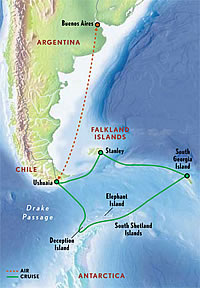
So once again the Falkland Islands have hit the headlines, and as usual for the wrong reasons. The British have given the green light for oil exploration around the islands and Argentina has resisted by imposing restrictions on shipping movements, if not (yet) an all-out blockade.

Who knows where this one will end? It could either fizzle out or erupt into another full-scale confrontation, since big issues are involved, and none bigger than nationalism, for Argentina claims the islands as “its own”.

The history of the Falkland Islands is long and complex, but the idea that Argentina has any fundamental right to these islands is surreally silly. Argentina is owned and ruled by descendants of the Spanish, who took over the land that now forms Argentina (a state in its own right only since the early 19th c) as part of the European colonisation of the world. By all means let us return the Falklands to their original owners, except that the first people to settle there were French for a start. And if you are going to adopt the principle of returning land to its original owners, then we can look forward to most of the population of Argentina returning to Spain and returning the land to the Indians, can we?

The other argument often advanced is that “the islands are near Argentina”. Well, I don’t know when these people last looked at a map but 300 miles isn’t exactly “near”. But in any case, if we are to adopt nearness as a criteria for the reapportioning of land then I look forward to England once again reclaiming France, a mere 21 miles away. And what on earth is Corsica doing as part of France? But of course France must have the Channel Islands, as they are very near – and so on. “Continental shelf”? “We own the land under the sea?” Go down this route and we’ll need a whole new generation of map-makers.

When all the idiotic, overblown, childish and nationalistic guff (which sadly  led to many hundreds of dead in the 1972 war) is stripped away from this debate, we are left with two fundamentals:

  • the right of self-determination
  • the way the Earth’s resources are used

As for the first, there have been British people living on the islands since at least 1833. They have – as I believe all people have – the right to determine their own fate.  This is called self-determination. Unfortunately, it is a noble principle to which the world all too often pays only lip-service. The nation state has become an entrenched, solidified system, mostly because it confers great power on the leaders of each state, who – especially when democracy has not taken root – use the statehood to advance their own power and megalomania. Statism has for centuries run roughshod over people’s fundamental rights. Iraq was a “state”, but one where the Kurds (denied their own state by British cynicism) suffered cruelly under the jackboot of a fascist psychopath. That the British eventually helped to remove this monster (suffering enormous criticism from in particular the country that inspired the world with its own Revolution in 1789) is only a tiny compensation for the original injustice done to the Kurds. They are by no means alone; minorities all over the world suffer in different degrees from arrogant statism: Tibetans; Basques,; American Indians and Australian aborigines among many others. Yes, injustices were done centuries ago, but you cannot wind back history, or where would it end?  How would Europe cope with all those Yanks for a start if they gave the USA back to Sitting Bull’s descendants? Apparently, we all came originally from Africa. Should we all return there and leave our countries empty?

Well, on the Falklands are Brits, and Britain did them the honour of allowing them freely to choose whether they want to be annexed to Argentina. This would in fact give them innumerable advantages, plus of course potentially-disastrous disadvantages. As trust is in short supply, these people prefer not to take the risk and so remain British. That is their right. In refusing to discuss “sovereignty”, Britian is doing no more than strike a blow for self-determination. To give Britain its due, it has pursued the same policy – albeit modestly – towards the (in the eyes of some of them) oppressed Welch, Scots and Irish.

So much for fundamental 1. The Argentinian case is pathetic.

What about the RESOURCES question?

Well, resources are another area where the state jackboot falls with great weight. We all breathe the same air, share the same sun, the same water; but where the stuff under the ground is concerned, it’s every state for itself. Yet casting aside state arrogance, isn’t it ridiculous that state A can derive vast wealth from “its” oil, gold or whatever, while state B alongside it is mired in poverty and misery? So much for “share-and-share” alike. Even belonging to the same race is no help; while some Arabs built extraordinary palaces and Audi Quattros made of solid silver, poor Somalis, Yemenis, and even Egyptians are mired in abject poverty. (Check out this Arab Palace in Dubai, and Mugabe’s presidential palace in Zimbabwe, which is by no means untypical of poverty-stricken Africa)

One day, in a joined-up world which recognizes that we are all brothers, we will share resources “fairly”. Britain could show the way by offering to share any oil resources with – not only Argentina – but all of Latin America (though we could leave out Venezuela …) What a blow for brotherhood that would be!

By Chris Snuggs

Old age!

A piece of Internet fiction still carries an important message

One of the features of the Internet is that stories can circulate widely across the globe.  This poem is one such example.  The ‘story’ behind the poem would appear to be fiction but so what!  It serves as a good reminder of something that affects us all (except those tragically cut off before they grow old!).

But before getting the poem, the reason that it was decided to publish the Post is that old age, whatever that really means, is a much bigger issue for societies than many care to acknowledge.  Because, I guess, the ‘many’ tend not to be old, or let us say, the right side of 60.

And look how even the terminology is so biased towards youth.  Why should it be the ‘right’ side of 60?  What is ‘wrong’ with being older than 60, or 70 or whatever age?

Of course, in so many ways nature’s purpose is for us to breed the next generation to continue our gene pool and once we have achieved that then our ‘natural’ use is limited.  But that is to ignore the value of wisdom, the huge advantage the next generation has in being able to tap into the experience and knowledge of the ‘ancients’.

Here’s an interesting piece from Aging and the Elderly by Hampton Roy MD and Charles Russell PhD

Wisdom has been attributed to older people in nearly all world societies from ancient times, but modern research on the psychology of aging has paid little attention to this quality of the late years

………………..
A number of researchers, however, have assessed the psychology of aging quite differently. Instead of measuring decline, their aim has been to measure the unique and special characteristics of mind possessed by older people.

………………….

These researchers might typically define wisdom as Kenyon did when he described it as “the ability to exercise good judgement about important but uncertain matters of life” -where “uncertain matters” refers to problems that may not have come up before, or to which there are competing or conflicting solutions, and so forth. These researchers describe the old as having “self-creating” powers because they seem to be more independent in their decisions, and less subject to external influences like the fads and trends that sweep over the young.
They propose also that the old are better able to live with contradictions in life and that they quickly see the essentials of situations because of their greater experience. Wisdom, they observe, includes the intent to do good, which in turn depends on holding favorable attitudes toward other people.

Then again, popular culture defines the ancient American Indian warrior as many things but old and decrepit doesn’t figure in that list!

Sioux warrior

So here’s that poem – may you live to a great age!

Read the rest of this Post