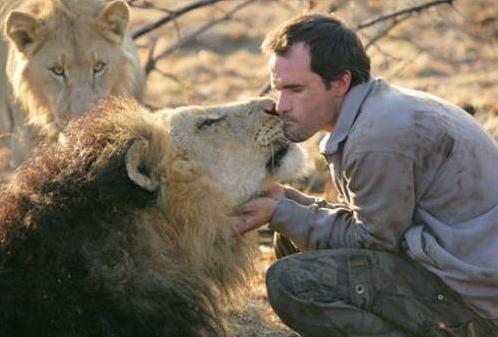
Almost a year ago, Learning from Dogs published an article about the ‘Lion Whisperer‘; Kevin Richardson. Here’s a small extract from that blog Post which has remained the most popular piece on this blog ever since it was first published.
His name is Kevin Richardson and there is an interesting account of how he works and some of his ‘experiences’ in Revolution Magazine, luckily with online content. That article is here. It starts thus:
To do this he does not use the common methods of breaking the animal’s spirit with sticks and chains, instead he uses love, understanding and trust. With this unusual method of training he has developed some exceptionally personal bonds with his students. He sleeps with lions, cuddles newborn hyenas, swims with lionesses. Kevin can confidently look into their eyes, crouch to the their level and even lie down with them – all taboos in the normal world of wild animal handling – yet he doesn’t get mauled or attacked.
The article goes on to say that Kevin often works with the animals when they are very young. Thus he is demonstrating very powerfully that how we behave, especially with our children when they are young, creates the environment for building trust out of consistency of deed and thought.
Just beautiful!
Anyway, I thought to look in on Kevin’s website, http://www.lionwhisperer.co.za/ once again and to view some of the videos posted on that website. Here’s an example – enjoy!
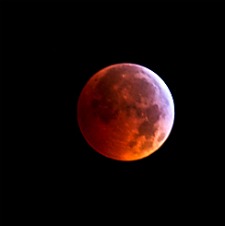
As it happens, here in Payson at 01:15 am on the morning of Tuesday, 21st December, low broken cloud was obscuring the moon much of the time. But nonetheless the pale outline of the darkened moon was visible, sitting above the constellation of Orion. Very, very mystical.
Here’s what it looked like without the cloud, thanks to a Google search for images.
Dec 21st 1638; Dec 21st 2010; Dec 21st 2094
And a late update, thanks to Pete N (via Facebook) who spotted this wonderful video recently placed on YouTube.
which then highlighted this video taken by the Kurdistan Planetarium – these are amazing examples of the power of our new virtual world in sharing images across so many peoples.
If you want to see this solar eclipse then read the times carefully – to assist, I am publishing this Post much earlier than normal, at 18:00 US Mountain Time (UTC -7hrs) on Monday, 20th December. Oh, and more information at Spacedex here.
Dec. 17, 2010: Everyone knows that “the moon on the breast of new-fallen snow gives the luster of mid-day to objects below.”
That is, except during a lunar eclipse.
The luster will be a bit “off” on Dec. 21st, the first day of northern winter, when the full Moon passes almost dead-center through
A similar lunar eclipse in Nov. 2003. Credit: Jim Fakatselis.
Earth’s shadow. For 72 minutes of eerie totality, an amber light will play across the snows of North America, throwing landscapes into an unusual state of ruddy shadow.
The eclipse begins on Tuesday morning, Dec. 21st, at 1:33 am EST (Monday, Dec. 20th, at 10:33 pm PST). At that time, Earth’s shadow will appear as a dark-red bite at the edge of the lunar disk. It takes about an hour for the “bite” to expand and swallow the entire Moon. Totality commences at 02:41 am EST (11:41 pm PST) and lasts for 72 minutes.
If you’re planning to dash out for only one quick look — it is December, after all — choose this moment: 03:17 am EST (17 minutes past midnight PST). That’s when the Moon will be in deepest shadow, displaying the most fantastic shades of coppery red.
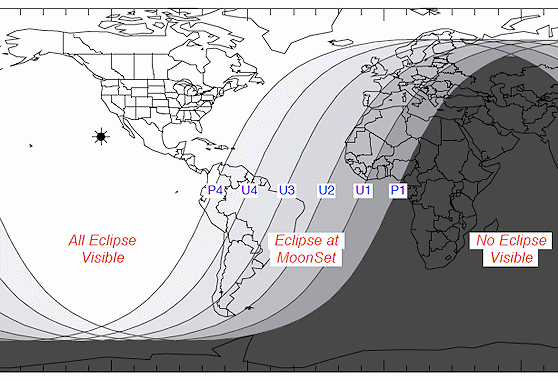
Credit: F. Espenak, NASA/GSFC.
From first to last bite, the eclipse favors observers in North America. The entire event can be seen from all points on the continent. Click to view a world map of visibility circumstances. Credit: F. Espenak, NASA/GSFC.
Why red?
A quick trip to the Moon provides the answer: Imagine yourself standing on a dusty lunar plain looking up at the sky. Overhead hangs Earth, nightside down, completely hiding the sun behind it. The eclipse is underway. You might expect Earth seen in this way to be utterly dark, but it’s not. The rim of the planet is on fire! As you scan your eye around Earth’s circumference, you’re seeing every sunrise and every sunset in the world, all of them, all at once. This incredible light beams into the heart of Earth’s shadow, filling it with a coppery glow and transforming the Moon into a great red orb.
Back on Earth, the shadowed Moon paints newly fallen snow with unfamiliar colors–not much luster, but lots of beauty.
Enjoy the show.
Coincidences (UPDATED): This lunar eclipse falls on the date of the northern winter solstice. How rare is that? Total lunar eclipses in northern winter are fairly common. There have been three of them in the past ten years alone. A lunar eclipse smack-dab on the date of the solstice, however, is unusual. Geoff Chester of the US Naval Observatory inspected a list of eclipses going back 2000 years. “Since Year 1, I can only find one previous instance of an eclipse matching the same calendar date as the solstice, and that is 1638 DEC 21,” says Chester. “Fortunately we won’t have to wait 372 years for the next one…that will be on 2094 DEC 21.“

 Learning from Dogs