The following photographs were sent to me by Jess Anderson. But first here is the story:
For years, photographer Tanja Brandt has made it her mission to capture magnificent photos of animals and wildlife and has drawn accolades in the German and international photography world with her heart-warming animal portraits.
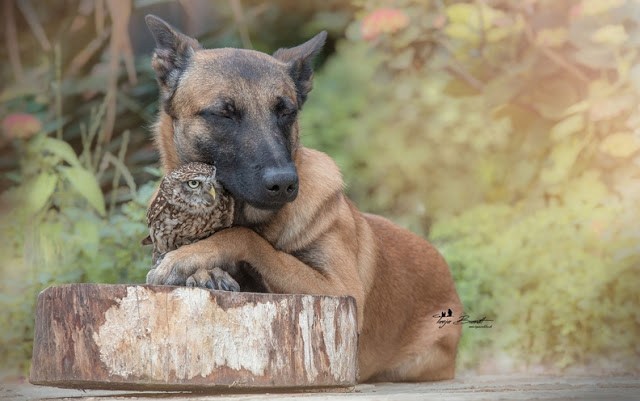
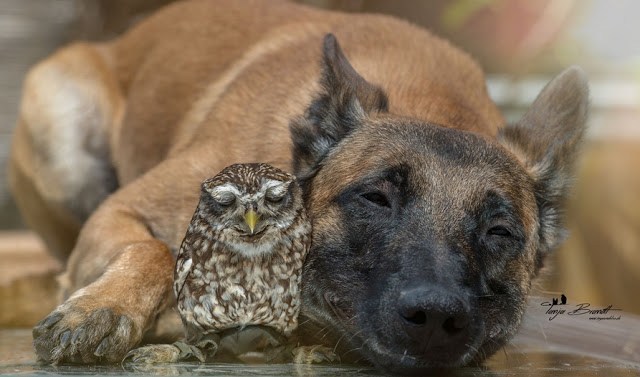
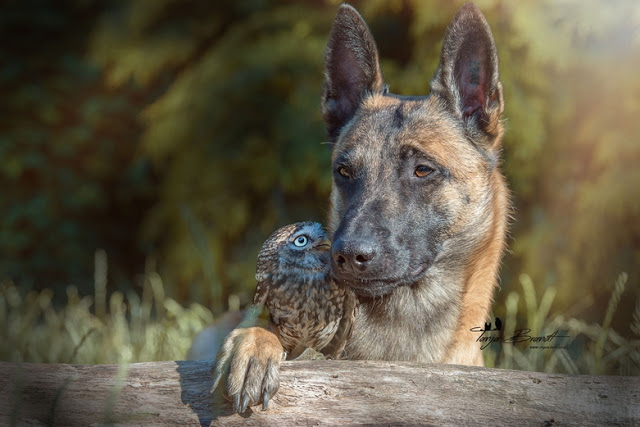
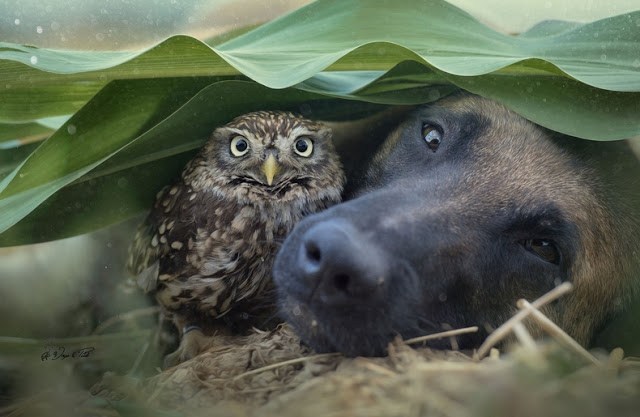
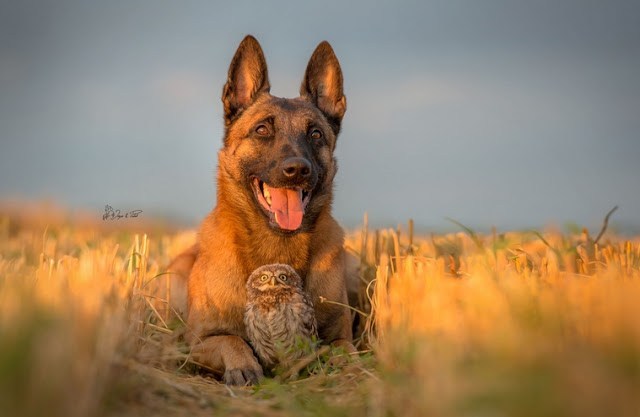
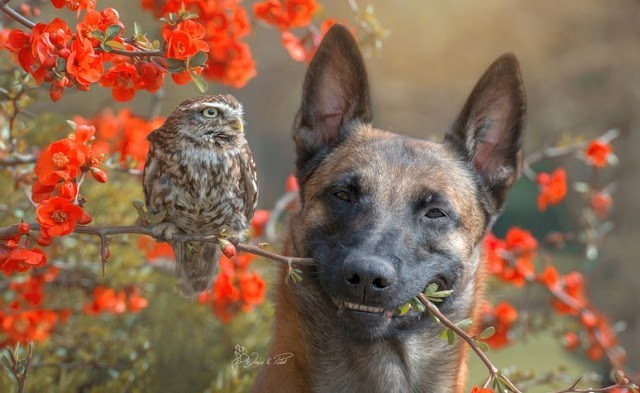
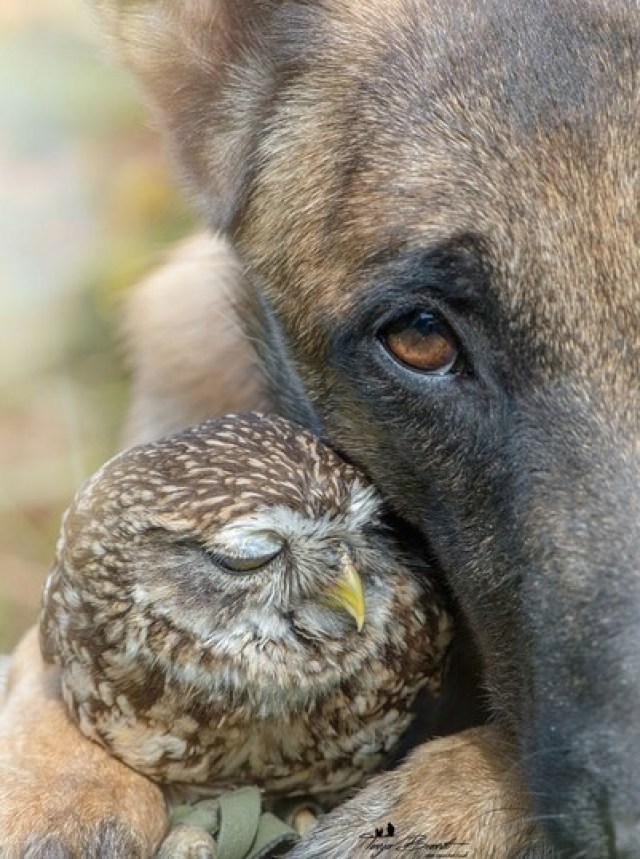
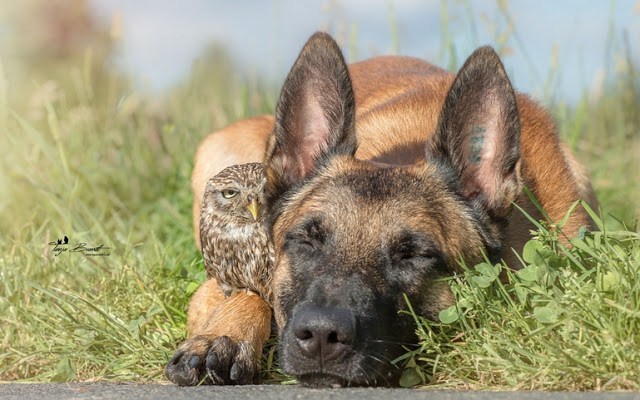
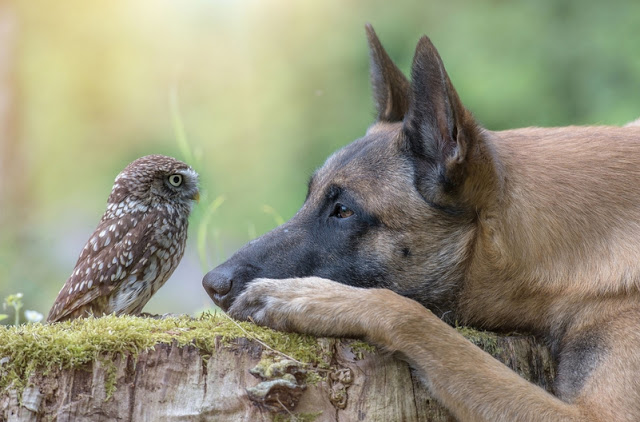
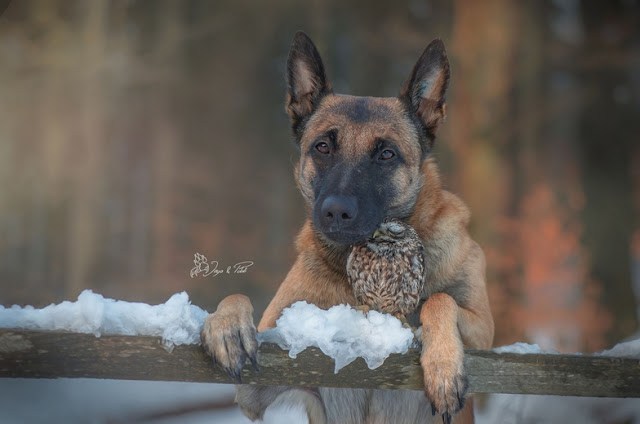
Recently, the German artist found a new challenge when she photographed the unique bond between two unlikely friends: Ingo, a Belgian Shepherd, and Poldi (Napoleon), a one-year-old owlet.
The owlet and canine have a special protector-protected relationship. Their affection toward each other couldn’t be any more evident. Ingo lovingly guards Poldi, who apparently doesn’t know how to live free.
The owlet hatched two days after his six brothers and sisters, therefore, has always been very vulnerable due to his small size. They respect each other and they can read each other, says the photographer.
oooo
oooo
oooo
oooo
oooo
oooo
oooo
oooo
oooo
These photographs are truly unique. Plus they are astoundingly beautiful.
This documentary reveals the unknown true stories of the working rescue dogs who saved lives at Ground Zero during the September 11, 2001 crisis and aftermath. Blind office worker Michael Hingson had to trust his seeing-eye dog Roselle on a treacherous descent of 78 flights of stairs to escape only moments before the towers collapsed. Lt. David Lim was called to duty with his dog Sirius. Genelle Guzman-McMillan was found by recovery dogs after being pinned under the rubble for 27 hours.
Once again, dogs come to the rescue of us humans, both physically and psychologically!
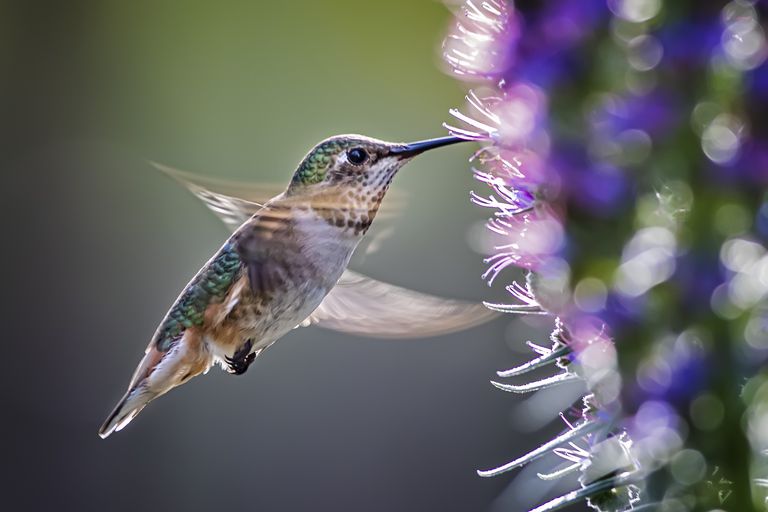
Glittery and graceful, hummingbirds hover and flit in midair as they gather nectar. But it’s not just their athleticism that helps them source food.
New research finds that these tiny birds have a great sense of smell that helps them detect potential danger when they are hunting for nectar.
“In the last 10-15 years, researchers have just now begun to realize the importance of smell in birds in general. For a very long time, it has been known that some birds, such as vultures, have a keen sense of smell and use it to find food,” study co-author Erin Wilson Rankin, an associate entomology professor at the University of California Riverside, tells Treehugger.
“However, the role of olfaction in most birds has only been recently recognized. That may be in part because many birds do not appear to use odor to help them locate food.”
In earlier studies, researchers were unable to show that hummingbirds preferred the smell of flowers that contained nectar. Also, flowers that have been pollinated by birds don’t have strong aromas, like those that have been pollinated by insects. That’s why scientists didn’t believe that birds had the ability to smell odors.
But with this new study, researchers believe otherwise.
For their experiment, Rankin and her colleagues observed more than 100 hummingbirds in the wild and in aviaries. The birds were given the choice between feeders that contained just sugar water, or sugar water with the addition of one of several chemicals with a scent that meant there was an insect present. The feeders otherwise looked exactly the same.
The scents included one deposited on flowers by European honeybees, a chemical produced by Argentine ants, and formic acid, which is released defensively by some formica ants and can injure birds and mammals.
“If a bird has any exposed skin on their legs, formic acid can hurt, and if they get it in their eyes, it isn’t pleasant,” Rankin said in a statement. “It’s also extremely volatile.”
In the experiments, the hummingbirds avoided the feeders with the sugar water that contained the ant-derived chemicals. They didn’t react to the sugar water with the honeybee scent, even though it’s been known to keep other bees from visiting flowers.
To make sure the bees weren’t avoiding the feeders due to a fear of a new smell, the researchers performed an extra test with sugar water and ethyl butyrate, which is a common additive in human food.
“It smells like Juicy Fruit gum, which is not a smell known in nature,” Rankin said. “I did not enjoy it. The birds did not care about it though and didn’t go out of their way to avoid it.”
For hummingbirds, recognizing smells isn’t just about finding a meal. They use their sense of smell much differently than vultures. These birds use the massive olfactory bulb in their brain like an “airborne bloodhound” to detect decaying carcasses.
Instead, hummingbirds use their excellent vision to locate flowers from which they collect nectar.
“Flowers, while specific species may be patchy in distribution, are much more common and numerous than the animal carcasses that vultures rely on. Thus, it is not surprising that vultures use their sense of smell to find carcasses which they then scavenge,” Rankin explains.
Hummingbirds use their ability to smell in a different way.
“Rather than using odors to find flowers, they will avoid flowers or feeders that have specific insect odors on them, such as formic acid or an Argentine ant aggregation pheromone. A hummingbird can use the chemical cues associated with ants to help them determine if the hummingbird should feed from there, or avoid it because it’s already occupied by ants, which can drink the nectar first or potentially harm them,” Rankin says.
“Ants are also very hard for hummingbirds to see until they are up close, so being able to smell them even when they are hidden deep in a flower could be advantageous. By avoiding defensive chemicals, hummingbirds can avoid interactions with ants and focus on feeding at safer food resources.”
ooOOoo
As long as I shall live I will never stop being amazed at what science discovers and then reports. And the photograph is gorgeous!
I heard yesterday from Erik Hoffner who is responsible for the Mongabay website that Bill McKibben is stepping up to the mark in wanting to take action regarding climate change.
I very quickly signed up and received the following email:
Dear Friend,
Many thanks for signing up to be a part—and we hope a big part—of Third Act.
My name is Bill McKibben, and I’m one of the volunteers helping to launch this effort for Americans 60 and older who want to build a fairer and more sustainable nation and planet.
We’re very much in the early days of this, and we need your help—especially if you’re good at the behind-the-scenes tasks like administration, development, and project management. If you’ve got some time to donate right now, write to us at info@thirdact.org.
And we will be back in touch as autumn rolls on, with some early campaigns focused on climate action and on ending voter suppression. As you can tell, we’re making this up as we go along. So it should be interesting, and also a little bumpy!
If you can assemble a sizable group of people, I’ll do my best to join you for a virtual talk to explain more about this idea. (And when the pandemic ends, we’ll try to do it in person!).
And if you can donate some small sum of money to help with the launch, here’s the place.
Thank you. This is our time to make some powerful change—we’ve got the skills, the resources, and the desire. So let’s try.
We’re over 60—the Baby Boomers and the Silent Generation. We have skills, we have resources, we have time—and many of us have kids and grandkids. We also have a history. In our early years we saw remarkable shifts in politics and society; now, in our latter years, we want to see those changes made real and lasting.
We were there for the first Earth Day, and we’ve been glad to see cleaner air and water—but now we know that the climate crisis presents an unparalleled threat. The heat is on and we must act quickly to turn it down.
We watched or participated in the civil rights movement—and now we know that its gains were not enough, and that gaps in wealth have only widened in our lifetimes. We’ve got to repair divisions instead of making them worse. We saw democracy expand—and now we’re seeing it contract, as voter suppression and gerrymandering threaten the core of the American experiment. We know that real change can only come if we all get to participate.
You are the key to this work. Maybe you’ve asked yourself: how can I give back on a scale that matters? The answer is, by working with others to build movements strong enough to matter. That’s why we hope you’ll join us.
Clearly I have signed up and I hope an enormous number of other people will do as well.
Because the time left is not very long and even me at the age of 76 fear for the near future if nothing is done urgently.
I was a bit tight on time yesterday and just looked for a YouTube video that might please.
Anyway, I quickly came across this from CBS. It goes back 7 years but so what, it is still very pertinent today.
People will tell you it’s not what you say to a dog that counts, it’s how you say it. But now researchers say dogs respond to much more than your tone of voice. They say brain scans confirm that canines can understand exactly what you’re saying. Michelle Miller reports.
:max_bytes(150000):strip_icc()/MaryJoDiLonardo-bw-treehugger-6d5044d7d4ae44298fb31df11a3d5a66.jpg)
 Learning from Dogs