And guess what? Another Sunday, another set of photographs from Kristýna Kvapilová

oooo

oooo

oooo

oooo

oooo

oooo

As before the photographs were copies of those here.
They continue to be superb.
Dogs are animals of integrity. We have much to learn from them.
Year: 2019
And guess what? Another Sunday, another set of photographs from Kristýna Kvapilová
oooo
oooo
oooo
oooo
oooo
oooo
As before the photographs were copies of those here.
They continue to be superb.
A timely article, again from the Beeb.
On the back of yesterday’s article about dogs obtaining protein from eating soldier ants comes another piece from the BBC about fibre. It has much information some of which I hadn’t come across before.
So it’s another share with you.
ooOOoo
By James Gallagher, Health and science correspondent, BBC News
January 11th, 2019.

If I offered you a superfood that would make you live longer, would you be interested?
Naturally it reduces the chances of debilitating heart attacks and strokes as well as life-long diseases such as type-2 diabetes.
And it helps keep your weight, blood pressure and cholesterol levels down.
I should mention it’s cheap and widely available in the supermarket.
What is it?
Fibre – it’s not the sexiest thing in the world but a major study has been investigating how much fibre we really need to be eating and found there are huge health benefits.
“The evidence is now overwhelming and this is a game-changer that people have to start doing something about it,” one of the researchers, Prof John Cummings, tells BBC News.
It’s well known for stopping constipation – but its health benefits are much broader than that.
How much fibre do we need?
The researchers, at the University of Otago, in New Zealand, and the University of Dundee say people should be eating a minimum of 25g of fibre per day.
But they call this an “adequate” amount for improving health and say there are benefits for pushing past 30g (1oz).
Is that all?
Well, a banana on its own weighs about 120g but that’s not pure fibre. Strip out everything else including all the natural sugars and water, and you’re left with only about 3g of fibre.
Most people around the world are eating less than 20g of fibre a day.
And in the UK, fewer than one in 10 adults eats 30g of fibre daily.
On average, women consume about 17g, and men 21g, a day.

What other foods have more fibre in them?
You find it in fruit and vegetables, some breakfast cereals, breads and pasta that use whole-grains, pulses such as beans, lentils and chickpeas, as well as nuts and seeds.
BBC Food: How carb-clever are you?
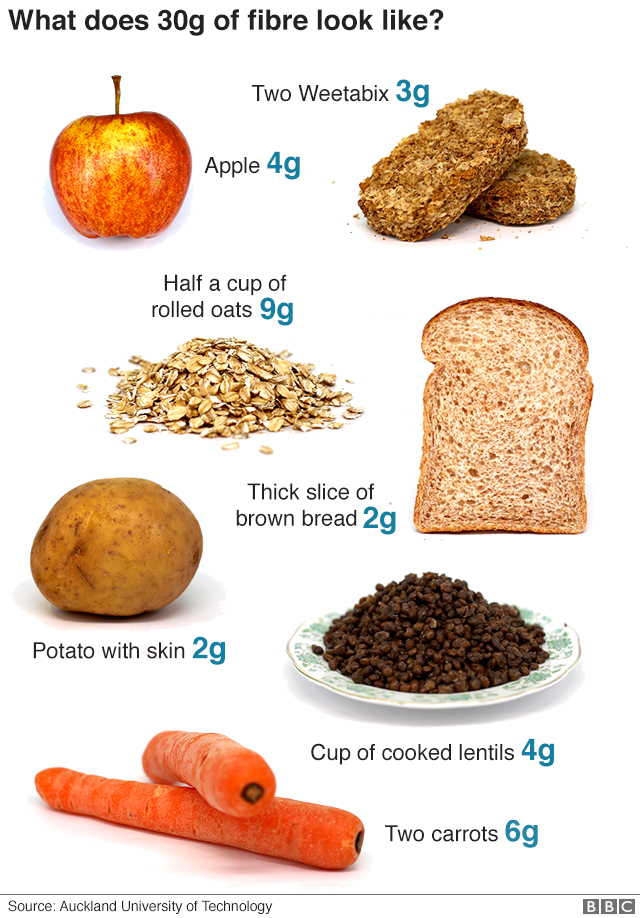
What does 30g look like?
Elaine Rush, a professor of nutrition at Auckland University of Technology, has put together this example for getting into the 25-30g camp:
But she says: “It is not easy to increase fibre in the diet.”
Prof Cummings agrees. “It’s a big change for people,” he says. “It’s quite a challenge.”
Are there any quick and easy tips?
The UK’s National Health Service has a page full of them.
They include:
BBC Food: High fibre breakfasts
What will the benefit be?
Well, after analysing 185 studies and 58 clinical trials, the results are in and have been published in the Lancet medical journal.
It suggests if you shifted 1,000 people from a low fibre diet (less than 15g) to a high-fibre one (25-29g), then it would prevent 13 deaths and six cases of heart disease.
That’s during the course of these studies, which tended to follow people for one to two decades.
It also showed lower levels of type-2 diabetes and bowel cancer as well as lower weight, blood pressure and cholesterol levels.
And the more fibre people ate, the better.
What is fibre doing in the body?
There used to be a view that fibre didn’t do much at all – that the human body could not digest it and it just sailed through.
But fibre makes us feel full and affects the way fat is absorbed in the small intestine – and things really become interesting in the large intestines, when your gut bacteria get to have their dinner.
The large intestines are home to billions of bacteria – and fibre is their food.
It’s a bit like a brewery down there, admittedly one you wouldn’t want a pint from, where bacteria are fermenting fibre to make a whole load of chemicals.
This includes short-chain fatty acids, which are absorbed and have effects throughout the body.
“We have this organ set up to digest fibre, which a lot of people just don’t use very much,” says Prof Cummings.
Why is this relevant now?
The fact fibre and whole-grains and fruit and vegetables are healthy should not come as a surprise.
But there is concern people are turning their back on fibre, with the popularity of low-carb diets.
Prof Nita Forouhi, from the University of Cambridge, says: “We need to take serious note of this study.
“Its findings do imply that, though increasingly popular in the community at large, any dietary regimes that recommend very low-carbohydrate diets should consider the opportunity cost of missing out on fibre from whole-grains.
“This research confirms that fibre and whole-grain intakes are clearly important for longer term health.”
The study has been done to help the World Health Organization come up with official guidelines for how much fibre people should be eating to boost health and they are expected next year.
Follow James on Twitter

Analysis from BBC Reality Check
One of the suggested ways of boosting the amount of fibre in your diet is to switch from white bread to brown or wholemeal.
This is what has been happening to sales of those products, based on a succession of government surveys of household spending since 1974.
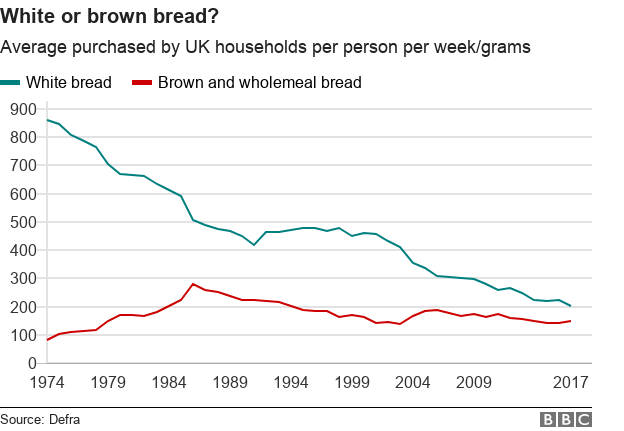
From the mid-seventies to the mid-eighties, white bread fell while brown and wholemeal rose.
Since then, white bread sales have continued to fall, but brown and wholemeal bread sales have been falling for most of that period, although at a slower rate.
So it looks as if while overall demand for bread has been falling, a higher proportion of bread sold has been higher fibre.
Whole wheat pasta has made less of an impact on sales than higher fibre breads, with a survey for the British Journal of Nutrition finding that pasta accounted for less than 1% of the occasions on which people were consuming whole grains.
ooOOoo
Well nothing much more to be said other than going vegan.
Dogs eating insects and helping climate change.
I had to look twice at this but it wasn’t April 1st and it appeared to be a serious article. It’s from the BBC website.
Will say no more. You have a read of it.
ooOOoo
By Roger Harrabin, BBC environment analyst
10th January, 2019

Do you fret that your pet pooch is blamed by environmentalists for turning rainforests into poo in the park?
Have no fear – you can now fatten Fido on black soldier flies instead of Brazilian beef.
A pet food manufacturer now claims that 40% of its new product is made from soldier flies.
It’s one of many firms hoping to cash in on the backlash against beef by people concerned that the cattle are fed on soya.
These soya plantations are responsible for the release of greenhouse gases in significant quantities.
Is it good for the dog?
The key question is whether a diet of 40% soldier flies meets the nutritional needs of your beloved canine.
We put the question to a pet diet expert at the Royal Veterinary College, Aarti Kathrani. Her conclusion was a cautious “yes”.
“Insects can be a very useful source of protein,” she told us. “More studies are needed to show how much of these nutrients can actually be absorbed by a dog’s body – but some studies suggest that insects can provide nutrients for dogs.”
Does it help the climate if dogs eat flies?
At first sight it seems obvious that feeding your dog meaty food is bad for the environment. The link between humans eating meat and the allied emissions of CO2 and methane is well established – and pets are estimated to eat 20% of global meat.
It’s also true that flies produce protein much more efficiently than cows – using a small percentage of the water and land.
But actually the analysis is more subtle than that – because as societies become more wealthy, people often turn to muscle meat and reject the animal’s offal.

That offal is just as nutritious – and it gets made into pet food. That means that dog food is just as sustainable – or unsustainable – as humans eating meat.
In fact, if dogs were weaned off meat and on to insects, the industry would have to find another purpose for the offal. More sausage, perhaps? Or more humans eating insect protein. Or more going vegan?
Could cat food be made out of insects, too?
Dogs are omnivores – they eat more or less anything. Cats are much more choosy, because they can’t make an essential amino acid, taurine. They find it instead in meat and fish.
But Dr Kathrani says studies show that insects do contain taurine, so it’s possible that insects could also form a useful part of the moggie diet.
The new product is from Yora, a UK start-up. The insect grubs are fed on food waste in the Netherlands.
There are several competitors which also produce pet food incorporating fly protein. They include Insectdog, Entomapetfood, Chippin and Wilderharrier.
ooOOoo
Now I have heard of some strange things but in essence this does make very good sense.
I can’t recall whether I have previously shown this to you …
I don’t think so.
(But see my note at the end of the piece.)
ooOOoo
By Assistant Professor of Marketing, University of Oregon
November 19th, 2018.
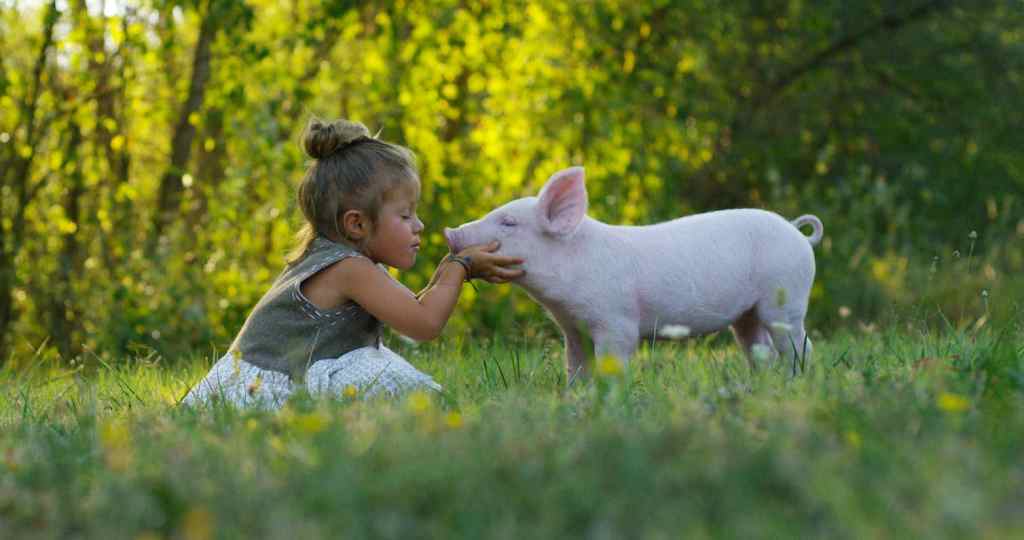
At the age of 14, a young Donald Watson watched as a terrified pig was slaughtered on his family farm. In the British boy’s eyes, the screaming pig was being murdered. Watson stopped eating meat and eventually gave up dairy as well.
Later, as an adult in 1944, Watson realized that other people shared his interest in a plant-only diet. And thus veganism – a term he coined – was born.
Flash-forward to today, and Watson’s legacy ripples through our culture. Even though only 3 percent of Americans actually identify as vegan, most people seem to have an unusually strong opinion about these fringe foodies – one way or the other.
As a behavioral scientist with a strong interest in consumer food movements, I thought November – World Vegan Month – would be a good time to explore why people become vegans, why they can inspire so much irritation and why many of us meat-eaters may soon join their ranks.
It’s an ideology not a choice
Like other alternative food movements such as locavorism, veganism arises from a belief structure that guides daily eating decisions.
They aren’t simply moral high-grounders. Vegans do believe it’s moral to avoid animal products, but they also believe it’s healthier and better for the environment.
Also, just like Donald Watson’s story, veganism is rooted in early life experiences.
Psychologists recently discovered that having a larger variety of pets as a child increases tendencies to avoid eating meat as an adult. Growing up with different sorts of pets increases concern for how animals are treated more generally.
Thus, when a friend opts for Tofurky this holiday season, rather than one of the 45 millionturkeys consumed for Thanksgiving, his decision isn’t just a high-minded choice. It arises from beliefs that are deeply held and hard to change.
Veganism as a symbolic threat
That doesn’t mean your faux-turkey loving friend won’t seem annoying if you’re a meat-eater.
The late celebrity chef Anthony Bourdain famously quipped that meat avoiders “are the enemy of everything good and decent in the human spirit.”
Why do some people find vegans so irritating? In fact, it might be more about “us” than them.
Most Americans think meat is an important part of a healthy diet. The government recommends eating 2-3 portions (5-6 ounces) per day of everything from bison to sea bass. As tribal humans, we naturally form biases against individuals who challenge our way of life, and because veganism runs counter to how we typically approach food, vegans feel threatening.
Humans respond to feelings of threat by derogating outgroups. Two out of 3 vegans experience discrimination daily, 1 in 4 report losing friends after “coming out” as vegan, and 1 in 10 believe being vegan cost them a job.
Veganism can be hard on a person’s sex life, too. Recent research finds that the more someone enjoys eating meat, the less likely they are to swipe right on a vegan. Also, women find men who are vegan less attractive than those who eat meat, as meat-eating seems masculine.
Crossing the vegan divide
It may be no surprise that being a vegan is tough, but meat-eaters and meat-abstainers probably have more in common than they might think.
Vegans are foremost focused on healthy eating. Six out of 10 Americans want their meals to be healthier, and research shows that plant-based diets are associated with reduced risk for heart disease, certain cancers, and Type 2 diabetes.
It may not be surprising, then, that 1 in 10 Americans are pursuing a mostly veggie diet. That number is higher among younger generations, suggesting that the long-term trend might be moving away from meat consumption.
In addition, several factors will make meat more costly in the near future.
Meat production accounts for as much as 15 percent of all greenhouse gas emissions, and clear-cutting for pasture land destroys 6.7 million acres of tropical forest per year. While some debate exists on the actual figures, it is clear that meat emits more than plants, and population growth is increasing demand for quality protein.
Seizing the opportunity, scientists have innovated new forms of plant-based meats that have proven to be appealing even to meat-eaters. The distributor of Beyond Meat’s plant-based patties says 86 percent of its customers are meat-eaters. It is rumored that this California-based vegan company will soon be publicly traded on Wall Street.
Even more astonishing, the science behind lab-grown, “cultured tissue” meat is improving. It used to cost more than $250,000 to produce a single lab-grown hamburger patty. Technological improvements by Dutch company Mosa Meat have reduced the cost to $10 per burger.
Watson’s legacy
Even during the holiday season, when meats like turkey and ham take center stage at family feasts, there’s a growing push to promote meatless eating.
London, for example, will host its first-ever “zero waste” Christmas market this year featuring vegan food vendors. Donald Watson, who was born just four hours north of London, would be proud.
Watson, who died in 2006 at the ripe old age of 95, outlived most of his critics. This may give quiet resolve to vegans as they brave our meat-loving world.
ooOOoo
Jeannie has been a vegetarian all her life and I willingly adopted the lifestyle back in 2008 when we first started living together. Then in 2017 we took the final step to becoming vegan on account of there being too much uncertainty about fish, chicken and dairy products.
We both feel great on a vegan diet and more and more people seem to be coming across to this position.
(N.B. And this post has been published before – oh well it won’t do any harm in being repeated.)
 Learning from Dogs