My posts of the last few days have been in the ‘cuddly, cosy’ vein of life and, as many would say, a long way from the reality of this 21st century.
The reality is tough and scary and many, including me, favour running away from scary places. I’m sure that the urge to flee and hide is a survival behaviour from long time ago. BUT!! But the only hope for us humans is to face the facts full on.
Take, for example, the Ganges River. We have all heard of this famous river (my emphasis below):
The source of the Ganges is the Gangotri glacier. Here it is:
Gaumukh, snout of the Gangotri glacier,surrounded by the Bhagirathi peaks of Garhwal Himalayas, at an altitude of over 4,000 metres. Photo: Vidya Venkat.
Scientists say dwindling snowfall affects volume of water fed to the Bhagirathi, the main source of the Ganga
After a four-hour-long trek from Bhojwasa, the final camping spot in Gangotri, when a brown, fractured pile of rocks finally came into view it was hard to believe that this was the mouth of the glacier from which the ‘holy’ Ganga emerged.
Gaumukh, the snout of the Gangotri glacier, named after its shape like the mouth of a cow, has retreated by over 3 kilometres since 1817, says glaciologist Milap Chand Sharma of Jawaharlal Nehru University.
It was nearly two centuries ago that the retreat of the glacier was first documented by John Hodgson, a Survey of India geologist.
With 10 Indian States reeling under drought and the country facing a severe water crisis after two weak monsoons, the story of retreating freshwater sources such as the Himalayan glaciers is worrying. And though a three-kilometre retreat over a period of two centuries might seem insignificant at first glance, data shows that the rate of retreat has increased sharply since 1971. The rate of retreat is 22 metres per year.
Twenty-two metres or seventy-two feet a year!
Wringing our hands is no good. All of us who care for our Living Planet have to shout out just what is going on. As George Monbiot continues to do. Take his latest essay, for example, that is republished here in full with GM’s very kind permission.
ooOOoo
Insectageddon
The scale and speed of environmental collapse is beyond imagination.
By George Monbiot, published in the Guardian 20th October 2017
Which of these would you name as the world’s most pressing environmental issue? Climate breakdown, air pollution, water loss, plastic waste or urban expansion? My answer is none of the above. Almost incredibly, I believe that climate breakdown takes third place, behind two issues that receive only a fraction of the attention.
This is not to downgrade the danger presented by global heating – on the contrary, it presents an existential threat. It is simply that I have come to realise that two other issues have such huge and immediate impacts that they push even this great predicament into third place.
One is industrial fishing, which, all over the blue planet, is now causing systemic ecological collapse. The other is the erasure of non-human life from the land by farming.
And perhaps not only non-human life. According to the UN Food and Agriculture Organisation, at current rates of soil loss, driven largely by poor farming practice, we have just 60 years of harvests left. And this is before the Global Land Outlook report, published in September, found that productivity is already declining on 20% of the world’s cropland.
The impact on wildlife of changes in farming practice (and the expansion of the farmed area) is so rapid and severe that it is hard to get your head round the scale of what is happening. A study published this week in the journal Plos One reveals that flying insects surveyed on nature reserves in Germany have declined by 76% in 27 years. The most likely cause of this Insectageddon is that the land surrounding those reserves has become hostile to them: the volume of pesticides and the destruction of habitat have turned farmland into a wildlife desert.
It is remarkable that we need to rely on a study in Germany to see what is likely to have been happening worldwide: long-term surveys of this kind simply do not exist elsewhere. This failure reflects distorted priorities in the funding of science. There is no end of grants for research on how to kill insects, but hardly any money for discovering what the impacts of this killing might be. Instead, the work has been left – as in the German case – to recordings by amateur naturalists.
But anyone of my generation (ie in the second bloom of youth) can see and feel the change. We remember the “moth snowstorm” that filled the headlight beams of our parents’ cars on summer nights (memorialised in Michael McCarthy’s lovely book of that name). Every year I collected dozens of species of caterpillars and watched them grow and pupate and hatch. This year I tried to find some caterpillars for my children to raise. I spent the whole summer looking and, aside from the cabbage whites on our broccoli plants, found nothing in the wild but one garden tiger larva. Yes, one caterpillar in one year. I could scarcely believe what I was seeing – or rather, not seeing.
Insects, of course, are critical to the survival of the rest of the living world. Knowing what we now know, there is nothing surprising about the calamitous decline of insect-eating birds. Those flying insects – not just bees and hoverflies but species of many different families – are the pollinators without which a vast tract of the plant kingdom, both wild and cultivated, cannot survive. The wonders of the living planet are vanishing before our eyes.
Well, I hear you say, we have to feed the world. Yes, but not this way. As a UN report published in March explained, the notion that pesticide use is essential for feeding a growing population is a myth. A recent study in Nature Plants reveals that most farms would increase production if they cut their use of pesticides. A study in the journal Arthropod-Plant Interactions shows that the more neonicotinoid pesticides were used to treat rapeseed crops, the more their yield declines. Why? Because the pesticides harm or kill the pollinators on which the crop depends.
Farmers and governments have been comprehensively conned by the global pesticide industry. It has ensured its products should not be properly regulated or even, in real-world conditions, properly assessed. A massive media onslaught by this industry has bamboozled us all about its utility and its impacts on the health of both human beings and the natural world.
The profits of these companies depend on ecocide. Do we allow them to hold the world to ransom, or do we acknowledge that the survival of the living world is more important than returns to their shareholders? At the moment, shareholder value comes first. And it will count for nothing when we have lost the living systems on which our survival depends.
To save ourselves and the rest of the living world, here’s what we need to do:
We need a global treaty to regulate pesticides, and put the manufacturers back in their box.
We need environmental impact assessments for the farming and fishing industries. It is amazing that, while these sectors present the greatest threats to the living world, they are, uniquely in many nations, not subject to such oversight.
We need firm rules based on the outcomes of these assessments, obliging those who use the land to protect and restore the ecosystems on which we all depend.
We need to reduce the amount of land used by farming, while sustaining the production of food. The most obvious way is greatly to reduce our use of livestock: many of the crops we grow and all of the grazing land we use are deployed to feed them. One study in Britain suggests that, if we stopped using animal products, everyone in Britain could be fed on just 3m of our 18.5m hectares of current farmland (or on 7m hectares if all our farming were organic). This would allow us to create huge wildlife and soil refuges: an investment against a terrifying future.
We should stop using land that should be growing food for people to grow maize for biogas and fuel for cars.
Then, at least, nature and people would have some respite from the global onslaught. And, I hope, a chance of getting through the century.
Science shows that animals, including dogs, do dream!
I wanted to republish a recent and serious article written by George Monbiot but couldn’t bear to push back against the wonderful video of yesterday. Those loving ripples are still spreading across my consciousness and, I’m sure, that’s the same for you.
Consciousness, sleep, and dreaming are fascinating states of the mind. Previously thought exclusively the states of human minds. But not so!
The electric eel exhibit at the New England Aquarium has a feature that makes it a favorite. Whenever the eel is hunting or stunning prey, the charge powers a voltmeter above his tank. It lights up when the eel is using his electricity, and allows you to see the invisible—like magic.
One day I saw another magical thing happen in the tank. Thanks to the voltmeter, I was able to watch the eel dream.
It happened when I was standing in front of the exhibit with Scott Dowd, the lead aquarist for the freshwater gallery, watching the eel resting motionless at the bottom of the tank. “I think he’s asleep,” I said to my companion.
“Yes, that eel is catching some serious z’s,” he agreed.
Being hard-core fish enthusiasts, we continued to watch transfixed while the electric eel slept. And that’s when it happened: A big flash shot across the voltmeter display—and another and another.
Electric eels hunt while swimming forward, wagging their heads to and fro, sending out electric signals that bounce back to them, sort of like a dolphin’s echolocation. But he was still motionless. So what was the flash for?
“I thought the eel was asleep!” I said to Dowd.
“He is asleep,” he replied.
We realized at once what we were almost surely witnessing. The electric eel was dreaming.
“It would appear that not only do men dream,” Aristotle wrote in History of Animals, “but horses also, and dogs, and oxen; aye, and sheep and goats. . . .”
It was obvious: Like most of us, Aristotle had watched sleeping dogs twitch their ears, paddle their paws, and bark in their sleep. Surely other animals dreamed as well.
But since Aristotle’s day, more “modern” thinkers denied that animals could dream. Complex and mysterious, dreams were considered the exclusive province of so-called higher minds.
As brain research advanced, however, researchers were forced to concede that Aristotle was right. Animals do dream.
And now we are even able to glimpse what they dream about.
Since the 1960s scientists have understood that our dreams happen during the rapid eye movement (REM) phase of the sleep cycle. During this time our muscles are normally paralyzed by the pons of the brain stem, so that we don’t act out our dreams. In 1965 researchers removed the pons from the brain stems of cats.* They discovered the cats would get up and walk around, move the head as if to follow prey, and pounce as if on invisible mice—all
while asleep.
By 2007 we would get an even more vivid picture of animals’ dreams. Massachusetts Institute of Technology scientists Matthew Wilson and graduate student Kenway Louie recorded the activity of rats’ brains while the animals were running a maze. Neurons fire in distinct patterns while a rat in a maze performs particular tasks. The researchers repeatedly saw the exact same patterns reproduced while the rats slept—and they saw this so clearly they could tell what point in the maze the rat was dreaming about and whether an individual rat was running or walking in his dreams.
The rats’ dreams arose from the hippocampus, the same area in the brain that seems to drive humans’ dreams. It’s an area known to record and store memories, and that supports the notion that one important function of dreams is to help us remember what we have learned. Of course, it’s important to a lab rat to remember the right way to run a maze.
So if rats dream of running mazes, what do birds dream about? Singing.
University of Chicago professor Daniel Margoliash conducted experiments on zebra finches. Like most birds, zebra finches aren’t born knowing their songs; they learn them, and young birds spend much of their days learning and rehearsing the song of their species. While awake, neurons in the forebrain known as the robustus archistrialis fire when the bird sings particular notes. The researcher was able to determine the individual notes based on the firing pattern of the neurons. While the birds were asleep, their neurons fired in the same order—as if they were singing in their dreams.
Much less work has been done on fish than on mammals and birds. No one has found REM sleep in fish—yet. But that does not mean they don’t dream. Interestingly, no one has discovered REM sleep in whales, either. But whales almost surely dream. They are long-lived, social animals with very big brains much like our own, and for whom long-term memory consolidation is crucial.
And if you were looking for rapid eye movement in sleeping owls, you’d never see it—because owls’ eyes are fixed in their sockets. That’s why they need to turn their heads around, Exorcist-style. Yet owls’ brain waves show they dream, too.
Fish do sleep, however—that much is well known. It’s been carefully documented that if zebra fish are deprived of sleep (because pesky researchers keep waking them up), they have trouble swimming the next day—just as a person would have trouble concentrating after a dreamless night.
What might an electric eel dream about? The voltmeter at the New England Aquarium showed us the answer: hunting and shocking prey.
*Care2 stands firmly against animal testing and believes it to be a cruel and unnecessary practice for which there are viable alternatives, such as computer modeling.
ooOOoo
A young Pharaoh asleep, and dreaming?? September, 2003.
Last October 4th, just three weeks ago tomorrow, I introduced Emily Ridgewell to you. She had written a guest post for us Return to the Movies. It was well-received.
For many, the next few weeks are an important time of the year to do a spot of gardening. A time when dog-owners allow their loved ones to ‘help’, especially in the digging department. But are our gardens as safe for dogs as many of us might like to believe? Emily’s second guest post addresses that question.
ooOOoo
How to Create a Dog-Friendly Garden
by Emily Ridgewell, October 18th, 2017
Being a pet owner is not only a great pleasure but also a huge responsibility. While most of the people think that taking care of dog only included feeding and walking it three times a day, the truth is that being a good dog owner means much more than that. There are plenty of unobvious things that might pose potential threats to the health and wellbeing of dogs, and plants from home garden is a telling example of such threats.
Before listing all home plants and flowers that might pose threat to your dog, it makes sense to say a bit about general rules of creating a dog-friendly garden. After all, it is not about the right or wrong plants only.
If possible, choose robust plants
Young plants or plants with especially delicate stems might not survive if your dog will run through them every now and then. That’s why you are strongly advised to plant large and robust plants like astilbe, hardy geranium, or lavender.
Remember to protect your garden
If you don’t want your home garden to be ruined by a happy running dog, make sure your garden has clearly defined boundaries and borders. Low-growing box hedge serves perfectly for this matter.
Be careful using chemicals
The importance of this point is paramount. Plenty of gardeners use non-organic slug pellets and other chemicals when taking care of a garden. If you own a dog, the only option for you is to learn how to deal with snails and slugs organically and avoid any chemicals altogether.
Choose gentle materials
If you want garden decorations, avoid sharp stones and kinds of materials that might become extremely hot under the sun or too slippery when wet.
Which home plants and flowers are not dog-friendly?
By now you know the most common rules you should follow when creating a dog-friendly garden. Now it is time to learn which particular plants and flowers might be dangerous for dogs and should be avoided at all cost.
All poisonous plants range from slightly toxic (those that might cause vomiting, but nothing more serious) to extremely toxic (those that might cause serious health problems, including death). The list of plants that are dangerous to dogs is long, so it makes sense to divide all plants into subcategories.
In the case with perennial flowers, you should avoid Foxglove, Mums, Lenten Rose, Bleeding Hearts, Hosta, Lily-of-the-valley, Monkshood, Yarrow, and Iris. Speaking of vines, your home garden should not have Morning Glory, English Ivy, Clematis, Bittersweets, Boston Ivy, and Wisteria. As for annuals, you’d better stay away from Lantana and Begonia. The list of poisonous shrubs includes Rose of Sharon, Hydrangea, Yew Bushes, Burning Bush, Azalea Genus, Boxwood, Daphne, and Andromeda. You should also be careful with certain trees, including American Holly, Golden Chain, Oak Trees, Yellow Bird of Paradise, and Oleander.
Armed with this information, you should not have any problems creating a beautiful and dog-friendly home garden. Just make sure to double-check all plants that you decide to plant and refer to common sense when choosing home garden decorations.
ooOOoo
I thought this was valuable information and a very helpful article from Emily.
Then wanted to close this post by sharing with you an example of how our dogs help with the gardening around here.
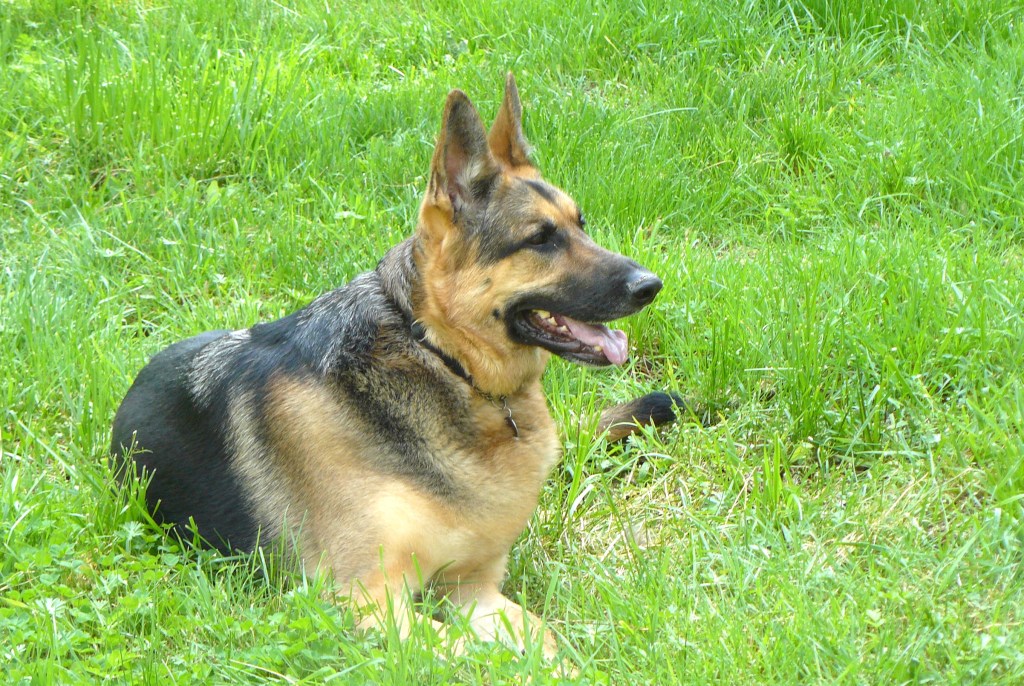
But all I could find was this photograph of Cleo ‘thinking’ of doing the front lawn.





 Learning from Dogs