The first of the New Year and dedicated to Sue of Sue Dreamwalker.
A week ago, Sue left a nice comment about our ‘backyard’ here in Oregon. Specifically with regard to the two photographs of deer feeding in front of the house. I replied by saying that today I would offer a selection of views of our property.
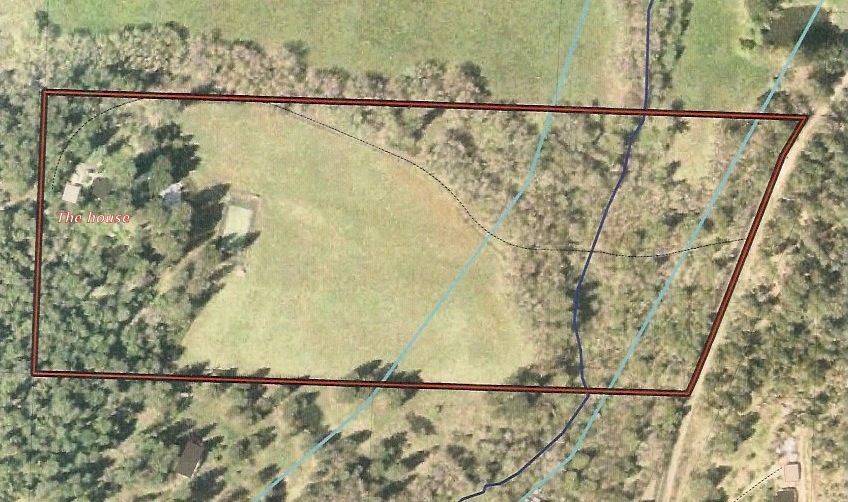
First off, an aerial view with the property boundary line overlaid, taken from the sale particulars. The right-hand, Eastern boundary follows the edge of Hugo Road. We are some four miles from Merlin in Southern Oregon.
Thirteen acres orientated West-East.
The solid blue line is the course of Bummer Creek that flows from top to bottom of the image. The thin, dotted blue line is the driveway that runs from Hugo Road up to the house, a distance of a 1/4 mile. The house is close to the Western boundary almost hidden from sight in this picture by the trees. There is a faint label ‘The House’ just below the building.
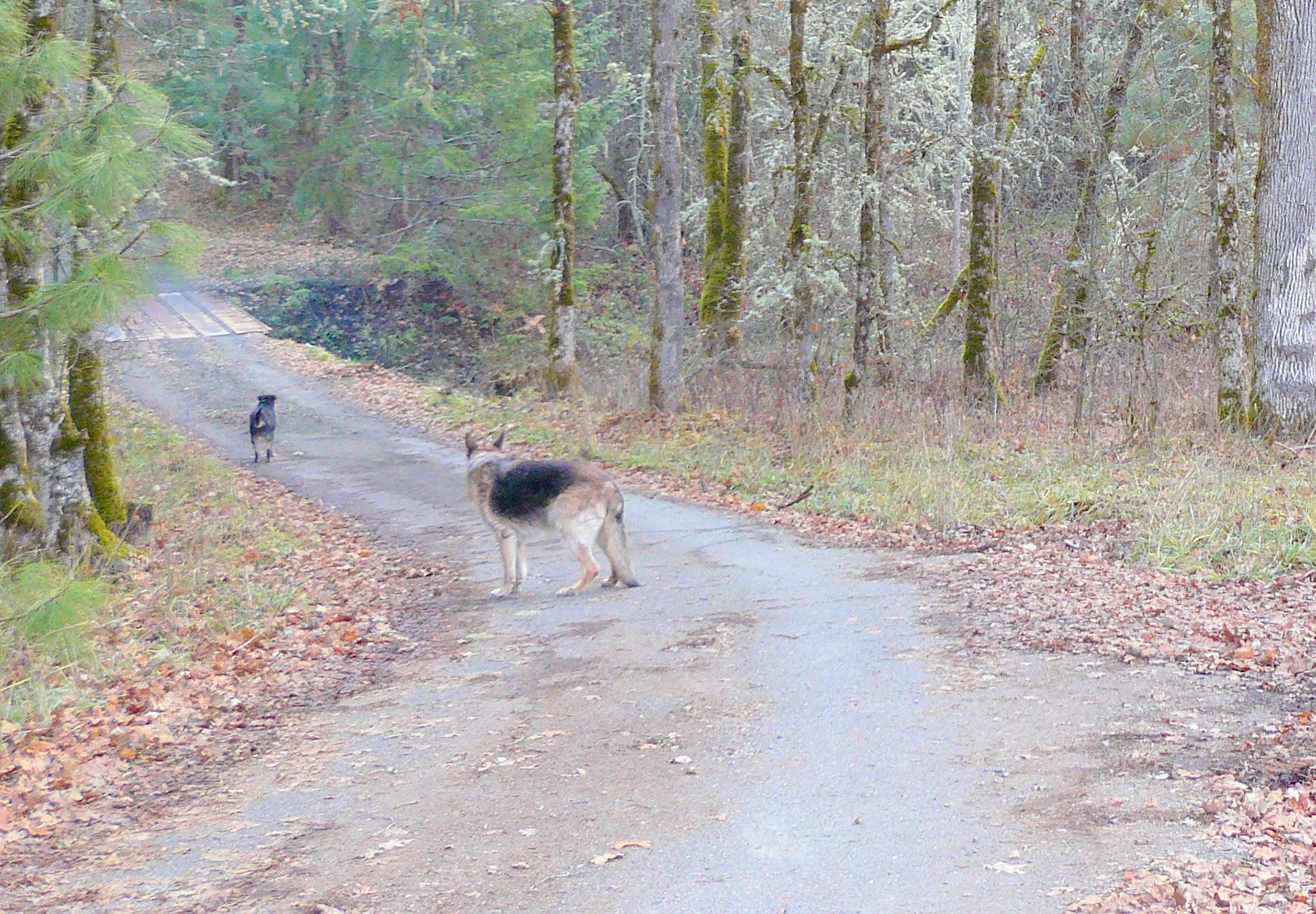
From left to right: Pharaoh, Sweeny, Cleo and Hazel.
The above photograph was taken from a point about half-way along the driveway, the house being behind the camera. Ahead, the driveway dips down to cross the bridge over the Creek, as the following picture reveals. Luckily the boundary fence is dog-proof!
oooo
Dogs and water!
Pharaoh in Bummer Creek just downstream of the bridge.
Looking further downstream from the bridge.
oooo
Looking upstream from the bridge.
The barrier across the Creek seen in the upper half of the photograph is a flood irrigation dam installed many years ago, presumably for agricultural purposes before the plot was sold for house building prior to 1977. One installs an iron pole on a centre bolt embedded in the dam and then places a stout plank across the flow on top of the dam. The plank can just be seen to the right of the dam, resting on the bank. Never tried the dam but going to some day!
Looking to the West up towards the house.
The above picture was taken close to where the previous one was shot. Simply by swinging around to the left and looking back up. The house is barely visible in the background behind the metal gate and wooden fence posts in the middle of the photograph.
Corinne’s field visible through the trees and undergrowth.
Again, the picture above is taken not far removed from where the previous two were taken. If one looks at the aerial view of the property in the first picture, in the top-right corner there is a small area of grassland; what would have been an offshoot of our neighbour’s grassland in previous times. After my sister, Corinne, died in the Summer of 2013 we named that area of grassland Corinne’s field.
A general view down over the main area of grass.
So now we are back standing just outside the Eastern side of the house looking South-East out over the main area where the dogs are walked twice a day. The picture was taken a little before noon and shows the low mist that has been with us for about two weeks.
Nature’s beauty.
Above, another photograph picking up on the mist that has been with us for some days. Until yesterday!
This is what I call a Winter day!
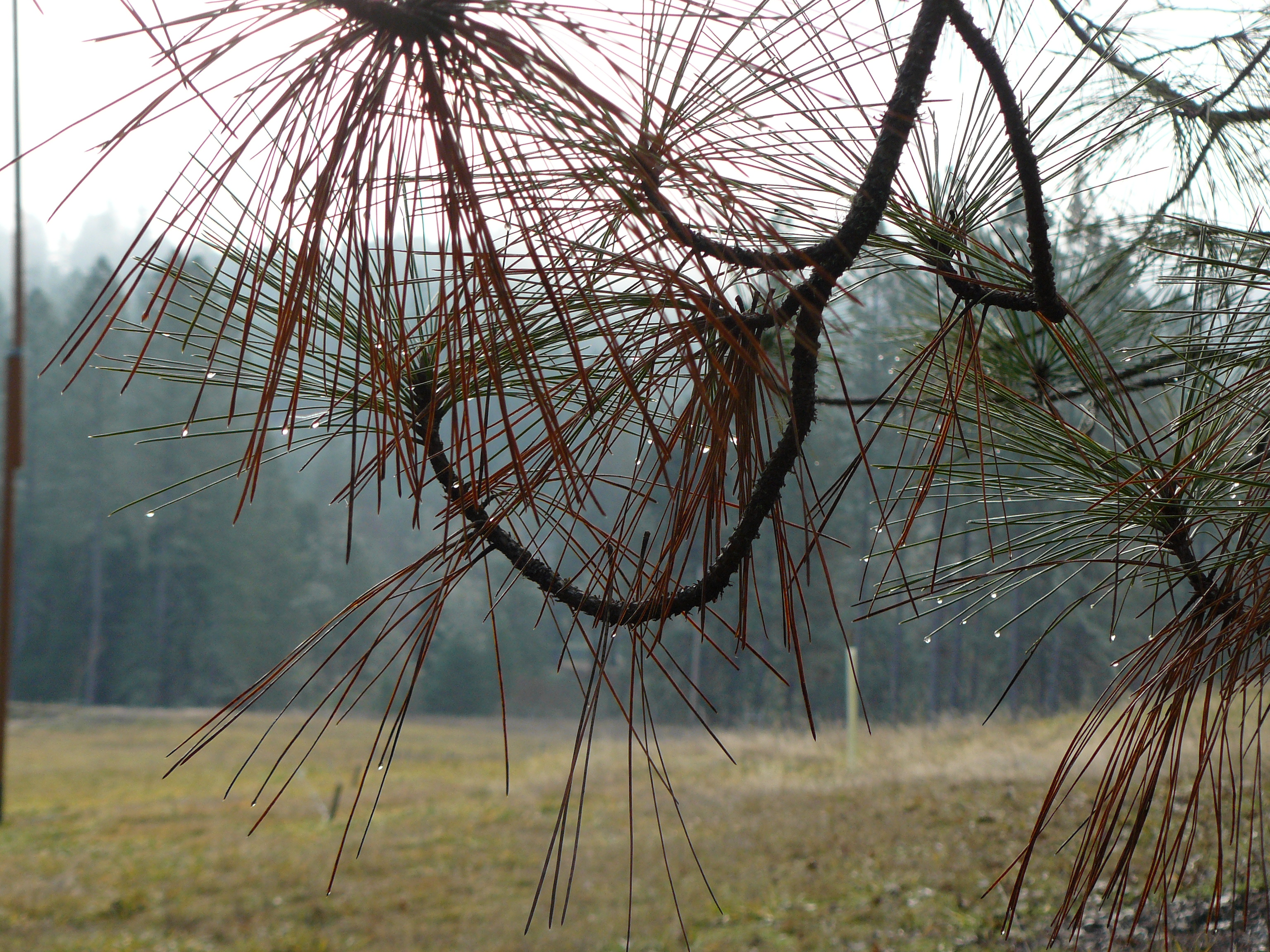
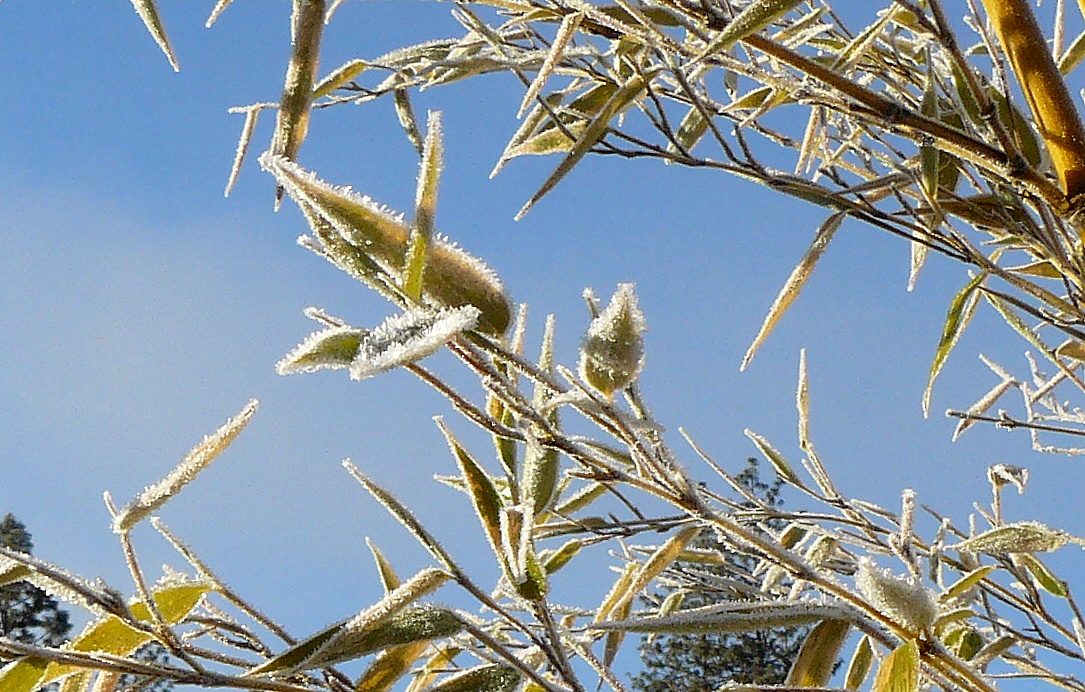
Yesterday dawned cold, clear and frosty. As this picture of one of our tall pine trees so vividly demonstrates. (The tree edges our driveway, about half-way to the house.)
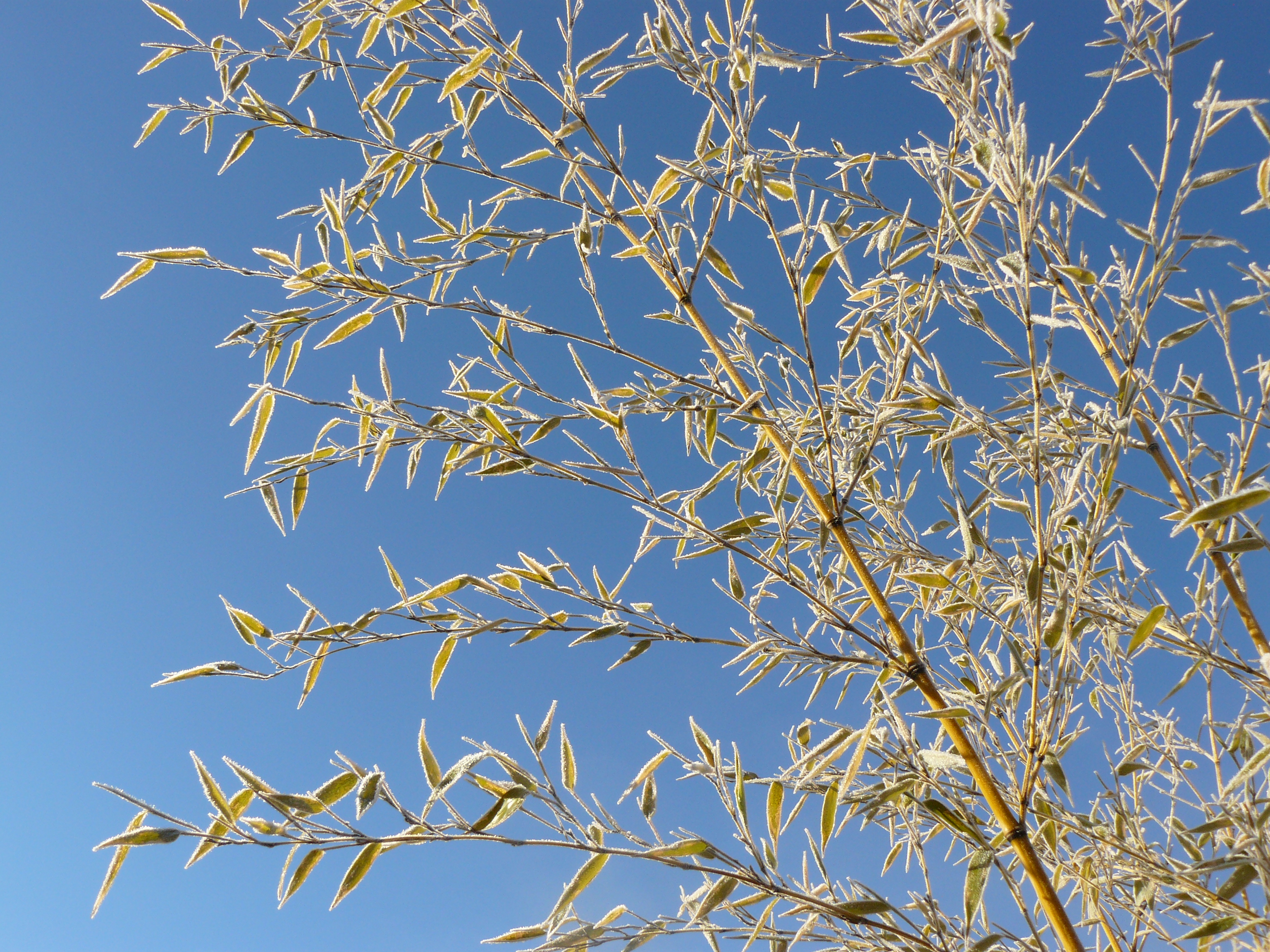
So will close today’s post with three more pictures of a frosty Saturday morning in Merlin, Oregon, USA.
A frosty yet sunny morning.
oooo
Frost on a bamboo tree.
oooo
It really is a beautiful world at times.
oooo
So there you are, Sue!
Needless to say, Jean and I are reminded almost daily how lucky we and all our animals are at finding such a beautiful place to live. I can’t ever imagine taking it for granted.
I can’t recall how I came across the story but it doesn’t matter. A story that was presented on the MNN website back in May, 2013. That had it’s origin in an episode of the Johnny Carson Show back in the year 1981. An episode where the late Jimmy Stewart read a poem about his dog, Beau.
Here’s the clip of that 1981 show.
Impossible not to be deeply moved by that clip.
oooo
A further web-search came across this item on WikiPedia:
Background
James Stewart owned a “willful but beloved” golden retriever named Beau, of whom he was extremely fond. Beau slept in the corner of Stewart’s bedroom, but would often crawl onto the bed between Stewart and his wife Gloria. Stewart recalled, “he was up there because he wanted me to pat his head, so that’s what I would do. Somehow, my touching his hair made him happier, and just the feeling of him laying against me helped me sleep better.”
While shooting a movie in Arizona, Stewart received a phone call from Dr. Keagy, his veterinarian, who informed him that Beau was terminally ill, and that Gloria sought his permission to perform euthanasia. Stewart declined to give a reply over the phone, and told Keagy to “keep him alive and I’ll be there.” Stewart requested several days’ leave, which allowed him to spend some time with Beau before granting the doctor permission to euthanize the sick dog. Following the procedure, Stewart sat in his car for ten minutes to clear his eyes of tears. Stewart later remembered:
After [Beau] died there were a lot of nights when I was certain that I could feel him get into bed beside me and I would reach out and pat his head. The feeling was so real that I wrote a poem about it and how much it hurt to realize that he wasn’t going to be there any more.
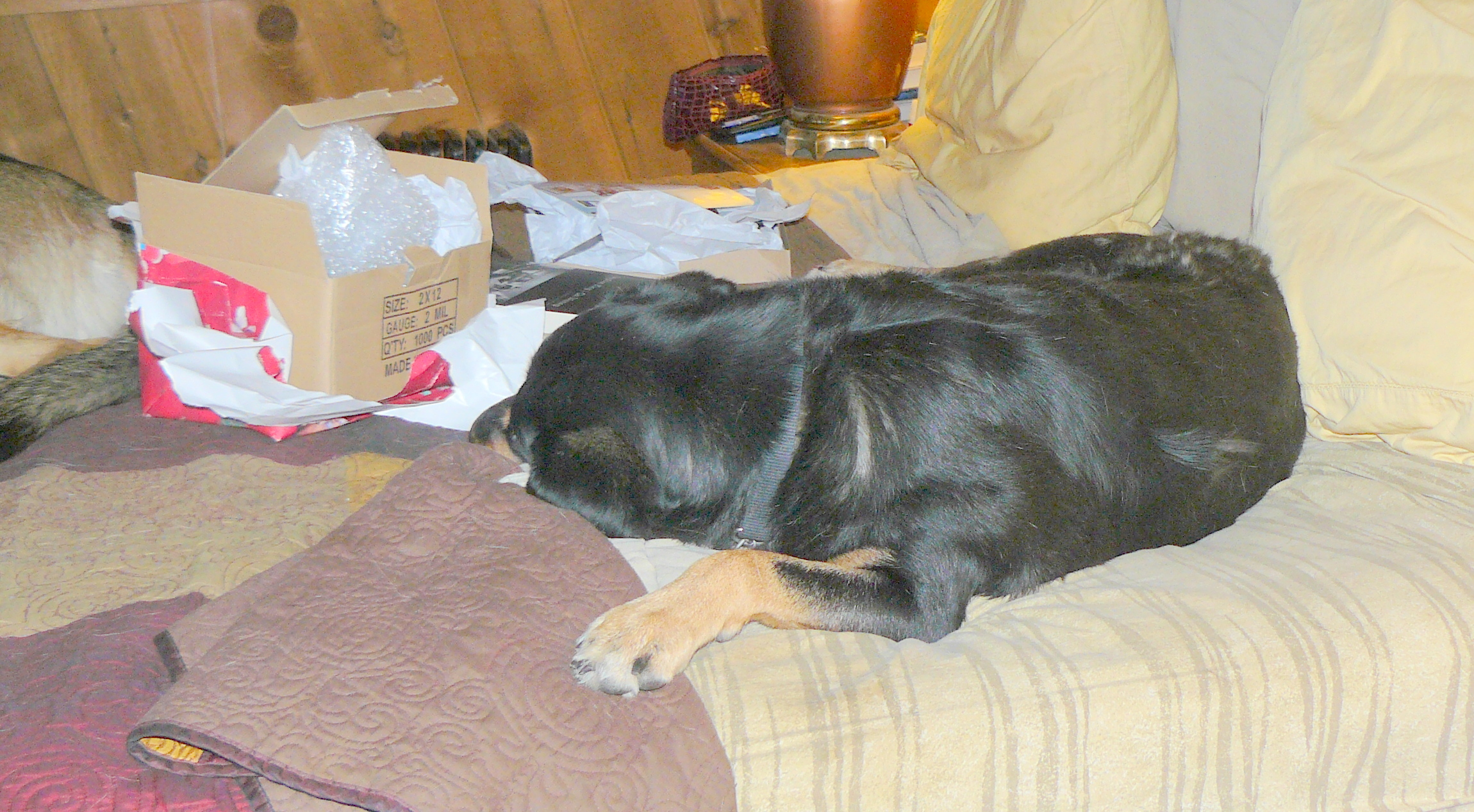
You can understand why I sub-titled this post ‘Millions will share these sentiments.’ because there are millions of dog-owners right across the world who have their dogs sleep with them in the bedroom. We have five do just that: Pharaoh, Sweeny, Cleo, Dhalia and Hazel. Hazel and Dhalia sleep in line pressed up against me and Sweeny sleeps in the crook of Jean’s legs. Yes, it can be a pain turning at night. Yes, it can be a pain going to the bathroom in the night. But would we miss them sleeping on the bed: YES!
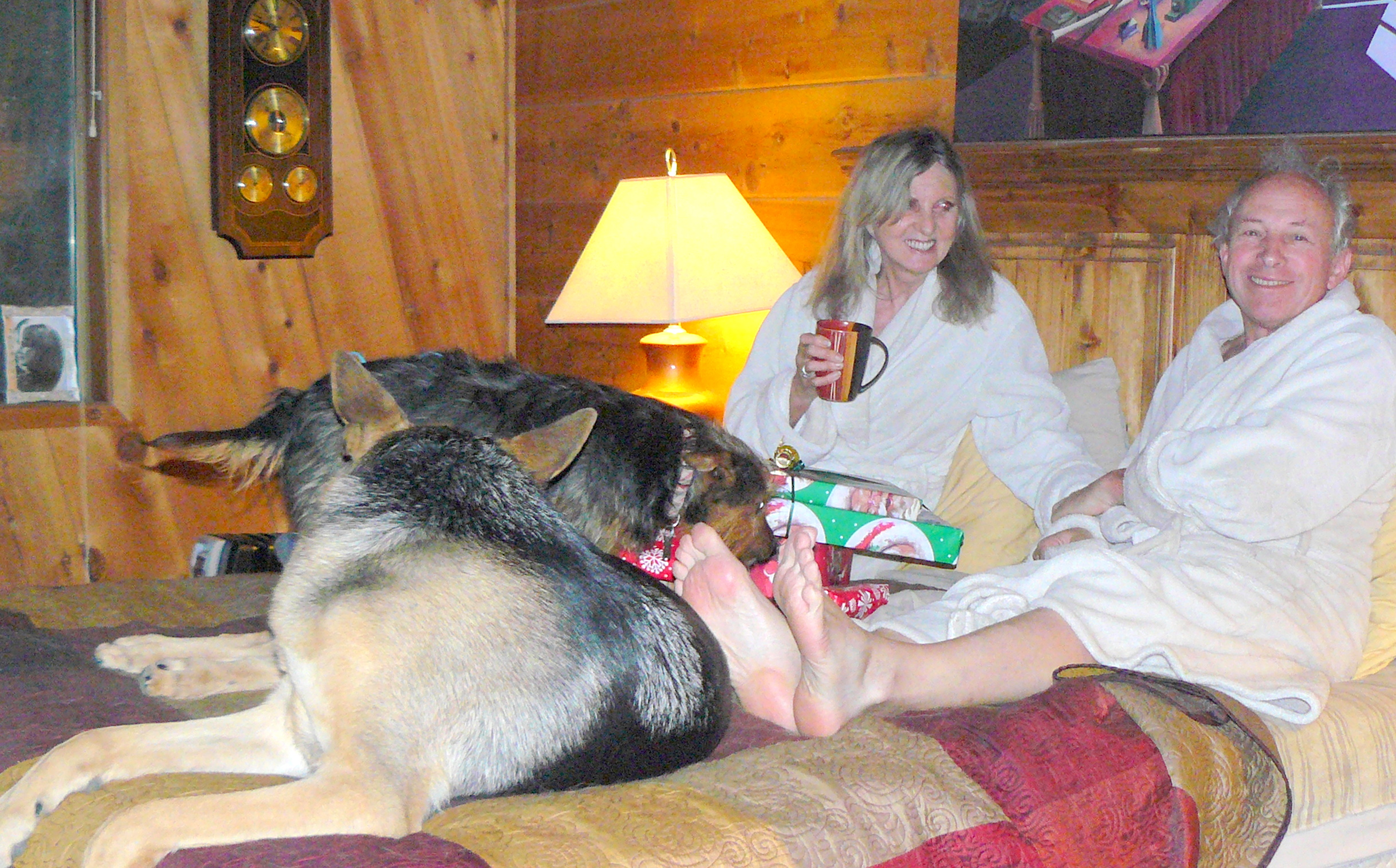
To reinforce that last point, here are two photographs of me and Jean on Christmas Day morning.
Hazel being very slow to get off the bed!
oooo
Cleo, foreground, and Sweeny helping open presents for Jean and me!
That web-search that found the WikiPedia item also found an excerpt from Professor Stanley Coren’s fabulous book Why We Love the Dogs We Do. I say fabulous because it’s a book that I have read and is on the book-shelf not four feet from where I am sitting. With Stanley Coren’s written permission, for which I say thanks, that excerpt is now republished:
While I was on a book tour a few years ago, I had the opportunity to meet with Jimmy Stewart. He was no longer the young Charles Linbergh character that I remembered from the film The Spirit of St. Louis, or the easy moving character that became a hero in The Man Who Shot Liberty Valance. His age had begun to show on him, and he appeared to be almost fragile. He was slow moving and even slower talking than I remember him being in the movies. However, when he started to speak about his dogs his face broke into a smile and the pace of his talking picked up. He told me:
“When I married Gloria she already had a German Shepherd named Bello. He loved her a lot and, after a while, he and I got along. Gloria really loves German Shepherds best of all, but sometime after we lost our second one, she decided that they weren’t the breed of dogs that I needed. Anyway, she went out and got me this Golden Retriever named Simba, and its been Goldens ever since for me. “We actually have three dogs now. Kelly and Judy, are Golden Retrievers, and then there is Princess who is some kind of a mixed breed that my daughter found and we sort of rescued. Princess had some behavior problems and I think that Kelly and Judy picked up some of her bad habits–figured that if Princess could get away with it so could they. We had met Matthew Margolis [who co- authored of a number of fine dog training books, such as When Good Dogs Do Bad Things, with Mordecai Siegal] and Gloria liked him. He runs the National Institute of Dog Training. Kelly and Judy were not behaving. They didn’t listen to anything we said, and they were always jumping up and barking and pulling on the leash–both were just imitating Princess, I think. Well, anyway, Matthew told us that he would have to take the dogs to his training kennel for six weeks to get them to behave. The reason that he wanted them at the kennel had something to do with ‘socialization’ and other dog things like that. It was supposed to help their shyness and excitability. Gloria and I didn’t like it, but she felt that we had to do something. Well that lasted just one day. You know I love my house, but without any dogs around it feels like some kind of mausoleum. I told Gloria ‘Get those dogs back home because I can’t put up with them not being here.’ Anyway, Matthew tried to set up a training program at the house, but it really didn’t work so well. In the end we compromised. We broke the three dogs up into squads, so we could send one or two of them to school for short sessions, and still have one or two at home for company. I still didn’t like it, even though we got to visit their school on weekends. Gloria made a lot of phone calls to make sure they were OK–to reassure me I guess. “I suppose the truth is that I’d rather have a happy dog than a trained one. My dogs have never been good at things like ‘sit’, ‘stay’ or even ‘come’. I think that we’ve given the tourists a few laughs, especially when the dogs hit the end of their leashes hard enough to drag Gloria down the street. I don’t even mind it when the dogs jump up. Matthew showed us how to jerk the leash to correct that kind of thing. I suppose that it does have to be done–you know to keep them from knocking someone down or messing their clothes–but it seems kind of cruel to me. If my dog jumps up on me I figure that he wants to kiss my face and tell me that he thinks that I’m a really nice person. I don’t believe that you should punish a dog for saying ‘I love you.’ When your dog’s face is up looking at yours like that I think that you should tell him just how nice you think that he is too. Gloria told me that Matthew says that we mother the dogs too much and that they’ll never really be well trained. Well, they’re a lot better now than what they were before, so some of the training must be working. The difference between ‘trained OK’ and ‘trained perfectly’ doesn’t really matter all that much to me. I once did a film with Lassie. When that dog got excited it jumped all over Rudd Weatherwax [Lassie’s trainer]. Now that’s the smartest dog in the world. If the world’s best trained dog can jump around to show he’s happy then my dogs should be allowed to do the same. “The truth is that it’s just really hard for me to get to sleep without a dog in my bedroom. It’s funny about that. I once had a dog named Beau. He used to sleep in a corner of the bedroom. Some nights, though, he would sneak onto the bed and lie right in between Gloria and me. I know that I should have pushed him off the bed, but I didn’t. He was up there because he wanted me to pat his head, so that’s what I would do. Somehow, my touching his hair made him happier, and just the feeling of him laying against me helped me sleep better. After he died there were a lot of nights when I was certain that I could feel him get into bed beside me and I would reach out and pat his head. The feeling was so real that I wrote a poem about it and about how much it hurt to realize that he wasn’t going to there any more.”
I later learned just how intense his feelings were for his dog Beau. At the time, Stewart was making a picture which was shooting on location in Arizona. One evening he got a phone call from his veterinarian, a Dr. Keagy. The call was about Beau. Keagy told him that Beau was very sick. He was having trouble breathing and was in considerable pain. The disease had progressed to the point that it was obvious to Keagy that the dog couldn’t be saved. He was calling for permission to end Beau’s life quickly. Stewart’s wife Gloria said that she couldn’t make that decision since Beau was Jimmy’s dog. “I can’t just tell you to put him to sleep like this,” Stewart said, “Not over the phone–not without seeing him. You keep him alive and I’ll be there.” Stewart was always known as an easy actor to work with, who never made excessive demands. So, the director was taken aback when he went to him to ask for a few days off to fly home to see to his dog. The leave was granted and Stewart got to sit with Beau for a long while before making the decision. He later admitted that when he left the veterinarian’s office he had to sit in his car for around 10 minutes, just to clear his eyes of tears, so that it would be safe to drive home.
NB: Please note that Professor Stanley Coren is the author of the above excerpt, the material is copyrighted by SC Psychological Enterprises Ltd and has been republished with permission. I would thoroughly recommend visiting the blog-site of Psychology Today, Canine Corner.
On New Year’s Day I published the first part of a film called Awakening the Dreamer: Changing the Dream. Then yesterday came the second part. I found it a remarkable film. Because, while the first part reminded the viewer of the list, the long list, of things that are wrong with these present times, the second part highlighted the many currents of positive changes that are taking place here and now.
Without hope there is nothing.
The film is available to watch on Top Documentary Films and here is the introduction offered in that place.
Of all the innumerable beliefs and hypotheses that make up our contemporary industrial perspective on life there is one that is dominant and very frequent. That’s the assumption that we are disconnected, from everyone and everything. This belief configures basically all our ideas and actions. There’s a crucial fallacy that we are separate. But, if there is only one, then whatever I do to you I’m actually doing it to myself, my family, and my children.
Spiritual attitude has long instructed that partition is actually an illusion. However, in the past, the narrative that’s been exchanged in the modern world, whether consciously or unconsciously, has been that the world functions like a huge machine made of separate parts like a big clock. For the past four centuries, the scientific established practice has been trying to take the clock apart, and figure out how it functions, so we can use it for our own ambitions.
This rigid aspect meant that instead of realizing the relation between things, we were analyzing and taking apart those very same things. So, what developed was kind of disintegrated view of the natural world. And we became entranced with the ability that came out of this technology, and we lost our relations to each other; we lost our connection to the enigma of the cosmos.
Although the modern worldview is superior on Earth, it’s valuable to identify that it’s not the only worldview. Traditional, native cultures are not so concentrated on “advancement”, rather they’re focused on their health and persistence of the community, and they see the interdependence of all things. They try to recognize that we’re related to everything… to the animals, fish, plants, trees, birds, and even to the microorganisms. Indigenous people of the world have a particularly important role to play at this moment in history. We need them to come forward and explain how they see things.
The film was produced by the Pachama Alliance, an organisation I hadn’t come across before. Their website is here and on the About page one learns:
Purpose
The Pachamama Alliance, empowered by our partnership with indigenous people, is dedicated to bringing forth an environmentally sustainable, spiritually fulfilling, socially just human presence on this planet. Our unique contribution is to generate, and engage people everywhere in, transformational conversations and experiences consistent with this purpose. We weave together indigenous and modern worldviews such that human beings are in touch with their dignity and are ennobled by the magnificence, mystery and opportunity of what is possible for humanity at this time. We are here to inspire and galvanize the human family to generate a critical mass of conscious commitment to a thriving, just and sustainable way of life on Earth. This is a commitment to transforming human systems and structures that separate us, and to transforming our relationships with ourselves, with one another, and with the natural world.
If you have read this post so far, then you will enjoy this video. More than enjoy it; you will find it inspiring and liberating.
Another organisation mentioned in the film was Bioneers, also not previously known to me. Their website is here. The organisation describes itself, in part:
Collective Heritage Institute – Bioneers is a non-profit New Mexico corporation founded in 1990 by Kenny Ausubel and Nina Simons. The overarching mission of Bioneers is the advancement of holistic education pertaining to global social, cultural and environmental issues. Bioneers identifies progressive yet nature-honoring solutions to rising challenges of instability, inequality, and unsustainable growth and disseminates this knowledge via independent media, events, and community action networks.
There is much on these two websites to offer hope.
Those of you who watched Part One of Awakening the Dreamer that was published yesterday could be excused for thinking that it was a very gloomy window on our world at the start of 2014.
Park those feelings and watch Part Two.
The Hope
[vimeo http://vimeo.com/52496263]
ooOOoo
Tomorrow, Friday, I will complete this run of four days by dropping in on a few of the organisations named in these films plus a few other items.
A very Happy New Year to you and all your loved ones!
Yesterday (I’m tempted to write last year!), I posted a little tale about the donkey in the well; essentially a message about being happy.
My original plan for today was to post a series of photographs of some animals next door that our neighbours, Larry and Janell, have recently adopted.
But then Jean and I watched a documentary two evenings ago that had us both spellbound. The documentary, Awakening the Dreamer, consisted of two 45-minute films. The first highlighting the precarious nature of our present times. The second showing the accelerating pace of people all across the world actively changing things for the better. Hence the title of the post The Pain and the Hope.
So here’s Part One. I do so hope you can find the time to watch it.





 Learning from Dogs