I am indebted to the website Naked Capitalism for including in their ‘links’ on the 25th July, this story from the online version of the Daily Mail UK newspaper.
Locked in combat: Mother lion takes on deadly crocodile to give cubs safe swim across river
Scanning the surface of the water, her amber eyes alight upon a threat to her pride – a deadly crocodile lurking in the river that the family of lions must cross.
The fiercely protective lioness did not hesitate, leaping into the water and grappling with the reptile to allow the rest of the pride to cross the river in safety.
These images show the magnificent big cat fastening her front legs around the crocodile’s jaws and dunking it underneath the water before making a break for the river bank at the Okavanga Delta in Botswana.
The lioness’ brave diversion tactics were witnessed by wildlife photographer Pia Dierickx, who said the creature moved with such incredible speed she did not realise what had happened until she looked back at the pictures on her camera.
The photographer, from Antwerp in Belgium, had been peacefully observing the lioness and her pride going about their business around the river when the sudden clash between the big cat and the crocodile occurred.
The 48-year-old said the struggle took place within one second.
The images are powerful and stunning. I’m going to take the liberty of reproducing just one, as below, but do go across to the story here and view the full set of photographs taken by Pia Dierickx – you will not be disappointed!
(A republication of a post first shown on the 15th August, 2009. NB, it was funny then and it is still incredibly funny today!)
One aspect of British culture is their dry sense of humour. In terms of satire, for over a decade three people have held pole positions: Rory Bremner, John Bird and John Fortune. WikiPedia has a very good summary.
Bird and Fortune have also recorded a series of ‘interviews’ focusing on some of the idiocies of life.
Here’s a classic about the sub-prime crisis. Slightly dated but no less funny for that.
More from these incredibly, clever guys from time to time.
Yesterday, I published a Post that I called What it is to be human. It was inspired and based on the compelling film ‘I AM‘ by Tom Shadyac. As so often seems to happen, shortly after completing yesterday’s Post, an item from Chris Martensen’s Blog caught my eye.
Author and social critic James Howard Kunstler has been one of the earliest, most direct, and most articulate voices to warn of the consequences — economic and otherwise — of modern society’s profligate wasting of the resources that underlie its growth.
In his new book, Too Much Magic, Jim attacks the wishful thinking dominant today that with a little more growth, a little more energy, a little more technology — a little more magic — we’ll somehow sail past our current tribulations without having to change our behavior.
Such self-delusion is particularly dangerous because it is preventing us from taking intelligent, constructive action at the national level when the clock is fast ticking out of our favor. In fact, Jim claims that we are past the state where solutions are possible. Instead, we need a response plan to help us best brace for the impact of the coming consequences. And we need it fast.
James Howard Kunstler
Mr. Kunstler is the author of the very successful book The Long Emergency and his latest book, as mentioned above, Too Much Magic expands on his alarming argument that our oil-addicted, technology-dependent society is on the brink of collapse, ergo that the long emergency has already begun. His website is here.
Anyway, back to the Chris Martenson’s piece. Chris goes on to quote Mr. Kunstler, as follows:
[We now live in] this weird, peculiar period in American history when the delusional thinking has risen to astronomical levels — predictably, really — in response to the stress levels that our society feels. And it is expressing itself as sort of “waiting for Santa Claus and the Tooth Fairy” to deliver a set of rescue remedies to us so that we can continue running Wal-Mart, Walt Disney World, Suburbia, the U.S. Army, and the Interstate Highway System by other means. That is the great wish out there. It is kind of understandable, because that is the stuff that we have, and people tend to defend the stuff that they have in any given society and the systems and platforms that they run on. But it is probably a form of collective behavior that is not really going to benefit us very much and really amounts to simply wasting our time, and wasting our dwindling resources, and even our spiritual resources when we could be doing things that are a lot more intelligent.
Here is something I have detected as I travel around the country: There is a clamor for “solutions.” Everywhere I go, people say “Don’t be a doomer; give us solutions.” And I discovered that the subtext to all that is they really want solutions for allowing them to keep on living exactly the way they are living now. To keep on running Wal-Mart, and keep on running Suburbia, and keep on running the highway system, and the whole kit of parts. And what that really means is that they are looking for ways to add on additional complexity to a society that is already suffering from too much complexity.
There is a podcast of the interview with James Kunstler here and also on YouTube, as below.
My own reflection on this item, as with so many other articles, essays and items available to read online, is that the power of the Web is informing and educating millions of people around the world in a way that Governments and the media have failed to so do.
That promises change and, maybe, sooner than we might expect.
I have recently started subscribing to the website of The Permaculture Research Institute of Australia. Information about them is here, from which I offer,
Permaculture (the word, coined by Bill Mollison, is a portmanteau of permanent agriculture and permanent culture) is the conscious design and maintenance of agriculturally productive ecosystems which have the diversity, stability, and resilience of natural ecosystems. It is the harmonious integration of landscape and people — providing their food, energy, shelter, and other material and non-material needs in a sustainable way. Without permanent agriculture there is no possibility of a stable social order.
I think you’ll find this documentary highly watchable. At least, I did. So, be warned — if you click play ten minutes before heading off to work, you may well be late…
I am, written and directed by Tom Shadyac, stands in stark contrast to his previous productions. Tom is well known for hit comedy films, like Ace Ventura: Pet Detective (Jim Carrey), and many others. He was hugely ’successful’ — as judged by the contemporary money-oriented measure of success — with an antique-filled mansion, private jet, etc., but, after a bicycle accident, and the severe physical suffering he experienced for months afterwards, Tom started to think a little more deeply about life and where we’re all headed. His thoughts about consumer society, where it’s taking us and its inability to satisfy us, despite all the damage done, lead him to ask himself two simple, but profound, questions: what’s wrong with the world, and what can we do to make it better?
After Tom’s physical problems finally started to fade, he decided to take a crew of four people and put those questions to some noteworthy individuals around the world — academics, environmentalists, philosophers, spiritual leaders, writers and scientists. It’s an interesting peek at humanity.
I personally like that Tom is trying to get beyond the symptoms of the world’s problems, to look more at the root issues from which they spring. The aspect that becomes central to the movie is whether man (and nature in general, for that matter) is inherently competitive, or inherently cooperative — whether man instinctively wants to live only for his own individualistic advancement, even if he must do so aggressively, or if he is more hard-wired to live for the good of others, collaboratively. My own subjective opinion is that both aspects are part of our makeup, but that one can override the other, depending on the choices we make. I also think these choices can become easier for us, depending on what we make the focus of our attention, and depending on the choices made by others around us — our family, friends, colleagues, etc. (i.e. we all influence each other). But, whatever your own opinion, I think most will find some valuable food for thought with this production.
The video at that URL wasn’t available for copyright reasons but here it is on YouTube. Settle down for an hour and a quarter and be deeply embraced by Tom’s message.
No let me say a little more. The theme of the film is one of immense hope in the face of what, to millions and millions of people, must seem like a scary and bleak future. As I have written before on Learning from Dogs, the truth about change is that it starts with the self: to change the world first change oneself. We can grumble, complain and be outspoken about so many aspects of the societies in which we live but it doesn’t alter the incontrovertible fact that change starts within.
So watch this film!
I AM is an utterly engaging and entertaining non-fiction film that poses two practical and provocative questions: what’s wrong with our world, and what can we do to make it better? The filmmaker behind the inquiry is Tom Shadyac, one of Hollywood’s leading comedy practitioners and the creative force behind such blockbusters as “Ace Ventura,” “Liar Liar,” “The Nutty Professor,” and “Bruce Almighty.” However, in I AM, Shadyac steps in front of the camera to recount what happened to him after a cycling accident left him incapacitated, possibly for good. Though he ultimately recovered, he emerged with a new sense of purpose, determined to share his own awakening to his prior life of excess and greed, and to investigate how he as an individual, and we as a race, could improve the way we live and walk in the world.
Towards a better understanding of this strange species – man!
Dianne was unaware when she contacted me that her timing was exquisite! Why? Because it had recently crossed my mind that many readers must wonder why a blog with the name of Learning from Dogs so infrequently had articles about dogs! Hopefully both the Welcome page and my piece on Dogs and integrity make it clear that it is the qualities of dogs, the examples they set to mankind, that inspire these writings. As I say in Dogs and integrity,
value and cherish the ‘present’ in a way that humans can only dream of achieving
are, by eons of time, a more successful species than man.
So it is a double pleasure to offer Dianne’s guest post today because it reminds us, so clearly, that the qualities of dogs are something very real for mankind.
Dianne Gray
Dianne is a writer. As she explains on her blog site,
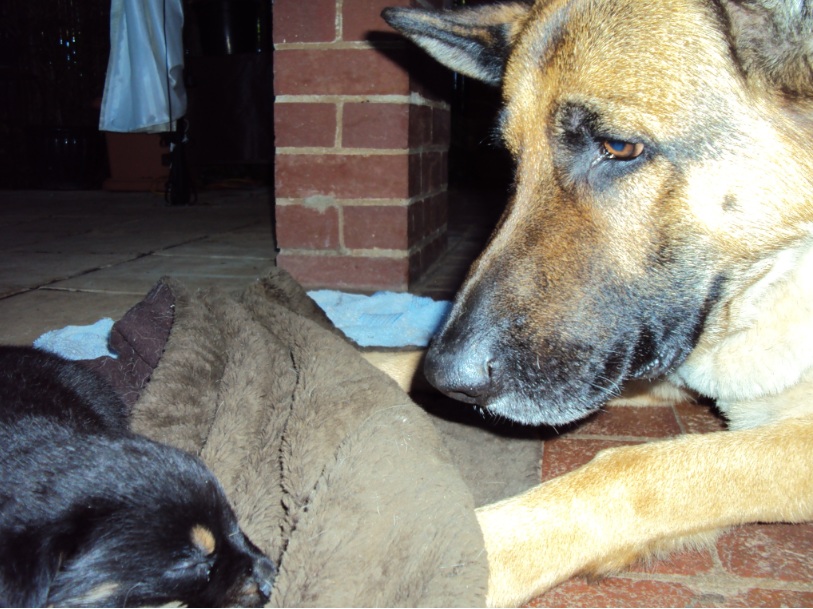
I live in Australia, have a sensitive-new-age Rottweiler called Kitty and a German Shepherd (in desperate need for The Dog Whisperer) called Sabre.
I’ve had interesting jobs, including working in a crocodile farm in Far North Queensland.
Sabre came into our lives in November 2004. He was seven weeks old. We were lucky enough to get Sabre from Bob Knight, a German shepherd breeder in Canberra, Australia. For those of you who don’t live in Australia you wouldn’t know that Bob was tragically shot and killed in 2010 while driving his truck through Sydney – the innocent victim of a gang war taking place several blocks away, he was hit by a stray bullet.
Bob was very passionate about his dogs and would interview those who were interested in buying one of the litter. If he didn’t think you were capable of managing a German shepherd he would not sell you one. He also ensured that each and every one of his puppies were brought back to him weekly (if possible) for free puppy training. So for over twelve months we (and the others who had bought one of the litter) met at the lake to take our dogs for a walk and training.
We live in the inner city and have an enormous yard so Sabre loved playing catch and patrolling the borders of our property. We live adjacent to a laneway and had some trouble with junkies shooting up near our fence and threatening to kill him if he barked at them. When he was two years old he became very ill very suddenly (it was Good Friday and near impossible to find a vet). We took him to the out-of-hours vet in the city who just looked at him and ($A800 later) told us not to feed him for the rest of the weekend.
By Saturday morning he could hardly move. We called Bob who told us about a woman called Jan who would be available to see him who lived in a nearby town. She was a country vet and looked after horses and cattle – so we loaded him in the car. This was the best move we ever made because, as it turned out, Jan would save his life a couple of times. When Jan saw him she couldn’t believe another vet would tell us not to feed him. “You don’t feed animals, they die,” she said. She gave us some horse paste (I still don’t know to this day what it was) and told us to put some in his mouth every hour. She said to try and give him his favourite food as often as possible and to call her every hour and tell her if he had eaten anything. She said he had the classic symptoms of having ingested a common bait (I’m not revealing what it was publically) and if we couldn’t get him to eat within four hours we had to bring him straight back to her. Basically he was starving to death.
We put the paste in his mouth as often as possible and tried to tempt him with cheese (his favourite) for three hours. Finally, he took a small mouthful of cheese and we celebrated like it was Christmas! We took him back to Jan for the next three days and he got stronger and stronger and within a week was back to his old playful self.
Twelve months later he began to walk with his head to one side and then he’d shake it and basically seemed very uncomfortable. We took him back to Jan who looked in his ear to find he had a chronic ear infection. She gave him antibiotics and cleaned his ear, but weeks passed and it just didn’t want to budge. We took him back to Jan every weekend and she would clean his ear (he wouldn’t let us touch it) and give him a penicillin injection. I surfed the net trying to find out what I could do to get rid of this damn infection – we were trying everything possible and it still wouldn’t budge. Then I read somewhere that yoghurt in a dog’s diet can be good for this kind of thing. I added yoghurt to his diet and within a week he was looking better. We still had him back to Jan’s every weekend for a few months and I still put yoghurt in his diet!
Six months later he started to change and became obnoxious and aggressive with us. We thought it may have had something to do with the ear infection so we took him back to Jan. She laid him on his back and felt his testies. He was kind of shocked and so were we, but she had definitely done the right thing because at this stage he had testicular cancer in both testies. She operated and found that the cancer was at the advanced stage. She was pretty sure she had got it all, but told us the signs to watch for over the next few months. She put him on ‘girly hormones’ as she called them and he was on those for about twelve months – and what a pleasure he became. He was behaving himself and not cranky or aggressive like before the operation. He was a different boy! If you have a male dog that is not de-sexed and he becomes even the slightest bit aggressive, I strongly suggest you have him checked for testicular cancer!
Because we’d had so much trouble with the junkies I decided to get cameras around the outside of the house. It was such a novelty at first – I’d come home from work and check the cameras to see what had happened during the day, but then I noticed something really sad. Sabre would say goodbye to me at the gate every morning and then just sit there ALL DAY waiting for me to come home. It was heartbreaking, I’d never realised until this time how lonely he was. I’d watch the tape on X30 and it reminded me of one of those television advertisements where someone stands still while everything around them speeds past. So hubby and I decided it was time for another dog. This is where Kitty comes into the picture. From the moment Sabre saw her he absolutely loved her and she loved him. She is obsessed with his tail and when we go anywhere she grips onto his tail and follows him.
First meeting Sabre and Kitty.
Sometimes when they’re playing in the yard she grabs his tail and runs past him so fast he ends up running sideways! Kitty has had her fair share of problems as well. She was spade (by a vet other than Jan because she doesn’t have the capacity or equipment to spade female pups) and three months later she went on heat! I took her back to the other vet and he had only removed one ovary. So she had to be spade again, the poor darling. Meanwhile, Sabre must have had enough male hormones left in him to want to mount her every five minutes. So what I did was rub eucalyptus oil on Kitty’s back and this was enough to keep him away (the smell made him sneeze). Now we find Kitty has arthritis (she’s only fifteen months old) so we’re back to see Jan every other weekend for treatment. We’re kind of like a family now!
Sabre and Kitty today.
Kitty and Sabre are a wonderful pair and now when I watch the cameras when I get home from work all I can see is the two of them playing all day long. It’s a wonderful life!
oooOOOooo
So back to me! Couple of items to close this lovely story from Dianne.
“Writing has nothing to do with publishing. Nothing. People get totally confused about that. You write because you have to – you write because you can’t not write. The rest is show-business. I can’t state that too strongly. Just write – worry about the rest of it later, if you worry at all. What matters is what happens to you while you’re writing the story, the poem, the play. The rest is show-business.” — Peter S. Beagle
Four days ago, there was a post on Learning from Dogs under the heading of We are what we eat! As is often the way, subsequently after writing that article (back on the 8th), there was a flurry of other associated items that I wanted to bring to your attention today.
The first was on the website of The Permaculture Research Institute of Australia. It was a very inspiring two-part article written by Anthea Hudson under the title of Preparing Our Children For a Resilient Future.
Part One was all about recycling and our role as facilitators. Here’s a little challenge for you, lifted from that first part,
Landfill — Our Dirty Legacy
Let’s begin by understanding a bit about how long the things we send to landfill last, before they break down.
Have a look at the list below and see if you can guess the order these items should be placed in, from the things that break down quickest, to those that take the longest. Then have a guess as to how long you think each one will take to break down.
paper bag
plastic jug
cigarette butt
glass bottle or jar
banana
aluminium can (soft drink can)
leather boot or shoe
plastic 6-pack rings
Styrofoam cup
cotton pillowcase
rubber sole of the leather boot (above)
wool sock or scarf
tin can (e.g. baked beans or soup can)
Don’t cheat by looking at the answers below, until you have made your own list.
Think you have worked it out? Now go here and check your answers! You may be suprised.
Part One is very comprehensive and Part Two even more so. Indeed, it serves as a wonderful check-list of all the reasons why and how we can be more responsible for what goes into our stomachs. It really is a most comprehensive review, nay tutorial, on how to grow your own. It includes such gems as this,
This video was created by the 2009 spring plant physiology class at Plymouth State University.
Next to the bad and ugly stuff.
Anyone who was shocked by the revelation of the harm being done to bees highlighted in my recent Post (the full article is on Food Freedom News) and to us humans,
A recent study showed that every human tested had the world’s best-selling pesticide, Roundup, detectable in their urine at concentrations between five and twenty times the level considered safe for drinking water.
will be further shocked, alarmed and (fill in your words) by this two-hour film introduced by Gary Null. We all need to watch it and yet I’m bound to say it will ruin your day! Jean and I have watched it in full and to all my readers, especially American ones, I say this – do watch this video, Please!
Progressive Radio Network presents
A Gary Null Production
WAR ON HEALTH: The FDA’s Cult of Tyranny
Introduced by the director (from his speech at the world premiere in New York City, June 15, 2012)
In the near future, American medical practice may change dramatically for the worse. No longer will maximal dose natural supplements—vitamins, natural compounds, and scientifically proven medicinal herbs—be available over the counter in local health and grocery stores. Holistic practice, which relies upon non-prescription natural treatments instead of Big Pharma drugs prescribed life-long, will diminish. American healthcare will be imprisoned, patients will be forced to abide by a single medical paradigm defined by corporate drug and food executives and dictated by a government enforcement agency, the Food and Drug Administration (FDA). This is the bleak scenario if the FDA succeeds in limiting Americans’ options to prevent and treat diseases.
‘War on Health’ is the first documentary detailing and challenging the FDA agenda and its allegiance with the international Codex Alimentarius, which hopes to establish a monolithic food and health regime. Betraying its founding mandate to assure drug, food and chemical safety in the interests of public health, the FDA today is a repressive bureaucracy serving pharmaceutical and agricultural greed and profits. Vaccines, medical devices, prescription drugs are fast tracked at alarming rates through the FDA at the expense of scientific oversight to assure their efficacy and safety. The
result is hundreds of thousands premature deaths annually from pharmaceutical drugs, vaccines and medical devices and an epidemic of medical incompetence and fraud sanctioned by federal health officials.
Featuring many pioneering American and European attorneys, physicians, medical researchers and advocates of health freedom, War on Health lifts the veil on FDA’s militaristic operations against organic food providers and alternative physicians. The film’s conclusion is perfectly clear: the FDA is a tyrannical cult founded upon the denial of sound medical science with little intention to improve the nation’s health and prevent disease.
Written and Directed by Gary Null
Produced by Valerie Van Cleve
Associate Producer: Richard Gale
Editor: Richie Williamson
Offline Editing: Valerie Van Cleve, L.A. Jones
Camera Operators: Marcello Coppuchino, Peter Bonilla, David Grier, L.A. Jones
Gregory Jason Russ, Jake Hammer Mesmire, Edson Tanakae, Valerie Van Cleve, Richie Williamson
As my dear friend of many, many years, Richard M., has a habit of saying, “Must go now, need to get back to Planet Earth!“
Evidence that supports the notion that deliberation is really rather a good idea!
In the issue of The Economist, the July 7th edition, there was a rather intriguing article from the pen of Schumpeter entitled,
In praise of procrastination
that proposes that the world of speed and instant decisions is much less efficient than giving things a decent ‘coating of thought’.
Here’s an extract from the article that makes this point,
These thoughts have been inspired by two (slowly savoured) works of management theory: an obscure article in the Academy of Management Journal by Brian Gunia of Johns Hopkins University; and a popular new book, “Wait: The Art and Science of Delay”, by Frank Partnoy of University of San Diego. Mr Gunia and his three co-authors demonstrated, in a series of experiments, that slowing down makes us more ethical. When confronted with a clear choice between right and wrong, people are five times more likely to do the right thing if they have time to think about it than if they are forced to make a snap decision. Organisations with a “fast pulse” (such as banks) are more likely to suffer from ethical problems than those that move more slowly. (The current LIBOR scandal engulfing Barclays in Britain supports this idea.) The authors suggest that companies should make greater use of “cooling-off periods” or introduce several levels of approval for important decisions.
Readers who want to read Brian Gunia’s research article may find it in full here. Details of Frank Partnoy’s book are here.
Then the day after reading that copy of The Economist, this came into my ‘inbox’ from the Big Think website,
Philosopher Slavoj Žižek is fundamentally anti-capitalist, and yet, the man who describes himself as a “complicated Marxist” also expresses palpable irritation at the idea that capitalists are nothing more than egomaniacal psychopaths. In a recent interview with Big Think, he told us that although he’s highly critical of capitalism in his work, when asked about it in public, he’s tempted to detail all the things that are great about it.
Political critiques that don’t account for the passion of the individual capitalist are flawed, he says, because capitalism is as much an ethical as it is an economic system. “It’s not true when people attack capitalists as egotists. ‘They don’t care.’ No! An ideal capitalist is someone who is ready, again, to stake his life, to risk everything just so that production grows, profit grows, capital circulates. His personal or her personal happiness is totally subordinate to this. This is what I think Walter Benjamin, the great Frankfurt School thinker, had in mind when he said capitalism is a form of religion.”
There’s a video interview with Slavoj Zizek in that Big Think article that isn’t available on YouTube, so to watch that video and read the full article, do go here and enjoy!
But there are other videos of Slavoj Zizek (anyone know how to pronounce his name??) on YouTube and I selected this one as possibly being of wider interest.
Philosopher Slavoj Zizek argues environmentally conscious consumers are desperate for simple tasks they can perform to alleviate their guilt, so they do things like purchase overpriced organic produce. Zizek also highlights Starbucks, which he suggests attracts customers by appealing to their sense of altruism.
Having completed this Post, I looked for a relevant photograph to head up the article. The one I chose came just by chance from the website of Ideas Champions, innovation consultants. Indeed the photo came from this article Creating Time to Innovate which included this paragraph,
Aspiring innovators don’t need pep talks. They need TIME. Time to think. And time to dream. Time to collaborate. And time to plan. Time to pilot. And time to test. Time to tinker. And time to tinker again.
Fancy that! Think I’ll go and lie down and have a good think!




 Learning from Dogs