Last November, I published a Post on Learning from Dogs under the title of This is rocket science! It included the film Walking on Air shot from the International Space Station.
Anyway, a few days ago, Ginger I. here in Payson, sent me an email with the YouTube version of the film and I decided to include it as the only item in today’s post.
Enjoy.
Time lapse sequences of photographs taken with a 4K-camera by Ron Garan fragileoasis.org/bloggernauts/Astro_Ron and the crew of expedition 28 & 29 onboard the International Space Station from August to October, 2011. All credit goes to them, who to my knowledge shot these pictures at an altitude of around 350 km. I intend to upload a FullHD-version presently.
HD, refurbished, smoothed, retimed, denoised, deflickered, cut, etc. All in all I tried to keep the looks of the material as original as possible, avoided adjusting the colors and the like, since in my opinion the original footage itself already has an almost surreal and aestethical visual nature.
Music: Jan Jelinek | Do Dekor, faitiche back2001 w+p by Jan Jelinek, published by Betke Edition janjelinek.com | faitiche.de
Image Courtesy of the Image Science & Analysis Laboratory, NASA Johnson Space Center, The Gateway to Astronaut Photography of Earth eol.jsc.nasa.gov
1. Aurora Borealis Pass over the United States at Night
2. Aurora Borealis and eastern United States at Night
3. Aurora Australis from Madagascar to southwest of Australia
4. Aurora Australis south of Australia
5. Northwest coast of United States to Central South America at Night
6. Aurora Australis from the Southern to the Northern Pacific Ocean
7. Halfway around the World
8. Night Pass over Central Africa and the Middle East
9. Evening Pass over the Sahara Desert and the Middle East
10. Pass over Canada and Central United States at Night
11. Pass over Southern California to Hudson Bay
12. Islands in the Philippine Sea at Night
13. Pass over Eastern Asia to Philippine Sea and Guam
14. Views of the Mideast at Night
15. Night Pass over Mediterranean Sea
16. Aurora Borealis and the United States at Night
17. Aurora Australis over Indian Ocean
18. Eastern Europe to Southeastern Asia at Night
Amazing to find that the saying was recorded as far back as 1546 when it is first recorded in John Heywood’s A dialogue conteinyng the nomber in effect of all the prouerbes in the Englishe tongue: “An yll wynde that blowth no man to good, men say.”
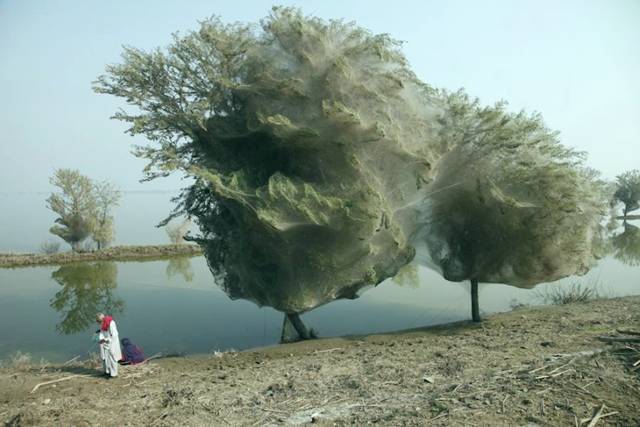
The reason this comes to mind is that good friend, John H. from here in Payson, recently sent me a piece under the title of Spider’s Web. This is how it started,
An unexpected side-effect of the flooding in parts of Pakistan has been
that millions of spiders climbed up into the trees to escape the rising flood
waters.
An unexpected side effect of the 2010 flooding in parts of Sindh, Pakistan, was that millions of spiders climbed up into the trees to escape the rising flood waters; because of the scale of the flooding and the fact that the water took so long to recede, many trees became cocooned in spiderwebs. People in the area had never seen this phenomenon before, but they also reported that there were fewer mosquitoes than they would have expected, given the amount of standing water that was left. Not being bitten by mosquitoes was one small blessing for people that had lost everything in the floods.
(This photo and caption were submitted to the 2011 National Geographic Photo Contest.)
John’s email also included more images, that are reproduced below.
So it looks as though we have much to learn from spiders as well as from dogs!
Or maybe, it’s just another example of the beauty, magic and mystery of nature!
Some people seem to have a knack for saying it how it should be!
My sub-heading, above, applies to many people right across the world. But the reason that this was triggered in my mind for today’s post, was a recent item on Christine’s excellent Blog, 350 or bust. Read more about that Blog here. I subscribe to that Blog.
Gene Roddenberry, the creator of the amazingly popular Star Trek series, was a man ahead of his time. Here is one of the things he had to say about humanity and our problems (with one editorial comment from me!):
“I believe in humanity. We are an incredible species. We’re still just a child creature, and we’re still being nasty to each other [Stephen Harper: are you listening?]. And all children go through those phases. We’re moving into adolescence now. When we grow up, man, we’re going to be something!”
But what caught my eye were these comments to the Post.
The first one from a Mickey Haist that read,
It’s a nice goal, but would clenching our teeth and willing progress be of any effect? After all, children don’t spontaneously mature – they’re raised.
Have to say that I was left unsure by what Mr. Haist was trying to convey. But not so Christine! This was the first of her two replies,
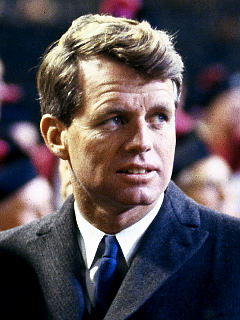
No teeth clenching allowed! Robert Kennedy once said “Each time a person stands up for an ideal, or acts to improve the lot of others, or strikes out against injustice, he or she sends forth a tiny ripple of hope. And crossing each other from a million different centers of energy and daring, those ripples build a current that can sweep down the mightiest walls of oppression and resistance.”
It’s not about everyone doing everything, it’s about each of us doing what we can. Not taking action because the problem is too big is not the answer.
And her second reply,
And Mickey – if the challenge of climate change/ocean acidification/biodiversity loss that we are facing as a species (taking the rest of the natural world with us) doesn’t make us mature, then nothing will. But I believe it will – as Paul Gilding says, humans are slow but not stupid!
Paul Gilding’s excellent website is always a great read, by the way.
But do reread those words of Robert Kennedy, they are powerfully inspiring.
Robert Kennedy
Each time a person stands up for an ideal, or acts to improve the lot of others, or strikes out against injustice, he or she sends forth a tiny ripple of hope. And crossing each other from a million different centers of energy and daring, those ripples build a current that can sweep down the mightiest walls of oppression and resistance.
Despite the fact that these words were said in response when South Africans suffered the tyranny of apartheid, the words are, perhaps, even more relevant today. Mankind has to combine the many ‘ripples of hope’ and build that current that will sweep away the crazy selfishness that is preventing us from living in harmony with this beautiful planet for hundreds of years ahead.
Now 19 days since our young German Shepherd puppy joined us.
On the 9th April, I wrote a Post about the arrival of young Cleo who became part of our family on the 8th. Here’s a couple of photographs from that Post.
Little bit of bonding going on!Welcome, young lady. I'm the boss around here!
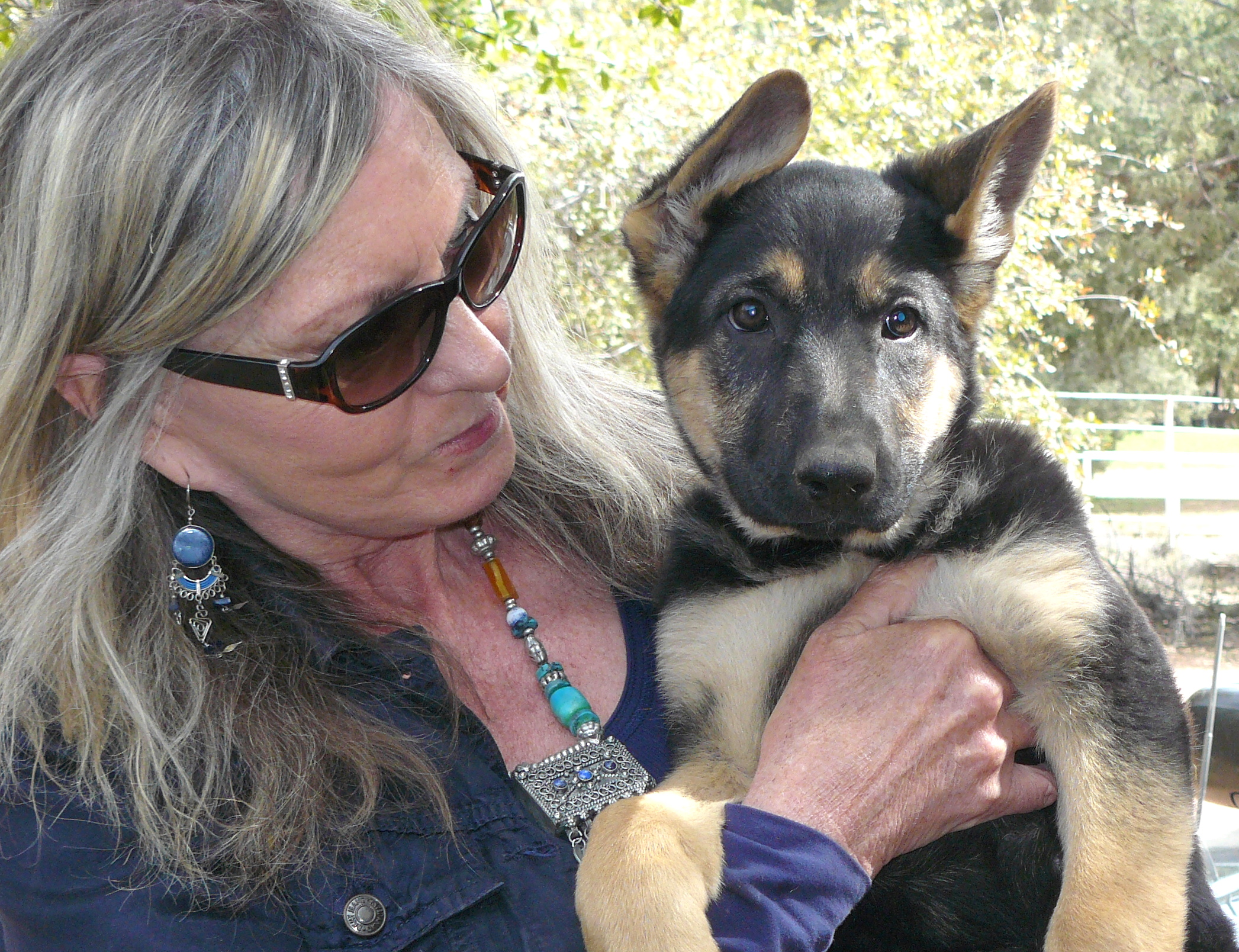
So here are a couple more taken yesterday afternoon, the 25th. Cleo was weighed last Monday and was 28 lbs, some 6 lbs gain since the 8th.
Two very loving ladies!Pharaoh and Cleo already inseparable.
Must say that Cleo has settled in very well with her other four pack mates. Indeed, Cleo, like Sweeny, mixes easily with all the other dogs, not just Pharaoh’s group.
A remarkable story about two very clever men and an equally clever dog!
Five days ago, I received an email from a Richard Hake quite out of the blue! This is what it said,
Dear Paul Handover,
I’m taking the liberty of cc’ing this to Tim Pennings since he may be interested in your blog “Learning from Dogs.”
As founding author of the great blog “Learning from Dogs”, I thought you might be interested in the work of Tim Pennings.
Paraphrasing from the Hope College website:
*~*~*~*~*~*~*~*~*~*~*~*~*~*~*~*~*~*~*~*~*~*
Tim Pennings is a professor of mathematics at Hope College and owner of a famous Welsh Corgi dog, Elvis, who knows calculus. He has given over a hundred talks – including several speaking tours – based on his papers “Do Dogs Know Calculus?” [Pennings (2003)] and “Do Dogs Know Bifurcations?” [Minton & Pennings (2007)]. Articles about Elvis are easily found on Google and Youtube. For example:
1. “A Dog, a Ball, and Calculus” Ivars Peterson’s MathTrek,
2. “Calculating Dogs” Ivars Peterson’s MathTrek ,
3. “Dog Plays Fetch With Calculus” YouTube (see below)
4. “Elvis The Calculus Dog at Roanoke College” Vime0 Videos.
*~*~*~*~*~*~*~*~*~*~*~*~*~*~*~*~*~*~*~*~*~*
Regards,
Richard Hake, Emeritus Professor of Physics, Indiana University
Honorary Member, Curmudgeon Lodge of Deventer, The Netherlands
President, PEdants for Definitive Academic References which Recognize the Invention of the Internet (PEDARRII)
Well what fun!
Let me start with that YouTube video mentioned above:
Tim Pennings of Hope College in Madison, Wisconsin takes a look at the mathematics his dog Elvis uses to play fetch.
And here are a number of wonderful pictures of Elvis from which comes this one:
Elvis: Professor Tim Pennings' dog.
More may be learnt about Tim Pennings from here, from which I quote:
I am a professor of mathematics at Hope College. My areas of research and writing include dynamical systems (the shadowing property in particular), mathematical modeling, and the infinite. I have directed the Mathematics REU Site since 1995 and have mentored research students almost every year since 1990. A complete list of published papers, talks, and other professional activity is included in my vitae.
I have a famous Welsh Corgi dog, Elvis, who knows calculus. Here are some pictures of us. We have given over a hundred talks – including several speaking tours – based on our papers “Do Dogs Know Calculus?” and “Do Dogs Know Bifurcations?” (written with Roland Minton) both published in the The College Mathematics Journal of the MAA. Articles about Elvis are easily found on Google and Youtube.
Finally, the author of the email, Richard Hake, is no slouch! Here’s Richard’s Blog Hake’sEdStuff and information on his academic background.
How lady luck brought joy for a ‘down-and-out’ Londoner and a cat called Bob!
I was chatting with my son yesterday and he happened to mention that perhaps I should write about a cat for a change! Alex mentioned a book recently published in the UK called A Street Cat Named Bob: How One Man and His Cat Found Hope on the Streets.
This is how the book is described on Amazon (UK site),
When James Bowen found an injured, ginger street cat curled up in the hallway of his sheltered accommodation, he had no idea just how much his life was about to change. James was living hand to mouth on the streets of London and the last thing he needed was a pet. Yet James couldn’t resist helping the strikingly intelligent tom cat, whom he quickly christened Bob. He slowly nursed Bob back to health and then sent the cat on his way, imagining he would never see him again. But Bob had other ideas. Soon the two were inseparable and their diverse, comic and occasionally dangerous adventures would transform both their lives, slowly healing the scars of each other’s troubled pasts. A Street Cat Named Bob is a moving and uplifting story that will touch the heart of anyone who reads it.
A quick web search found volumes of material, so let’s start with this video,
The local London newspaper the Islington Tribune wrote this back in 2010,
Two cool cats… the Big Issue seller and a stray called Bob
Inseparable: musician James Bowen with Bob
Down-on-his-luck musician teams up with ‘wonderful loyal friend’ he rescued from streets
Published: 24 September, 2010
by PETER GRUNER
NOT since the legendary Dick Whittington has a man and his cat become such unlikely celebrities on the streets of Islington.
Big Issue seller James Bowen and his docile ginger cat Bob, who go everywhere together, have been attracting comments since they first appeared outside Angel Tube station.
The story of how they met – widely reported in blogs on the internet – is one of such extraordinary pathos that it seems only a matter of time before we get a Hollywood film.
James, 31, who lives off Seven Sisters Road, Holloway, is a musician who has fallen on hard times.
He ekes out a basic living selling the homeless people’s magazine Big Issue at Angel and Covent Garden.
Bob was a stray discovered by James outside his accommodation one day.
The cat was limping after apparently being attacked by another animal, possibly a fox.
After failing to discover the cat’s owner, James took him to the RSPCA hospital at Finsbury Park, which prescribed a course of antibiotics.
“I kept him for two weeks until he was well enough to go on his way,” said James. “But when I opened the front door to let him out Bob wouldn’t move. He seemed to me to be saying: ‘I want to stay with you.’
“Now we go everywhere together. I even have a cat harness when we go out and Bob gets really excited when I show it to him.”
Read the rest of the article here and if you want more information, a web search on Bob the Cat will finds loads more.
It’s a fabulous story with a great message of hope for not just for James and Bob but for all of us that find ourselves ‘up a creek without a paddle’ at points in our lives.
Here’s how the newspaper The Daily Mail wrote about it on their website,
[last half of the story]
But then Bob started following him and it became increasingly difficult to shoo him away, especially as there were dangerous roads to be crossed. One day there was nothing for it but to put Bob on a makeshift lead and take him along. Bob travelled sitting on James’s shoulders.
The trouble was, so many cat-mad passers-by stopped him to stroke the animal that James arrived late at his pitch, secretly cursing Bob for thereby costing him some of his usual £25-a-day takings. He couldn’t have been more wrong.
Within minutes, people who would normally have walked by without giving James a second glance were lingering to make a fuss of the cat sitting sedately in his guitar case, and most made a donation. By the end of the day, he’d racked up more than £60.
It was the beginning of a phenomenon as tourists and commuters befriended Bob and James, many bringing titbits for the cat. People were amazed at how placidly Bob would sit all day, quite happily watching the world go by while James earned a living. Not that it was always without a hitch; on a couple of occasions Bob bolted when startled, leading to a frantic chase through the crowded streets.
Bob’s popularity continued when James switched from busking to selling the Big Issue, the magazine produced and sold by homeless people. This change in direction was part of James’s growing sense of a need to get his life in order, which he puts down to the responsibility of looking after Bob, and the example the cat offered of the possibility of a second chance.
It enabled James to make the final push to end his drug dependency, going through the necessary cold turkey to get off heroin substitutes, and to mend broken contacts with his family. The final result of Bob’s influence came when a literary agent who passed the duo every day and had seen them on YouTube suggested James tell their story in a book. The result is this heart-warming tale with a message of hope that will appeal especially to the many cat obsessives out there.
A discovery of some writing from the past triggers memories.
Way back on the 15th November, 2009, I wrote a post about single-handed sailing and how it caused me much disquiet. Rather than just leave you with a link to that reflection, I’m going to include the post again, below. The reason is that a few days ago, in looking through some of my earlier writings in conjunction with a writing group that Jean and I belong to, I came across a piece that I wrote following a solo voyage from Larnaca in Cyprus, west along the Mediterranean Sea and then out over the Atlantic from Gibraltar to Horta on the island of Faial in the Azores. That last leg was a little over 1,100 nautical miles (1,300 land miles) and took me eight days.
So first here’s that earlier post from 2009.
A personal reflection on this rather strange way of travelling!
The recent Post about young Jessica Watson sailing alone around the world raised a few comments but also reminded me of my own experiences of solo sailing.
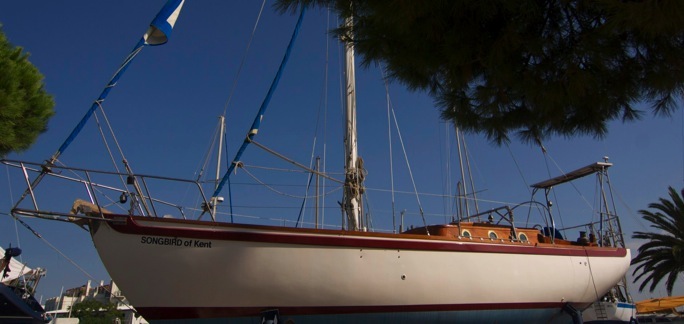
Some years ago, having successfully sold my own IT company, I warmed to the idea of being a full-time yachtie! A second-hand Tradewind 33 was discovered on the Island of Corfu. (Now here’s a surprise! I was just browsing the web looking for a picture of a Tradewind and came across my old yacht currently up for sale. Her name is Songbird of Kent! Picture below.)
Tradewind 33 - Songbird of Kent
Anyway, the deal was done and having sold my house in England I flew out to Corfu to collect Songbird of Kent. Inevitably it was a number of months before the boat was ready to head out into the Mediterranean but in early Spring 1988 it was time to explore the long coastlines of Greece and Turkey.
After a fantastic summer cruising from one idyllic anchorage to another mostly with friends or family on board, it was time to find a winter haven. Many recommended Larnaca Marina in Cyprus. Thus it was late in the summer of 1988 that I said goodbye to friends and set out on my own to cross from Antalya in Turkey to Cyprus and along the South coast of Cyprus to Larnaca, on the SE side of the island.
That sea crossing, a little over 200 nautical miles, was to become a regular solo experience at the start and end of each summer season. Impossible to do in a single day thus it always included a night at sea and rarely, if things didn’t go well with the weather, a couple of nights. I hated it! Maybe it was the sudden transition from coastal sailing to a deep water crossing, often going from having friends on board to being alone, but whatever it was I never enjoyed my time on my own and knew that long-distance solo sailing was never going to be my scene.
Anyway, I ended up spending several very happy winters in Larnaca.
One time, there was news of a Frenchman who had come into Larnaca on his way home to France having nearly completed a circumnavigation of the world. He was on his own!
I was astounded to hear how someone could do this and made a point of calling round to his berth. The boat was a beautiful, solid steel yacht, the very epitome of a craft that could challenge the oceans. The owner’s name was Pierre (it would be!). Pierre invited me aboard and we went down to his saloon to drink a hot coffee – real French coffee!
Inevitably the conversation turned to the challenges of sailing alone. Pierre said that the big cargo ships at sea moved quickly relative to the speed of a yacht so at night he set an alarm for every 15 minutes. That was the time that a ship could go from being hull down over the horizon to being close enough to be a hazard. Thus while at sea Pierre got up briefly every 15 minutes during the night to avoid being run down! It sounded totally exhausting.
Then Pierre asked me about the sailing I had done and whether I had sailed on my own. I declared my trivial journeys back and forth from Cyprus to Turkey and revealed that being on my own made me very, very unhappy. Pierre was surprised to hear that as he admitted that being at sea alone was one of the most tranquil and peaceful experiences ever. Pierre asked how long these solo journeys took. I replied, two or three days.
“Ah!”, he said, “That is the problem.” “I, too, hate the three days. It is always a period where you adjust and it is terrible.“
“My friend, you must find a way to be alone for more than three days. You will see that it is very different.“
It was some years before that opportunity came about but, in the end, I did undertake a solo journey of 8 days. Pierre was right. The first three days were hell, the rest were heaven!
Thank you, Songbird of Kent, you gave me some fabulous memories!
By Paul Handover
Now on to my writings about being out at sea alone on a small yacht.
Being at Sea
Going to sea in a small vessel is a profound experience.
In harbour we build up a reliance on things external. We have no need to worry if there is insufficient food on board, we can plug into the dockside power supply, sleep through the night undisturbed and we can wander off and enjoy the company of others if the boat feels a little claustrophobic.
Then slowly, imperceptibly, but with huge force, arrives the need to move on. The realisation that our cosy life connected to the busy, bustling and self-obsessed world of shoreside is not fulfilling our search for adventure and for the truths that lay over the horizon. It is time to leave.
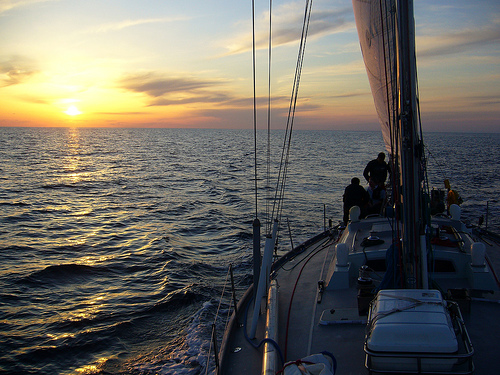
The act of casting off is always exciting as it heralds a new adventure. But it also carries feelings of loss and apprehension as one lets go of the bonds of a previous certainty. The first few hours are filled with the workload of getting one’s craft shipshape and battened down for the unknown seas. Then gradually comes the realisation that the land is now less the dominating visual feature than the vastness of the seascape that is ahead. But with the land in sight, albeit a distant horizon behind one, you can still sense the life you are leaving.
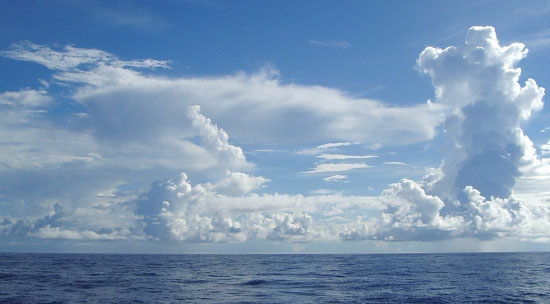
Now all that surrounds you is the sea. You are now truly disconnected from the land. It is often at this point that despondency and uncertainty play with your mind; after all this new life is still very unfamiliar compared to the warmth of that island home that still resonates in your heart. Time to remind yourself of why you wanted to take this voyage.
A small boat is very fragile. Just a centimetre of hull separating you from the unimaginable depths of the ocean beneath your keel. Not until the end of your voyage, when you draw your boat up, metaphorically on to that beach, will you ever stop feeling how close fate is, how it rides on your shoulder night and day. That, of course, is why we go to sea. It is the place where we taste life, where we savour each moment of the present because the future seems too bound up in the mystery, the uncertainty of the ocean. You are in charge of your tiny craft. Your survival depends on how you manage your small ship, how you navigate these seas, how you read the weather ahead and avoid the storms.
Soon your life on the ocean becomes everything to you. You have time to reflect on so much that is left behind. The distance seems to dissolve all the nuisances, bring into focus all the things that are important to you. There is no certainty with the ocean apart from the knowledge that you are very small and very, very vulnerable and yet, in a sense, also so strong.
In the end, we have to break away from our insecurities and our emotional dependencies on external people and situations because, without that, we are never able to command our own life and the destiny that flows from that captaincy. There is a real strength in knowing ourselves as we would know our own boat. If we really know every spar, sail, rope and fitting, if we have real understanding of the strengths and weaknesses of our small vessel then we are able to know when to breast the waves or when to turn and run before the storm. We are secure that our small craft will protect us day and night.
Thus self-knowledge gives us the same freedom to manage our lives, to know when to fight and when to turn away. And just as after every long voyage the boat will need hours of careful maintenance so our own souls need regular love and caring from our spiritual keeper.




 Learning from Dogs