A light distraction to the serious article yesterday!
My son mentioned the other day that a rather unusual property is for sale in North Devon, SW England. What’s unusual about it? Well the picture below answers that question!
Hartland Point Lighthouse
Not a bad view, is it! The lighthouse, or rather ex-lighthouse, depending in which direction one is looking, has the start of the Bristol Channel off to the right, or the Atlantic Ocean directly ahead with the Island of Newfoundland being the next stop Westwards.
The island seen on the horizon in the picture is Lundy Island, a granite outcrop, three and a half miles long and half a mile wide. As an aside, I can recall a fly-in to Lundy many years ago. Went there in the Piper Super Cub and the landing and take-off were ‘interesting’.
Back to Hartland Point Lighthouse. Thanks to WikiPedia, we learn that,
Hartland Point Lighthouse is a Grade II listed building at Hartland Point Devon, England. The point marks the western limit (on the English side) of the Bristol Channel Atlantic Ocean continuing to the west.
Built in 1874 by Mr. Yerward of Wales under the direction of Sir James Douglass, the tower is 18 metres (59 ft) tall with the lamp being 37 metres (121 ft) above mean sea level. The light can be seen up to 25 miles (40 km) away from the coast. It is protected by a 30 metres (98 ft) long sea wall which was built in 1925 to prevent erosion of the rocks on which it stands.
It was blessed by Frederick Temple, Bishop of Exeter, who later became Archbishop of Canterbury, and the light was lit for the first time by Lady Stuckley of Hartland Abbey during the opening ceremony on July 1, 1874.
The tower was automated in 1984 and is now controlled from Trinity House Operations Centre at Harwich in Essex. Prior to automation the lighthouse was built with accommodation for four keepers and their families. The keepers’ dwellings have since been demolished to make room for a helipad to be constructed. This was necessary due to the precarious nature of the access road which is liable to frequent rock falls and landslips. Vehicular access is now very difficult and the gates tend to remain locked. The large concrete structures immediately to the south of the lighthouse were to provide the keepers with fresh water.
In the 2010 Aids to Navigation Review, by Trinity House, they proposed to discontinue the Hartland Point Lighthouse Station on grounds that the rocks that it sits on is eroding away.
So if you are looking for that really special room with a view, this could be it! The agency selling the Lighthouse are Smithsgore and the details, including a guide price of £500,000, may be found here.
“Have the courage to say no. Have the courage to face the truth. Do the right thing because it is right. These are the magic keys to living your life with integrity.”
The above is attributed to W. Clement Stone, a businessman, philanthropist and author who died in 2002, aged 100. It seemed an appropriate quotation with which to introduce a recent article by Bill McKibben, on the Grist blog, about the proposed Keystone XL pipeline.
Bill McKibben
Keystone pipeline’s last defense: Cold, hard cash
What do you do if you’ve lost an argument?
Say you really really want to build a big pipeline from the tar sands of Alberta so that you can sell your bitumen to the world
But 20 of the nation’s top scientists have written to the president to say it’s a terrible idea — and the planet’s leading climatologist says burning the tar sands would be “game over for the climate.” And nine recent winners of the Nobel Peace Prize have condemned the plan. And Robert Redford has just made a video explaining why the plan is an attack on the nation’s heartland. Then, if you’re a poor forlorn oil industry feeling unloved and under assault, what do you do?
There’s really only one answer: Flash your wad.
As we get to the final chapters of the Keystone pipeline saga (the president has said he’ll make his decision by year’s end), money’s the only argument these guys have left.
They managed to buy a favorable environmental review from the U.S. State Department, which helpfully outsourced the job to a company that was a “major client” of TransCanada, the pipeline builder.
And yesterday, they proposed a $100 million “performance bond” to the state of Nebraska, whose Republican governor and senator have come out against the pipeline. The money is apparently designed to pay for damage to the Ogallala Aquifer if the pipeline starts to leak.
Meanwhile, when 33 Democratic representatives sent a letter to the White House demanding a rejection of the plan, lobbyists for TransCanada rounded up their own list of lawmakers from the president’s party to issue a rejoinder. But they only found 22. And what do you know — they included nine of the top 10 Democratic recipients of oil money in the House. On average the signatories received over 4.25 times more oil money than the average House Democrat in the 112th Congress. That would be 325 percent more. That would be how the game is played.
The other side — that is, scientists, Nobelists, and the kind of average people who went to jail in record numbers this summer to block the plan — doesn’t have that kind of money. We’ve had to figure out other currencies to work in: spirit, passion, creativity. We’ve spent our bodies, putting them on the line. The odds are still against us, but the odds are changing; we’re on a roll as we head toward Nov. 6, when we’ll ring the White House with people, exactly one year before the election. (You can sign up here.)
But every once in a while we get to play the money game too! While TransCanada was out there setting the $100 million price on the Ogallala Aquifer, this news story rolled across my screen. It described a big Democratic giver, Barbarina Heyerdahl. She gave 120 grand to Obama and the Democratic National Committee over the last three years, not to mention knocking on doors for the 2008 campaign. But she said Keystone is a bridge too far, that “she won’t be writing any more checks to Obama if he approves the carbon conduit that’s become the focus of the climate-change movement. ‘It’s a baseline issue,’ she says.”
I have no doubt that, even with Heyerdahl and other donors accounted for, the oil industry has all the money they need to win this fight. The Koch brothers are the third and fourth richest men in America, and they filed papers in Canada declaring their “direct and substantial” interest in the project. If money’s the only thing that matters, they’ll carry the day.
But if money’s the only thing that matters, we’re done for anyway. So we’ll keep using science and art and courage. And we’ll hope that Barack Obama hasn’t sold his soul. We’re going to find out in the next few weeks.
Bill McKibben is founder of 350.org and Schumann Distinguished Professor at Middlebury College in Vermont. He also serves on Grist’s Board of Directors.
Bill’s website may be found here. Also, please PLEASE watch the video made by Robert Redford. Only 3 mins 25 seconds long, the ink to the video is here.
John O’Donohue, in yesterday’s post, touched on the essence of today’s theme, “The greatest philosophers admit that to a large degree all knowledge comes through the senses. The senses are our bridge to the world.”
Dogs, of course, demonstrate powerfully how their senses provide a ‘bridge to the world’.
This odd collection of writings (ramblings?) that comprise Learning from Dogs is based around the ‘i’ word – Integrity. The banner on the home page proclaims Dogs are integrous animals. We have much to learn from them. Ergo, dogs offer a powerful metaphor for the pressing need for integrity among those that ‘manage’ our societies.
Thus my senses are more tuned, than otherwise, to the conversations in the world out there that support the premise that unless we, as in modern man, radically amend our attitudes and behaviours, then the species homo sapiens is going to hell in a hand-basket!
End of preamble!
Professor Bill Mitchell is one person who recently touched my senses. As his Blog outlines he is an interesting fellow,
(Photo taken in August 2011 in Melbourne, Australia)
He is also a professional musician and plays guitar with the Melbourne Reggae-Dub band – Pressure Drop. The band was popular around the live music scene in Melbourne in the late 1970s and early 1980s. The band reformed in late 2010.
He also plays with a Newcastle swing blues band – The Blues Box. You can find music and other things on his Home Page.
Professor Mitchell’s Blog is not for the faint-hearted, it can be pretty technical at times. Nevertheless, I have been a daily subscriber for a couple of months now.
Economists have a strange way of writing up briefing documents. There is an advanced capacity to dehumanise economic advice and ignore the most important economic and social problems (unemployment and poverty) in favour of promoting non-issues (like public debt ratios). It reminds me sometimes of how the Nazis who were brutal in the extreme in the execution of their ideology sat around getting portraits of themselves taken with their loving families etc. The training of economists creates an advanced state of separation from human issues and an absence of empathy.
In a sense, we all understand this, this use of language to separate us from our collective humanity. A random Google search came up with this. A statement by British Prime Minister, David Cameron, to Parliament on the 24th regarding Europe, as in,
Mr Speaker, let me turn to yesterday’s European Council.
This European Council was about three things.
Sorting out the problems of the Eurozone.
Promoting growth in the EU.
And ensuring that as the Eurozone develops new arrangements for governance, the interests of those outside the Eurozone are protected.
This latter point touches directly on the debate in this House later today, and I will say a word on this later in my statement.
Resolving the problems in the Eurozone is the urgent and over-riding priority facing not only the Eurozone members, but the EU as a whole – and indeed the rest of the world economy.
Britain is playing a positive role proposing the three vital steps needed to deal with this crisis – the establishment of a financial firewall big enough to contain any contagion; the credible recapitalisation of European banks; and a decisive solution to the problems in Greece.
Read the last paragraph. Wonderful words that seem to make sense to the casual listener but picking up on Prof. Bill, an utter ‘separation from human issues and an absence of empathy‘. There is no humanity in those words from the British Prime Minister. We all know there are hundreds of other examples from mouthpieces all across our global society. Back to Bill Mitchell’s article,
Greece has failed. To say this is not another report of investment banks or research centers, but directly Troika officials who have just completed their review on Hellenic public finance. Linkiesta is in possession of the entire report of the troika, composed of officials from the International Monetary Fund (IMF), European Central Bank (ECB) and European Commission.
I have a rule of thumb that I use when considering documents such as these. The rule is to assess how strong the concern for unemployment is. How often is unemployment mentioned? The answer is zero. The document never mentions the word or concept.
So obsessed are the Troika and their bean counters about public debt stabilisation that they have completely lost sight of one of the worst problems an economy can encounter – the failure to generate work for all.
Read those last words again, “completely lost sight of one of the worst problems an economy can encounter – the failure to generate work for all“. One last extract from the article,
There is absolutely no historical evidence which shows that when all nations are contracting or stagnant and private spending is flat (or contracting) that cutting public spending will create growth.
So why did these economists think that a nation would grow when all components of spending were strongly indicated to fall or were being actually cut? The answer lies in acknowledging that they operate in an ideologically blinkered world and are never taken to account for their policy mistakes. They are unaccountable and do not suffer income losses when the nations they dispense advice to and impose policies on behave contrary to the “expectation” which results in millions being unemployed.
In my view, my profession should be liable for the advice it gives and economists should be held personally liable for damages if their advice causes harm to other individuals. If the economists in the IMF and elsewhere were held personally responsible then the advice would quickly change because they would be “playing” with their own fortunes and not the fortunes of an amorphous group of Greeks that they have never met.
Very powerful words that strike at the heart of the matter, that of integrity. (If you want to read it in full, then the article is here.)
Let me move on a little. The 24th also saw a powerful essay on Yves Smith’s Blog Naked Capitalism, from Philip Pilkington, a journalist and writer living in Dublin, Ireland. Here’s a taste of what Mr. Pilkington wrote.
Every now and then a terrible thought enters my mind. It runs like this: what if the theatre of the Eurocrisis is really and truly a political power-game being cynically played by politicians from the core while the periphery burns?
Yes, of course, we can engage in polemic and say that such is the case. But in doing so we are trying to stoke emotion and generally allowing our rhetorical flourish to carry the argument. At least, that is what I thought. I had heard this rhetoric; I had engaged in it to some extent myself; but I had never really believed it. Only once or twice, in my nightmares, I had thought that, maybe, just maybe, it might have some truth.
Can you see the parallels between Prof. Mitchell and Philip Pilkington? The latter wrote, “a political power-game being cynically played by politicians from the core while the periphery burns“, the former wrote, “If the economists in the IMF and elsewhere were held personally responsible then the advice would quickly change because they would be “playing” with their own fortunes and not the fortunes of an amorphous group of Greeks that they have never met.”
It’s clearly obvious to all those that have commented to both the Bill Mitchell and Philip Pilkington items. That is, in my words, a complete lack of integrity, truth and a commitment to serve the people, from so many in places of influence and power.
We all sense this, hear it so clearly, a separation from human issues and an absence of empathy.
We have so much to learn, so much sense to learn, from dogs!
————–
Footnote. Had just completed the above when I came across a piece by Patrick Cockburn in last Sunday’s Independent newspaper, that starts thus,
World View: A sense of injustice is growing. Elite politicians and notorious wrongdoers appear immune as ordinary Greeks reel from wage and job cuts
Up close, the most striking feature of the reforms being forced on Greece by its international creditors is their destructiveness and futility. The pay cuts, tax rises, cuts and job losses agreed to by parliament in Athens last week will serve only to send the economy into a steeper tailspin, even if it extracted a much-needed €8bn in bailout money from the EU leaders. “Nothing but a lost war could be worse than this situation,” one left-wing ex-minister tells me. “What is worse, no party or political group in Greece is offering real solutions to our crisis.
A return to the beautiful writings of Irishman, John O’Donohue
Last week, I published a Post about John O’Donuhue‘s book Anam Cara, entitled Soul friend, the meaning of anam cara in Gaelic. There were a number of lovely responses, both as comments to the Post, and as emails sent to me. I thought I would share another essay with you. First, some reflections about transfiguration or, perhaps a better word for today’s challenging times is ‘change’.
I have made no secret of my belief that we are in a period of great change, perhaps greater than mankind has faced before. Possibly that is slightly hyperbolic, but looked at from the perspective of the extinction of homo sapiens then perhaps it is no exaggeration. The vast majority of people, who stop and reflect, sense that on several fronts it is change or die!
A classic behavioural attribute of modern man is to see ‘change’ as something that others should do, rather than change coming from within. From time to time, I have quoted this,
For today, I am in charge of my life.
Today, I choose my thoughts,
Today, I choose my attitudes,
Today, I choose my actions and behaviours,
With these, I create my life and my destiny.
Much, much easier to say, and write, than to undertake. But it does underscore the obvious – change flows from our journey inwards. Let’s turn to John O’Donohue’s inspirational words about this subject.
From the John O’Donohue website
Spirituality of transfiguration
Spirituality is the art of transfiguration. We should not force ourselves to change by hammering our lives into any predetermined shape. We do not need to operate according to the idea of a predetermined programme or plan for our lives. Rather, we need to practise a new art of attention to our inner rhythm of our days and lives. This attention brings a new awareness of our own human and divine presence. A dramatic example of this kind of transfiguration is the one all parents know. You watch your children carefully, but one day they surprise you; you still recognise them, but your knowledge of them is insufficient. You have to start listening to them all over again.
It is far more creative to work with the idea of mindfulness rather than with the idea of will. Too often people try to change their lives by using the will as a kind of hammer to beat their life into proper shape. The intellect identifies the goal of the programme, and the will accordingly forces the life into that shape. This way of approaching the sacredness of one’s own presence is externalistic and violent. It brings you falsely outside your own self and you can spend years lost in the wilderness of your own mechanical, spiritual programmes. You can perish in a famine of your own making.
If you work with a different rhythm, you will come easily and naturally home to your self. Your soul knows the geography of your destiny. Your soul alone has a map of your future, therefore you can trust this indirect, oblique side of your self. If you do, it will take you where you need to go, but more importantly it will teach you a kindness of rhythm in your journey. There are no general principles for this art of being. Yet the signature of this unique journey is inscribed deeply in each soul. If you attend to your self and seek to come into your own presence, you will find exactly the right rhythm for your life. The senses are generous pathways which can bring you home.
A renewal, indeed a complete transfiguration of your life, can come through attention to your senses. Your senses are the guides to take you deep into the inner world of your heart. The greatest philosophers admit that to a large degree all knowledge comes through the senses. The senses are our bridge to the world. Human skin is porous; the world flows through you. Your senses are large pores which let the world in. Through attunement to the wisdom of your senses, you will never become an exile in your own life, an outsider lost in an external spiritual place which your will and intellect have constructed.
Please just read those words from John again. Re-read the last paragraph. Then go one paragraph up and read that again, “Your soul knows the geography of your destiny. Your soul alone has a map of your future, therefore you can trust this indirect, oblique side of your self. If you do, it will take you where you need to go, but more importantly it will teach you a kindness of rhythm in your journey.”
Each of us taking us to where we need to go, and one by one, each of us taking our world to where it needs to go.
History repeating itself in terms of the commercial sailing ship.
Tea clipper 'Cutty Sark'
Most Brits have heard of the tea clipper Cutty Sark. As the Cutty Sark website explains,
Cutty Sark has travelled across the world, sailing under both the Red Ensign and the Portuguese flag, visiting every major port in the world through the course of her working life. In admiration of her beauty and in recognition of her fame, she was preserved for the nation by Captain Wilfred Dowman in 1922.
Since then, the old clipper has been berthed in Falmouth and Greenhithe, finally arriving at her current resting place in Greenwich in 1954.
She is the only surviving extreme clipper, and the only tea clipper still in existence.
Most of her hull fabric survives from her original construction and she is the best example of a merchant composite construction vessel.
She has captured the imagination of millions of people, 15 million of whom have come on board to learn the stories she has to tell.
She was preserved in Greenwich partly as a memorial to the men of the merchant navy, particularly those who lost their lives in both world wars.
She is one of the great sights of London.
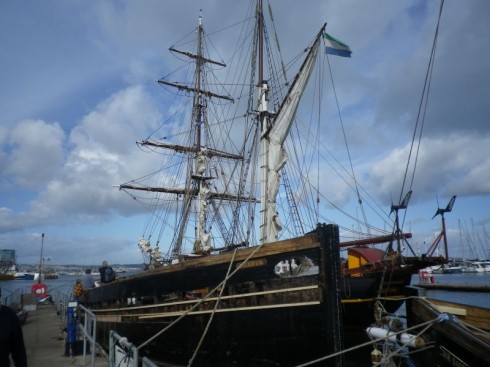
I mention the Cutty Sark because it seems a historic connection with something very relevant to today’s world that was the subject of a recent item on Rob Hopkin’s Transition Culture blogsite. In it Rob presents his first podcast, the topic being the sailing ship Tres Hombres, that is being used for commercial sea transport. The link to the Transition Culture story is here, and the podcast follows, (just click on the link to listen to the fascinating 14 minutes audio story about the ship Tres Hombres.)
The first Transition podcast! A visit to the Tres Hombres, tasting a revolution in shipping
Last week I did a course with the Media Trust on how to make podcasts (highly recommended). So, here, with some fanfare, is the first ‘Transition podcast’, I hope you like it. If so, do embed it in other places. It means I spent the time I would spend writing editing pieces of audio. Let me know what you think. So, the podcast is about a fascinating morning I spent visiting the sailing ship Tres Hombres which visited Brixham earlier this week. It explores the potential of sail-powered shipping as the price of oil rises and the economy tightens. It’s an exciting story.
Finally, let me close with a very well-known poem about sailing the big ships.
“Sea-Fever”
I must down to the seas again, to the lonely sea and the sky,
And all I ask is a tall ship and a star to steer her by,
And the wheel’s kick and the wind’s song and the white sail’s shaking,
And a grey mist on the sea’s face, and a grey dawn breaking.
I must down to the seas again, for the call of the running tide
Is a wild call and a clear call that may not be denied;
And all I ask is a windy day with the white clouds flying,
And the flung spray and the blown spume, and the sea-gulls crying.
I must down to the seas again, to the vagrant gypsy life,
To the gull’s way and the whale’s way where the wind’s like a whetted knife;
And all I ask is a merry yarn from a laughing fellow-rover
And quiet sleep and a sweet dream when the long trick’s over.
By John Masefield (1878-1967).
(English Poet Laureate, 1930-1967.)




 Learning from Dogs