Year: 2011

Crazy, dangerous and very, very beautiful

I love taking photographs but this takes the cake!

(Note: there’s an option in WordPress to insert a ‘read more‘ link, the effect of which is to limit what you, dear reader, can see when you first come to a Blog article.  I prefer normally not to insert that link.  But for reasons that will soon be very obvious, it has to be used in this Post.)

Just watch this.

OK, more about this amazing man follows,

Continue reading “Crazy, dangerous and very, very beautiful”

More from Lester Brown

The president of Earth Policy Institute presents his thesis on how best to save mankind.

Before turning to the theme of this Post, just a personal message.  I arrived back home in Payson, Arizona yesterday and, as much as I love the huge number of readers that now regularly visit Learning from Dogs, I love my dear wife rather more 😉  So for the next few days, please understand why this Blog will be tending to ‘republish’ the fine works of others, to lessen the creative load on yours truly.

Here’s the Lester Brown article that was recently published on the Earth Policy Institute website.

JUNE 09, 2011
Turning Toward the Sun for Energy

Lester R. Brown

One key component of the Plan B climate stabilization strategy is solar energy. Solar is even more ubiquitous than wind energy and can be harnessed with both solar photovoltaics (PV) and solar thermal collectors.

Solar PV—both silicon-based and thin film—converts sunlight directly into electricity. The growth in solar cell production climbed from an annual expansion of 38 percent in 2006 to an off-the-chart 89 percent in 2008, before settling back to 51 percent in 2009. At the end of 2009, there were 23,000 megawatts of PV installations worldwide, which when operating at peak power could match the output of 23 nuclear power plants. Germany, with an installed PV power generating capacity of almost 10,000 megawatts, is far and away the world leader in installations.

On the manufacturing front, the early leaders—the United States, Japan, and Germany—have been overtaken by China, which produces more than twice as many solar cells annually as Japan. World PV production has roughly doubled every two years since 2001 and exceeded 20,000 megawatts in 2010.

Historically, photovoltaic installations were small-scale—mostly residential rooftop installations. Now that is changing as utility-scale PV projects are being launched in several countries. The United States, for example, has under construction and development some 77 utility-scale projects, adding up to 13,200 megawatts of generating capacity. Morocco is now planning five large solar-generating projects, either photovoltaic or solar thermal or both, each ranging from 100 to 500 megawatts.

More and more countries, states, and provinces are setting solar installation goals. Italy’s solar industry group is projecting 15,000 megawatts of installed capacity by 2020. Japan is planning 28,000 megawatts by 2020. The state of California has set a goal of 3,000 megawatts by 2017. Solar-rich Saudi Arabia recently announced that it plans to shift from oil to solar energy to power new desalination plants that supply the country’s residential water. It currently uses 1.5 million barrels of oil per day to operate some 30 desalting plants.

With installations of solar PV climbing, with costs continuing to fall, and with concerns about climate change escalating, cumulative PV installations could reach 1.5 million megawatts (1,500 gigawatts) in 2020. Although this estimate may seem overly ambitious, it could in fact be conservative, because if most of the 1.5 billion people who lack electricity today get it by 2020, it will likely be because they have installed home solar systems. In many cases, it is cheaper to install solar cells for individual homes than it is to build a grid and a central power plant.

The second, very promising way to harness solar energy on a massive scale is a large-scale solar thermal technology, often referred to as concentrating solar power (CSP), that uses reflectors to concentrate sunlight on a liquid, producing steam to drive a turbine and generate electricity. One of the attractions of utility-scale CSP plants is that heat during the day can be stored in molten salt at temperatures above 1,000 degrees Fahrenheit. The heat can then be used to keep the turbines running for eight or more hours after sunset.

CSP first came on the scene with the construction of a 350-megawatt solar thermal power plant complex in California. Completed in 1991, it was the world’s only utility-scale solar thermal generating facility until the completion of a 64-megawatt power plant in Nevada in 2007.

Although solar thermal power has been slow to get under way, utility-scale plants are being built rapidly now, led by the United States and Spain. The United States has more than 40 solar thermal power plants operating, under construction, and under development that range from 10 to 1,200 megawatts each. Spain has 60 power plants in these same stages of development, most of which are 50 megawatts each. The American Solar Energy Societynotes that solar thermal resources in the U.S. Southwest can satisfy current U.S. electricity needs nearly four times over.

In July 2009, a group of 11 leading European firms and one Algerian firm, led by Munich Re and including Deutsche Bank, Siemens, and ABB, announced that they were going to craft a strategy and funding proposal to develop solar thermal generating capacity in North Africa and the Middle East. Their proposal would meet the needs of the producer countries and supply part of Europe’s electricity via undersea cable.

This initiative, known as the Desertec Industrial Initiative, could develop 300,000 megawatts of solar thermal generating capacity—huge by any standard. Caio Koch-Weser, vice chair of Deutsche Bank, noted that “the Initiative shows in what dimensions and on what scale we must think if we are to master the challenges from climate change.”

Even before this proposal, Algeria—for decades an oil exporter—was planning to build 6,000 megawatts of solar thermal generating capacity for export to Europe via undersea cable. The Algerians note that they have enough harnessable solar energy in their vast desert to power the entire world economy. This is not a mathematical error. The German government was quick to respond to the Algerian initiative. The plan is to build a 1,900-mile high-voltage transmission line from Adrar deep in the Algerian desert to Aachen, a town on Germany’s border with the Netherlands.

At the global level, Greenpeace, the European Solar Thermal Electricity Association, and the International Energy Agency’s SolarPACES program have outlined a plan to develop 1.5 million megawatts of solar thermal power plant capacity by 2050. For Earth Policy Institute’sPlan B to save civilization, we suggest a more immediate world goal of 200,000 megawatts by 2020, a goal that may well be exceeded as the economic potential becomes clearer.

The pace of solar energy development is accelerating as the installation of rooftop solar water heaters—solar thermal collectors on a smaller scale—takes off. This technology is sweeping China like wildfire, with an estimated 1.9 billion square feet of rooftop solar thermal collectors installed, enough to supply 120 million Chinese households with hot water. Other developing countries such as India and Brazil may also soon see millions of households turning to this inexpensive water heating technology. Once the initial installment cost of rooftop solar water heaters is paid back, the hot water is essentially free.

In Europe, where energy costs are relatively high, rooftop solar water heaters are also spreading fast. Systems typically pay for themselves in electricity savings within 10 years. In Austria, 15 percent of all households now rely on them for hot water. As in China, in some Austrian villages nearly all homes have rooftop collectors. And some 2 million Germans are now living in homes where water and space are both heated by rooftop solar systems.

The U.S. rooftop solar water heating industry has historically concentrated on a niche market—selling and marketing 100 million square feet of solar water heaters for swimming pools between 1995 and 2005. The industry was poised to mass-market residential solar water and space heating systems when federal tax credits were introduced in 2006. Led by Hawaii, California, and Florida, annual U.S. installation of these systems has more than tripled since 2005. The state of Hawaii requires that all new single-family homes have rooftop solar water heaters. California aims to install 200,000 solar water heaters by 2017, and New York State aims to have 170,000 residential solar water systems in operation by 2020.

With the cost of rooftop heating systems declining, many other countries will likely join Israel, Spain, and Portugal in mandating that all new buildings incorporate rooftop solar water heaters. Worldwide, Plan B calls for a total of 1,100 thermal gigawatts of rooftop solar water and space heating capacity by 2020.

Moving fast to harness the world’s enormous solar potential would bring a clear win for local economies and for the climate.

Adapted from World on the Edge by Lester R. Brown. Full book available online atwww.earth-policy.org/books/wote

There are a couple of videos well worth watching on YouTube, one that’s just under 10 minutes,

and a full-length one of 1 hr 7 minutes,

Consciousness, science or God?

More of Peter Russell’s insightful ideas.

It was back in March, the 8th to be precise, when I first wrote about Peter Russell.  Well just over a week ago, I came across another article by Russell from the Huffington Post.  It was then a moment’s work to find it on Peter Russell’s own website.  (This links to various essays on the topic.)

Here’s a ‘taste’ from the first essay.

The Anomaly of Consciousness

Excerpted from book From Science to God

Science has had remarkable success in explaining the structure and functioning of the material world, but when it comes to the inner world of the mind science falls curiously silent. There is nothing in physics, chemistry, biology, or any other science that can account for our having an interior world. In a strange way, scientists would be much happier if there were no such thing as consciousness.

David Chalmers, professor of philosophy at the University of Arizona, calls this the “hard problem” of consciousness. The so-called “easy problems” are those concerned with brain function and its correlation with mental phenomena: how, for example, we discriminate, categorize, and react to stimuli; how incoming sensory data are integrated with past experience; how we focus our attention; and what distinguishes wakefulness from sleep.

It would be wrong to publish anything more so if you are interested in more, then go here and pick away or better still buy the book!

If you have a quiet 30 minutes, settle down and watch these videos

Part One

Part Two

Part Three

Always two sides

I am indebted to my life-long friend, Dan Gomez, for this piece.

Background (Personal nostalgia warning!!!)

Dan and I go back too many years; I mean way too many!  He and I met in Spring 1979 when I was addressing a national conference of US Commodore PC dealers in Boston, USA.  I was there to promote a British Word Processing program called Wordcraft, written by Peter Dowson, that I had exclusive rights to.  I was also a Commodore PC dealer in Colchester, Essex, England; indeed I was the 8th dealer appointed in the UK.  The luck in finding Wordcraft is underlined by the fact that between 1970 and 1978 I was a salesman with IBM UK Office Products division and ended up as a word-processing specialist salesman for IBM.

Anyway, in my sales pitch to these US dealers, I used the word ‘fortnight’, a common term in England.  From somewhere out in the audience, this Californian voice shouted out, “Hey Handover, what’s a fortnight?”  Many readers will be aware that Americans don’t use that term.  That Californian voice was Dan!

From that cheeky start came a great relationship including Dan being my West Coast distributor for Wordcraft.  It was Dan’s sister, whom I have also known for countless years, who invited me to her Winter home in San Carlos, Mexico, to spend Christmas 2007 with her and her husband and which was the catalyst of me meeting Jean, who is now by most beautiful wife!

Dan, my Best Man, at the wedding of Jean and me, November 20th 2010

————————ooOOOoo————————

OK, to the theme of this article.

Shortly after the Newsweek ‘Weather Panic‘ article on the 10th, Dan sent me this email,

Paul – Saw your blog vis a vis Newsweek’s recent cover.

Don’t forget to publish the other side of this perennial story without all the sensationalism of selling newspapers and proselytizing to the unwashed masses or you could end up drinking your own cool-aid.  The science of weather cycles, sun activity, ocean currents, high-altitude jet streams, colliding warm/cool fronts have been at work long before any creature walked the earth, let alone man. The facts demonstrate this time and time again. Good science is skeptical science and needs to be viewed carefully by way of verifiable and constant testing of hypotheses.

The below article, although not at all sexy, has a different view, in general, as to the vagaries of weather extremes.  There are many like this and represent unbiased, and to some, unpopular scientific reasoning at work.

Just food for thought.

–DG

He then included this.

Recent Weather Extremes: Global Warming Fingerprint Not

by Chip Knappenberger
March 21, 2011

On occasion, I have the opportunity to assist Dr. Patrick J. Michaels (Senior Fellow in Environmental Studies at the Cato Institute) in reviewing the latest scientific research on climate change. When we happen upon findings in the peer-reviewed scientific literature that may not have received the media attention that they deserved, or have been misinterpreted in the popular press, Pat sometimes covers them over at the “Current Wisdom” section of the Cato@Liberty blog site.

His latest posting there highlights research findings that show that extreme weather events during last summer and the previous two winters can be fully explained by natural climate variability—and that “global warming” need not (and should not) be invoked.

This topic—whether or not weather extremes (or at least some portion of them) can be attributed to anthropogenic global warming (or, as Dr. Pielke Sr., prefers, anthropogenic climate change)—has been garnering a lot of attention as of late. It was a major reason for holding the House Subcommittee hearing last week, is a hot topic of discussion in the press, and is the subject of an in-progress major report from the Intergovernmental Panel on Climate Change (IPCC).

As such, I wanted to highlight some of the findings that Pat reported on. I encourage a visit to the full article “Overplaying the Human Contribution to Recent Weather Extremes” over at Cato@Liberty.

The Great Russian Heat Wave of 2010

A new paper by Randall Dole and colleagues from the Physical Sciences Division (PSD) of the Earth System Research Laboratory (ESRL) of the National Oceanic and Atmospheric Administration (NOAA) examined the events leading up to and causing the big heat wave in Russia last summer (which was also part of an atmospheric pattern that was connected to the floods in Pakistan). Here is what they found:

“Our analysis points to a primarily natural cause for the Russian heat wave. This event appears to be mainly due to internal atmospheric dynamical processes that produced and maintained an intense and long-lived blocking event. Results from prior studies suggest that it is likely that the intensity of the heat wave was further increased by regional land surface feedbacks. The absence of long-term trends in regional mean temperatures and variability together with the [climate] model results indicate that it is very unlikely that warming attributable to increasing greenhouse gas concentrations contributed substantially to the magnitude of this heat wave.”

As Pat commented, “Can’t be much clearer than that.”

Recent Winter Severity

From Pat’s article:

Another soon-to-be released paper to appear in Geophysical Research Lettersdescribes the results of using the seasonal weather prediction model from the European Center for Medium-Range Weather Forecasts (ECMWF) to help untangle the causes of the unusual atmospheric circulation patterns that gave rise to the harsh winter of 2009-2010 on both sides of the Atlantic. A team of ECMWF scientists led by Thomas Jung went back and did experiments changing initial conditions that were fed into the ECMWF model and then assessed how well the model simulated the known weather patterns of the winter of 2009-2010. The different set of initial conditions was selected so as to test all the pet theories behind the origins of the harsh winter. Jung et al. describe their investigations this way: “Here, the origin and predictability of the unusual winter of 2009/10 are explored through numerical experimentation with the ECMWF Monthly forecasting system. More specifically, the role of anomalies in sea surface temperature (SST) and sea ice, the tropical atmospheric circulation, the stratospheric polar vortex, solar insolation and near surface temperature (proxy for snow cover) are examined.”

In a nutshell, here is what Jung et al. found:

“The results of this study, therefore, increase the likelihood that both the development and persistence of negative NAO phase [an atmospheric circulation pattern that was largely behind the harsh winter conditions] resulted from internal atmospheric dynamical processes.”

Or, as Pat put it “Translation: Random variability.”

Pat also examined a third study by Roseanne D’Arrigo and colleagues who found an historical analog of the conditions responsible for the harsh winter of 2009-2010 way back in 1783-1784. The winter of 1783-1784 was a historically extreme one on both sides of the Atlantic and has long been associated with a large volcanic eruption that occurred in Iceland during the summer of 1783. Even Benjamin Franklin connected the winter conditions to the volcano. But D’Arrigo and colleagues now suggest a different mechanism. According to Pat:

But in their new study, Roseanne D’Arrigo and colleagues conclude that the harshness of that winter primarily was the result of anomalous atmospheric circulation patterns that closely resembled those observed during the winter of 2009-10, and that the previous summer’s volcanic eruption played a far less prominent role:

“Our results suggest that Franklin and others may have been mistaken in attributing winter conditions in 1783-4 mainly to Laki or another eruption, rather than unforced variability.

“Similarly, conditions during the 2009-10 winter likely resulted from natural [atmospheric] variability, not tied to greenhouse gas forcing… Evidence thus suggests that these winters were linked to the rare but natural occurrence of negative NAO and El Niño events.”

Bottom Line

The take home message of Pat’s post is worth repeating:

The point is that natural variability can and does produce extreme events on every time scale, from days (e.g., individual storms), weeks (e.g., the Russian heat wave), months (e.g., the winter of 2009-10), decades (e.g., the lack of global warming since 1998), centuries (e.g., the Little Ice Age), millennia (e.g., the cycle of major Ice Ages), and eons (e.g., snowball earth).

Folks would do well to keep this in mind next time global warming is being posited for the weather disaster du jour. Almost assuredly, it is all hype and little might.

Be sure to check out Pat’s full article which includes much more in depth coverage of these three soon-to-be-released scientific studies.

————————ooOOOoo————————

I need to mull over this when I am back home with more time.  In the meantime, comments from readers most welcomed.

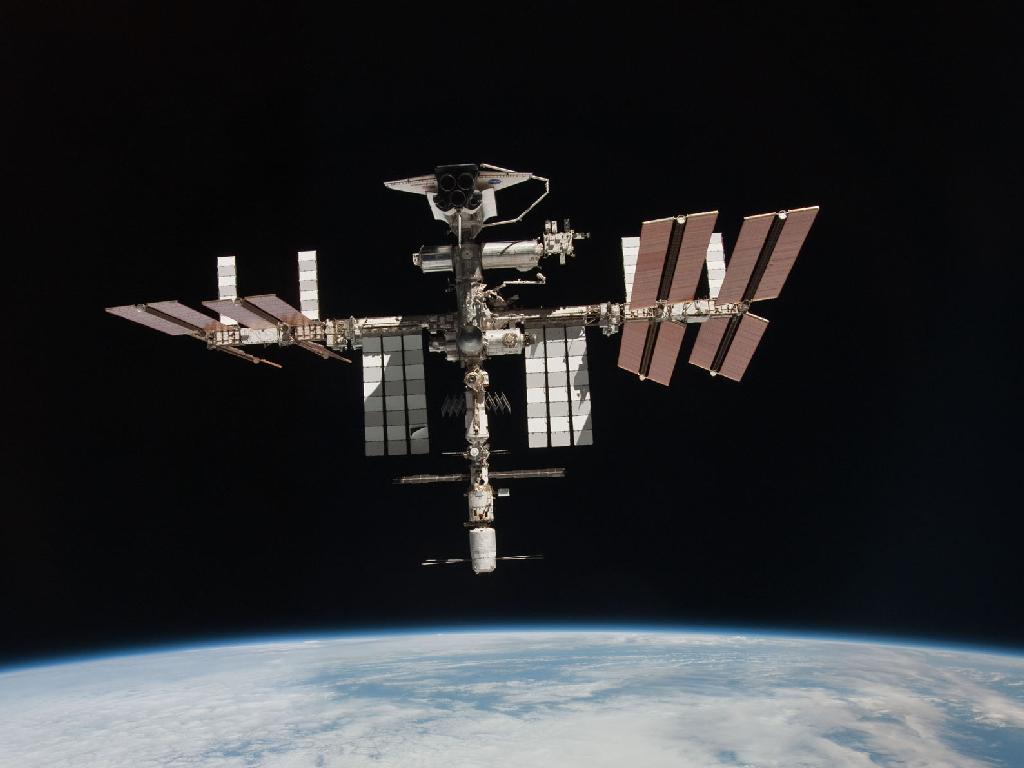
Stunning NASA Shuttle picture

The incredible achievements of man.

The International Space Station and the Docked Space Shuttle Endeavour

From the BBC website,

By Jonathan Amos
Science correspondent, BBC News

It is a stunning image and one that is bound to be reproduced over and over again whenever they recall the history of the US space shuttle.

The picture was taken by Italian astronaut Paolo Nespoli as he left the International Space Station in May in a Soyuz capsule to return to Earth.

Safety procedures mean the Russian vehicle would never normally be in transit when a shuttle is present.

It makes this the first-ever image of an American orbiter docked to the ISS.

Endeavour sits firmly on the bow of the station, which is moving across the surface of the Earth at a speed of 27,000km/h (17,000mph) and at an altitude of approximately 355km (220 miles).

Nespoli’s camera is looking along the ISS’s truss, or backbone, which carries the four sets of giant solar wings. The stern is occupied by Europe’s robotic freighter – the Johannes Kepler ship.

The pictures were acquired on 23 May but were only released by the US space agency (Nasa) on Tuesday [7th June, PH]. They had been eagerly awaited by space fans.

Nespoli had spent a lot of time during his 159-day stay at the station taking pictures of Earth and life aboard the international outpost. Many of these images were posted on his mission Flickr account. It was widely expected therefore that the European Space Agency astronaut would get some excellent shots during the unique departure.

Enthusiasts on the ground with telescopes routinely try to snap a shuttle attached to the ISS, and some of the results have been very impressive. But none of these pictures compares to the majestic portrait acquired by Nespoli so close to the orbiting complex.

The timing and subject are also perfect. Endeavour is seen here making her final sortie into orbit, making the last big US assembly item delivery – a $2bn particle physics experiment known as the Alpha Magnetic Spectrometer. The seven-tonne machine now sits on top of the platform.

Endeavour was also the orbiter chosen to take up the first American segment of the platform when the project had just got started in the late 1990s.

The youngest of Nasa’s shuttles returned to Earth on 1 June and will now be prepared for public display at a science museum in California. Sister ship Atlantis stands ready on the launch pad in Florida for a swansong of her own in July. Once her mission is done, no orbiter will ever fly again.

Nespoli’s crewmates in the Soyuz were Russian cosmonaut and Expedition 27 commander Dmitry Kondratyev; and Nasa astronaut Cady Coleman. Apart from the photo opportunity, their departure was a standard ISS crew rotation flight.

Their replacements blasted off from Kazakhstan on Tuesday in another Soyuz vehicle. Nasa astronaut Mike Fossum, Russian cosmonaut Sergei Volkov and Japanese astronaut Satoshi Furukawa are scheduled to arrive at the ISS on Thursday, raising its complement once again to six individuals.

The venerable Soyuz will be the only way for astronauts and cosmonauts to reach the platform in the years following the retirement of the shuttle fleet.

Nasa hopes some US commercial carriers will become available in the middle of the decade.

The NASA weblink attributed above is here, from which can be read,

This image of the International Space Station and the docked space shuttle Endeavour, flying at an altitude of approximately 220 miles, was taken by Expedition 27 crew member Paolo Nespoli from the Soyuz TMA-20 following its undocking on May 23, 2011 (USA time). The pictures taken by Nespoli are the first taken of a shuttle docked to the International Space Station from the perspective of a Russian Soyuz spacecraft.  Onboard the Soyuz were Russian cosmonaut and Expedition 27 commander Dmitry Kondratyev; Nespoli, a European Space Agency astronaut; and NASA astronaut Cady Coleman. Coleman and Nespoli were both flight engineers. The three landed in Kazakhstan later that day, completing 159 days in space.

Do go to the NASA website here as there are a total of 40 stunning images.

Earth’s climate

Where’s it going?

Last Friday (10th) I wrote about a recent article that appeared in the Newsweek magazine of June 6th and mused about there seeming to be a growing awareness of the changing of the Planet Earth.

I just wanted to add a few other important elements (pardon the pun) of the current awareness.

First, at the time of writing this (June 2nd) the website that shows the monthly level of CO2 in the atmosphere was still showing the figure for April.  Here it is,

CO2 in the atmosphere

Go here and check out what it is for May 2011.  We all know that it won’t be below 393.18, which is already over 12% above the maximum safe level that scientists have determined.

UPDATE (June 7th): The figures for May are now on the website CO2 Now and they are 394.35 up, as predicted, from the figure of 393.18 for April, 2011.

Then go and watch this, from Bill McKibben,

Then go to the CO2 Now website and read, and ponder and think about what is becoming increasingly obvious to us all.

Finally, read a article that Bill McKibben has recently written that seems to have been widely published.  Here it is on the TomDispatch website.  It starts thus,

Three Strikes and You’re Hot
Time for Obama to Say No to the Fossil Fuel Wish List 

By Bill McKibben

In our globalized world, old-fashioned geography is not supposed to count for much: mountain ranges, deep-water ports, railroad grades — those seem so nineteenth century. The earth is flat, or so I remember somebody saying.

But those nostalgic for an earlier day, take heart. The Obama administration is making its biggest decisions yet on our energy future and those decisions are intimately tied to this continent’s geography. Remember those old maps from your high-school textbooks that showed each state and province’s prime economic activities? A sheaf of wheat for farm country? A little steel mill for manufacturing? These days in North America what you want to look for are the pickaxes that mean mining, and the derricks that stand for oil.

Yes, it all seems ‘doom and gloom’ around us at present but then consider that the only way we, as in mankind, can change to a truly sustainable relationship with this Planet is through better understanding and a global realisation that the time for change is now!  That is a very positive message!

That very special relationship

No, not the one between the USA and the UK but between dogs and man.

Great thanks to Peter N. a loyal Learning from Dogs reader, who passed this item to me just a few days before I left for England, where I am until the 16th.  The story comes from the website Life With Dogs, not a website that I had previously come across, where it appeared on June 2nd. It is reproduced in full below.

'Puppy' Bear

A Piedmont, OK man says his devoted dog tried to save his wife’s life during last week’s tornado.

Leanne Sneed was at home when the deadly tornado struck. Her husband Gary said she took cover as the twister began to rip the house apart around her, laying down and covering her head as debris fell.

What happened next can only be explained as an act of love. Bear used his considerable frame to protect Leanne. He laid down on top of her, completely covering her body with his. He did not move, keeping her pinned under him until the storm had passed. Miraculously, despite the complete destruction that surrounded them, neither Bear nor Leanne suffered any injuries.

Gary Sneed said that Bear’s bravery is even more impressive when you consider that he’s still just a puppy. He said the 160-pound dog is incredibly loving, and he fully believes Bear was willing to sacrifice his life for Leanne’s.