Year: 2010

Sold to the Devil, one Soul

The shame of modern foreign policies.

On 12th May 1997 former British Foreign Minister Robin Cook made a famous speech in which he outlined his intention to give Britain’s foreign policy an “ethical dimension.”

Here is an extract:

Burma

“Our foreign policy must have an ethical dimension and must support the demands of other peoples for the democratic rights on which we insist for ourselves. The Labour Government will put human rights at the heart of our foreign policy and will publish an annual report on our work in promoting human rights abroad.”

In truth this became something of an albatross since it is easier to pledge an “ethical foreign policy” than to actually deliver it, and sadly Robin Cook never lived to  see his brain-child through to maturity. [He died on the 6th August, 2005. Ed.]

However, many were inspired by this speech and felt that a new beginning was being made, one where national interests and economic greed might take second place to “ethics”. However, like many great ideas, it seems to have come to nothing when faced with the cold, hard light of day. And nowhere is the demise of this dream more clear than in the current British Prime Minster’s  recent trade mission to India.

Yes, the PM these days is as much a travelling salesman as moral, spiritual and practical leader ….. unfortunately, he chose to visit India the week after this great country had been graced with a visit from the leader of Burma, General Than Shwe.

This “leader” is of course in reality a gangster dictator who seized power after an election gave victory to the democratic opposition. He now rules over a police state from the middle of the jungle, rumouredly using astrology as one of his principal policy-making guides.

Senior General Than Shwe arrived in India on Sunday (25th July) to sign economic agreements. On the first day of his visit, he travelled to Bodh Gaya and Sarnath, two important pilgrimage sites related to the life of Gautama Buddha.

He also laid a wreath at the the site where the world’s most famous non-violent protester, Mahatma Gandhi was cremated; Rajghat in New Delhi. What Gandhi would of thought of that one can only imagine – two days earlier, the Burmese military wiped out a Christian village in Karen State, eastern Myanmar.

This was no great surprise, since this is one of the nastiest, most corrupt and oppressive regimes on Earth. This from Wikipedia: (This is a long extract from Wikipedia but please read it carefully.)

Human rights in Burma are a long-standing concern for the international community and human rights organisations. There is general consensus that the military regime in Burma is one of the world’s most repressive and abusive regimes.Several human rights organisations, including Human Rights Watch and Amnesty International, and the American Association for the Advancement of Science have reported on human rights abuses by the military government.[95][96] They have claimed that there is no independent judiciary in Burma. The military government restricts Internet access through software-based censorship that limits the material citizens can access on-line.[97][98] Forced labour, human trafficking, and child labour are common.[99] The military is also notorious for rampant use of sexual violence as an instrument of control, including allegations of systematic rapes and taking of sex slaves as porters for the military. A strong women’s pro-democracy movement has formed in exile, largely along the Thai border and in Chiang Mai. There is a growing international movement to defend women’s human rights issues.[100]

The Freedom in the World 2004 report by Freedom House notes that “The junta rules by decree, controls the judiciary, suppresses all basic rights, and commits human rights abuses with impunity. Military officers hold all cabinet positions, and active or retired officers hold all top posts in all ministries. Official corruption is reportedly rampant both at the higher and local levels.”[101]

Brad Adams, director of Human Rights Watch’s Asia division, in a 2004 address described the human rights situation in the country as appalling: “Burma is the textbook example of a police state. Government informants and spies are omnipresent. Average Burmese people are afraid to speak to foreigners except in most superficial of manners for fear of being hauled in later for questioning or worse. There is no freedom of speech, assembly or association.”[102]

Evidence has been gathered suggesting that the Burmese regime has marked certain ethnic minorities such as the Karen for extermination or ‘Burmisation’.[103] This, however, has received little attention from the international community since it has been more subtle and indirect than the mass killings in places like Rwanda.[104]

In April 2007, the U.S. Government Accountability Office (GAO) identified financial and other restrictions that the military government places on international humanitarian assistance. The GAO report, entitled “Assistance Programs Constrained in Burma”, outlined the specific efforts of the government to hinder the humanitarian work of international organisations, including restrictions on the free movement of international staff within the country. The report notes that the regime has tightened its control over assistance work since former Prime Minister Khin Nyunt was purged in October 2004. The military junta passed guidelines in February 2006, which formalised these restrictive policies. According to the report, the guidelines require that programs run by humanitarian groups “enhance and safeguard the national interest” and that international organisations coordinate with state agents and select their Burmese staff from government-prepared lists of individuals. United Nations officials have declared these restrictions unacceptable.

Burma’s government spends the least percentage of its GDP on health care of any country in the world, and international donor organisations give less to Burma, per capita, than any other country except India.[105] According to the report named “Preventable Fate”, published by Doctors without Borders, 25,000 Burmese AIDS patients died in 2007, deaths that could largely have been prevented by Anti Retroviral Therapy drugs and proper treatment.[105]

Here’s something very recent:

New Delhi (AsiaNews)Soldiers from the Burmese Army attacked Tha Dah Der, a Christian village in Karen State, eastern Myanmar, on 23 July, burning 50 homes, a school and a church. Over 600 villagers fled in the jungle as the army advanced, joining 300 more from neighbouring villages who had also abandoned their homes in fear.
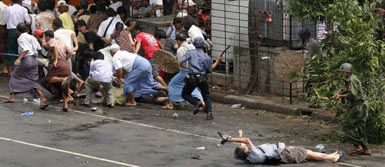
A Burmese photographer dies ....

Yes, we have got used to nasty regimes, and to states sucking up to their psychopathic gangster leaders, but there are limits, surely?

Why is the British Prime Minister grovelling to India (and by the way grossly insulting Pakistan at the same time) when India is laying out the red carpet for the Burmese murderer?

I don’t think “murderer” is too strong a word. Apart from all the usual and well-documented pogroms against minorities (remind anyone of Hitler?) the Burmese mafia government refused to allow international aid agencies to help after the catastrophic 2008 cyclone, the worst in Burma’s history. This condemned hundreds of thousands of Burmese citizens to heartless, needless suffering and certainly cost many lives.

Well, above I asked “why”?

Of course, it’s for selfish national interest. India wants access to Burma’s natural resources, especially oil, while Britain wants industrial contracts with India. Cynics would say Cameron succeeded; a follow-on deal for India to buy British Hawk trainer fighters has just been announced.

But why am I reminded of Goethe’s “Faust”? Is it really worth selling our soul to the Devil (indirectly condoning India’s sickening sycophancy to the Burmese Fuehrer) for the sake of some British jobs? A confirmative answer would seem to suggest that ethics in foreign policy is well and truly dead.

Once again, a vicious dictatorship flourishes by divide and rule. Where is the united international front that might help to put an end to our fellow-humans’ suffering? We managed this unity to help end South African apartheid; have our moral standards declined so much since then?

PS South Africa? Oh weep …. In January 2007, Russia and China vetoed a draft resolution before the United Nations Security Council calling on the government of Myanmar to respect human rights and begin a democratic transition. South Africa also voted against the resolution.

Still, they put on a good World Cup, so that’s all right then ……

By Chris Snuggs
Here’s a question on financial regulations, but only for the brave.

Here’s a thought for Basel.

Per Kurowski has been a loyal follower and supporter of this Blog and I’m indebted to him for this.  Per writes the Blog

Per Kurowski

Tea with FT (Financial Times) but his busy life seems to allow sufficient space for the odd comment on Learning from Dogs.

Here’s what Per wrote as a comment to the recent Post entitled, “Is thinking going out of fashion?“.  It seem worthy of being a guest post.

In reference to courage, here is a question on financial regulations, only for the brave.

Currently the financial regulators in the Basel Committee requires the bank to hold 8 percent when lending to unrated small businesses and entrepreneurs but only 1.6 percent when lending to triple A rated clients.

What would have happened if exactly the opposite capital requirements had been imposed? The banks having to hold instead 8 percent in capital when lending to triple-A rated clients and only 1.6 percent when lending to unrated small businesses and entrepreneurs.

It would most surely have created problems, any regulatory discrimination does, but I hold that a crisis as large as the current one would not have happened… since no gigantic financial crisis has ever resulted from excessive lending to those who are perceived as risky, they have always resulted from excessive lending to those who are perceived as not risky.

We could also have had a lot more of jobs, since almost always the next-generation of decent sustainable jobs is to be found among the current small businesses and entrepreneurs.

Our biggest financial systemic risk is without any doubt our financial regulators.

The Verdict!

A nearly 30-year old film has real relevance for today!

Those of you that read yesterday’s Post right through to the end will have picked up on the fact that after completing that article last Friday, Jean and I watched the movie The Verdict.

Amazingly, this powerful film was released on the 8th December 1982.

So why the connection between the film and the Post written yesterday?

Well yesterday I wrote about two recent examples of, at best, a terrible lack of integrity, or, at worst, blatant examples of powerful institutions lying to us.  It troubled me greatly and I found no adequate way of closing the Post expressing my troubles in a succinct and fitting way.  Stay with me for a few moments.

In the film The Verdict, Paul Newman plays Frank Galvin – here’s the synopsis from the IMDb website:

Frank Galvin is a down-on-his luck lawyer, reduced to drinking and ambulance chasing. Former associate Mickey Morrissey reminds him of his obligations in a medical malpractice suit that he himself served to Galvin on a silver platter: all parties willing to settle out of court. Blundering his way through the preliminaries, he suddenly realizes that perhaps after all the case should go to court: to punish the guilty, to get a decent settlement for his clients, and to restore his standing as a lawyer.

As one might have guessed, Galvin wins the case against all the odds, which doesn’t in any way reduce the power of the film.  Newman was brilliant.

Tackling a medical malpractice case that could revive his once glorious career, attorney Frank Galvin (Paul Newman) questions a key witness, Dr. Thompson (Joe Seneca), in the compelling courtroom drama The Verdict.

At the end of the hearing Galvin rises to give his summation.  Technically the case appears utterly lost to his side.  Galvin slowly stands, hesitantly looks as his notes, cast the sheet aside and reluctantly addresses the jury.

You know, so much of the time we’re just lost.

We say, “Please, God, tell us what is right; tell us what is true.” And there is no justice: the rich win, the poor are powerless. We become tired of hearing people lie.

And after a time, we become dead… a little dead. We think of ourselves as victims… and we become victims. We become… we become weak. We doubt ourselves, we doubt our beliefs. We doubt our institutions. And we doubt the law.

But today you are the law. You ARE the law. Not some book… not the lawyers… not the, a marble statue… or the trappings of the court. See those are just symbols of our desire to be just. They are… they are, in fact, a prayer: a fervent and a frightened prayer. In my religion, they say, “Act as if ye had faith… and faith will be given to you.” IF… if we are to have faith in justice, we need only to believe in ourselves. And ACT with justice. See, I believe there is justice in our hearts.

Now go back and read my Post of yesterday.  Read of the Citi executives paying token fines for lying to investors.  Read of the allegation that the 2009 data set in the US GDP report was a “bald-faced lie”.

Now read again, aloud to yourself if you can, the first few sentences of Galvin’s summation.  Here they are again (my emphasis).

You know, so much of the time we’re just lost.

We say, “Please, God, tell us what is right; tell us what is true.” And there is no justice: the rich win, the poor are powerless. We become tired of hearing people lie.

And after a time, we become dead… a little dead. We think of ourselves as victims… and we become victims. We become… we become weak. We doubt ourselves, we doubt our beliefs. We doubt our institutions. And we doubt the law.

I firmly believe that this is where millions of ordinary, hard-working, caring citizens of many countries have arrived today because of the lack of integrity, the lack of honesty and the lack of grace shown by so many in positions of power and privilege.

But do not despair because if we do that, then all is lost.  No, believe in the power of good men.  Back to the summation from the film:

In my religion, they say, “Act as if ye had faith… and faith will be given to you.” IF… if we are to have faith in justice, we need only to believe in ourselves. And ACT with justice. See, I believe there is justice in our hearts.

Exactly!

By Paul Handover

Of the people, for the people – huh!

It’s enough to make one weep!

Gettysburg Address

Just a couple of items from disparate sources came together last Friday to demonstrate just how possibly corrupt it has been over the last so many years!  But there is a golden lining to this stuff.

That is the ever increasing spread and reach of all forms of digital communications, from the humble email through to Wikileaks, is making it increasingly difficult for those that wish to cheat and lie their way through their lives, at the expense of others, to do so without detection.

Anyway, back to the theme of the Post.

The first item is from here (thanks to Naked Capitalism for the link):

Under the article title of – The Wages of Sin: Former Citi Execs Pay Token Fines for Lying to Investors

A news story today provides further confirmation of the rule by the banking classes in the US, with only token gestures to the rule of law.
(and after an in-depth review closes with:)
The message seems pretty clear. Sarbox [Sarbanes-Oxley Act. Ed]was intended to curtail phony corporate accounting in the wake of Enron. But why resort to complicated transactions like the energy company’s famed Raptors when Citi shows that mere lying will produce the same results with much less fuss?

The second from Karl Denninger, from which closes with these words are offered: GDP Report: Liar Liar Pants on Fire:

All three years of the revision period were revised down. Again, if a mistake or inaccuracy (as opposed to intentional falsehood) is responsible for errors, one would expect them to be normally distributed – that is, some would be positive, some negative.  This is obviously not the case.

Is there any good news in the report?  Well, yes – there was a material uptick in non-residential fixed investment, centered around equipment and software.  How much of this is a normal replacement cycle (deferred last year) and how much signifies real expansion is an open question and one not easily answered.  However, I wouldn’t call this particularly “robust”, despite the pump monkey characterization this morning in the media.

The drops in some of the previously-published numbers were, however, simply stunning.  For example, PCE (personal consumption) was previously reported for Q1/2010 as 2.13.  The revision is 1.33, a thirty percent downward revision.  That’s not an error, it was a falsehood.

Worse was the services false report.  The previous reported number for Q1/2010 was 0.69.  Revised was 0.03, a downward revision of ninety-five percent.

The services revision backward was truly sickening – the entirety of 2009 was negative with the exception of the fourth quarter, where all but the first was previously reported positive, and the changes were ridiculous.  First quarter was revised down from -0.13% to -0.75%, second from +0.09% to -0.79%, and so on.  Again, that’s not an error, it’s a lie.

Needless to say when I get all my graph source data updated, it’s going to look worse than it did – including my “government ponzi support” graph, one of my favorites.

The futures are diving on the report, as well they should.  Not because it’s bad – but because the entirety of the 2009 data set was a bald-faced lie.

Frankly, I’m much less interested in what is happening to Western economies – my views have been regularly reported on Learning from Dogs.

What appals me is how far we seem from those famous words in the Gettysburg Address given by President Abraham Lincoln on the afternoon of Thursday, November 19, 1863 (my emphasis):

It is rather for us to be here dedicated to the great task remaining before us—that from these honored dead we take increased devotion to that cause for which they gave the last full measure of devotion—that we here highly resolve that these dead shall not have died in vain—that this nation, under God, shall have a new birth of freedom—and that government of the people, by the people, for the people, shall not perish from the earth.

Pres. Lincoln's words

P.S. As it happens, after finishing this article last Friday, Jean and I watched the film The Verdict in the evening.  The words used by the lawyer Frank Galvin (Paul Newman) in his summation struck me so powerfully that I have made them a separate Post for tomorrow.
By Paul Handover

More on those noctilucent clouds

Otherwise known as Night Shining Clouds

There was an article on Learning from Dogs on July 22nd about these mysterious and beautiful clouds.

This is just an update to show you an example of photographs taken by Finn Jari Luomanen over the night of the 29th-30th July. All the pictures may be seen here – they are of this quality:

2010_07_29-30 Mesoscale convective system

Here’s what Jari said about this night:

This mesoscale convective system sweeped over Finland with ferocious energy. The day before was historical as a record breaking temperature of 37,2 degs Celsius was recorded. The MCS proved to be a good match.

Thunderstrikes happened every two seconds at the peak and it was difficult to expose correctly due to the multiple strikes in each exposure.

Noctilucent clouds shone above the swiftly moving cell creating an eerie electric blue backdrop for the spectacle.

Never before have I seen anything close to this. I was jumping behind the tripod firing away in the hot, humid night. Since when has Finland turned into tropics?

This is a very beautiful planet!

By Paul Handover

Is thinking going out of fashion?

Another Yves Smith special!

Many will know that Naked Capitalism is a wonderful Blog and what Yves does is truly amazing.  (And a big ‘thank you’

Yves Smith

to Richard Smith who so ably stood in for Yves on her recent European trip.)

On the 29th July this year, Yves reran an article that she posted on May 11th, 2007.  It’s spot on, in my opinion.

Here’s how Yves starts the Post:

I am beginning to suspect that many are reacting to the over-stimulation of the modern world – the accelerating pace of change, data overload, time pressure, work and relationship instability – by turning off their brains. The rise of fundamentalism and the “family values” push, both efforts to turn back the clock, is one set of responses.

Another is the rise of sound-biting, of using pithy communications to cut through the clutter of the daily information assault. But sound biting is inherently reductionist. It doesn’t permit nuanced argument, or pointing out fuzziness in data, or shades of grey. Sound bites are great for simple, emotional appeals, lousy for policy development (which is one reason why this country seems incapable of having an intelligent discussion on important topics like health care. The public has been trained out of having a long enough attention span to listen to alternatives).

That is so true. Just re-read the sentences, “But sound biting is inherently reductionist. It doesn’t permit nuanced argument, or pointing out fuzziness in data, or shades of grey.” (My italics.)

We live in such a complex world that reducing any important idea or concept to a headline or to an executive summary is, in its own way, significantly short on integrity.

That article from Yves concludes thus:

Most businesses operated in competitive environments far too complex for a terse phrase to be a useful guide to action. Yet a magic incantation, a talisman, a battle cry is terribly appealing. But those who can resist the temptation of relying on a simple playbook and face the complexity and uncertainty of their environment are likely to steer a better path. But understanding risk and adapting also demands far more courage that trusting simple ideas.

Ironically, if one reflects for a moment, that closing sentence is a pretty good executive summary! “…… understanding risk and adapting also demands far more courage that trusting simple ideas.

Precisely!

By Paul Handover

Unintended Consequences

A modern Greek tragedy – that could have been foreseen.

As I tried to point out in a recent Learning From Dogs post, foreign policy is an extremely complicated thing.  This sounds self-evident, but it’s amazing the extent to which certain officials think they can control events occurring around the world.

I like to characterize US foreign policy in the Middle East as throwing rocks at a hornet’s nest, and then expecting to be

Unintended consequences

able to control the hornets when they emerge.  The consequences of intervention are so many, so widespread, so complicated, and so unforeseen that no one can hope to be able to manage them, without inevitably intervening even more and thus fueling even more unintended consequences.  (You can see a strong parallel between the overconfidence of government officials in the area of foreign policy and their attitude in areas of attempted economic control.  But, that’s a separate discussion.)

Thanks to the wonderful (in my opinion) people at WikiLeaks, we have been able to see a much more realistic picture of the war in Afghanistan than has so far been available.  CNN reports on one element of these reports that is none other than one of these most unintended of consequences — some of the most advanced military technology in our country’s arsenal falling into the hands of…well we’re not really sure who.  CNN reports:

When unmanned aircraft crash in Afghanistan, scavenger hunters frequently aren’t far behind, U.S. military incident reports published by WikiLeaks suggest.

On several occasions, military units sent to recover the aircraft — known as tactical unmanned aerial vehicles — have arrived to find the aircraft stripped of valuable parts.

In April 2007, a parachute deployed on one that had maintenance issues, one report says. Troops sent to recover the aircraft couldn’t reach it until the next day, when they discovered it was missing some of its electronic components and its payload.

Is this a surprise?  For me, no!

For those who oversimplify foreign policy to international powers moving on a chess board, yes.  Government officials often forget that at the end of the day we are not dealing simply with “the Taliban” or “Al Qaeda” — we are dealing with individual human beings.

And while the Taliban and Al Qaeda as groups may seem predictable, individual human beings are essentially the most advanced supercomputers ever to exist on this planet.  To think that one can predict the actions of human beings on the other side of the world, especially human beings whose culture and background one hardly understandings, is nothing but the highest form of hubris.

And, just like in Greek tragedy, the hubris comes just before the fall, when it turns out that the prideful character did not have everything under control, and in fact is the victim of consequences that he was too prideful to foresee or even consider as a possibility.

By Elliot Engstrom

Dogs ‘copy’ their owners

More evidence that shows there’s more to dogs than we realise.

Earlier on this year, a series of Posts was published on Learning from Dogs based on a science programme on the BBC (BBC Horizon) that revealed the degree of sophistication that is inherent in these clever animals.

This is the link to that article.  Unfortunately the YouTube videos have now been removed but there are some clips available on the BBC website here.  As the programme was introduced:

We have an extraordinary relationship with dogs – closer than with any other animal on the planet. But what makes the bond between us so special?

Research into dogs is gaining momentum, and scientists are investigating them like never before. From the latest fossil evidence, to the sequencing of the canine genome, to cognitive experiments, dogs are fast turning into the new chimps as a window into understanding ourselves.

Anyway, all this is a lead in to an item on the news today regarding a study into dogs by the University of Vienna.

Dogs “automatically imitate” the body movements of their owners, according to a study.

This automatic imitation is a crucial part of social learning in humans.

But Austrian researchers report that the phenomenon – where the sight of another’s body movement causes the observer to move in the same way – is evident in many other animals.

They say that it reveals clues about how this type of learning evolved.

The study, which was led by Dr Friederike Range from the University of Vienna in Austria, also suggests that the way in which people interact with and play with their dogs as they are growing up shapes their ability to imitate.

The phenomenon under investigation is known as "selective imitation" and implies that dogs -- like human infants -- do not simply copy an action they observe, but adjust the extent to which they imitate to the circumstances of the action. (Credit: iStockphoto/David Brimm)

There’s more to the news release on Science Daily from which is quoted:

New research by Friederike Range and Ludwig Huber, of the University of Vienna, and Zsofia Viranyi, of the Eötvös University in Budapest, reveals striking similarities between humans and dogs in the way they imitate the actions of others. The phenomenon under investigation is known as “selective imitation” and implies that dogs–like human infants–do not simply copy an action they observe, but adjust the extent to which they imitate to the circumstances of the action.

By Paul Handover

Mau Piailug

A Pacific master navigator sails into the sunset

The Economist, for me, is one of the great newspapers of our time.  I have often referred to it on Learning from Dogs.

Last Saturday’s edition (July 24th – 30th 2010) carried a most beautiful obituary about Mau Piailug who in 1976 demonstrated that ancient seafarers could indeed have voyaged from Hawaii to Tahiti, a distance of some 2,500 miles, before the age of compasses, sextants or charts.  Here is an extract from that obituary (you may need to register to view it):

As a Micronesian he did not know the waters or the winds round Tahiti, far south-east. But he had an image of Tahiti in his head. He knew that if he aimed for that image, he would not get lost. And he never did. More than 2,000 miles out, a flock of small white terns skimmed past the Hokule’a heading for the still invisible Mataiva Atoll, next to Tahiti. Mau knew then that the voyage was almost over.

On that month-long trip he carried no compass, sextant or charts. He was not against modern instruments on principle. A compass could occasionally be useful in daylight; and, at least in old age, he wore a chunky watch. But Mau did not operate on latitude, longitude, angles, or mathematical calculations of any kind. He walked, and sailed, under an arching web of stars moving slowly east to west from their rising to their setting points, and knew them so well—more than 100 of them by name, and their associated stars by colour, light and habit—that he seemed to hold a whole cosmos in his head, with himself, determined, stocky and unassuming, at the nub of the celestial action.

Mau Piailug creating model of his canoe - Steve Thomas Photo

Here’s an extract from the website Suite101.com:

Mau Piailug was born in 1932 on Satawal, a tiny Pacific island no wider than a mile in Micronesia. When he was still a little baby, his grandfather put him in a tide pool as though he were putting him in a cradle. There the sea gently rocked him back and forth with the rhythm of the tides.

When Mau was six, his grandfather began to teach him about navigation. He started by telling him about the stars; the grandfather made a star compass out of a circle of coral rocks, and in the center he put a little canoe he had made of palm fronds. Then he explained how the stars rose in the sky and traveled from east to west.

As he grew older, Mau spent his evenings in the canoe house. There he asked the elders to teach him about navigation. In this way, and with his grandfather’s help, he learned the paths of more than a hundred stars. He also learned that when clouds covered the sky, he could use the direction of the ocean waves to guide the canoe. He could also follow the birds toward land when they headed home in the evening, and he studied the creatures of the sea, for in times of trouble they, too, could help him find land.

A film was made about Mau called The Last Navigator.  Do click on the link and read more about what Steve ‘learnt’ from Mau – here’s a closing taste:

It has been nearly fifteen years since I first met Piailug. In that time I have been blessed with relative fame and prosperity – an eventuality, by the way, that Piailug foretold to me. As I look back, I am impressed now by the twin qualities in the man that impressed me then: his generosity and his courage. Piailug took me into his family, assumed responsibility for my material and political well-being, and taught me his navigation without reserve. The knowledge he gave me about navigation is considered priceless in his culture. The knowledge he gave me about myself, I have come to see, is priceless as well. I often think of Piailug, and the fierceness and determination with which he defends a way of life he knows will die as the wise elders died. He has the courage to live and teach and voyage in spite of the certain knowledge that his struggle can never stem the tide of Westernization, which will change the character of his archipelago and may well eliminate the very role of the navigator as steward of his island’s sustenance and keeper of the flame of cultural knowledge.

Mau - asleep in the waves

A remarkable man.

By Paul Handover

Our economic outlook – where to?

The fundamentals always win, in the end!

Those that know me or have followed Learning from Dogs for the last year (and thank you!) know that I am pretty pessimistic about the economic future for North America and Europe (at least!).  I speak not as an economist, far from it, but as someone sufficiently old to think that many millions of individuals and their countries have been living on borrowed time for decades.

David Kauders

Twenty years ago I didn’t really do anything than feel uncomfortable when friends announced another new house with mortgages far in excess of the old ‘rule’ of 1.5 to 2.0 times one’s annual income.

Then I came across David Kauders of Kauders Portfolio Management who explained in fundamental ways why this was all going to end in tears, so to speak.  Wasn’t he right!

Thanks to David, I am moderately more well-off than I would have been – without a doubt.  Not only did David manage my private pension, he greatly influenced my modest personal investments outside his portfolio.

Where’s this heading?  This Blog is an attempt to show that integrity in all that we all do is not only the best personal strategy, it is the only viable course for mankind in bringing us back from the brink of global disaster.  So a couple of recent items about economic matters from people of great integrity underlined the value of mentioning them in this Blog.

The first is a talk given by Elizabeth Warren two years ago, in January 2008, entitled The Coming Collapse of the Middle Class.  It’s nearly an hour long but very well worth watching especially in the way that Ms. Warren shows how counter-intuitive is our understanding of how family costs have risen over the last 30 years.  Although it applies to the US, it certainly has relevance for British viewers.  Do watch it.

Here’s how the video is described:

Distinguished law scholar Elizabeth Warren teaches contract law, bankruptcy, and commercial law at Harvard Law School. She is an outspoken critic of America’s credit economy, which she has linked to the continuing rise in bankruptcy among the middle-class.

Next is that stalwart Karl Denninger.  How he finds the energy and enthusiasm for publishing his Market Ticker is beyond me.  He’s not subtle but his personal integrity is beyond reproach in my opinion.

Karl was recently interviewed by Bill Still (Bill produced the highly acclaimed film The Money Masters) and despite the videos being heavily edited Karl says “and for the most part accurately captures my views on the topics covered.”

Again these interviews are not short but, again, if you want to understand how dangerous the fundamentals still are – then watch them.

Karl Denninger, author of Market Ticker and winner of the 2008 Reed Irvine Accuracy in Media Award explains the roots of the current crisis and why real economic growth is impossible. He explains why the stock market rebounded in 2009 and why that can’t continue. He explains what needs to be done with the banks and predicts that all the big banks will fail.

Part One:

Part Two:

Finally back to David Kauders.  He also publishes an opinion website Contrary View. Here’s what David wrote in February 2010.

No. 73 22nd February 2010 Predicting lost decades

There is plenty of evidence from Japan about lost decades for investments. Japan has now lost two decades in equity and property investment, during which time only Government Bonds provided any sanctuary. All policy options failed, because none tackled the real problem, which is that there is already too much debt. What lessons can be drawn for Britain?

Shares here have certainly had a lost decade. On the Japanese evidence, they may well suffer another lost decade. Property has only hit minor bumps, so the Japanese experience suggests that property may suffer a long decline for two decades. In the UK, the Bank of England’s support for mortgages will be withdrawn over the next two years, which itself threatens prices. Why, though, the hysteria about Government debt?

It is questionable whether pundits appreciate the extent of the private sector debt problem, which explains why two groups of economists can offer totally contradictory remedies. In a world with no Gold standard and therefore no anchor to the monetary system, Government debt is relatively safe. The global economy is perched on a knife edge, with a permanent loss of output that must cause income loss and therefore restrict the capacity of households to service their debts. Seeing the commercial risks, banks are still restricting lending, which means there can be no sustained recovery.

There is a misconceived demographic argument being touted at present, which completely ignores the real driver of the post-1945 expansion, namely increased credit. That credit growth has simply gone too far and now brings its own problems. For those people who neither saw the credit crunch nor the long fall in interest rates and inflation coming, to now be credible in predicting a lost decade for bonds, is itself unbelievable.

You see how it all makes sense – the fundamentals are in charge, and always will be!

You be safe out there!

By Paul Handover