Many thanks to close friend Dan G for forwarding this – it’s priceless!
Year: 2010
Quiet Blog day
So here’s a nice distraction- thanks to Sherry Jarrell who sent them to me.

There are about 23 or 24 pictures on the theme of what dogs mean to humans and every odd day or two over the Christmas period, you can enjoy one of them.
Here’s the first:
A ‘steady’ relationship with Planet Earth
Perpetual economic growth is neither possible nor desirable. Growth, especially in wealthy nations, is already causing more problems than it solves.
Recession isn’t sustainable or healthy either. The positive, sustainable alternative is a steady state economy.
These are the opening sentences that one sees when going to the CASSE website. CASSE is an acronym for Centre for the Advancement of the Steady State Economy. More on this organisation as I spend more time getting to know the background. But my instinct is to support it, hence the reason it is the subject of a Post on Learning from Dogs.
With the permission of CASSE I am re-publishing something that was on the CASSE Blogsite recently. Well worth signing up to, in my humble opinion.
Anyway, the article is called From Black Friday to a Better Way and is written by Brent Blackwelder who, among other things, was recent President of Friends of the Earth.

From Black Friday to a Better Way
Rethinking Consumer Spending and Enjoying the Holidays
by Brent Blackwelder
The day following Thanksgiving Day in the United States is called Black Friday. For retailers the day marks the beginning of the Christmas shopping season. While the origin of the term is debated, it is today associated with special sales and extraordinary promotions that retailers use to induce shoppers into spending the holiday weekend on a shopping spree.
Our modern economy is structured such that its stability depends upon ever increasing consumer spending. In my first economics course in college in 1961, the professor told the class to go out and shop because it is good for the gross national product (GNP). Then and now, mainstream economics continues to treat the Earth as if it were a business in a liquidation sale.
At a time of high unemployment in the United States, it may seem like an act of madness to question the growth economy, but relentless pursuit of growth has failed to deliver again and again on the promise of economic stability and security. Its recipes are not making people any happier, and it is undermining the ecological life support systems of our planet. It has failed about one third of the world’s population who live on less than $2 per day, while simultaneously producing an exclusive club of gratuitously wealthy individuals. Those of us advocating a steady state economy seek a new way to maintain full employment that does not incentivize employers to seek dirt-cheap labor or to replace people with machines.
Professor Tim Jackson’s 2009 report to the UK Sustainable Development Commission entitled Prosperity without Growth provides an outstanding foundation for any discussion of consumerism and the growth economy. For those interested in a steady state economy, it is worthwhile to think in this holiday season about the nature of shopping in such an economy.
Throughout history religious leaders have expressed concerns about the accumulation of stuff. Two thousand years ago Jesus cautioned about excessive attention to material possessions, saying: “Lay not up for yourself treasures on earth where moth and rust doth corrupt and where thieves break through and steal.”
Over 100 years ago the economist and philosopher John Stuart Mill recognized that eventually humanity would have to move toward a stationary state of capital and wealth, but that condition need not entail a stagnation of human improvement.
Two centuries ago the poet William Wordsworth expressed alarm at the consumerism he witnessed in England: “The world is too much with us, late and soon. Getting and spending we lay waste our powers. Little we see in nature that is ours. We have given our hearts away…”
Today’s economy is five times bigger than in the 1950s, and at current growth rates stimulated by commercial promotions, it is headed to a global economy 80 times as large.
The consumer rampage is in part fueled by slick advertising for novel consumer products, and much of this advertising is targeted at youth. Ralph Nader questions who is watching what young people worldwide are being enticed to buy? He writes: “Undermining parental authority with penetrating marketing schemes and temptations, companies deceptively excite youngsters to buy massive amounts of products that are bad for their safety, health and minds.”
Excessive packaging accompanying today’s products attracts ecological criticism, but it is only the tip of the iceberg in terms of waste. The volume of raw resource extraction required in the manufacture of products dwarfs the packaging waste. For example, many mining operations for valuable metals leave behind as waste over 90% of the material excavated, and such rocky rubble often releases a mass of toxicity onto the land and into the water.
Has happiness been improved by having all these products? Studies over the past two decades have suggested that a certain amount of material comfort and ease provided by various products increases one’s happiness, but beyond a certain point – one study suggested $75,000 income – more stuff doesn’t produce more happiness. In fact, it can yield the perverse result of adding stress, worry and depression.
It is amazing that times of holiday celebration in the United States are frequently the very times of peak stress. What should be a fun and cheerful experience becomes a week or even a month of worry.
The holiday season is a good time to reexamine the kinds of purchases we make to see whether they are reducing the use of natural resources and encouraging more sustainable ways of growing food and conducting commercial business.
Many religious congregations are looking toward a different approach to reclaim the holidays from preoccupation with material gifts. Some offer ways to reduce the volume of purchasing and to make different kinds of purchases that reduce throughput and pollution.
For example, Interfaith Power and Light seeks to get religious congregations to purchase renewable energy and to reduce energy use in their homes and their places of worship. Through Greater Washington Interfaith Power and Light, our family now purchases all our electricity, sourced from wind farms, at a surcharge of about $130 a year.
By voting with their food dollars many Americans have already sent powerful signals in favor of local farm markets and organic food. With some due diligence, people can determine whether their purchases lend further support to child labor and slave conditions, whether the purchases harm women or empower women, and whether the product came from an animal-slum factory farm operation. The Fair Trade label allows consumers to identify imported products that avoid harmful labor and environmental degradation in their manufacture.
We have options. We can do better than liquidating our natural bounty for consumer novelty, we can refrain from pitching unnecessary products to our children, and we can stop pursuing growth for growth’s sake. The steady state economy is a better choice than continuous pursuit of economic growth, but the transition starts with better choices about what and how we consume.
If you didn’t read yesterday’s Post touching on the second bitterly cold winter in Europe, then you may care to read it and ponder.
By Paul Handover
Basic geometry
North-West Europe’s Winter weather.
As I write this article, the temperature in London (it’s 5pm on Tuesday 14th.) is 4 deg C/ 38 F heading down to a forecast -2 deg C/28 F overnight. Similarly cold temperatures are forecast during the rest of the week.
Here’s something that was published in October:
Coldest winter in 1,000 years on its way
04 October, 2010, 22:20
After the record heat wave this summer, Russia’s weather seems to have acquired a taste for the extreme.
Forecasters say this winter could be the coldest Europe has seen in the last 1,000 years.
The change is reportedly connected with the speed of the Gulf Stream, which has shrunk in half in just the last couple of years. Polish scientists say that it means the stream will not be able to compensate for the cold from the Arctic winds. According to them, when the stream is completely stopped, a new Ice Age will begin in Europe.
So far, the results have been lower temperatures: for example, in Central Russia, they are a couple of degrees below the norm.
“Although the forecast for the next month is only 70 percent accurate, I find the cold winter scenario quite likely,” Vadim Zavodchenkov, a leading specialist at the Fobos weather center, told RT. “We will be able to judge with more certainty come November. As for last summer’s heat, the statistical models that meteorologists use to draw up long-term forecasts aren’t able to predict an anomaly like that.”
In order to meet the harsh winter head on, Moscow authorities are drawing up measures to help Muscovites survive the extreme cold.
Read the rest of the article here.
So why the heading for this Post, as in Basic Geometry?
Because places on the Globe are measured using Latitude and Longitude. Let’s look at the Latitude of some places:
London 51°30′N
Calgary, Alberta 51°03′N
Kiev, Ukraine 50°27′N
Krakow, Poland 50°03′N
Now let’s look at those Cities again with the current temperatures (you have to accept the local time differences):
London 51°30′N +4 deg C
Calgary, Alberta 51°03′N -9 deg C
Kiev, Ukraine 50°27′N -6 deg C
Krakow, Poland 50°03′N -12 deg C
In other words, Britain enjoys, or should enjoy, a much warmer Winter than most other places of the same or similar latitudes because of the effect of the Gulf Stream.
Just a muse!
By Paul Handover
The good old flying days!
Lovely story courtesy of Capt. Robert Derham
The scene is sometime in the old era when cockpits had round dials plus flight engineers and navigators.
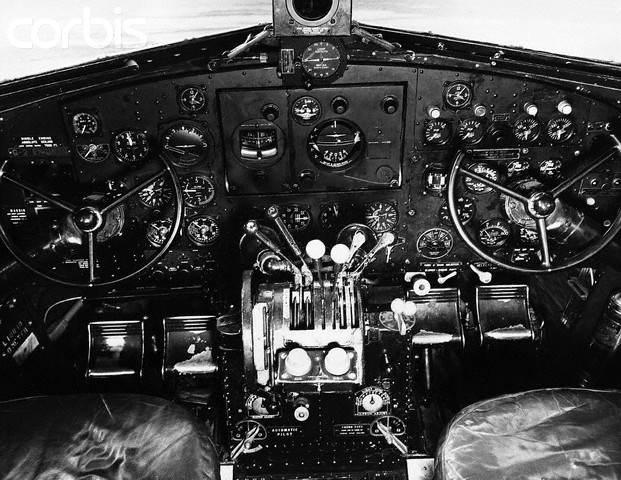
The crusty old-timer captain is breaking in a brand new navigator.
The captain opens his briefcase, pulls out a .38 and rests it on the glare panel. He asks the navigator, “Know what this is for?”
“No, sir,” replies the newbie.
“I use it on navigators that get us lost,” explains the captain, winking at his first officer.
The navigator then opens his briefcase, pulls out a .45 an sets it on his chart table. “What’s THAT for?” queries the surprised captain.
“Well, sir,” replies the navigator, “I’ll know that we’re lost before you will.“
Essence Of The Civilizational Crisis.
A guest Post from Patrice Ayme.
(Well I say ‘guest’ in the sense that Patrice has very kindly allowed me to publish a post he recently published on his own Blog. It’s very much appreciated. I should add that the minor changes that I have made, in my editorial role, are gently to improve the clarity of this fine piece of work, not in any way to amend meaning. Ed.)
THE PRIVATIZATION OF MONEY CREATION IS THE ENGINE OF PLUTOCRACY.
To understand the present financial and economic crisis, we need the clarity of deep philosophy.
The situation is actually simple, in its grossest outline. To create public money, the money everybody uses (be it cash, electronic transfers, swaps, whatever) we use a private system, with proprietary money creating devices inside (say subprime, or derivatives). Civilization has never worked this way before, as the state previously was careful to stay the one and only money creator.
Now society, worldwide, uses a privately-managed public-money ‘system’ creating what is known as a fractional reserve system. [Wikipedia explanation of fractional reserve system, Ed]
That puts huge power in the hands of underground private individuals we don’t even know the names of. Those cloaked powers in turn corrupt the visible political socio-economy, from below. The whole metastasis is not even described, because intellectuals would have to do so, but most are paid by institutions subservient to the present global corruption.
We saw a similar situation in the Roman empire, when the intellectual class was at its richest, but its critical ability had been corrupted.
The modern banking system is a Faustian bargain (as in a deal with the Devil) with the bankers; in exchange for the immense powers the private bankers were given with money creation, they were supposed to loan it back to society for its development.
This worked reasonably well in the Nineteenth Century. But in the Twentieth Century, bankers observed they could support fascism regimes, and get away with it (only Dr. Schacht, one of the “Lords of Finance”, sat in Nuremberg tribunal, and he was exonerated). Now bankers think they can engineer a depression, and get even richer from it: just keep the profits, and make taxpayers pay for the losses.
By Patrice Ayme
Note 1: Paul Krugman observes, with many others, that the crisis of the West needs “intellectual clarity” to be resolved, and, meanwhile we are “overmatched“. I made preceding comment in answer to Krugman’s cogent remarks. (The New York Times had the kindness to publish what I wrote within two minutes! )
Note 2: HOW THE FINANCIAL CRISIS IS TURNING CIVILIZATIONAL:
China just established another train speed record for “unmodified’ train sets (481 km/h). OK, some will claim China stole a lot of Japanese and European technology. And some French engineers have sneered that the very high speed system in China is not as high performing as it looks (France has much higher average speeds, the highest in the world). However, this is not the point. The point is that China is trying very hard to progress and improve. Meanwhile some of the colossal technological edge of the West is eroding away quickly. The result will be world war, or global plutocratic peace (as plutocracy furthers its deal with China).
How does China improve so much and so fast? Because Chinese banks, the largest in the world, operate according to the fiduciary duty, the Faustian bargain, that the fractional reserve system ought to impose, and used to impose in the West.
Top Chinese bankers know all too well that if they cheated, they may end up with a bullet in their skull. China is led by scientists and engineers who turned to politics, but know that they cannot make mistakes in their calculations. Mao made many mistakes, and dozens of millions died.
The history of China, in the 26 centuries before that, was spoiled by a well meaning, but meek philosophy, which left too small a place to deliver progress of the material, and intellectual kinds.
Civilization is not about “leaving it at that”, the way Confucius mostly had it. Civilization is also about the dream, and implementing it. Indeed, civilization cannot stand still, anymore than a biker can stand still, because resources run out always (as Rome and the Mayas found out). Thus moving on is the price of sustainability. Progress is the price of sustainability.
Note 3: It may seem a curious thing that Karl Marx did not make a strident version of the preceding critique (instead he modestly accused tangentially bankers of “monopoly” powers).
But this Marxist discretion proves the point I alluded to above, namely that bankers were better behaved in the 19C. So Marx talked about other things.
Ironically, early American presidents had perfectly well seen the danger bankers posed, and worried more about them than Marx himself! And let no one call Andrew Jackson a communist: that would be serious mistake…
In the 21st Century, by capturing the states (USA, EU), and various institutions above them (IMF, World Bank, BIS), the bankers have established a monopoly of power early American presidents rightly feared (and Jackson, wounded at 13 by an English sword, later a proud carrier of several bullets, and a general in the field, feared very little). The wise know what to fear. The mentally simple just smile, thinking only about themselves, as they can’t think much further than that.
*********************************
From the Ed.
Dear Readers, I really hope that you read Patrice’s post in full and in a quiet place where you could reflect on the meaning and underlying implications of what Patrice is saying. Those in the UK may have been able to watch a typically fabulous BBC Television series, Ancient Worlds. It’s still available on BBC iPlayer.
What comes out from the message of mankind over the centuries is that wonderful French expression plus ça change, plus c’est la même chose – the more that changes, the more it stays the same thing. But where we are as we approach the New Year of 2011 A.D. is possibly at a cross-roads – and I intend to write a little more on this idea over the coming days.
 Learning from Dogs