The series is called Naturebang: “Becky Ripley and Emily Knight make sense of what it means to be human by looking to the natural world… Science meets storytelling with a philosophical twist.“
There are 35 episodes. I particularly liked the episode broadcast yesterday about the Clams.
“How do we extract the maximum amount of power from the sun? Becky Ripley and Emily Knight enlist the help of a giant, thousand-year old clam. And end up in the depths of space…
Featuring Professor Alison Sweeney at Yale University, and Mike Garrett from the Jodrell Bank Centre for Astrophysics.
Produced and presented by Emily Knight and Becky Ripley“
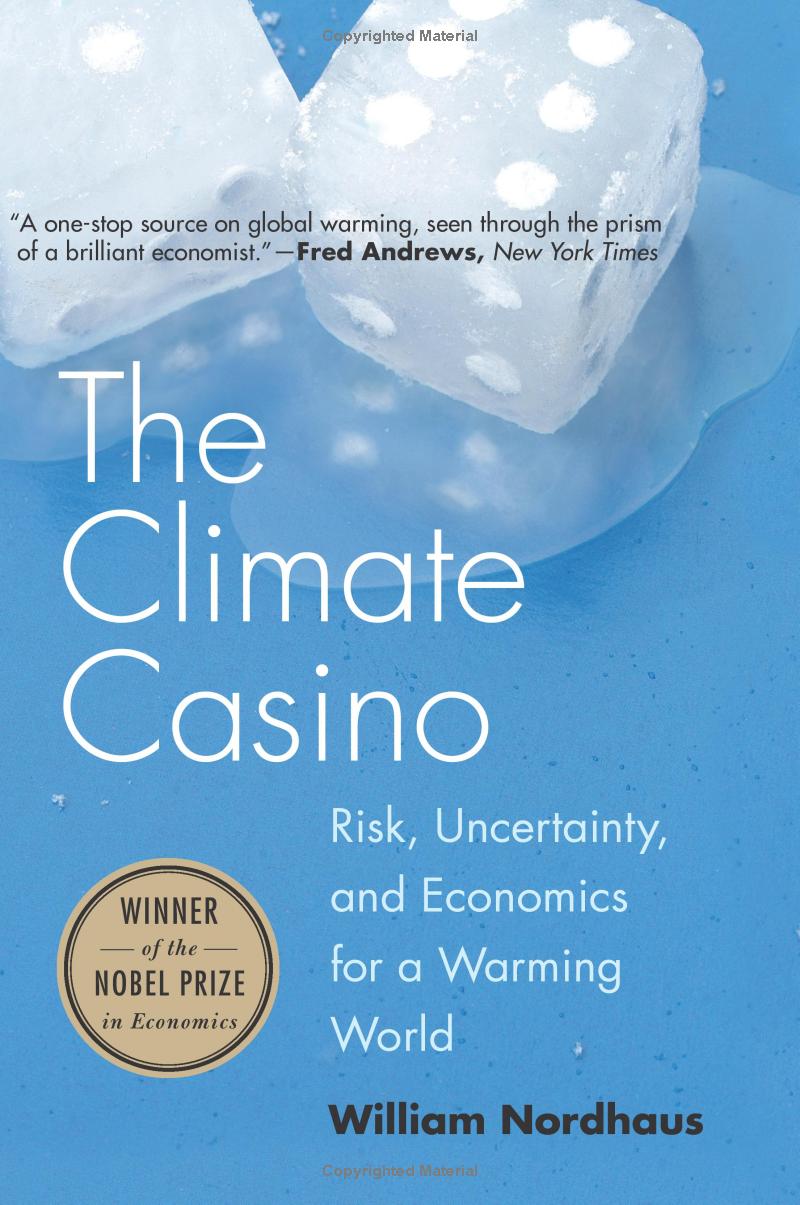
I bought this book from Thriftbooks and was so fired up that I sat down and started reading it almost immediately. For as the back cover explains:
Climate change is profoundly altering our world in ways that pose major risks to human societies and natural systems. We have entered the Climate Casino and are rolling the global-warming dice, warns William Nordhaus. But there is still time to turn around and walk back out of the casino, and in this book the author explains how.
William Nordhaus
William Nordhaus is a brilliant economist as Fred Andrews describes above. Indeed he is the Sterling Professor of Economics at Yale University and he has his website here.
Now I am going straight to two videos.
The first is William Nordhaus receiving the Nobel Prize in 2018.
And the second is that lecture given at the same venue in 2018.
A fascinating item recently published by Yale University.
Apologies, time pressure allows me little more than to repeat this in full. But still no less interesting.
oooOOOooo
Nearby super-Earth likely a diamond planet
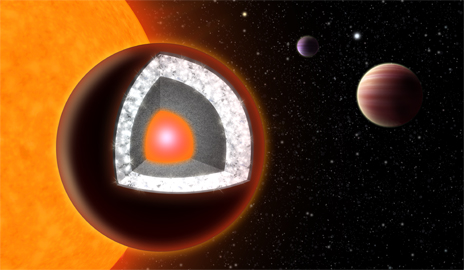
Illustration of the interior of 55 Cancri e — an extremely hot planet with a surface of mostly graphite surrounding a thick layer of diamond, below which is a layer of silicon-based minerals and a molten iron core at the center. (Image by Haven Giguere)
October 11, 2012
New research led by Yale University scientists suggests that a rocky planet twice Earth’s size orbiting a nearby star is a diamond planet.
“This is our first glimpse of a rocky world with a fundamentally different chemistry from Earth,” said lead researcher Nikku Madhusudhan, a Yale postdoctoral researcher in physics and astronomy. “The surface of this planet is likely covered in graphite and diamond rather than water and granite.”
The paper reporting the findings has been accepted for publication in the journal Astrophysical Journal Letters.
The planet — called 55 Cancri e — has a radius twice Earth’s, and a mass eight times greater, making it a “super-Earth.” It is one of five planets orbiting a sun-like star, 55 Cancri, that is located 40 light years from Earth yet visible to the naked eye in the constellation of Cancer.
The planet orbits at hyper speed — its year lasts just 18 hours, in contrast to Earth’s 365 days. It is also blazingly hot, with a temperature of about 3,900 degrees Fahrenheit, researchers said, a far cry from a habitable world.
The planet was first observed transiting its star last year, allowing astronomers to measure its radius for the first time. This new information, combined with the most recent estimate of its mass, allowed Madhusudhan and colleagues to infer its chemical composition using models of its interior and by computing all possible combinations of elements and compounds that would yield those specific characteristics.
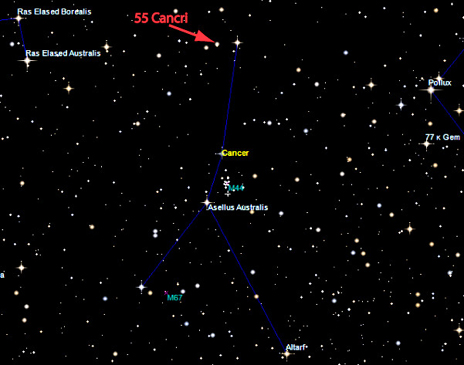
Star map showing the planet-hosting star 55 Cancri in the constellation of Cancer. The star is visible to the naked eye, though better through binoculars. (Image by Nikku Madhusudhan; created using Sky Map Online
Astronomers had previously reported that the host star has more carbon than oxygen, and Madhusudhan and colleagues confirmed that substantial amounts of carbon and silicon carbide, and a negligible amount of water ice, were available during the planet’s formation.
Astronomers also thought 55 Cancri e contained a substantial amount of super-heated water, based on the assumption that its chemical makeup was similar to Earth’s, Madhusudhan said. But the new research suggests the planet has no water at all, and appears to be composed primarily of carbon (as graphite and diamond), iron, silicon carbide, and, possibly, some silicates. The study estimates that at least a third of the planet’s mass — the equivalent of about three Earth masses — could be diamond.
“By contrast, Earth’s interior is rich in oxygen, but extremely poor in carbon — less than a part in thousand by mass,” says co-author and Yale geophysicist Kanani Lee.
The identification of a carbon-rich super-Earth means that distant rocky planets can no longer be assumed to have chemical constituents, interiors, atmospheres, or biologies similar to those of Earth, Madhusudhan said. The discovery also opens new avenues for the study of geochemistry and geophysical processes in Earth-sized alien planets. A carbon-rich composition could influence the planet’s thermal evolution and plate tectonics, for example, with implications for volcanism, seismic activity, and mountain formation.
“Stars are simple — given a star’s mass and age, you know its basic structure and history,” said David Spergel, professor of astronomy and chair of astrophysical sciences at Princeton University, who is not a co-author of the study. “Planets are much more complex. This ‘diamond-rich super-Earth’ is likely just one example of the rich sets of discoveries that await us as we begin to explore planets around nearby stars.”
In 2011, Madhusudhan led the first discovery of a carbon-rich atmosphere in a distant gas giant planet, opening the possibility of long-theorized carbon-rich rocky planets (or “diamond planets”). The new research represents the first time that astronomers have identified a likely diamond planet around a sun-like star and specified its chemical make-up. Follow-up observations of the planet’s atmosphere and additional estimates of the stellar composition would strengthen the findings about the planet’s chemical composition.
The authors of the paper are Madhusudhan, Lee, and Olivier Mousis, a planetary scientist at the Institut de Recherche en Astrophysique et Planetologie in Toulose, France.
The paper is titled “A Possible Carbon-rich Interior in Super-Earth 55 Cancri e.”
The research was supported by the Yale Center for Astronomy and Astrophysics (YCAA) in the Yale Department of Physics through Madhusudhan’s YCAA postdoctoral prize fellowship.
I have long subscribed to Baseline Scenario and the latest article from James Kwak is a great example of why.
On August 23rd James published a Post with the compelling title of, “Housing in Ten Words”. Here’s a flavour:
By James Kwak
“Housing Fades as a Means to Build Wealth, Analysts Say.” That’s the title of a New York Times article by David Streitfeld. Here’s most of the lead:
“Many real estate experts now believe that home ownership will never again yield rewards like those enjoyed in the second half of the 20th century, when houses not only provided shelter but also a plump nest egg.
“The wealth generated by housing in those decades, particularly on the coasts, did more than assure the owners a comfortable retirement. It powered the economy, paying for the education of children and grandchildren, keeping the cruise ships and golf courses full and the restaurants humming.
“More than likely, that era is gone for good.”
I’ve been telling my friends for a decade that housing is a bad investment. These are real housing prices over the past century, based on data collected by Robert Shiller:
Robert Schiller is, of course, the well-known Yale University professor who wrote the book, Irrational Exuberance. From Wikipedia:
Irrational Exuberance is a March 2000 book written by Yale University professor Robert Shiller, named after Alan Greenspan‘s “irrational exuberance” quote. Published at the height of the dot-com boom, it put forth several arguments demonstrating how the stock markets were overvalued at the time. Shiller was soon proven right when the Nasdaq peaked on the very month of the book’s publication, and the stock markets collapsed right after.
The second edition of Irrational Exuberance published in 2005 is updated to cover the housing bubble, especially in the United States. Shiller writes that the real estate bubble may soon burst, and he supports his claim by showing that median home prices are now six to nine times greater than median income in some areas of the country. He also shows that home prices, when adjusted for inflation, have produced very modest returns of less than 1%/year.
Anyway, do read the full article from James on Baseline Scenario as it has plenty of messages that are still critically important for those trying to work out where it’s all still heading, economically.
For my money, I still think that slowly but steadily we are reverting to the old mean of home prices being about 2 to 2.5 times average annual salaries. With the added proviso that I think that it is more than likely that average salaries will slowly decline on both sides of the Atlantic over the next few years. Tough times indeed!
 Learning from Dogs