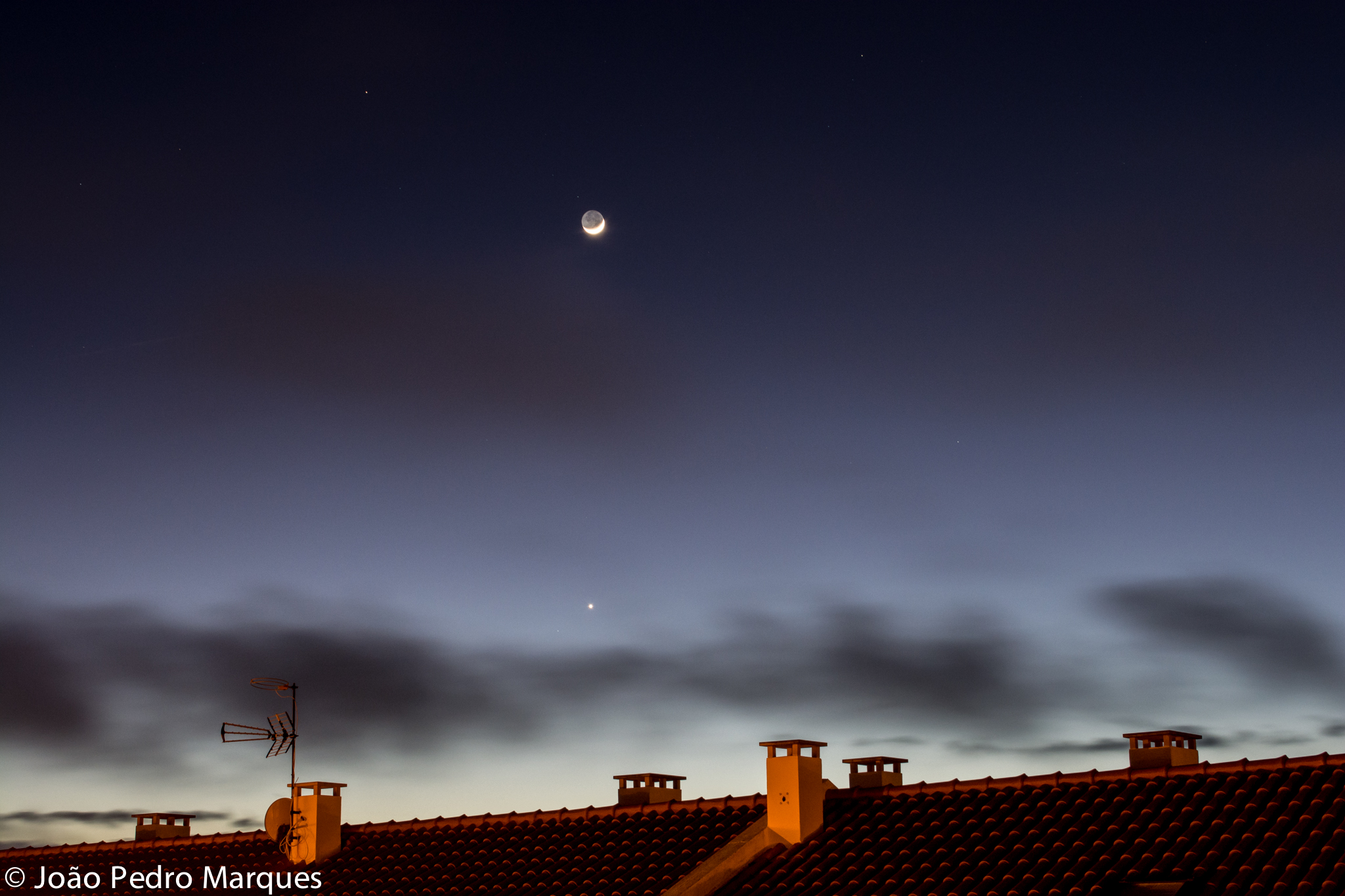
A photograph taken yesterday at 05:40 (PDT).
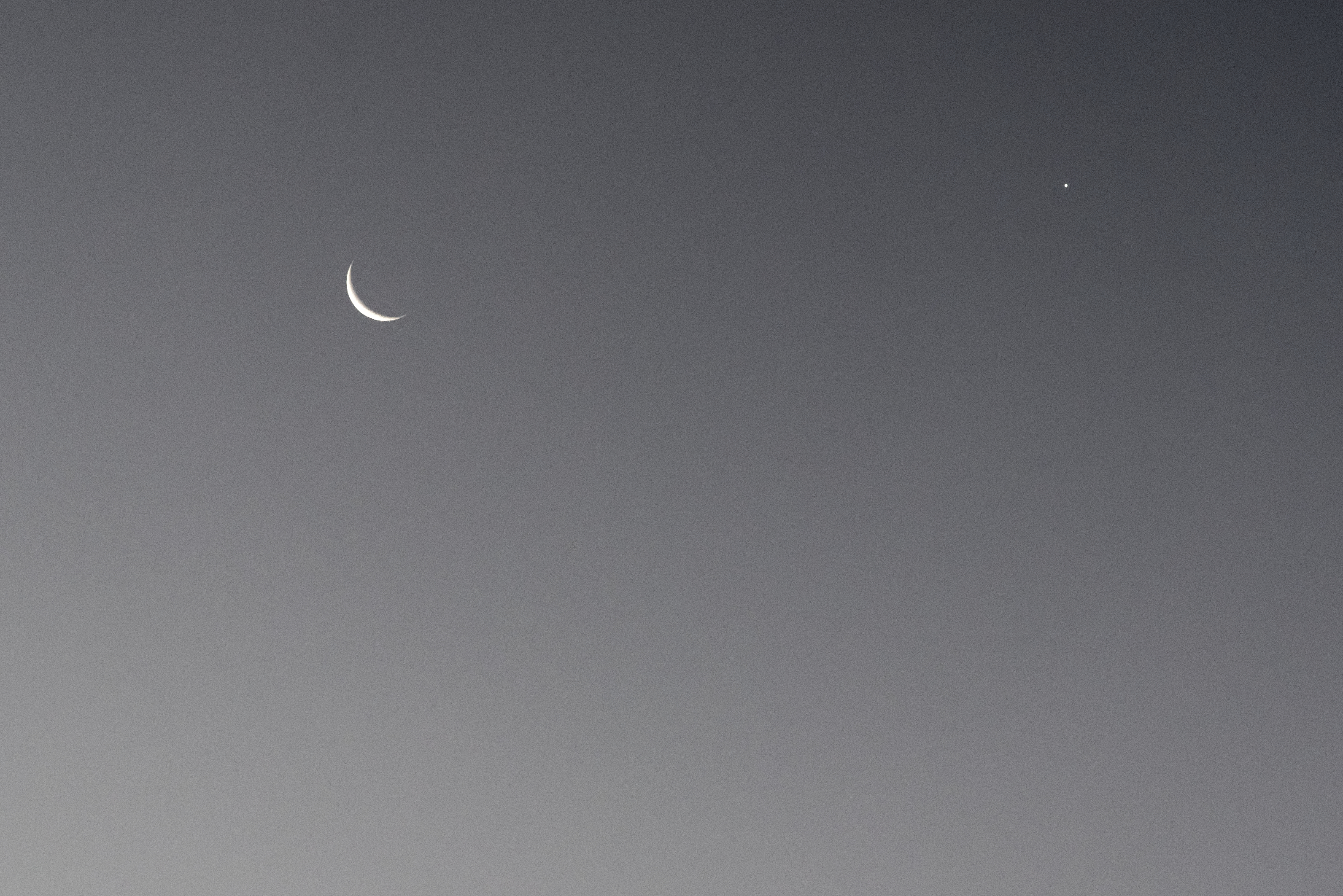
This was taken with a Nikon D750 from the rear deck of our house.
It has been greatly cropped and slightly adjusted in terms of contrast and shadows.
But, although I say it myself, it is an outstanding photograph! The moon is in a waning phase, about 10% illumination. Venus is just beautiful!
Here is the full moon.

And part of a Wikipedia extract:
The Moon is an astronomical body orbiting Earth and is the planet’s only natural satellite. It is the fifth-largest satellite in the Solar System, and by far[13] the largest among planetary satellites relative to the size of the planet that it orbits (its primary). The Moon is, after Jupiter‘s satellite Io, the second-densest satellite in the Solar System among those whose densities are known.
The Moon is thought to have formed about 4.51 billion years ago, not long after Earth. The most widely accepted explanation is that the Moon formed from the debris left over after a giant impact between Earth and a hypothetical Mars-sized body called Theia. New research of Moon rocks, although not rejecting the Theia hypothesis, suggests that the Moon may be older than previously thought.[14]
The Moon is in synchronous rotation with Earth, and thus always shows the same side to Earth, the near side. Because of libration, slightly more than half (about 59%) of the total lunar surface can be viewed from Earth.[15] The near side is marked by dark volcanic maria that fill the spaces between the bright ancient crustal highlands and the prominent impact craters. After the Sun, the Moon is the second-brightest celestial object regularly visible in Earth’s sky. Its surface is actually dark, although compared to the night sky it appears very bright, with a reflectance just slightly higher than that of worn asphalt. Its gravitational influence produces the ocean tides, body tides, and the slight lengthening of the day.
The Moon’s average orbital distance is 384,402 km (238,856 mi),[16][17] or 1.28 light-seconds. This is about thirty times the diameter of Earth. The Moon’s apparent size in the sky is almost the same as that of the Sun, since the star is about 400 times the lunar distance and diameter. Therefore, the Moon covers the Sun nearly precisely during a total solar eclipse. This matching of apparent visual size will not continue in the far future because the Moon’s distance from Earth is gradually increasing.
Here is a part of Wikipedia on Venus:
Venus is the second planet from the Sun. It is named after the Roman goddess of love and beauty. As the second-brightest natural object in the night sky after the Moon, Venus can cast shadows and can be, on rare occasion, visible to the naked eye in broad daylight.[15][16] Venus lies within Earth’s orbit, and so never appears to venture far from the Sun, either setting in the west just after dusk or rising in the east a bit before dawn. Venus orbits the Sun every 224.7 Earth days.[17] With a rotation period of 243 Earth days, it takes longer to rotate about its axis than any other planet in the Solar System and does so in the opposite direction to all but Uranus (meaning the Sun rises in the west and sets in the east).[18] Venus does not have any moons, a distinction it shares only with Mercury among planets in the Solar System.[19]
Venus is a terrestrial planet and is sometimes called Earth’s “sister planet” because of their similar size, mass, proximity to the Sun, and bulk composition. It is radically different from Earth in other respects. It has the densest atmosphere of the four terrestrial planets, consisting of more than 96% carbon dioxide. The atmospheric pressure at the planet’s surface is 92 times that of Earth, or roughly the pressure found 900 m (3,000 ft) underwater on Earth. Venus is by far the hottest planet in the Solar System, with a mean surface temperature of 737 K (464 °C; 867 °F), even though Mercury is closer to the Sun. Venus is shrouded by an opaque layer of highly reflective clouds of sulfuric acid, preventing its surface from being seen from space in visible light. It may have had water oceans in the past,[20][21] but these would have vaporized as the temperature rose due to a runaway greenhouse effect.[22] The water has probably photodissociated, and the free hydrogen has been swept into interplanetary space by the solar wind because of the lack of a planetary magnetic field.[23] Venus’s surface is a dry desertscape interspersed with slab-like rocks and is periodically resurfaced by volcanism.
As one of the brightest objects in the sky, Venus has been a major fixture in human culture for as long as records have existed. It has been made sacred to gods of many cultures, and has been a prime inspiration for writers and poets as the morning star and evening star. Venus was the first planet to have its motions plotted across the sky, as early as the second millennium BC.[24]
I included these excerpts from WikiPedia because many will find them of interest and quite a few, including yours truly, actually learnt something!




 Learning from Dogs