We keep chickens at our home in Devon, England and, thus, we have an account with a local farming supplies organisation called Mole Valley Farmers. Once a month we get a small news letter which I find fascinating. The first page always has The Chairman’s Newsletter and I love reading about the current price of grain, what’s current in the dairy world and a bit about food politics – usually very little about chickens but then I’m biased!
The Chairman quoted a British Government minister at a recent conference making a reference to the need to increase food production but then spending most of his speech talking about “rewilding” the countryside by reintroducing lynx and elk. (The link is to a slightly tongue-in-cheek article in the Times Online.)
Quite how that would help food production was “incomprehensible” but it shows a complete lack of understanding about the serious threat to the UK, and other countries, as we now import so much of our basic food needs and many local farmers have been underpriced out of farming by the monopoly of the supermarkets. An interesting parallel with the banks and greed in general.
With a world food shortage affecting many parts of the world it makes me wonder what is in store for us, especially our children. So far, I am unaware of anyone in UK politics making a link between pollution, food shortages, global warming and the fact that unless we wake up soon, we stand a big risk of reproducing ourselves out of existence.
Sabi – an Australian Army bomb-sniffing dog makes it back to base.
This is a lovely story that has been doing the news rounds recently, and not without good cause. It’s the sort of ‘cuddly feeling’ story that we all need from time to time. Anyway, first a thanks to Yves Smith of Naked Capitalism, who included a link to the BBC story in her daily summary on November 12th.
In the words typical of many online newspapers:
(AP) SYDNEY — A bomb-sniffing dog that disappeared during a fierce battle in Afghanistan between Australian troops and militant fighters has been found and returned to its unit after more than a year.
And Sabi the black Labrador is getting a celebrity welcome home.
Sabi was with a joint Australian-Afghan army patrol ambushed in restive Uruzgan province in September 2008, triggering a gunfight that wounded nine troops and earned one Australian soldier the country’s highest bravery medal.
Sabi, a four-year-old black labrador, was returned to the Australian base at Tarin Kowt after an American soldier found her wandering in a remote area of the southern province of Oruzgan last week.
The US soldier, named only as John, knew that his Australian counterparts had lost their canine companion during a gun battle between Australian, US and Afghan special forces and Taleban insurgents in south east Afghanistan last September. Nine Australian soldiers, including Sabi’s handler, were wounded during the assault and Sabi went missing.
Sabi, who was on her second tour of duty in Afghanistan, was officially declared missing in action. It is not known how she survived the past year, presumably eluding the Taleban, before being discovered by the soldier, who realised that she was not a stray dog because she understood certain commands.
Energy contradictions underline some very strange attitudes. I went for a bike ride this afternoon ….. there is a super 6km circuit that goes from our village Unterthingau along a country road, up past a farm with magnificent views over the Allgäu countryside then along to Oberthingau and back home ….. On the way there are horses and cows munching happily in fields and of course the snow-capped Alps in the background …. The exercise and the fresh air were great, but during the ride I was struck by a couple of things. On the skyline in the direction of Kempten was – as usual – a line of a dozen wind turbines. All were – as usual – immobile, save one which was doing its best to turn languidly, and hardly succeeding.
A private house in the village
Now the Germans do things properly, as we know. This area is pristine, hardly a blade of grass or a stone out of place; it is stunning. So when it comes to energy-saving, they do it seriously (up to a point).
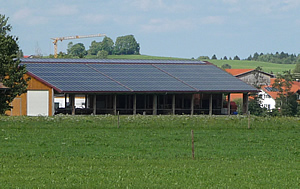
For a start, there are solar panels covering many roofs; the farmers get a subsidy for the installations and sell any surplus to the German National Grid. And then there are those windmills …. but the point is, they are usually motionless. There may be plenty of winter snow in this area, but there isn’t much wind.
Solar panels on cowshed ...
This confirmed my view that windmills in most places in Europe are never going to solve the energy shortage. They are contributing almost nothing now, and of course only produce anything at all when there’s wind. Full marks to the Germans for trying, but it’ll never be enough.
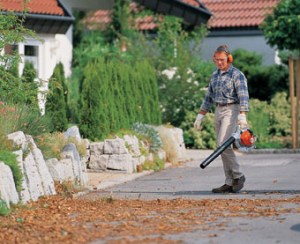
leaf-blower ....
Then as I rode through Oberthingau I saw a local resident blowing leaves off his forecourt with one of those “leaf-blower” machines …. This struck me as bizarre.
In truth, I’ve NEVER understood those things. What is the point? You blow the leaves from one place to another and later on when there is a little wind it’ll blow them straight back again. If he had been hoovering UP the leaves, fine, but blowing them from one place to another? Why not use a broom? And what have they got against leaves, anyway?
And I thought, on the one hand we are rushing around like headless chickens trying to think of ways of generating energy and on the other we are totally wasting it on ludicrous non-essentials.
As has been claimed and to my mind proven for Africa, what is needed is not giant, national and international projects (though more nuclear power-stations would help) but micro-projects for the masses, and especially a cosmic change in the mindset. You only have to look around to see examples of humungous waste of energy. Get rid for a start of most traffic lights! Dangerous? Errrmmm, no actually … experiments have shown that when there are no lights people drive more cautiously …. Get rid of those barriers on motorways that go up and down thousands of times every day. How many people actually drive through a toll barrier without paying? And even if they do, the operator can take their number and report them; why on earth do we need an energy-consuming barrier?
It’s individual mindsets that need to change … Do people really have to fire up their car to drive 300 metres to the baker’s on Saturday mornings? What happened to walking? The British “school run” is a classic example; kids are driven to school, don’t get enough exercise and so get fat, the roads are clogged up (and dangerous) and loads of CO2 is produced. Insane …..
Debt stress in Middle Class America – how may this play out?
On Saturday, October 24th Yves Smith of Naked Capitalism ran a Post on her Blog about an anonymous couple who were over their heads in debt. (Yves has given me written permission to reproduce the Post.) The story of this couple then generated a huge response of comments. Read the comments, each and every one of them.
Then ask yourself where this is all heading? These comments may, almost certainly are, just be the tip of the iceberg. Seems a long way from Lincoln’s Gettysburg address in which he was reputed to have used the words: “… government of the people, by the people, for the people, shall not perish from the earth.”
Some days I worry; worry a lot!
The extract from Yves Post about this couple is reproduced below but far better is to go and read the whole Post and all the comments.
UPDATE: Since writing this Post Yves has published a further Post on the topic again generating a huge volume of comments. That was Sunday, November 1st. Then bright and early on November 2nd James Kwak of Baseline Scenario weighs in with his version, Do smart, hard-working people deserve to make more money? 150 comments (at the time of writing) for that one. Interestingly, as the days have gone on the mood of the commentators has become more reflective and thoughtful thus partly negating the theme behind this Post.
What is the purpose of “Daylight Saving”? [Interesting history of Daylight Saving on Wikipedia. Ed.]
This week we are in a particularly interesting situation as we are in the middle of a one week separation between the dates when Europe and US change their clocks back to “normal” winter time. I.e. Europe changed their clocks back at 2am last Sunday and most, but not all, US States change their clocks back at 2am this coming Sunday.
This is even more confusing than normal. But why are we doing this at all?
Is it to save fuel, to save lives, to save time or to save something else?
In my humble opinion it is all nonsense!
“Time management” is a myth
Time is time! People say that they do not have enough time to do this or that, as if they have ways to make some more; and, of course, there is much talk about “time management”. Yet we all have the same amount of time and no amount of management will change that!
We are certainly able to manage the things that we try to fit into the available time. That is, we can manage tasks, effort and so on. But, in everyday (Newtonian rather than Einsteinian) regimes, time is an inelastic independent variable. Fiddling about with the clocks and trying to “manage time” have no effect on the stuff whatsoever. Let it be!
There must be a better way!
Yes, I know! Some people make claims of wasted daylight or of the dangers to schoolchildren walking to or from school in the dark. These are valid areas of concern. If adjusting the times of business operations or schooling helps to deal with them, then by all means do so. But, for goodness, let’s not pretend the time is different.
[I owe Chris an apology as this Post was prepared for publication on the 20th August and somehow got lost in the works. I believe it is still a relevant and important topic and has not lost any impact from this unintentional delay. Ed.]
The swine flu “pandemic” is to me a very interesting phenomenon. Sadly, it seems typical of the sort of combination of marketing hype and hysteria that is all too common.
I am principally interested in seeing beyond all the media lies and spin to know the TRUTH about what is going on. From what I have so far read the following seems to be true, but if anyone is able to correct me on some issues I would be most grateful.
Seems that Congress is hell bent on replacing the best-functioning labor market in the world with their own unique brand of wisdom. Well, I have a better idea. Why don’t we slash in half the pay of all those Congressional leaders who came up with the TARP idea in the first place, since they are spending our money, and I think it is clear that they are spending our money unwisely, which is precisely the logic they use to confiscate the salaries and bonuses of the bail-out executives.
Moral of the story? Government should not be in the business of trying to run a business. The TARP bailout should have never seen the light of day. With no TARP bailout, Congress would not have had it’s latest excuse for grabbing up yet more of the private economy’s resources for trying to put this country back on track toward improved productivity, output, jobs, income, and security.
A work trip to Brittany, France and a chance to reflect on the differences.
I’m sat writing this in my hotel room on the outskirts of Quimper in Brittany. Usual overcast and drizzle but considering I’m only a couple of hundred miles south of home, that’s the only similarity with the Devon weather.
Quimper
They simply seem to have no comprehension about the recession. There are small signs of some new office building being empty but more buildings seem to have appeared and business appears to be booming. The super market where I have lunch is even busier than last year and the shops are full of people buying things.
What’s the difference?
I’m sure my friend Chris [Chris Snuggs, another author on this Blog] who I used to work for here will be able to say, but I can’t believe it’s all about the main business of food and agriculture, which predominates in this part of the country.
Back home in Devon, the same set of circumstance ought to hold true as it’s mainly agriculture and tourism, just like in Brittany. However there is a vibrancy in Quimper that I find refreshing. And a lack of charity shops!
What can we learn from this?
I was bought up in an environment that did not trust the French and it wasn’t until I got an opportunity to work here 10 years ago I realised that it wasn’t all that I’d been told.
I really like Brittany and its people who are friendly and very welcoming. There is definitely something to learn from this.
Is CERN investing in fundamental science or wasting money?
Frankly, any rational assessment of CERN must conclude that it is the most humungous and nonsensical waste of money at a time when millions or even billions of people are threatened by a) starvation and/or death from lack of water and/or b) flooding, burning or freezing caused by Global warming not to mention the wars that are inevitable as people (probably mostly in the Middle East, Asia or Africa) start to fight over scarce resources.
The billions spent on this rather esoteric and ridiculous research would be better spent on practical steps to save people and the planet. And, “yes”, I do know that basic research can lead to useful “products”, and I have nothing against research into, for example fusion power. But why we really have to know what happened in the universe one millisecond after it blew up is beyond me, especially given the cost.
The Internet has produced many changes to the way we all behave. One of them is the ease by which all sorts of material may be circulated rapidly. Much of it is tittle-tattle but a recent one caught my eye. I was in two minds to publish it but having seen ahead of time Paul’s forthcoming Post about Access Journalism (visible from the 19th onwards) convinced me I should. Make of it what you will.

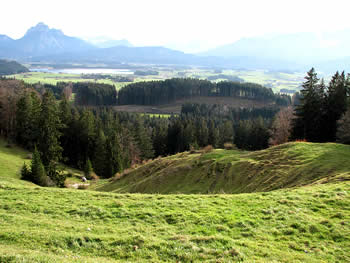 I went for a bike ride this afternoon ….. there is a super 6km circuit that goes from our village Unterthingau along a country road, up past a farm with magnificent views over the Allgäu countryside then along to Oberthingau and back home ….. On the way there are horses and cows munching happily in fields and of course the snow-capped Alps in the background …. The exercise and the fresh air were great, but during the ride I was struck by a couple of things. On the skyline in the direction of Kempten was – as usual – a line of a dozen wind turbines. All were – as usual – immobile, save one which was doing its best to turn languidly, and hardly succeeding.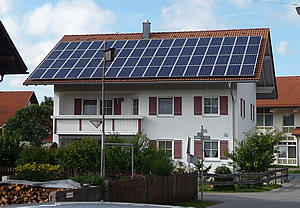
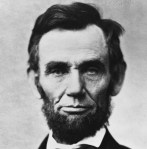 where this is all heading? These comments may, almost certainly are, just be the tip of the iceberg. Seems a long way from Lincoln’s
  This week we are in a particularly interesting situation as we are in the middle of a one week separation between the dates when Europe and US change their clocks back to “normal” winter time. I.e. Europe changed their clocks back at 2am last Sunday and most, but not all, US States change their clocks back at 2am this coming Sunday.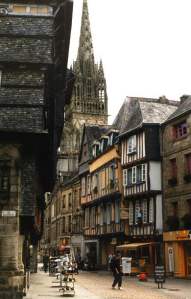
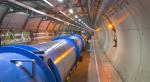 people (probably mostly in the Middle East, Asia or Africa) start to fight over scarce resources.
 Learning from Dogs