Tag: Naked Capitalism

Yves Smith, Naked Capitalism and Tony the Tiger

You may well ask what on earth does this Blog title mean!

I have on previous occasions acknowledged the splendid job that Yves Smith does in terms of publishing the blog, Naked Capitalism.  I’m sure that I will have cause to mention her splendid Blog again.  Frankly, I don’t know how Yves finds the time to relentlessly publish every day a whole skew of articles and lots of links to other articles that have caught her eye.   So why the mention today?

Well this evening is the first of four evenings where I am running a course at our local Church Hall.  It’s a new project for me and the last few days have been ‘interesting’ as I get my stuff together and fret about it all, as I am wont to do!

So it was a blessing to find that the links presented on Naked Capitalism yesterday (10th) contained some wonderful stories that seemed appropriate for all you good readers, with the bonus that it allowed me to focus on last-minute preparations for the course.

Here’s the first one that caught my eye, published on the Care2 website, not a website that I had come across before.

Victory! ALDF Wins Freedom for Tony the Truck Stop Tiger

Tony, the 10-year-old Siberian Bengal tiger who’s been at the heart of an ongoing catfight over his living conditions at the Tiger Truck Stop in Grosse Tete, La., has had his freedom granted!

On Friday, May 6, District Judge R. Michael Caldwell of the East Baton Rouge District Court granted the Animal Legal Defense Fund’s (ALDF) request for a permanent injunction against the Louisiana Department of Wildlife and Fisheries (LDWF), preventing them from renewing the annual permit that allows Michael Sandlin to keep Tony as of this December 14.

Unbeknownst to Tony, he’s garnered the attention of people around the world who have been fighting to have him freed from the concrete cell he’s spent his entire life in for years. Unfortunately, officials have bent the rules and looked the other way when it came to the Tiger Truck Stop.

From the Care2 article, there was a link to the Animal Legal Defense Fund and the following press release.

Victory in Animal Legal Defense Fund’s Lawsuit to Free Tony the Truck Stop Tiger

May 6th, 2011

Baton Rouge Court Grants Permanent Injunction, Ordering Department of Wildlife and Fisheries to Stop Issuing Illegal Permit Allowing Tony to Be Kept on Display in Iberville Parish 

For immediate release

Contact:
Lisa Franzetta, Animal Legal Defense Fund
Megan Backus, Animal Legal Defense Fund

BATON ROUGE, La. – This morning, a judge in East Baton Rouge District Court granted the Animal Legal Defense Fund’s (ALDF) request for a permanent injunction against the Louisiana Department of Wildlife and Fisheries, preventing the Department from renewing the annual permit that allows Michael Sandlin, owner of Grosse Tete’s Tiger Truck Stop, to displayTony, a ten-year-old Siberian-Bengal tiger. When the current permit expires in December 2011, Sandlin will no longer be able to keep Tony confined as a roadside exhibit at the truck stop where he has languished for over a decade. The court also assessed costs against the Department in the case.

In preparation for the day the current permit expires and Tony is finally free, ALDF hopes to work with the Department to find the best possible new home for him, providing recommendations for reputable sanctuaries where Tony can live out his life in a peaceful, natural environment, free from the 24-hour exposure to noise and diesel fumes that have plagued his life to date.

ALDF’s lawsuit to free Tony has drawn the support of high profile advocates like Leonardo DiCaprio and True Blood’s Kristin Bauer and has galvanized activists around the world. This week, ALDF delivered to the Department of Wildlife and Fisheries over 31,000 signed petitions urging it to revoke Sandlin’s permit to keep Tony. Tony has been on exhibit at the Tiger Truck Stop since 2001; he has lived there with no other tiger companions since 2003. Joining ALDF as a co-plaintiff in the case is former Louisiana Representative Warren Triche, who authored the state’s law that led to the ban on the private ownership of big cats, including tigers. Two other Louisiana residents, also deeply concerned by Tony’s long-time suffering, are additional co-plaintiffs. The law offices of Baker, Donelson, Bearman, Caldwell, & Berkowitz, P.C. are providing pro bonoassistance with the lawsuit.

“Today, the law was upheld in the state of Louisiana, which has explicit regulations designed to protect tigers like Tony,” says ALDF Executive Director Stephen Wells. “It is an incredible victory for ALDF, the tens of thousands around the world who have supported this campaign, and most of all, for Tony. We eagerly look forward to the day that he leaves behind the noise and fumes of the Tiger Truck Stop for a new life of freedom that he has never known.”

Tony the Tiger

Splendid, splendid result which serendipitously led me to another aspect of tigers that I want to present to you tomorrow.

The modern internet – a perspective.

A very thoughtful article from an interesting website.

By definition, everyone reading this article will be doing it as a result of the incredible advances in digital communications.  Thus it was that from today’s issue of Naked Capitalism there was reference to an article on a website called The Scholarly Kitchen, a site that I hadn’t come across before.  I won’t reproduce the article in full – that doesn’t seem right.  But I will present extracts to give you an idea of the thrust of the article.

The article is called The Battle for Control – What People who worry about the Internet are really worried about. Here’s how it starts:

Over the past few years, we’ve been witness to a parade of partisans in the debate over whether the Internet is making us smarter and more capable or turning us into shallow and superficial information parasites.

Nicholas Carr carries the most water for this argument, but others have joined in. Usually, their arguments that we’re going too far, becoming too fragmented, or becoming distracted are positioned to seem as if they have our best interests at heart — concern for our minds, our families, our communities, our culture.

Adam Gopnik, writing recently in theNew Yorker, breaks down the more typical partisans in the following manner:

. . . the Never-Betters, the Better-Nevers, and the Ever-Wasers. The Never-Betters believe that we’re on the brink of a new utopia, where information will be free and democratic. . . . The Better-Nevers think that we would have been better off if the whole thing had never happened, that . . . books and magazines create private space for minds in ways that twenty-second bursts of information don’t. The Ever-Wasers insist that at any moment in modernity something like this is going on, and that a new way of organizing data and connecting users is always thrilling to some and chilling to others.

A recent post by Jeff Jarvis puts what he calls “the distraction trope” into perspective. Instead of worrying about whether our brains, families, or communities are changing, Jarvis strips away that sophistry and lays bare something more primal that seems to be at stake:

And isn’t really their fear . . . that they are being replaced? Control in culture is shifting. We triumphalists — I don’t think I am one but, what the hell, I’ll don the uniform — argue that these tools unlock some potential in us, help us do what we want to do and better. The catastrophists are saying that we can be easily led astray to do stupid things and become stupid. One is an argument of enablement. One is an argument of enslavement. Which reveals more respect for humanity? That is the real dividing line. I start with faith in my fellow man and woman. The catastrophists start with little or none.

Throughout history, this fear of losing control has been consistently masked as concerns for higher, even altruistic interests. Jarvis quotes Erasmus (via Elizabeth Eisenstein’s new book, “Divine Art, Infernal Machine“), who said during the proliferation of books:

To what corner of the world do they not fly, these swarms of new books? . . . the very multitude of them is hurting scholarship, because it creates a glut, and even in good things satiety is most harmful. [The minds of men,] flighty and curious of anything new [are lured] away from the study of old authors.

Erasmus was worried about losing control over a world he’d mastered through his knowledge of old authors and stable cultural touchstones, and Carr is worried about losing control over a way of studying and thinking and processing information he’s become adept with. These are not the political leaders of the Middle East who are concerned about destabilization at an entirely different level (but for some of the same basic reasons, and from some of the same fundamental causes). Control has a softer side than anything we’d associate with authoritarianism.

Control can be channeled from competence and tradition. Change threatens both of these.

Do cut across and read the full article – it really is worth reading. It concludes thus:

It’s not that one is all good and one is all bad. There is a trade-off, an elusive balance, a mix of benefits and traits. In writing that seems prescient to both the pros and cons of humanity’s continuing exploration of its boundaries, Sigmund Freud once wrote:

Man has, as it were, become a kind of prosthetic god. When he puts on all his auxiliary organs he is truly magnificent; but those organs have not grown on to him and they still give him much trouble at times.

We may argue again and again whether the Internet is changing our brains, elevating us, lowering us, making us smarter, or making us stupid. But at the end of the day, it seems the real argument is about control — who has it, who shares it, and who wants it.

So, despite all the partisans, sophistry, and essays about our brains, our culture, our souls, it’s important to remember that what we’re really arguing about is control.

Sometimes, a cigar is just a cigar.

Power of social networks in the area of finance

The nature and reach of social conversations in the investment arena.

The above sub-heading is from a recent Post on Naked Capitalism that rather spookily comes hot on the heels of one of my recent musings.  Here’s what I published on the 12th January although I wrote it on the 9th.

In the past opinion and commentary has been in the hands, more or less, of the giant media moguls.  But technology has changed that.  Now more than ever a huge people have access to the Internet.  Indeed, a quick Google search reveals that of a world population of 6.85 billion people, just under 2 billion (29%) have internet access.  In North America that percentage is 77.4% (226 million) and in Europe the percentage is 58.4% (475 million).  I.e. nearly a billion people in just North America and Europe!

My point is that, in a manner never before experienced in human history, the vast majority of us have the ability to read, learn and muse about the critically important issues facing us today, coming to conclusions that carry political weight.  We have almost infinite choice as to where and how we form opinions.

Thus having access, via the internet, to the scribblings of so many wise people may end up giving democracy the boost it really needs in the face of overwhelming powerful plutocratic forces.

Coincidentally, also on the 12th Yves Smith of Naked Capitalism published an article entitled, The 20 most influential blogs in financial media.  You can find that article here.  Here’s a flavour of what was written.

Thanks to Minyanville for publicizing this study by MindfulMoney on the nature and reach of social conversations in the investment arena. But even bigger thanks go to loyal readers and contributors for their frequent comments, leads, and critiques. The success of a blog depends on its community and I am very grateful for all the input so many of you have generously provided.

Perhaps the most interesting finding (boldface ours):

The research confirms the existence of a network of investment super-connectors with extraordinary media influence and reach. These super-connected new influentials are, for the most part, not well established voices in the media but individual bloggers who fiercely champion their independence….In the US, the network functions as the unofficial voice of Wall Street & the US federal bank with no mainstream media players at the centre of the network.

Given how many of these top blogs are critical of the status quo, this map may be hopeful sign that the blogosphere is beginning to become a important channel of discourse outside the reach of the PR machinery of major corporations and government entities.

And rather than publish all the top 20 names, you can see that list here, the top 10 are as follows:

1. Naked Capitalism
2. Infectious Greed
3. The Big Picture
4. Jesse’s Cross Roads Cafe
5. Zerohedge
6. Mish’s Global Economic Analysis
7. Calculated Risk
8. Paul Krugman’s Blog
9. FT Alphaville
10. Ludwig von Mises Institute

Anyone interested in downloading the original report as published on the MindfulMoney website can go to the article here; the link to the pdf, requiring prior registration, is towards the end of the article.  The article opens thus:

Most investors would acknowledge that social media is playing an increasing role in their investment decisions. Yet no-one has mapped the emerging network of influence likely to be playing a crucial part in those decisions.

Until now that is.  MindfulMoney’s ‘Social Finance: The New Influentials” report is aiming to better understand what this network looks like and to see if a number of super connections, so beloved of writers like Malcolm Gladwell, exist.

The research indicates that they do.

As I said, to download the article you need to register first – that link is here.

It’s a very interesting new world that we are living in and one, I pray, that is returning real power to the electorates.


Friendship – alpaca style

Yet another beauty from Naked Capitalism

Regular readers will have run out of counting the number of times that I applaud Yves Smith and her amazing blog, Naked Capitalism.  Not only is it a fantastic source of many stories of real public concern, her daily antidote du jour is often delightful.  Here’s the one that came from her Blog posting of the 19th September.

Clarence and Cindy

Cattle dog Clarence plays with an alpaca named Cindy in “Alpaca Land” in Goeming, Austria. The two have lived together on the farm since they were 3 months old. Eighty-seven alpacas, the largest flock in Austria, live on the farm.

By Paul Handover

Kevin Richardson, magic person

Apologies for the repeat but unable to write a fresh post for the next few days.  This post about Kevin has been one of the most popular on Learning from Dogs.

Trust is both taught and learnt!

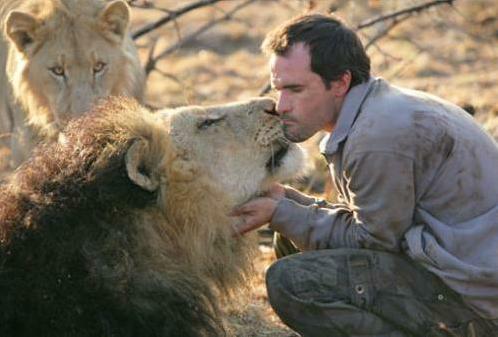
Thanks to Naked Capitalism, we posted an item on the 19th December about an unknown wild-life ranger working in the wildlife refuge area of Lanseria, South Africa.  Here was one of the pictures included in that Post:

The Post finished with an appeal to anyone that knew the name of this Ranger.  Many of you did and responded; thank you!

His name is Kevin Richardson and there is an interesting account of how he works and some of his ‘experiences’ in Revolution Magazine, luckily with online content.  That article is here.  It starts thus:

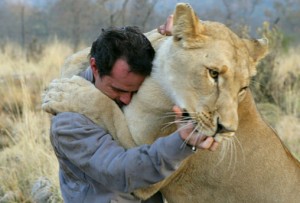
To do this he does not use the common methods of breaking the animal’s spirit with sticks and chains, instead he uses love, understanding and trust. With this unusual method of training he has developed some exceptionally personal bonds with his students. He sleeps with lions, cuddles newborn hyenas, swims with lionesses.  Kevin can confidently look into their eyes, crouch to the their level and even lie down with them – all taboos in the normal world of wild animal handling – yet he doesn’t get  mauled or attacked.

The article goes on to say that Kevin often works with the animals when they are very young.  Thus he is demonstrating very powerfully that how we behave, especially with our children when they are young, creates the environment for building trust out of consistency of deed and thought.  (By the way, do read some of the comments posted at the end of that Magazine article – some of them make for powerful reading.)

Kevin Richardson at 'work'.

Luckily, thanks to this wired world we now live in, there is also video of Kevin available on YouTube.  A quick search under Kevin Richardson on YouTube will quickly find a number of videos but here are two that I wanted to share with you.

The first will leave you speechless and possibly wet-eyed!

The second is a promotional video by Kevin encouraging us to buy his recent book – and why not!

This is a very remarkable person and it’s an honour to share this with you.  We have so much to learn from all animals.

By Paul Handover

Is thinking going out of fashion?

Another Yves Smith special!

Many will know that Naked Capitalism is a wonderful Blog and what Yves does is truly amazing.  (And a big ‘thank you’

Yves Smith

to Richard Smith who so ably stood in for Yves on her recent European trip.)

On the 29th July this year, Yves reran an article that she posted on May 11th, 2007.  It’s spot on, in my opinion.

Here’s how Yves starts the Post:

I am beginning to suspect that many are reacting to the over-stimulation of the modern world – the accelerating pace of change, data overload, time pressure, work and relationship instability – by turning off their brains. The rise of fundamentalism and the “family values” push, both efforts to turn back the clock, is one set of responses.

Another is the rise of sound-biting, of using pithy communications to cut through the clutter of the daily information assault. But sound biting is inherently reductionist. It doesn’t permit nuanced argument, or pointing out fuzziness in data, or shades of grey. Sound bites are great for simple, emotional appeals, lousy for policy development (which is one reason why this country seems incapable of having an intelligent discussion on important topics like health care. The public has been trained out of having a long enough attention span to listen to alternatives).

That is so true. Just re-read the sentences, “But sound biting is inherently reductionist. It doesn’t permit nuanced argument, or pointing out fuzziness in data, or shades of grey.” (My italics.)

We live in such a complex world that reducing any important idea or concept to a headline or to an executive summary is, in its own way, significantly short on integrity.

That article from Yves concludes thus:

Most businesses operated in competitive environments far too complex for a terse phrase to be a useful guide to action. Yet a magic incantation, a talisman, a battle cry is terribly appealing. But those who can resist the temptation of relying on a simple playbook and face the complexity and uncertainty of their environment are likely to steer a better path. But understanding risk and adapting also demands far more courage that trusting simple ideas.

Ironically, if one reflects for a moment, that closing sentence is a pretty good executive summary! “…… understanding risk and adapting also demands far more courage that trusting simple ideas.

Precisely!

By Paul Handover

Econned, by Yves Smith

Learning from Dogs muses the new book from Yves Smith

ECONned, by Yves Smith

In Econned, Yves Smith, founder of Naked Capitalism, argues that the economy was doing just fine in the regulated environment up to the 1970s.  Then began the work of the Chicago economists who challenged Keynesian economics and touted the benefits of deregulation which eventually led to the financial crisis we have today.

Yves argument is internally consistent and well researched, but ignores some factors that I think would change the conclusions drawn from her work.

Yves Smith, author and founder of Naked Capitalism

First, Yves notes that the primary reason that economists are not useful to the real world is that economic research presumes equilibrium.  Smith misses the point here, but it is understandable. It took me years of study and contemplation to fully appreciate that an equilibrium simply gives economists a point of reference, a common base, from which to study shocks and movements. In and of itself, equilibrium is not interesting or important.   But movements to and from equilibrium are of real interest because they enable us to study and try to predict how individuals will react to incentives and changes in market conditions.

Second, we have to put the contributions of the Chicago economists of the 1970s into context.  Up until that time, the only real school of thought in macroeconomics was based on Keynes, who presumed that markets fail and that the government must play an active and large role – primarily through government spending and taxes — for the economy to perform well.  Keynes’ work was a reaction to the Great Depression.

Friedman’s monetarism also sought to explain the Great Depression, but focused on the role of monetary policy on the economy. This work showed that the missteps of the Federal Reserve was the primary cause of the depth and length of the Great Depression, and that long-term accommodative monetary policy causes inflation.  This body of work did not stress deregulation, although it did lean more heavily on enabling private market solutions than on replacing them with government solutions.  Neither theory is complete; Keynes focused on the short run (“In the long run, we are all dead” is a rather famous Keynes quip) and Monetarism focused on the long run.

There was a second large body of work that came out of the University of Chicago during the late 1960s and 1970s.  This research documented the tremendous costs of regulation. I know this literature personally and believe that its conclusions are very sound:  it shows that any effective regulation limits either the quantity or price of a good or service away from what it would have been without the regulation.  In fact, in my view, it was the passage of regulations requiring certain lending behavior that set off the series of events that led to the crisis, which is the exact opposite argument from what Ms. Smith makes.

By Sherry Jarrell

In praise of Yves Smith

Helping thousands better understand this crisis

Yves’ Blog Naked Capitalism has been mentioned many times on Learning from Dogs.  Indeed, she was one of the Blog authors highlighted recently in this Post.

Yves Smith

I fail to understand how she finds the hours in the day to write in such detail – but those of us interested in getting under the skin of our present economic situation are all the better for it.  Here’s a great example that was published on the 23rd February.  I quote the opening paragraphs and then link to the rest of her post. From here on is her piece:

———————–

Martin Wolf, the Financial Times’ highly respected chief economics editor, weighs in with a pretty pessimistic piece tonight. This makes for a companion to Peter Boone and Simon Johnson’s Doomsday cycle post from yesterday.

Let us cut to the chase of Wolf’s argument:

Now, after the implosion, we witness the extraordinary rescue efforts. So what happens next? We can identify two alternatives: success and failure.

By “success”, I mean reignition of the credit engine in high-income deficit countries. So private sector spending surges anew, fiscal deficits shrink and the economy appears to being going back to normal, at last. By “failure” I mean that the deleveraging continues, private spending fails to pick up with any real vigour and fiscal deficits remain far bigger, for far longer, than almost anybody now dares to imagine. This would be post-bubble Japan on a far wider scale.

Yves here. Notice he associates success and failure with polar options. But how can you “reignite the credit engine” when the financial system is undercapitalized even before allowing for the need to take further writedowns? The IMF has found the converse in its study of 124 banking crises, that purging bad debt is a painful but necessary precursor to growth. So I fail to understand how Wolf envisages that “skip Go, collect $200″ of releveraging quickly comes about. And in fact, it turns out that Wolf’s “success” is a straw man:

[to read the rest click here, Ed]

By Paul Handover

Free speech!

Hats off to some intrepid commentators

We are going through unprecedented troubled times and the way ahead looks very uncertain.  The whole world could be participating in the ‘lost decade’ that Japan experienced previously.

But this article is not about doom and gloom!  It is about recognising the commitment to open and honest reporting being undertaken by (at least) these three  individuals.  Three commentators that this author follows in admiration and awe.

Learning from Dogs has nothing like the following of James Kwak, Yves Smith and Karl Denninger but the LfD authors do have an inkling of the work involved in writing not one but often several articles each day.  It is a huge commitment.

James Kwak

First James Kwak of Baseline Scenario.  Simon Johnson is, perhaps, the more well-known of this duo that comprise Baseline Scenario but it is James that puts in the leg-work.  Here’s a taste of a recent article from James:

Radio Stories

I spend a lot of time in the car driving to and from school, so I end up listening to a lot of podcasts (mainly This American Life, Radio Lab, Fresh Air, and Planet Money). I was catching up recently and wanted to point out a few highlights.
Last week on Fresh Air, Terry Gross interviewed Scott Patterson, author of The Quants, and Ed Thorp, mathematician,  inventor of blackjack card counting (or, at least, the first person to publish his methods), and, according to the book, also the inventor of the market-neutral hedge fund.

Large chunk snipped ……

I finally got around to listening to Planet Money’s interview with Russ Roberts from December. Russ Roberts and I are pretty sure to disagree on almost any actual policy question. But what I liked about his interview was that he basically admitted that policy questions cannot be settled by looking at the empirical studies. On whether the minimum wage increases or decreases employment for example, he says that he can poke holes in the studies whose conclusions he doesn’t agree with, but other people can poke holes in the studies he agrees with. In Roberts’s view, people’s policy positions are determined by their prior normative commitments.

I don’t completely agree. I don’t think that these questions, like the one about the minimum wage, are inherently unanswerable in the sense that the answer does not exist. But I agree that empirical studies are unlikely to get to the truth, particularly on a politically charged question, because there are so many ways to fudge an empirical study. As one of my professors said, there are a million ways you can screw up a study, and only one way to do it right. But I agree with the general sentiment. We are living in an age of numbers, where people think that statistics can answer any question. Statistics can answer any question, but they can answer it in multiple ways depending on who is sitting at the keyboard.

By James Kwak

Read about Yves Smith & Karl Denninger

Track – the puppy

Yet another lovely dog rescue story

Once again, we are indebted to Naked Capitalism for bringing this lovely story to our attention.  It was originally published in the Birmingham (Alabama) News.

Track inspector for CSX railroad Gary McLean found this puppy frozen to the tracks in last weekend's cold snap. The puppy, now named Track, has found a home with a dog lover in Bessemer.

One near victim of the cold is now happy and warm and residing in Bessemer.

Last Saturday, Gary McLean, a track inspector for CSX Railroad, found and rescued a tiny shivering puppy who’d become frozen to the train tracks.

It was 7:30 a.m. and the temperature was about 14 degrees. McClean, a resident of the Trussville-Argo area, was riding in a rail mounted truck near Caro lina Avenue looking for any obstacles in advance of a train that would be headed down that track about an hour later. He heard something go bump on the track, stopped and looked back, but saw nothing. He turned forward and, ahead of him, he saw a tiny ball of fur on the tracks.

McLean is accustomed to encountering dead dogs along the tracks, but as he got closer, he saw the little ball of fur moving.”It was big timeshivering,” he said. “I felt so sorry for him.”

Apparently, the 5-inch-tall mutt had gotten wet in a nearby ditch. When he tried to jump the 7-inch-tall rail, he got stuck and his icy fur froze to the track. McLean tried applying warm water and lifting him off. That didn’t work. So he took a knife and carefully cut him off the track.

If the train had come, the dog would never have been able to set himself free, McLean said. McLean took pictures of the puppy and sent them to his wife, Lois.
The McLean’s already have three dogs and couldn’t adopt another. So they turned to the Internet to find the dog a home.

She posted the picture on Facebook and the story found its way to the blog of ABC 33/40 meteorologist James Spann. The e-mails started pouring in.

Sorting through the of fers, the McLeans decided to give the dog to Terry Walls of Bessemer.

He is doing great,” Walls said as the puppy she’s named Track chewed on her slipper.

Track had a manly ring to it,” she said.

Walls estimated the puppy is 7 or 8 weeks old. It has a full set of sharp teeth and has German Shepherd and possibly some husky in his ancestry.

'Track' the lucky puppy

By Paul Handover