The wonderful BBC science programme, BBC Horizon, recently showed a fascinating programme entitled: Is your Brain Male or Female? The programme is introduced on the Horizon website:
Dr. Mosley and Prof. Roberts.
Dr Michael Mosley and Professor Alice Roberts investigate if male and female brains really are wired differently.
New research suggests that the connections in men and women’s brains follow different patterns, patterns which may explain typical forms of male and female behaviour. But are these patterns innate, or are they shaped by the world around us?
Using a team of human lab rats and a troop of barbary monkeys, Michael and Alice test the science and challenge old stereotypes. They ask whether this new scientific research will benefit both men and women – or whether it could drive the sexes even further apart.
Now I haven’t a clue as to how long this fascinating programme will remain on YouTube, but if you aren’t in the UK or don’t have access to the BBC iPlayer then don’t hesitate to watch it now.
Essentially, science shows that the ‘hard-wired’ differences are minute and the vast bulk of the preferences between the genders, trucks versus dolls, for example, is subtle conditioning from parents and the wider world; for instance, advertisements.
One thing that did jump ‘off the page’ at me was the evidence supporting how malleable or plastic is the brain. In other words, we are never too old to learn.
As if to reinforce that aspect of the flexibility of our brain, just yesterday morning I read an item on the BBC News website about memory.
As someone whose memory is a long way from where it used to be, this item really caught my attention:
Are there ways to stop yourself losing your memory? The latest brain research suggests there’s hope for the forgetful…
Memory loss has to be one of our biggest fears. Names, words, facts and faces – nothing is spared.
As the latest video from the Head Squeeze team describes above, mental deterioration was once thought to be an inevitable consequence of ageing, thanks to the steady erosion of our brain matter: we lose about 0.5% of our brain volume every year. The hippocampus – the region responsible for memory and learning – was thought to weather particularly badly; by the time we are 90, many of us have lost around a third of its grey matter.
Fortunately, recent research has shown that the brain is not concrete, but certain regions can adapt and grow. In 2000, a study of London taxi drivers, for instance, showed that the 4-year training of London’s 25,000 streets showed a remarkable growth in the hippocampus compared to bus drivers who early learnt a fixed number of routes. The scientists think that, by memorising the maps of London, the brain had built many more of the “synaptic connections” that allow the brain cells to communicate with each other. In other words, it may be possible to train the brain to compensate for some of the neural decline that accompanies our expanding waistlines and receding hairlines.
Challenging your brain could be one way of preserving your recollections – though the value of commercial brain training apps is debatable; some experiments seem to show that while people may become a whizz at the games on their screen, the improvements fail to transfer to daily life. But other, more traditional activities – like learning a musical instrument or a second language – do seem to have some protective benefits, at least on short-term recall. Ideally, it is probably best to keep your brain active throughout your life, well before you begin to approach your dotage.
Exercise and a healthy diet are also thought to offer some protection against dementia. As can an active social life – since regular contact with other people is also thought to excite our neurons and preserve our synapses. Ensuring that you regularly get a good night’s sleep helps too.
Of course, nothing can guarantee health and vitality in old age. But these few simple measures might give you the best possible chances of preserving your wits against the ravages of time.
For more videos subscribe to the Head Squeeze channel on YouTube. This video is part of a series produced in partnership with the European Union’s Hello Brain project, which aims to provide easy-to-understand information about the brain and brain health.
If you would like to comment on this video or anything else you have seen on Future, head over to our Facebook page or message us on Twitter.
So it’s clear now.
All I need to do is to learn a new language while in between my training to be the oldest trainee cabbie in London and applying for second violin position at the Royal Philharmonic Orchestra and I’ll never forget anything else in my life.
Oh, anyone seen where I left my car keys?
Or perhaps, harking back to the opening question of the differences between our sexes, I should be closing, thus:
From today until the end of the year, while there will still be a post each day, I will be leaning more towards republishing items that have been sent to me or that, otherwise, have caught my eye. Nothing heavy.
The Gentleman’s Guide to Racing.
Dan Gomez sent me the link to this video a couple of months ago. The description of the YouTube video is thus:
In November of 2011 two amateurs decided their first professional race ever would be one of the worlds toughest- the Score BAJA 1000. The infamous illegal street racer Alex Roy and Skiny begin a journey that will take them around the world to test themselves against some of the worlds most challenging races and hangovers.
There is also a website that includes the video below but also, more usefully, much background information, for example:
DAY 1: THE BEGINNING
Today starts a journey of a lifetime. The decision has been made to turn my forty year-old life over to the pursuit of racing for the next three years, and hopefully inspire some people along the way to take leave of all that is important to seek out the thing that thrills them most. My hope is that the journey will be interesting enough to fill the pages of a book – aptly titled the Gentleman’s Guide to Racing – and to make some friendships along the way with people I already know but just haven’t met.
I wanted to start writing today so as to retain a snapshot of this adventure in its seedling stage. As of right now I have nothing. No money, no car, and no sponsors. But I do have determination, and getting to the race is often the most interesting half of the battle.
Today I commit to sharing my exploits with whomever is interested in the trials and triumphs of a lone man seeking to test himself on some of the world’s toughest and most grueling races.
Steve McQueen famously said “Racing is life, anything that happens before or after is just waiting.”
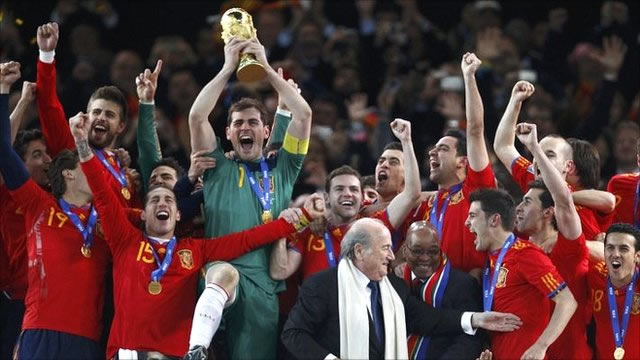
SPAIN AT LAST - AND DESERVEDLY - WIN THE WORLD CUP!!
Background: People of my generation were doubly spoilt in the 60s to 80s; it was a golden age of both popular music and football. As for the latter, we thrilled at the Brazilian and Argentinian magic, the famous German “efficiency” – and occasional touch of magic of their own – and of course the Dutch sides of 1974 and 1978. Their “total football” and tremendous skills made them exhilarating to watch. The names still linger in the memory; Cruyff, Krol, Neeskens, Hahn, Rep, Rensenbrinck, van Hanegem, van de Kerkhof …
But they never quite made it to the summit. This was not through any lack of quality, but they didn’t have – for me – that little bit of luck at the right time that you almost always need at this level. Could this latest Dutch team possibly do what the astounding Cruyff team hadn’t quite managed to pull off?
Setting the Scene: Unfortunately, the omens for the final weren’t that great. The Dutch coach had made noises about it “not being pretty” and that he didn’t mind how they won as long as they did. There was in fact to be no romantic looking back to the magic of the Dutch sides of 1974 and 1978; this Dutch side was pragmatic. They were going to make up for the past. They were NOT going to be the third Dutch team to lose in the final ……
In truth, they had done well to make the final, in particular stunning the much-fancied Brazil; you had to take them seriously after that. But they were efficient rather than slinky-skilled like the Spanish. With only one real star, the mercurial Arjen Robben, they were hard and “pragmatic”, which unfortunately – and as it once again proved in the final – often means “rough and brutal”.
The Spanish had shown great footballing skills, particularly in their mastery of the midfield, where they choked the life-blood out of the Germans in the semi-final. Pundits had agreed that the Germans had shown them “too much respect” and “allowed them to play their own game.” This, however, was one mistake the Dutch were NOT going to repeat. They were unlikely to be able to out-football the Spanish, so another strategy had to be found.
The Referee: What an honour to referee the World Cup Final! What excitement Howard Webb and his team must have felt as the kick-off approached. But it’s a fantastic “one-off”; you can never turn back the clock. Mistakes are fixed in time and unerasable, and there were to be several to scar the memory of his special day; which is a personal tragedy in itself.
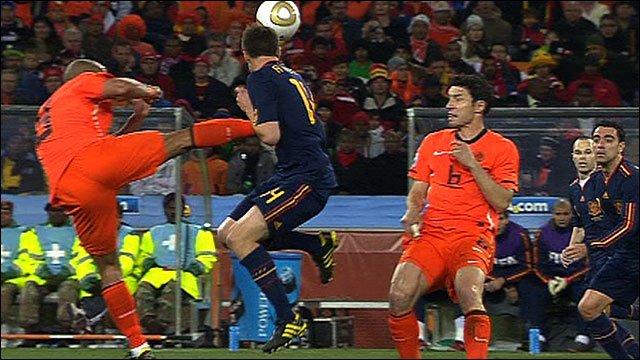
The Game: Let’s not beat about the bush; the first half was a disgrace. The Dutch game-plan seemed to be to kick the Spain out of their rhythm and indeed even off the field. Some of the tackling was appalling. Feet were smashing in left, right and centre with no hope of getting the ball. Webb was forced to issue yellow after yellow, yet seemed so stunned by and unprepared for the ferocity of what was going on that in fact, he was over-lenient despite the number of bookings (14 yellows and one red, easily a record for the final). The Dutch were lucky to reach the interval with 11 players. Van Bommel could well have gone with a straight red; how de Joong didn’t get a straight red is a total mystery to everyone I’ve talked or listened to.
It was appalling, and not just in terms of what was actually happening, it being quite sickening to see players smashed recklessly to the ground. After all, a single clumsy, violent and of course illegal challenge can end a player’s career. No, the deeper tragedy was in the realization that in their desperation to win, the Dutch had cast aside sportsmanship and in essence betrayed the memories of their magical predecessors. I have no idea what their coach said before, but the brutality of much of the tackling seemed so widespread that one felt it could only be part of a game plan and not just “World Cup nerves”. After some time, the Spanish (somewhat naturally) began to respond in kind so that the yellow cards began to mount up on both sides, and then, mercifully, came half time.
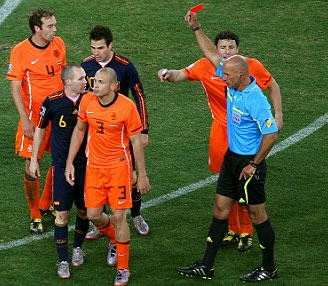
The second half was a bit better; had the players had a bollocking in the dressing room? Of course, for almost half the Dutch side they now HAD to be more careful, since a second booking meant they were off and their team one man down. As it happens, they survived till extra time before they had a man sent off; how is a mystery, and sadly, the referee has to take the blame. Yes, it is a showpiece. Yes, in one sense a sending-off would “spoil the game”, but the spoiling would have been self-inflicted by the Dutch, not the referee’s fault.
The Result? Non-partisan before the game, I was now rooting for Spain. Despite my nostalgia for Dutch teams of the past, their cynical approach could not prevail, could it? But the Spanish were doing everything possible to gift them the game. They simply could not find the goal, despite their usual domination of the midfield. The funny thing is that despite their being “the best side of the tournament”, they won it by scoring the fewest goals in World Cup history – only EIGHT, and winning ALL the knock-out stages just 1-0. As time went on, it seemed they would never score, with shot after shot whizzing miles over the bar or left or right of an untroubled goalkeeper, while the Dutch lurked and waited and should have won with Robben’s one-on-one with the Spanish goalkeeper after a magnificent through-ball on the counter-attack. Mysteriously – and tragically for the Dutch – Robben could not lift the ball a couple of feet and thus surely over Cepillas’ desperately-sliding legs.
And so we went into extra time, the Dutch seeming to play for a draw until finally their misdeeds caught up with them and Heitinga was sent off. With Dutch legs flagging Spain launched wave after wave of attacks and finally found the target with 10 minutes to go. This spared us the agony of a penalty shoot-out, which I would have backed the pragmatic Dutch to win.
But thank God they didn’t and that their brutality of the first half was not rewarded. I asked myself whether a Dutchman could have been proud of this side. Surely nationalism and pride should not prevail over sportsmanship? I am waiting to see what the great Cruyff has to say about it all. (see below)
Agreed, the ref had a very poor game (though the players must take much of the blame for this.) Apart from all the brutality, he missed an obvious corner to the Dutch just before the latter scored their goal. But had the Dutch won, I suspect there would have been an absolute furore in the media, and a legacy of much bitterness.
But in the end, they had nothing to complain about (which didn’t stop them looking). The better – and MORE IMPORTANTLY – more sporting side won, but the post-mortem will continue. And the final questions are:
Is winning really worth losing your honour? If it is, then I’ll stop watching professional football; it’s already going that way to some extent as we saw on Sunday.
Will FIFA one day get its act together and sort out the constant gamesmanship and brutality that scar the game? Video evidence seems essential here, INCLUDING its use AFTER games to retrospectively punish bad and unsporting play, which too many players get away with.
Why is FIFA so CONSERVATIVE? Why not as in rugby a SIN-BIN for players booked? Knowing that a yellow card would mean 10 or 15 minutes off the pitch would seriously concentrate the minds one thinks. I hate punishment on a philosophical level, but if it IS felt necessary then it HAS TO BE EFFECTIVE. It is not for nothing that I have nicknamed the FIFA President Sepp Blabber, or even Blather – either seems appropriate.
By Chris Snuggs
PS I found out about Cruyff – as I had hoped and suspected he would, he has severely criticised his own national team, showing the same admirable qualities as a man that he did as a player. His countrymen have to take a long, hard look at themselves after all this, not just at the way the team played but at how some people in Holland have reacted to the defeat.
A relaxing contrast to high profile events in the UK
During March I was working in the UAE, and there in the hotel where I was staying in Sharjah were the Pakistan cricket first team, and the English Lions representing England and Wales.
Pakistani cricket team
The weather was lovely with temperatures in the mid 70`s during the day. It was interesting to watch the players of each team, relaxing, but really using this time to prepare for the season, running round the lagoon, and getting fit. There were no raised voices, or bad behaviour, in fact quite the opposite, and each team came into the eating area well dressed, quietly enjoying the week.
There were several matches starting in Sharjah at the old cricket ground. No posters, no large crowds, just a few people like myself who had heard about the games and who had wandered along to find a bench and sit and watch a 20/20 match without the big coverage and hullabaloo which will come later in the year.
One lovely six went flying over the stands and later a young boy came proudly back with the ball which he had found the other side of a main road, stuck in the sand.
The teams later moved on to Abu Dhabi some 70 miles along the coast to play in the new stadium and ground. This, like the new world-class Formula 1 racing circuit is brand new, and full of bright lights and modern style.
Venus Williams
Dubai in between Sharjah and Abu Dhabi likes to host sport during this time of the year, and just as with the cricket, tennis has a big following, with all the big names appearing in the small stadium near the airport in Dubai.
One evening I was watching Venus Williams play, and in the quiet of the late evening, and the general quiet of the match it was interesting to hear the chanting from the minaret as prayer time came.
If you want a winter break, and enjoy cricket motor racing, tennis, or golf you could do worse than stop off in the UAE to relax and enjoy your time.




 Learning from Dogs