A quick Google search shows that this is a well-documented story that has been doing the rounds since 2009. But I hadn’t come across it before so was very grateful for a friend in England, Richard Howell, including me on a recent email circulation. I shall reproduce Richard’s email just as it was received.
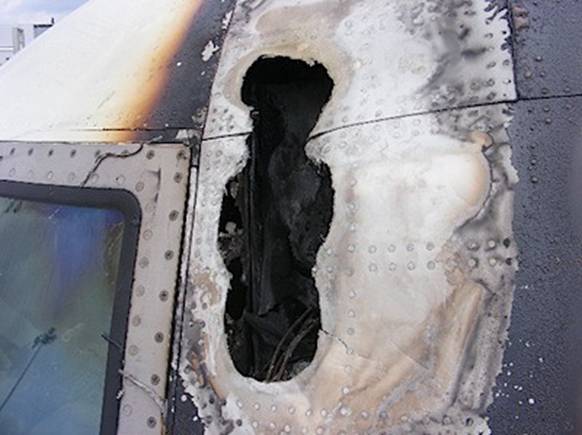
OK… so… you’re the pilot of a plane…
It’s on auto-pilot and you’re catching up on People magazine and having a cup of coffee.
Suddenly the loudest sound you will ever hear goes off just behind your left ear.
You’re blinded by the flash and can’t hear.
All you can feel is something warm running down your leg.
You immediately consider retirement.
This is an Atlantic Southeast Airlines/Delta Connection aircraft… soon after it suffered a lightning strike.
The British Royal Air Force frequently train their air crews in and around the valleys of North Wales. Much of that area is designated a Tactical Training Area. One such route is known as The Loop. Here’s a description of that from the website Warplane.co.uk:
Machynlleth Loop
The most appropriate place to start with is the Machynlleth Loop which is usually referred to by aircrews as ‘The Loop’ although the USAF crews refer to it as ‘The Roundabout’. It is literally a roundabout of flowed valleys running counter-clockwise following the A470 north eastwards from Machynlleth in the south to Dinas Mawddwy then heading north west to join the A487 at the Cross Foxes Inn. From here it follows the A487 southwards through Corris to end back at Machynlleth. Ordnance Survey Explorer Map OL23 is recommended for anyone planning a visit.
It is arguably the busiest part of the UK low fly system and although the cold war days of up to 80 plus movements in a day are long gone it is still sometimes possible to see 30 plus aircraft in one day. The usual daily total is usually between 10 and 20 aircraft mainly made up of Hawks with the odd Tornado, Harrier or Hercules thrown in. It is certainly the place to go to practice your panning technique.
It takes about 3 minutes for a jet aircraft to do a circuit of the Loop and multiple passes by aircraft is not an uncommon sight, especially by Hawks. So whenever you see an aircraft it is worth checking to see if it looks like doing a circuit as you may be lucky enough to see it again in 3 minutes.
Do click on the link if only to view some of the fantastic flying photographs.
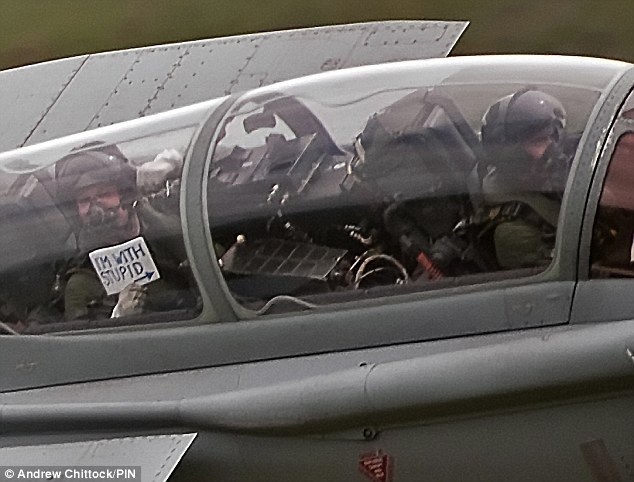
Anyway, a couple of British newspapers recently published a piece about an RAF Navigator holding up a sign inside the cockpit for the many amateur photographers who frequent this part of the country.
A RAF navigator gave plane-spotters a chuckle as he held up a sign reading ‘I’m with stupid’ with an arrow pointing to the pilot.
The pair were on a training mission in a £13million Tornado GR4 aircraft, capable of reaching 1,400mph, when the navigator pulled the prank as they jetted through a valley in Wales.
Trying to say anything new about the implications of the terrible disaster in the Gulf of Mexico would be impossible.
All I can do is to admit my very great discomfort at knowing that later today, I shall be returning to Phoenix by flying across the Atlantic in a Boeing 747.
A small amount of web research suggests that there are about 600 transatlantic flights a day and that my B747 will use roughly 10 tons of fuel an hour, i.e. conservatively 100 tons for the flight LHR-PHX.
So 600 x 100 = 60,000 tons of fuel every day just in flights across the Atlantic!
So pointing the finger at BP is, in a very real sense, misdirected. BP are only responding to our need for oil, in all its forms.
Do watch the videos from Prof Al Bartlett being shown on this Blog from tomorrow to understand the mathematics behind our unsustainable way of life.
Many years ago I saw an overview of airline safety rules and regulations which revealed, in my view, a disturbing double standard: airline attendants are provided with protective smoke hoods to use in the event of a crash, but passengers are not.
Could be safer?
These hoods protect your eyes from cinders and smoke, and your lungs from most toxic fumes. The hood (presuming you can get it on in an actual emergency) gives the wearer up to two minutes of precious extra breathing and visibility after a crash, which is when the vast majority of airline crash deaths occur: not during the crash, but afterwards as survivors try to escape the burning wreckage.
A simple, compact smoke hood
That’s right. The statistics clearly show that most of us, up to 75 or 80%, survive the actual impact; it is the dark, confusion, smoke, toxic fumes, and the inability to see or breathe that cause up to 80% of all fatalities in plane crashes.
The airline attendants and crew are provided with officially sanctioned smoke hoods for their use during an emergency, presumably to stay alert and safe enough to help blinded, coughing, choking passengers out to safety … maybe. Once a plane starts smoldering, one has only about 90 seconds to get out alive.
Well, I’m not a big fan of restricted access to a product that I believe could save my life or the lives of my children. So I rattled some cages, asked some airline personnel and made some calls and it turns out, at the time I was pushing this issue, the FAA was considering — as it had been for many years — several different patent-pending smoke hood models for passengers.
In fact, according to the FAA, they were considering so many smoke hood models that it would take some time to find “the” right one.
The FAA banned all such masks until they found “the one.” As of press time, “the one” had not yet been approved. So passengers remain unprotected, and dying.
So I contacted a company in the UK that sold the smoke holds which led me to a distributor in Fort Worth, Texas. As it turned out, I was living in Dallas at the time so could drive to the vendor to do business.
The vendor informed me that in order for him to sell me the smoke hoods at about $60 a pop, I would have to be a business. I asked him what was the smallest order he had ever filled for a business. He said six.
So I instantly became an academic consulting business and ordered six smoke hoods. Within a couple of days, I was the proud owner of six orange-colored, travel savvy smoke hoods for any type of fire or smoke emergency, including in hotel rooms, on cruise ships, and in the cabin of an airplane. This, by the way, was in 1990, TWENTY years ago!
So, I wonder how that federal legislation that is supposed to provide passengers with the same protection as airline employees is coming along these days?
The next time you board a commercial flight, try to get a peek at the safety equipment provided to the airline attendants. Then, you’ll have to ask the attendant why the same safety equipment is not made available to passengers.
We were climbing after take off in a Cessna 152, and I was applying significant control inputs to keep the aircraft level. Before the flight, there had been some conversation among other pilots on the ground about there being some turbulence at low level today, and I had just remarked that this seemed to be true.
In response to this gentle instruction, I took one hand off the control column, but continued to concentrate on maintaining the attitude of the aircraft in the bumpy conditions. Then the instruction was repeated, still gently, but with a little more emphasis:
“Take your hands OFF the controls”!
Now, whether one follows instructions like this does depend to some extent on who is issuing them! On this occasion, I was honoured to be flying with the most capable pilot and flying instructor I have ever met, or am ever likely to meet.
As it happens, I was not formally under instruction, being qualified to fly and my “passenger” having lost that privilege on medical grounds. Nevertheless, when flying with other people there is always something to learn and, when flying with someone as experienced and knowledgeable as Dickie Dougan, one is learning all the time! Dickie had a very long flying career during which very many people learnt a tremendous amount from him. Sadly, he passed away in 2007, at the age of 89.
So, in this case, the instruction was being issued by someone for whom I had the utmost respect and trust. Nevertheless, it was contrary to my instincts and seemed to me to be decidedly risky.
Very gingerly, I let go of the controls which, now free from my grasp, moved more violently and over a much wider range than I had been moving them. My instinct was to grab them again, but my trust in the instruction that I’d been given was just sufficient to hold that instinct at bay for a short while.
The aircraft seemed to be rolling more than it had under my control, but it was returning to level flight fairly consistently. It was, at least, stable and seemed to be flying satisfactorily without any input from me (to be accurate, I was continuing to apply some right rudder to compensate for the yaw effects of the single propellor in the climb, but it seemed to me that I was not controlling anything!)
After I had realised that the world was not turning upside down and my level of anxiety lowered slightly, Dickie then said quietly, in his soft Irish tones:
“There you are; you’re working too hard! The aircraft can fly itself!”
Incidents like that teach us something quite profound. The world functions without us.
We are not the centre of the universe!
Background:
This post was inspired by Trey Pennington’s description of his conversation with his daughter about Copernicus, as described in his interview of C.C.Chapman.
Further information about the legendary Dickie Dougan can be found in this document in an obituary for him written by Chris Martin who was the Chief Flying Instructor at Exeter Flying Club during the time that I was trained there.
Wonderful short film of the P-38 Lightning (thanks to Steve).
The Lockheed P-38 Lightning was a WWII American fighter aircraft. Equipped with droppable fuel tanks under its wings, the P-38 was used as a long-range escort fighter and saw action in every major combat area of the world.
A very versatile aircraft, the Lightning was also used for dive bombing, level bombing, ground strafing and photo reconnaissance missions.
The Lockheed team chose twin booms to accommodate the tail assembly, engines, and turbo superchargers, with a central nacelle for the pilot and armament. The nose was designed to carry two Browning .50 machine guns, two .30″ Brownings and an Oldsmobile 37 mm cannon.
The P-38 was the only American fighter aircraft in active production throughout the duration of American involvement in the war, from Pearl Harbor to VJ Day.
Music: Benny Goodman with Helen Forrest – ‘It’s Always You’.
Some videos are just fun to watch. Whether you are interested in aviation or not, this blast through the making of an aircraft by Boeing makes it all look quite easy really:
It seems that there has been nothing else on the news following the eruption of Mount Eyjafjallajokull
in Iceland, which was of particular interest to me because on the 10th April I was flying from New York across the southern area of Iceland on my way to Rome, since which time I have passed through the UAE and Singapore on my way to Japan.
My work replacement was due to arrive on the 18th April after a holiday in the Mediterranean, but the flight which he was on was diverted into Paris because UK airspace was suddenly closed. He managed to continue his journey by train, ferry, car, taxi and bus but was then stuck in England. My duty had to continue but there seemed little point in propping up a hotel bar with other crews, so I decided to turn the situation into something positive.
After an exploratory trip into Tokyo, it was Paul, our Editor in Chief who put me in contact with his sister and her husband in the city, and another friend who suggested I should jump on a train and go to Hiroshima to see his son, who I know, so my travels started.
The transport system in Japan is extremely well organised with instructions and information well displayed in English along side Japanese. Everything is clean and modern, and runs to the second! At short notice I decided to make the journey to Hiroshima in this once in a life time opportunity, and there was the famous bullet train a monster of modern technology, which runs on banked rails at steady speeds of 400 kph.
Mount Fuji - Japan
We sped along through ever changing countryside. Initially the skyline was of mainly high rise buildings which changed to two story properties once we were out of town. The new leaves of spring and the famous blossom of the plum and cherry trees, and the quick glimpse of a Japanese water garden. Industry is mixed with small allotments, and tiny houses, roads and rail lines raised from ground level to make everything fit, and above that cables and wires, because of the threat of earthquakes, and past the stunning Mount Fuji, white with snow against a blue sky.
I never met such polite people, and on the train the guards and girls who pass through the carriage with drinks and food bow when they enter and leave. They are so well dressed and smart. No graffiti here!
Familiar Japanese trading names on local buildings, and strangely a huge Union Jack flag. I wonder how there can be so many buildings and parking areas full of cars ,but seemingly no people in view, but many large span bridges arching across hill sides to join places together.
Through Kyoto where there seemed to be a lot of energy being used, for purposes that were not immediately clear. College students in smart suits with white shirts and blue ties, passed quietly through the train. I noticed each time they had left the train at a station they took their rubbish with them, and put the seat back in the upright position!
The A-Bomb Dome
At last after four hours we arrived at Hiroshima, which today it is a lovely modern city of which to be proud. There is just one damaged building standing in a stark fashion at the waters edge which is all that it takes to remind us of such devastation and the Garden of Peace, there to allow some quiet reflection.
I took a 45 minute boat ride to Mijajima, now a World Heritage site. This beautiful island is probably 15 miles from Hiroshima, and there amongst the beauty of the trees and a 500 year old shrine wander the deer, quite happy to sit as people pass by.
My thought as I came away from Hiroshima was that all leaders of any country with any connection to Nuclear weapons or power should be made to attend the A-Bomb Dome and reflect. As all the plaques say this must never be allowed to happen again.
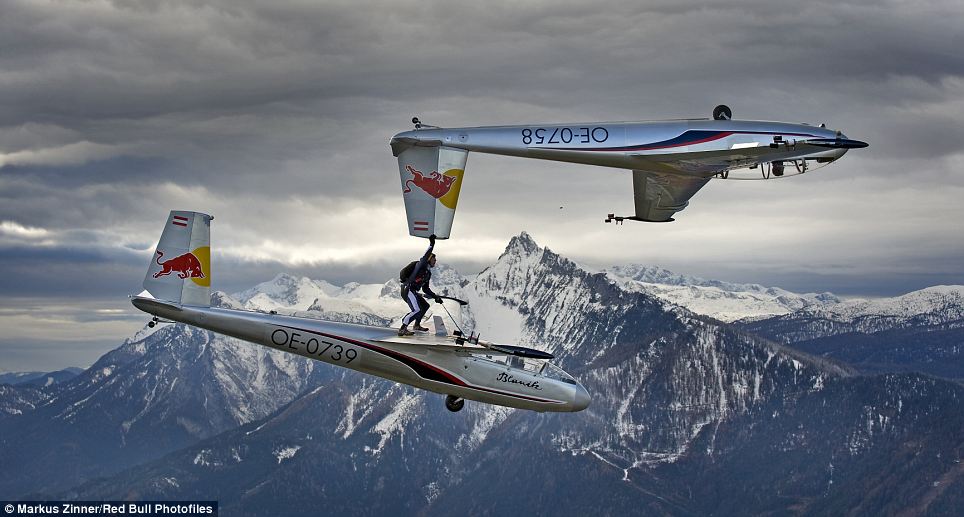
A skydiver has pulled off an astonishing stunt by climbing out of a glider’s cockpit, crawling along the wing and then somersaulting underneath and stepping onto the wing of a second glider flying below.
Paul Steiner then moves back onto the main fuselage of the second glider while the first glider turns upside down and flies overhead so that he can reach up and hold the tail fin at 100mph, forming a human link between the two aircraft. He then leaps off and parachutes back to the ground.
The spectacular stunt, captured on YouTube, was carried out by the Red Bull skydive team 2,100 metres above the mountains in Styria, Austria. And they look mightily relieved as they returned to their airfield.
John’s couple of articles about the SR-71 here and here reminded me of the time that I was given an article by my instructor at Mojave. He was a military test pilot and ended up with NASA and he was one of a select few to fly the Blackbird as a civilian….a great chap to talk to… I continue with Part 2
     The SR-71 was an expensive aircraft to operate. The most significant
cost was tanker support, and in 1990, confronted with budget cutbacks, the
Air Force retired the SR-71. The Blackbird had outrun nearly 4,000 missiles,
not once taking a scratch from enemy fire. On her final flight, the
Blackbird, destined for the Smithsonian National Air and Space Museum, sped
from Los Angeles to Washington in 64 minutes, averaging 2,145 mph and
setting four speed records.

        The SR-71 served six presidents, protecting America for a quarter of
a century. Unbeknownst to most of the country, the plane flew over North
Vietnam, Red China, North Korea, the Middle East, South Africa, Cuba,
Nicaragua, Iran, Libya, and the Falkland Islands. On a weekly basis, the
SR-71 kept watch over every Soviet nuclear submarine and mobile missile
site, and all of their troop movements. It was a key factor in winning the
Cold War.

 Read the final part of this great story








 Learning from Dogs