Many thanks to close friend Dan G for forwarding this – it’s priceless!
Category: Flying
The good old flying days!
Lovely story courtesy of Capt. Robert Derham
The scene is sometime in the old era when cockpits had round dials plus flight engineers and navigators.
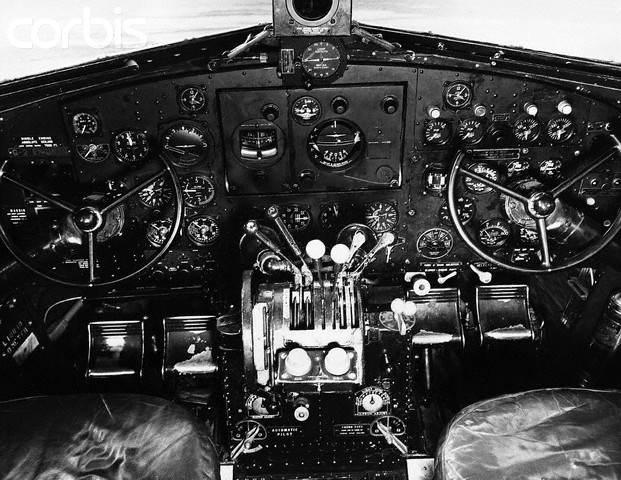
The crusty old-timer captain is breaking in a brand new navigator.
The captain opens his briefcase, pulls out a .38 and rests it on the glare panel. He asks the navigator, “Know what this is for?”
“No, sir,” replies the newbie.
“I use it on navigators that get us lost,” explains the captain, winking at his first officer.
The navigator then opens his briefcase, pulls out a .45 an sets it on his chart table. “What’s THAT for?” queries the surprised captain.
“Well, sir,” replies the navigator, “I’ll know that we’re lost before you will.“
Beauty of flight
There’s more to flying than many of us realise.
Thanks to Mike T who I have known for a few years now. Mike is an air traffic controller as well as being a keen private pilot so if there is one person who can see through the telescope from both ends, it’s this man.
Anyway, GE Aviation are one of the big players in aviation. Here’s a quote from the website that I am going to link you to in a moment.
GE Aviation designs engines, flightpaths, and advanced aircraft systems. And we wanted to share the intricate choreography of flying in all its glory.
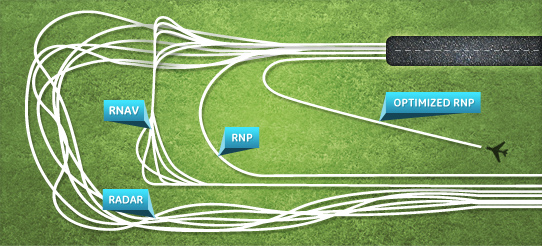
Here’s the video – just 1:48 long – it’s captivating. This link takes you to the GE web page where there is much more of great interest other than the video.
If you only want to watch the video then, of course, there’s a copy on YouTube, as below. Enjoy!
Thanks Mike.
By Paul Handover
Onwards and upwards
Some remarkable recent achievements in aeronautics
Just happened that a few items crossed my inbox more or less in the same time-frame that made me reflect on the ingenuity and persistence of inventors and explorers.
Here’s the first item that I came across in The Register.
Canadian enthusiasts have finally achieved a feat that has eluded humanity’s finest engineers since the time of Leonardo da Vinci – to build a machine, powered by a human pilot’s muscles, which flies by flapping its wings: an ornithopter.
Here it is on YouTube.
Read the rest of the report here.
Then Klaus Ohlmann is recorded on the FAI website as submitting a world record claim for flying a solar powered glider a total of 375.7 km (233.4 miles) around three turning points. Oh, and not forgetting a claim by Jan BÈM and Olga ZALUSKÁ from the Czech Republic for a world record altitude by a weight-shift microlight – 8,188 metres no less (26,864 feet!) – or the claim by Richard Young of the USA for a world record of flying an aircraft between 300 to 500 kg around a closed circuit of 100 km at a speed of 390 km/h (242 mph). What is it with these guys – have they not got proper jobs to go to? 😉
Anyway, here’s Klaus on a nice video.
Finally, my dear friend of many years, Dan Gomez, reminded me in a recent email of this very brave pushing back of the boundaries.
More from here.

By Paul Handover
Sullenberger and US Airways Flight 1549
Not forgetting First Officer Jeffrey Skiles
There has been much written and published about these two heros who enabled the stricken Airbus A-320 to ditch on the Hudson River with no loss of life. That was Flight 1549 on the 15th January, 2009.
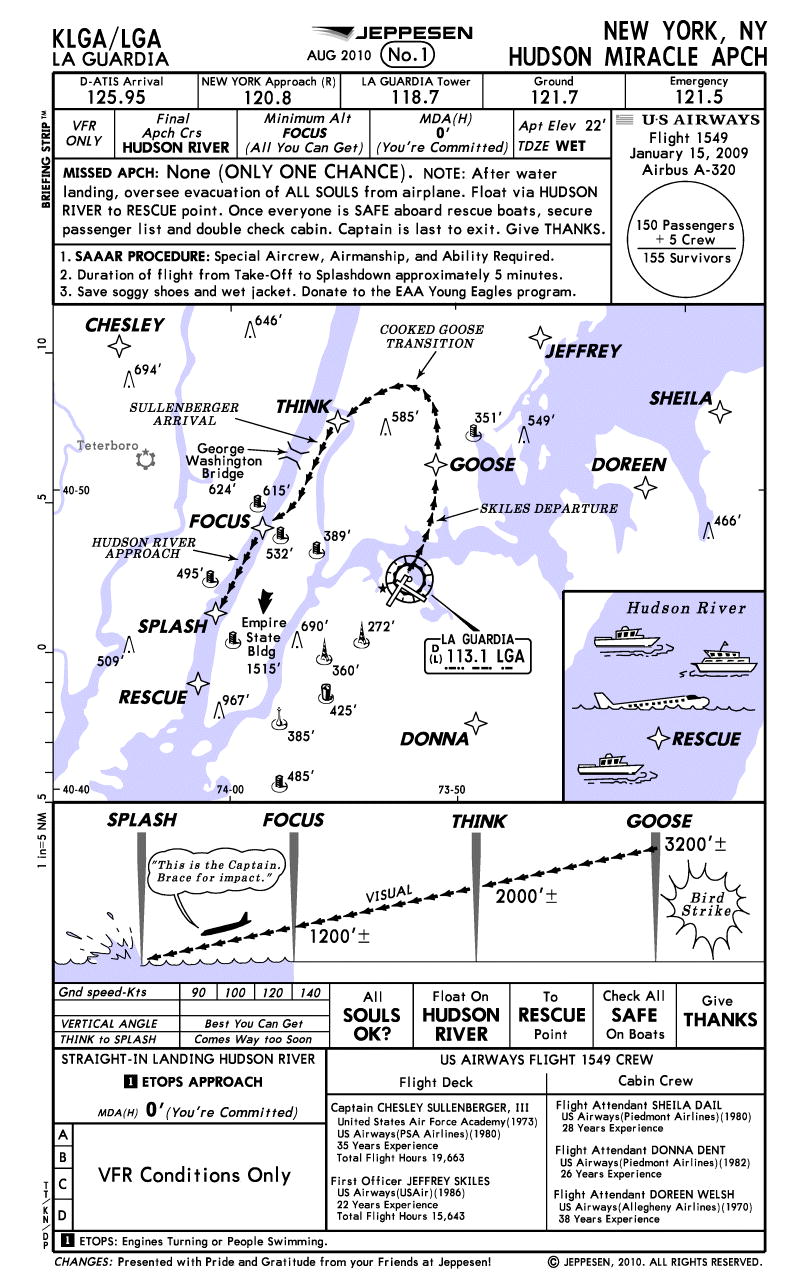
However, at this year’s Oshkosh, Sullenberger and Skiles were presented with a wonderful memento from Jeppesen who publish among other products instrument approach charts for aircraft. They did something very creative in producing the following.
Here’s what was said by Jeppesen:
Englewood, Colo. | 27 Aug 2010
Jeppesen, known in the aviation industry as the worldwide leader in navigation and charting services, recently presented “Miracle on the Hudson” pilots captain Chesley Sullenberger and first-officer Jeffrey Skiles with a specially designed approach chart and engraved Jeppesen chart binders to commemorate the remarkable ditching of US Airways flight 1549 in the Hudson River in New York in January 2009.
Entitled “Hudson Miracle APCH,” the one-of-a-kind chart includes several light-hearted notations that honor the famous water landing that saved the lives of 155 passengers and crew on board the flight disabled by bird strikes. In the “briefing strip” section of the chart, instructions include: “After water landing, oversee evacuation of ALL SOULS from airplane. Float via HUDSON RIVER to RESCUE point. Once everyone is SAFE aboard rescue boats, secure passenger list and double check cabin. Captain is last to exit. Give THANKS.”
The chart documents the historic five minute flight with a unique graphic, beginning with departure from LaGuardia Airport, followed by a “Cooked Goose Transition” point and “Hudson River Approach,” which is then followed by “Splash” and “Rescue” points on the water. The humorous chart also salutes the career achievements of the crew of flight 1549, including Sullenberger, Skiles, and veteran flight attendants Sheila Dail, Donna Dent and Doreen Welsh.
Along with the commemorative chart, the pilots were presented with a special Jeppesen chart binder, engraved with the famous fortune cookie advice kept in Sullenberger’s flight bag: “A delay is better than a disaster.” The items were presented by Mark Van Tine, Jeppesen president and CEO, during the 2010 Gathering of Eagles fundraiser dinner and auction held during the EAA AirVenture fly-in and air show in Oshkosh, Wisc. The EAA Young Eagles event raises funds and awareness for youth involvement in aviation.
To view the commemorative US Airways flight 1549 chart, please visit this page.
A fellow pilot, Martin Thorpe, sent me the chart shortly after the Oshkosh event but it seemed appropriate to let some water flow under the bridge, so to speak, before I mentioned it on Learning from Dogs.
By Paul Handover
A Wow from Oshkosh
Hat tip Carol ‘de Solla Atkin
Just enjoy!
By Paul Handover
Bob Hoover, the best stick and rudder man in the world
Demonstrating the joy of being really good at what you do!
Before I get to the subject matter, just another word from me about the Posts being published on Learning from Dogs just now. As I mentioned earlier, I’m presently away from home and back in England for as long as it takes to complete all the necessary procedures at the US Embassy in London. All part of me being allowed to become a resident of Payson, Arizona and the husband to my lovely Jeannie.
Anyway, I’m posting items that catch my eye and don’t require the normal amount of time to prepare and write, simply because to have a new Post every day means keeping the pipeline going to cover the times when I shall be in darkest Devon and away from internet coverage! Trust I have your support during this period – I just love seeing so many readers of the Blog!
OK, to the article.

Bob Hoover is well known to many besides pilots because for years he has demonstrated the huge skill in managing the energy of a flying aircraft – with both engines stopped.
Thanks to Peter Kelsey, a Facebook contact, who recently posted a YouTube video of Bob flying his famous display. But more about the man. Here’s an extract from Wikipedia:
Robert A. “Bob” Hoover (born January 24, 1922) is a former air show pilot andUnited States Air Force test pilot, known for his wide-brimmed straw hat and wide smile. In aviation circles, he is often referred to as “The pilots’ pilot.”
Bob Hoover learned to fly at Nashville‘s Berry Field while working at a local grocery store to pay for the flight training.[1] He enlisted in the Tennessee National Guard and was sent for pilot training with the Army.[2] He was sent to Casablanca where his first major assignment of the war was test flying the assembled aircraft ready for service.[3] He was later assigned to the Spitfire-equipped 52nd Fighter Group in Sicily.[4] In 1944, on his 59th mission, his malfunctioning Mark V Spitfire was shot down by a Focke-Wulf Fw 190 off the coast of Southern France and he was taken prisoner.[5] He spent 16 months at the German prison camp Stalag Luft 1 in Barth,Germany.[6]
He managed to escape from the prison camp, stole an Fw 190, and flew to safety in the Netherlands.[7] After the war, he was assigned to flight-test duty at Wright Field. There he impressed and befriended Chuck Yeager.[8] Later when Yeager was asked who he wanted for flight crew for the supersonic Bell X-1 flight, he named Bob Hoover. Hoover was Yeager’s backup pilot in the Bell X-1 program and flew chase for Yeager in a Lockheed P-80 Shooting Star during the Mach 1 flight.[9] He also flew chase for the 50th anniversary in an F-16 Fighting Falcon.[10]
What Bob shows is that true professionalism, in whatever one does, work or play, always comes over as an underplayed, understated skill. Just look at this video for proof of that:
Well over 1,700,000 viewings at the time of writing this Post!
Remember Gordo Cooper in the film “The Right Stuff” poses the question, “Who’s the greatest pilot you ever saw?” Most pilots of all sorts would elect Bob Hoover for that honorable position.
The Smithsonian seem to agree as well. If you can, settle back and watch Bob Hoover’s talk at the 2010 Smithsonian Charles A Lindberg lecture. The video at that link is a long one and Bob doesn’t come on stage until minute 20.
But the flying scenes in the introduction include some historic footage and the talk by Bob Hoover, now nearly 90, is just wonderful. That link also includes the following summary of Bob Hoover:
Robert A. “Bob” Hoover is a fighter, military, and civilian test and air show pilot of legendary proportions. Using his superb piloting skills to fly aircraft to the edge of their performance capabilities, Hoover has left an indelible mark in aviation history. During his Air Force and North American Aviation careers, he flew 58 combat missions (and as a WWII POW flew himself to freedom), served as back-up pilot on the Bell X-1 and tested a wide array of fighter aircraft. As an ambassador of aviation, Hoover flew aerobatic routines in a North American P-51 Mustang, the T-39, and the Aero Commander fleet, culminating in the Shrike Commander 500S, at more than 2,500 civilian and military air shows. Bob Hoover will discuss his career in aviation and some of the pilots he has known including Orville Wright, Eddie Rickenbacker, Charles Lindbergh, Jacqueline Cochran, Neil Armstrong, and Yuri Gagarin.
By Paul Handover
Battle of Britain, memories
Seventy years on – many still remember.
Many of the English readers of Learning from Dogs will comfortably skip this Post as already much of the news has been reporting the fact that we are 70 years after the Battle of Britain in 1940.
But for those that are from other places, where the BoB is not in the psyche of their national bloodstream, these links may be of interest.
The BBC has been doing well in presenting material.
Here’s a good piece setting the scene:
While memories of the Battle of Britain remain fresh in the minds of The Few who flew, and the staff who supported them, veterans fear its significance could soon be forgotten by others.
The Luftwaffe lost 1,733 aircraft and the RAF 915 in the Battle of Britain
Seventy years ago the RAF was locked in a life and death struggle with the Luftwaffe in the skies over England.
The three weeks between mid-August and early September in 1940 were decisive for the Battle of Britain.
The bravery of the RAF pilots was captured in Winston Churchill’s speech on 20 August when he said “never in the field of human conflict was so much owed by so many to so few”.
Those left of The Few, as those pilots became known, are now in their 90s. Some of them fear they will soon not be around to remind people of the events that summer.
And if you want a flavour of what it was like to fly a Spitfire, then click here – excellent piece from Evan Davis of the BBC.
Seventy years on from the Battle of Britain, can the current generation comprehend what it is like to fly a Spitfire?
To find out, BBC Radio 4 Today programme presenter Evan Davis took a flight with The Aircraft Restoration Company’s chief engineer and test pilot John Romain.
See more on the Today website.

And a thank-you to my Uncle who, despite being rather ill, is still alive. He was in the RAF and stationed at Biggin Hill during those demanding months in 1940.
By Paul Handover
Feeling the sun from both sides
Another great lesson from dogs.
Humans understand, if we stop and think about it, that the most powerful force in the world is …. love!
As the American psychiatrist, David Viscott put it, “To love and be loved is to feel the sun from both sides.”
That’s one reason why dogs are so special to humans. Dogs naturally and easily demonstrate unconditional love which is the highest form of love. Even dogs that have been terribly treated in previous times, if given sufficient space and patience, will let their instinct to love come to the fore.
We have 13 dogs here at home and one of them, Loopy, is a great example of that. Loopy was a Mexican rescue dog that took weeks and weeks before she would even allow one of us to touch her. Food had to be left at a distance. It took nearly a year before I could cuddle her and even longer before we trusted each other sufficient for me to put my face up against the side of her jaw.
Compare that to my German Shepherd, Pharaoh, whom I bought out from England in 2008, who has been loved by me since he was 6 weeks old. He and I trust each other so deeply that we can get up to all sorts of fun things.
For example, a few years ago I was at the private airstrip where I used to keep my Piper Super Cub. It’s a large grass airstrip and while I was pottering around the aircraft, Pharaoh was enjoying the wide open spaces and all the great smells. The plan was to go off for a short flight on this wonderful spring day.
I walked back to the hangar to fetch something just prior to putting Pharaoh in the car for 30 minutes while I did my flight.
Pharaoh, as is his way, must have worked out that he was due to be shut in the car because as I came out of the hangar, Pharaoh was running towards the open cockpit and with one bound had jumped up into the rear passenger seat. Miraculously, as he leapt up, he had placed his feet on the hard wooden edge to the fuselage and not punched a hole through the fabric!
I turned back and grabbed his body harness from the car, walked up to the Super Cub and proceeded to strap him tightly into the rear seat.
There was no way that it would have been safe to fly with him but I was interested to see how he would react to me taxiing around the grass airfield. That’s when his trust towards me paid off.
I started the engine – no reaction at all. Even to the powerful draft coming off the propeller through the open door.
Then I taxied slowly – again no reaction at all. Unless one can count what looked suspiciously like a grin on a dog’s face!
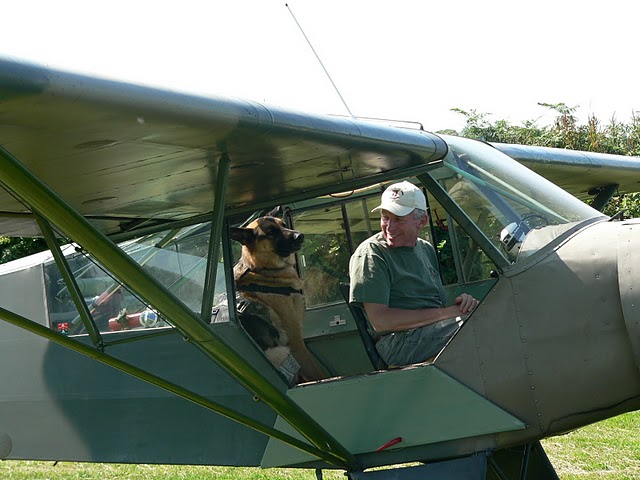
Then I taxied quickly – same result.
Then I lined up at the start of the runway, closed the door, put on full power and let the aircraft accelerate until we just lifted clear of the grass. Almost immediately I closed the throttle, we touched down and slowed to a walking pace and we returned to the hangar. There was no question of us flying even though it looked like it would have been a non-event!
That was one of the many highlights of being Pharaoh’s friend, companion and protector – just as he is towards me. That sort of closeness would have been impossible without huge trust from Pharaoh that I would never do anything to hurt him.
So the moral of this message? That is, that when we love everyone and everything around us, it is reflected back to us – every moment of the day. This allows us to live in a world of mutual trust and reap the rewards of closeness.
We feel the sun from both sides!
By Paul Handover
Anniversary message from Paul
Learning from Dogs has been running for one year.
On July 15th, 2009 a post called Parenting lessons from Dogs started what has now become a bit of a ‘habit’. But more reflections tomorrow.
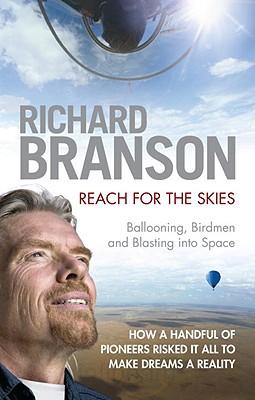
Today I want to voice something that has been running around my mind for some time. It is whether we give in to the mounting doom and gloom at so many levels in our societies (and it can be a very compelling draw) or whether we see this as a painful but necessary period where slowly but surely the desires of ordinary people; for a fairer, more truthful, more integrous world are gaining power.
And I’m going to use Richard Branson to voice it for me!
(Now this is an unusually long Post so I’ve inserted the Read More divider to prevent the Post visually swamping your browser.)
 Learning from Dogs