We must never lose sight of the greater power of positive thoughts.
Indeed, who cannot look at a dog’s wagging tail and not feel better about life. There is so much doom and gloom around that we need constantly to remind ourselves that there is a brighter future ahead, there always is.
And to understand how little it takes for a positive difference to sweep through, take a look at this article from Science Daily,
Scientists at Rensselaer Polytechnic Institute have found that when just 10 percent of the population holds an unshakable belief, their belief will always be adopted by the majority of the society.
The implications of this are profound. Be sure that we are living through a transition period, a period necessary to find a better future. Find another nine people who agree with you, and there’s a hundred on their way! Back to the article,
“When the number of committed opinion holders is below 10 percent, there is no visible progress in the spread of ideas. It would literally take the amount of time comparable to the age of the universe for this size group to reach the majority,” said SCNARC Director Boleslaw Szymanski, the Claire and Roland Schmitt Distinguished Professor at Rensselaer. “Once that number grows above 10 percent, the idea spreads like flame.”
Today, delighted to offer a guest post from author Garth Stein
Garth Stein and dog!
But first to how this came about. Way back in June, I was contacted by Wiley Saichek who signed off his email, Marketing Director, Authors On The Web. To be frank, I hadn’t heard of the organisation before. Wiley invited me to participate in something he called a Blog Tour on behalf of Garth Stein. It was connected with Garth’s latest book, The Art of Racing in the Rain.
Jeannie had read it some time ago and thoroughly enjoyed it. The book had been next to my side of the bed for weeks but, ironically, the demands of my own writing had just got in the way of me reading it.
Anyway, back to the Blog Tour!
Apparently, the ideal was to have the guest post published on Learning from Dogs during the period July 18th to August 1st but I dragged my heels waiting and hoping that the story from Garth could include a picture of Comet. The picture has not been forthcoming so here it is anyway. I shall be reviewing Garth’s book The Art of Racing in the Rain as soon as I can get around to reading it.
A Game Called Fetch, by Garth Stein
People often ask me about my dog, Comet. They want to know if she was the inspiration for Enzo, the dog narrator in my book, The Art of Racing in the Rain (and the young reader version, Racing in the Rain: My Life as a Dog). And the answer is, flatly, no. Enzo is a singular character, I tell them, and has no predecessor. Comet is goofy and silly, and is very much not Enzo. But she’s still very smart–in her own Comet way–and has taught me much about the world.
When Comet was just a pup, she hated being left at home; she didn’t like the responsibility of having the house to herself. She would always get into some mischief: eat an entire bunch of bananas, for instance (having peeled them first!). Or claw her way into the pantry looking for cookies. But one day, she communicated her anxiety in a way that was so clear, so unmistakable, there was no doubt at all as to her feelings. We went out for a couple of hours, confining her to the kitchen/dining area of our house. And when we came home, there was a perfectly round, undisturbed puddle of urine on the dining room table.
Now that is a statement. Message received. Since that day, whenever we get ready to leave her alone in the house, she willingly–one might saygratefully–finds her crate, curls up, and waits for us to secure the door.
While Comet may not be able to wax eloquently about philosophy and popular culture as Enzo does, she did teach me an important lesson this summer.
Comet loves playing fetch with a tennis ball. She always has. And she will run herself into the ground chasing balls, so that my arm gets sore throwing a ball for her with my Chuck-It, and I find myself neglecting my cooking duties, my lawn mowing, my reading, my writing, and even my children…all to throw a tennis ball for Comet.
This summer I purchased a GoDogGo. It’s a ball launcher with a bucket of tennis balls and a delayed feed, so one can teach one’s dog to play fetch with herself. A brilliant idea! The machine spits the ball, the dog fetches it, drops it in the bucket, the machine spits it again. Ad infinitum.
And so one weekend this summer, I decided to teach Comet how to use this machine so I could do other things that needed doing, like cleaning gutters and grilling chickens.
Well, she got the idea right away. Launch, fetch, drop. She was really quite good. And then I taught her launch, fetch, drop-in-the-bucket, prepare for re-launch. And she got that, too.
“I have the smartest tennis-ball-dog on the planet,” I thought. “She picked this up in ten minutes! Now I can go have an iced tea while she plays fetch with a ball throwing machine.”
But it didn’t work. As soon as I stepped away, she lost the thread. Ball launch, ball fetch, ball dropped in the bucket. Instead, she dropped it next to the bucket and stared at it while the machine ground its ball-throwing wheels in anticipation.
“Come on, Comet,” I said. “Drop it in the bucket!”
I dropped the ball in the bucket, the launcher launched, Comet fetched, and dropped the ball at my feet.
“In the bucket,” I said. She wagged, sat and barked and waited for me to drop the ball in the bucket.
I spent two days teaching her how to drop the ball in the bucket by herself. Sometimes she’d do it for me–so I knew it was possible!–but the moment I stepped away to attend to some other business, she lost her ability to drop the ball in the bucket. She’d stand over the ball and bark until I came to help her. It was a miserable time.
As Sunday evening arrived, my wife came outside to see how our training was going. I expressed to her my frustration. “She knows what to do,” I said. “She just won’t do it.”
My wife watched as I put the ball in the bucket and the launcher clicked, ratcheting up its gears. Comet had gotten to recognize the clicks that meant the ball would soon be launched, and she sunk to her haunches, tail wagging, staring at the launch tube. And then with a thwack! the ball sailed across the yard and she took off after it, recovered it, dropped it at my feet and barked happily.
“She won’t drop it in the bucket,” I said, bewildered. “She wants me to drop it in the bucket.”
My wife smiled at me my sympathetically. “Comet doesn’t want to play fetch with a machine,” she said. “She wants to play fetch withyou.”
And I realized, in my effort to make my life more efficient, in order to multi-task one more thing during a busy day, that playing fetch is not about economy and efficiency. It’s about playing fetch.
The ball launcher sits in the shed gathering dust these days, but the Chuck-It is always in use. And while Comet might like to spend every waking hour of every day playing fetch, she realizes that I have to put the ball down at some point to cook dinner or play with my family or write a book. But she’s okay with that. Because when we do play fetch together, that’s the only thing we’re doing–we are focused on each other, and that’s what the game is all about.
Sustainable is an overused word these days. All for the right reasons, of course! But how often is the word used in the context of relationships? Of the relationships between the domesticated dog and man? I suspect rarely.
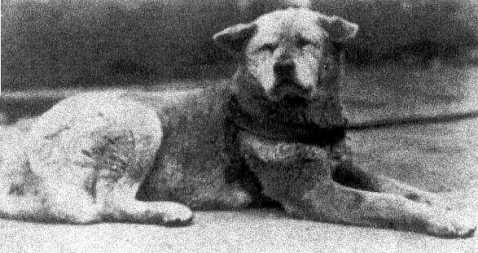
Take the example of the Japanese Akita dog called Hachi, (Hachikō in Japanese) that I wrote about almost a year ago.
In 1924, Hidesaburō Ueno, a professor in the agriculture department at theUniversity of Tokyo took in Hachikō as a pet. During his owner’s life Hachikō saw him out from the front door and greeted him at the end of the day at the nearby Shibuya Station. The pair continued their daily routine until May 1925, when Professor Ueno did not return on the usual train one evening. The professor had suffered from a cerebral hemorrhage at the university that day. He died and never returned to the train station where his friend was waiting. Hachikō was loyal and every day for the next nine years he waited sitting there amongst the town’s folk.
Hachikō 1925
“…. every day for the next nine years he waited sitting there amongst the town’s folk” Truly a sustainable relationship.
Now to something closer to home; literally.
The Payson Roundup is our local newspaper. Last Tuesday’s edition had the following story which Tom Brossart, Editor, has kindly given me written permission to reproduce here on Learning from Dogs. Thank you, Tom.
Best friends help save man’s life
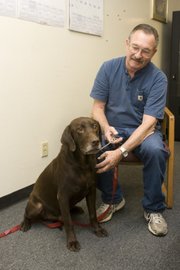
Both Logger and Harold Green are a little gray around the muzzle, but they have lots of good days ahead after Logger helped save Green’s life back on July 1.Photo by Andy Towle
Logger is Harold Green’s best friend. Logger isn’t a flannel-wearing, tattooed burly woodsman; he is a sweet-tempered chocolate Labrador retriever. And this best friend saved Green’s life.
Green makes his home up in Happy Jack. Recently he and Logger drove into the woods and went for a walk, and then Green had a heart attack. He didn’t have a history of heart disease, but all of a sudden his chest became tight. He collapsed and on his way to the ground, he hit a fallen log and wound up hitting his forehead and nose, tearing his bottom lip away from his gums, cutting his chin and breaking a rib.
“Right before I had the heart attack I had a page there was a fire, and that’s the last thing I remember,” he said. Green is an emergency medical technician with the Blue Ridge Fire Department.
He said the next thing he remembers was waking up and trying to call 911. “There was so much blood in my eyes I couldn’t see at first, but Logger licked the blood away.”
Green was conscious long enough to dial 911 and try to explain where he was. He heard the sirens go past him and with that information; the emergency responders had a place to start looking for him.
At that point, Logger left Green’s side to go to the rescue personnel.
“From what they told me, he was like Lassie. He came running to them, barking, and started running back to me, stopped and made sure they were following,” Green said.
The first person on the scene with him was a law enforcement officer with the Forest Service. Green said he told him his nose was bleeding so much he thought it was broken.
Next to arrive was a deputy sheriff. Green said he later learned the guy was off duty, but came to help anyway.
The Blue Ridge ambulance crew arrived next.
“Logger did the same with all of them as he had with the first one on the scene. They told me, without Logger’s help they would have had to search for me a lot longer.”
Green said when they first reached him his heart rate was in the mid-40s and he had no blood pressure. The rescue team stabilized him and carried him out to the ambulance to take him to the fire station where a helicopter could land.
“They said Logger tried to get into the ambulance with me,” Green said.
He said he has little or no memory of everything that took place, when he woke up he was in the hospital in Flagstaff.
Logger couldn’t ride in the ambulance with Green and couldn’t come see him in the hospital, but since he has been out, the dog has not been more than three feet from him for three weeks.
“It is really humbling to have so many friends there to help you out,” Green said.
The people who came to his rescue were all friends and, just like Logger, they did what best friends do, except it was something they do every day, for friends and strangers alike.
Logger has been part of Green’s family for seven years, joining it when he was just a puppy.
Green is the son of longtime Rim Country Realtor Bea Baxter, who has been in the community for around 40 years.
So dear, lovely Logger also demonstrated the same, deep sustainability of relationship that Hachikō did back in 1925. There is so much that we can learn from dogs. Think about sustainability, as it relates to the relationship between dogs and man. It goes back at least 30,000 years. It’s an unimaginable length of time.
In this context, sustainability is an underused word!
The latest announcement continues to show dogs in very good light!
Before I plunge into this Post, just an apology. I’m trying hard to get out of what feels like a recent pattern of ‘re-publishing’ stuff rather than posting material that is primarily my own creative output. Ironically, it’s become a little harder to achieve since starting a creating writing course last Tuesday 23rd (every Tuesday evening for 12 weeks!). The course requires several thousand words of ‘homework’ each week.
Then I lost the plot and published two posts yesterday, when one of them should have been scheduled for today! Thus making it almost impossible to be fully creative today!
Anyway, to today’s theme. Which comes very close on the heels of my post on Monday about the antics of the big oil companies and ‘recovering’ oil from tar sands in Canada.
We all know that some of the most ecologically and environmentally fragile places on the planet are the polar regions. Of the two polar regions, the more sensitive one is the North Polar region. The Arctic ice cap is forecast to be clear of ice each Summer by 2030 assuming the huge annual run-off of fresh water doesn’t screw up the existing ocean currents before then. (Indeed, a fascinating film about the complexity of the weather systems as a result of very long heating and cooling cycles was seen recently on YouTube – link at the end of this post.)
So continued madness over our love affair with oil is just that: madness. Don’t get me wrong. Jean and I drive gasoline-powered vehicles but at least we are conscious of the damage we are doing and will change just as soon as it becomes viable for us to so do.
So with all that in mind, here’s a recent announcement from Exxon first seen on the BBC News website.
US oil major Exxon Mobil has clinched an Arctic oil exploration deal withRussian state-owned oil firm Rosneft.
The venture seemingly extinguishes any remaining chance of BP reviving its own deal, which lapsed in May.The agreement was signed on Tuesday in the presence of Prime Minister Vladimir Putin, a Rosneft spokesman said.
Prime Minister Putin said that it would also allow Rosneft to develop fields in the Gulf of Mexico and Texas, according to local media reports.
“New horizons are opening up. One of the world’s leading companies, Exxon Mobil, is starting to work on Russia’s strategic shelf and deepwater continental shelf,” he said.
‘Big win
‘Under the agreement, the two firms will spend $3.2bn on deep-sea exploration in the East Prinovozemelsky region of the Kara Sea, as well as in the Russian Black Sea.
Exxon described these areas as “among the most promising and least explored offshore areas globally, with high potential for liquids and gas”.
The two companies will also co-operate on the development of oil fields in Western Siberia.
Exxon spokesman Alan Jeffers told the BBC: “[The Russian Arctic] is among the most promising and least explored regions for oil, that is why we are very interested.
Cynic mode on: “The Russian Arctic is among the most promising and least explored regions for oil …” Well that’s alright then!
If one follows that link in the BBC news item, it goes to the ExxonMobil press release where one can quickly read the following key points,
US $3.2 billion exploration program planned for Kara Sea and Black Sea
Establishment of a joint Arctic Research and Design Center for Offshore Development in St. Petersburg
Rosneft participation in ExxonMobil projects in the U.S. and other countries with a focus on building offshore and tight oil expertise
Joint operations to develop Western Siberia tight oil resources
Companies form partnership to undertake projects in the Russian Federation and internationally
Thus this is not some small sideline – it’s potentially very big business for both partners.
The Kara Sea, an extension of the Arctic Ocean, is located off the coastline of Siberia in far northwestern Russia.
It’s separated from the Barents Sea (in the west) by the Kara Strait and Novaya Zemlya – and the Laptev Sea (in the east) by the Taymyr Peninsula and Severnaya Zemlya. The northern border (shown) is a mapping opinion.
It has an estimated area of 880,000 sq km (340,000 sq mi), an average depth of 128 m (420 ft) and a maximum depth of 620 m (2,034 ft).
Ice-bound for most of the year, the sea is generally navigable only during August and September.
The main ports are Dikson (Dickson) and Novyy Port, and they are heavily used during the two-month (lucrative) fishing season. They will also be distribution points when the petroleum and natural gas discovered here is brought to the surface.
Just look at that map again and see how far North of the Arctic Circle is the Kara Sea.
Dad, where's the ice gone?
Let’s go back to dogs. When dogs were primarily wild animals, really when they were still carrying all the ‘habits’ of the Grey Wolf, from which dogs are genetically descended, they were very territorial, as indeed domestic dogs are towards their domestic area. WikiPedia explains, ‘The core of their territory is on average 35 km2 (14 sq mi), in which they spend 50% of their time.‘ (That’s a great article on WikiPedia about the Grey Wolf, by the way.)
Anyway, the wolves, like practically all other animal species, live in harmony within their territory and only move or amend their territorial boundaries if the survival of the pack is threatened.
So when, oh when, is mankind going to learn that our territory is Planet Earth. We have no other territory to move to. I still remember my form teacher way back in my first English school saying to me, “There are two ways you can learn this lesson, the easy way or the hard way!” Same applies to us all! Let’s urgently learn this lesson from dogs and move on from oil.
Finally, that YouTube video. Less than an hour long, it has some interesting facts about climate change over many thousands of years and a rather interesting conclusion.
Being in the present is the key message that we can learn from dogs. Why is this so important?
‘Drink your tea slowly and reverently, as if it is the axis
on which the world earth revolves – slowly, evenly, without
rushing toward the future. Live the actual moment. Only this moment is life.’ ~Thich Nhat Hanh
[my blue emboldening]
Unlike Jon, I muse as an ‘amateur’ when I sense that the human psyche is attracted to fear. I use that word ‘attracted’ simply because some stimuli that touch our consciousness seem to have more force than others. Ergo, the response to the simple question of asking someone how they are, is likely to me more engaging if they come up with some form of crisis reply than by saying, “Everything’s fine, thanks!” Look at how the news media use the power of fear to capture our attention.
There is a strong biological explanation for this. From the Science daily website,
The amygdala (Latin, corpus amygdaloideum) is an almond-shape set of neurons located deep in the brain’s medial temporal lobe. Shown to play a key role in the processing of emotions, the amygdala forms part of the limbic system.
In humans and other animals, this subcortical brain structure is linked to both fear responses and pleasure. Its size is positively correlated with aggressive behaviour across species. In humans, it is the most sexually-dimorphic brain structure, and shrinks by more than 30% in males upon castration.
Conditions such as anxiety, autism, depression, post-traumatic stress disorder, and phobias are suspected of being linked to abnormal functioning of the amygdala, owing to damage, developmental problems, or neurotransmitter imbalance.
For more information about the topic Amygdala, read the full article at Wikipedia.org
I am going to get to the point of this article but stay with me a little longer. Let’s look some more at the ‘fight or flight’ aspect of our brains. From the website, How Stuff Works,
It’s dark out, and you’re home alone. The house is quiet other than the sound of the show you’re watching on TV. You see it and hear it at the same time: The front door is suddenly thrown against the door frame. Your breathing speeds up. Your heart races. Your muscles tighten.
An instant later, you know it’s the wind. No one is trying to get into your home.
For a split second, you were so afraid that you reacted as if your life were in danger, your body initiating the fight-or-flight response that is critical to any animal’s survival. But really, there was no danger at all. What happened to cause such an intense reaction? What exactly is fear? In this article, we’ll examine the psychological and physical properties of fear, find out what causes a fear response and look at some ways you can defeat it.
What is Fear?
Fear is a chain reaction in the brain that starts with a stressful stimulus and ends with the release of chemicals that cause a racing heart, fast breathing and energized muscles, among other things, also known as the fight-or-flight response. The stimulus could be a spider, a knife at your throat, an auditorium full of people waiting for you to speak or the sudden thud of your front door against the door frame.
The brain is a profoundly complex organ. More than 100 billion nerve cells comprise an intricate network of communications that is the starting point of everything we sense, think and do. Some of these communications lead to conscious thought and action, while others produce autonomic responses. The fear response is almost entirely autonomic: We don’t consciously trigger it or even know what’s going on until it has run its course.
Because cells in the brain are constantly transferring information and triggering responses, there are dozens of areas of the brain at least peripherally involved in fear. But research has discovered that certain parts of the brain play central roles in the process:
Thalamus – decides where to send incoming sensory data (from eyes, ears, mouth, skin)
Sensory cortex – interprets sensory data
Hippocampus – stores and retrieves conscious memories; processes sets of stimuli to establish context
Amygdala – decodes emotions; determines possible threat; stores fear memories
Hypothalamus – activates “fight or flight” response
Now I originally called this article Present Perfect but WordPress quickly indicated that the title had already been used. Once again, the old memory cells are failing me! In fact the post of the name Present Perfect was published on the 8th June, just a couple of months ago. Glad that I was reminded because from that article in June,
Did you see Mr. Holland’s Opus? About Glenn Holland’s lifetime of teaching music to a high school band. In one scene he is giving a private lesson to Gertrude. She is playing clarinet, making noises that can only be described as other-worldly. He is clearly frustrated. As is she. Finally Mr. Holland says, “Let me ask you a question. When you look in the mirror what do you like best about yourself?”
“My hair,” says Gertrude.
“Why?”
“Well, my father always says that it reminds him of the sunset.”
After a pause, Mr. Holland says, “Okay. Close your eyes this time. And play the sunset.”
And from her clarinet? Music. Sweet music.
Sometime today, I invite you to set aside the manual, or the list, or the prescription.
Take a Sabbath moment. . . close your eyes and play the sunset.
Mary Oliver describes such a moment this way, “. . .a seizure of happiness. Time seemed to vanish. Urgency vanished.”
Because, in such a moment, we are in, quite literally, a State of Grace. In other words, what we experience here is not as a means to anything else.
If I am to focused on evaluating, I cannot bask in the moment.
If I am measuring and weighing, I cannot marvel at little miracles.
If I am anticipating a payoff, I cannot give thanks for simple pleasures.
If I am feeling guilty about not hearing or living the music, I cannot luxuriate in the wonders of the day.
Beautiful thoughts all woven around the power of focusing on the moment (if you want to catch up on the full article it is here).
Jon’s article last Monday was all about the way forward in a positive, well-being sense. In that article Jon showed the Maslow Hierarchy of Needs pyramid. It’s reproduced again below; spend a few moments absorbing the nature and sense of each level in that hierarchy.
Now ponder on that fear – ‘fight or flight’ – response. Most likely it’s going to be initiated in the ‘Safety’ level but flick straight down one level to the ‘Physiological’ layer. All very primitive stuff and utterly out of our control! Remember from the extract above, “The fear response is almost entirely autonomic.”
Even modest amounts of these fear responses is very wearying, very unsettling. Remember Jon touched on that when he wrote,
The point I’m trying to make is that the same panic I notice in many of the companies I work in, and in me, is based on fear of the unknown and on a lack of trust in all its forms. I’ve deliberately underlined that last phrase because it is so incredibly important. The truth is that we get more of what we focus on. So we can choose to focus on the constant news of more difficulties, hardship and redundancies, or we can focus on what is working.
So because our fear response is entirely autonomic and because there is so much out there, all around us, pulling those autonomic strings we have to actively, quite deliberately, do what dogs (and many other animals) do quite naturally. We deliberately have to focus on spending time being in the present!
There was a recent piece from Leo Babauta about being in the present. While he doesn’t touch on the underlying biology of why we humans are so ‘attracted’ to fear, he does offer some excellent advice about being in the present.
No matter how out-of-control your day is, no matter how stressful your job or life becomes, the act of being present can become an oasis. It can change your life, and it’s incredibly simple.
Look at Lorraine’s website (a recent visitor to Learning from Dogs). In particular this piece, from which I quote,
3. The Serenity Prayer – all about accepting the things I cannot change and changing the things I can.
4. People are always more important than things. Things can mostly be replaced but people cannot.
5. Do it now – if there is something to be done, then what is stopping me from doing it straight away?
6. If I appreciate and look after what I have now, there will be a positive flow back to me in the future. If I am neglectful and ungrateful with what I have now, I cannot expect to be rewarded with more in the future.
7. Be quiet and keep breathing – no one will know how crazy I feel inside
8. Don’t hold on to people or things too tightly. Be open to letting go and letting be.
9. It is really important to let others know that I love them. They need to know now and often. Love isn’t just a beautiful feeling – show it by how I act and speak with those I love.
10. I can’t make anyone love me and I can’t fix anyone by loving them. I may have a script for how life should be but I have no control over other people, places or things. Go with the flow and accept what is.
(The blue emboldening is mine – highlighting the power of now.)
Grandson Morten - peace in the present
“Live the actual moment. Only this moment is life.”
A new book about dogs by John Bradshaw offers a theme for today.
Yesterday, I mentioned an article from the current issue of The Economist. Also in that issue was a review of a new book from John Bradshaw, called Dog Sense: How the New Science of Dog Behaviour Can Make You a Better Friend to Your Pet. You can read the review here. But in terms of the theme of today’s post, read this paragraph from that review,
Dogs are not like nicely brought-up wolves, says the author, nor are they much like people despite their extraordinary ability to enter our lives and our hearts. This is not to deny that some dogs are very clever or that they are capable of feeling emotion deeply. But their intelligence is different from ours. The idea that some dogs can understand as many words as a two-year-old child is simply wrong and an inappropriate way of trying to measure canine intellect. Rather, their emotional range is more limited than ours, partly because, with little sense of time, they are trapped almost entirely in the present. Dogs can experience joy, anxiety and anger. But emotions that demand a capacity for self-reflection, such as guilt or jealousy, are almost certainly beyond them, contrary to the convictions of many dog owners.
That last sentence is key, “But emotions that demand a capacity for self-reflection, such as guilt or jealousy, are almost certainly beyond them, contrary to the convictions of many dog owners.”
So in yesterday’s post, when I wrote about the terrible uncertainty that millions and millions of humans must be experiencing, there is no useful metaphor available to link this human idea to how the dogs feel; as John Bradshaw writes, this level of reflection is just beyond them.
We hug a dog (or any animal) to escape from matters complex. As Sue Miller wrote so beautifully, “I was taken up by them [pets] and their life and energy, by what they needed and asked of me. I let go of everything difficult or complex in my life. As I was driving home, I thought of all this, and it seemed to me that I’d chosen work which offered me daily the presence of pure innocence, a forgiveness for all my human flaws.”
So accept the gift of pure innocence that our pets give us.
But what ‘gift’ can we humans accept that relates to the very complex world that we humans see all around us?
What about hope? Let’s accept the gift of hope. As I wrote recently in an email to a friend (before the London riots burst upon our consciousness),
‘Hope’ is going to be the key message over the coming weeks and months because the feeling that the ‘end of the world is nigh’ is incredibly strong, well it is to me!
Of course, the ‘end of the world’ feeling is, as you well know from me, really the end of an era. But an era where for decades money has equalled power; ergo money has equalled control.
Now the speed of change must be terrifying to millions across the world. So out of that terror must come a new order, a new way of understanding that how we have treated our planet is a busted model and that it is time, indeed the 11th hour as it were, to find that new order, of love and sustainability with our planet, both in earthly and spiritual ways.
We must have faith in the hope that we are living through the chaotic transition from an era of greed and destruction to one where we have a future that goes on for thousands of years.
While being born an Englishman in 1944 has me slightly ahead of the so-called Baby Boomer period, which in American terms, ergo the U.S. Census Bureau, is defined as those born between January 1st, 1946 and December 31st, 1964, American and British people born in those ‘boomer’ years after WWII share many attitudes.
However, there is one stark difference between the UK and the USA regarding that period; the Vietnam War.
U.S. military advisors arrived beginning in 1950 and that U.S. involvement escalated in the early 1960s, with U.S. troop levels tripling in 1961 and tripling again in 1962.
Many good young Americans paid the ultimate price for that involvement (58,220 U.S. service members died in the conflict).
Why do I mention this? Because just as so many Americans have no idea of the scale of enemy bombing that England suffered during WWII, just as many Brits have no idea of the scale of the ‘draft’ (i.e. conscription) that was employed by the U.S. Government as the Vietnam involvement grew.
Now keep that in mind as a means of adding context to what follows.
Until Tuesday is a book of many extremes. It is a powerful book, a disturbing book, and a book about the beauty, dignity and, sadly, the madness of man.
I have been talking to a good friend of my life-long Californian pal, Dan Gomez. Let me just call him Tom. Tom saw service in Vietnam. This is how Tom describes his early experiences.
I was young and keen for some adventure. I had watched many war movies so I knew exactly what war was all about. So I enlisted as a soldier and was shipped out to Vietnam. After 60 days, I had experienced sufficient to know that things were not as they were portrayed by the media and the reality of Vietnam was very different to those movies. I had seen enough and was ready to come home.
Except that it didn’t work that way. I was there for a full tour of duty.
It became increasingly apparent by our behavior that we were not there to liberate the masses. We were there because some politicians had a theory and because of it didn’t want the locals to have a democratic election. So good people were put into harm’s way, died or were severely injured for no other reason than some politicians had a theory – that proved to be false in the end.
Through it all, the biggest pain that I suffered was to see my Government operating under false pretences, with no integrity and no dignity. It left me with a deep anger and mistrust of government that is still deep inside me.
Tom’s very personal and intimate sharing of his experiences of Vietnam resonates powerfully with what Captain Montalvan experienced in Iraq. Here’s an extract from the book,
I am an American soldier. I am an expert and I am a professional.
But at the same time, I was coming unmoored, my mind dwelling on the hand-to-hand struggle for my life, the Syrian ambush, the sandstorms, the riots, and Ali, Emad and Maher, the men left behind.
I am a guardian of freedom and the American way of life.
The wife of one of my best men from Al-Waleed had become pregnant during his midtour leave. The foetus was fatally deformed, but Tricare, the army’s health service, doesn’t provide abortions under any circumstances, and she was forced to carry the child to term. I will never accept defeat. Little Layla was born without a nose and several internal organs. Her parents had no financial resources on a soldier’s pay to provide her comfort. I emailed everyone I knew for help – hundreds of dollars were sent to the sergeant and his family. Nevertheless, it was heartbreaking, absolutely heartbreaking, to hold Layla in my hands. I will never quit. She lived eight weeks, and the difficulty of her life, and the inhumanity of forcing that existence not only from her but her parents too – I will never leave a fallen comrade – fuelled my downwards drive.
I was angry with the army. Not on the surface, but underneath, in the depth of my mind. Why did Layla and her parents have to endure that pain, especially after everything they had already endured? Why were they forcing our regiment back to Iraq just ten months after our return? Why weren’t they helping us cope with our pain? We were badly banged up. We were undermanned and underequipped. The army didn’t care. They were churning us through. They cared more about getting us back to Iraq and making the numbers than they did about our health and survival.
It was the summer of 2004. Victory was slipping away. Everyone could see that, but the media kept pounding the message: ‘The generals say there are enough men. The generals say there is enough equipment. The generals say everything is going well.’ It was a lie. The soldiers on the line knew it because we were the ones suffering. We were the ones who endured days of enemy mortar fire when we arrived in Iraq without weapons or ammunition, as my eighty troopers had in Balad in 2003; we were the ones going back in 2005 without adequate recovery time or armour for our Humvees. And that is the ultimate betrayal: when the commanding officers care more about the media and the bosses than about their soldiers on the ground. [Chapter 5, An American Soldier, pps 88-89]
So the first thing that most definitely comes out of the pages of Until Tuesday is the depth of disconnect between Montalvan as an active soldier in the front line and his nation. Just like Tom in Vietnam!
It’s not until Chapter 8, The Thought of Dogs, that the author moves on from his obsessiveness about his military experiences to his future world. Please realise that when I use the word ‘obsessiveness’, in no way is it used as a derogatory term. One of the symptoms of mental insecurity is the ease with which we can obsess on things in our lives.
Here’s how Chapter 8 starts,
I can’t tell you how much my life changed when I read the email on 1 July 2008. (A Tuesday, I just realised. I’ll have to add that to my list of fake reasons for Tuesday’s name.) The Wounded Warrior Project, the veteran service organisation I went with to the Bruce Springsteen concert, forwarded the message. They forwarded messages every day, actually, but I usually didn’t read them. This tagline intrigued me: ‘WWP and Puppies Behind Bars’. Puppies behind bars?
The message was almost as simple: ‘Dear Warriors, please note below. Puppies Behind Bars has 30 dogs a year to place, free of charge, with veterans from Iraq or Afghanistan who are suffering from PTSD, traumatic brain injuries or physical injuries. I’ve attached the Dog Tags brochure which explains the programme, as well as the Dog Tags application.’
As soon as I read the attached description, I knew the programme was for me. I suffered from debilitating social anxiety, and the dogs were trained to understand and soothe emotional distress. I suffered from vertigo and frequent falls, and a dog could keep me stable. Because of my back I could barely tie my own shoes, and a dog could retrieve and pick things up for me. I was the perfect candidate. I was down, but I was working towards a future. I was a leader, so I would never give up. And I was lonely. Terribly, terribly lonely.
From this point onwards the remaining 189 pages of Until Tuesday are about Luis Montalvan’s recovery built upon the foundation of his beautiful relationship with Tuesday, his service dog.
Of course there are ups and downs, as there are in all our lives, but the overall message is clear. A dog loves a human in the most beautiful and purest fashion of all. That unconditional, undemanding love for the humans in that dog’s life unlock even the most damaged souls. Tuesday unlocked the private hell that Captain Montalvan endured for so long.
In the privacy of a deep hug of your dog lays release. From that release comes peace, understanding and the desire to re-connect with the larger world. There is no greater gift than that.
So standing back in terms of reviewing this book (I reviewed the UK edition) here are my thoughts.
It’s a deeply moving book which many, but especially dog owners, will be touched by.
It’s a book that offers real hope and inspiration, most certainly for those who are going through their own private hell.
It’s a very American book and, at times, when reading it I did wonder if some UK readers might find themselves culturally disconnected.
Overall, this is a book that needs to be read.
Perhaps I should close by saying this. I didn’t have to pay for the book, it was sent to me on a complimentary basis once I had agreed to do the review. In the UK Until Tuesday is published by Headline Publishing. However, having read the book I realise that to have missed the opportunity of reading it would have left my life a little poorer.
Footnote
A note for all those that have been good enough to read to the end! This post published today is the 1,000th post since Learning from Dogs first saw the light of day on July 15th, 2009. That it has reached this point is a direct result of the number of readers and the support that so many of you give to this rather crazy enterprise! Thank you all!
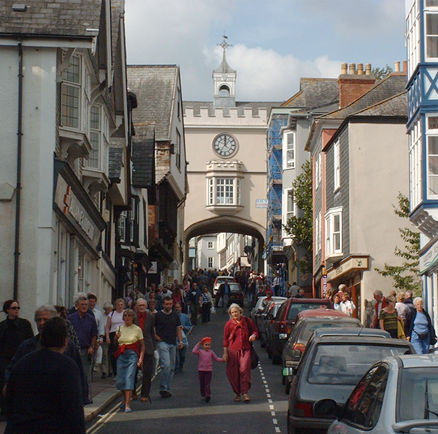
There’s no question that when one stays very still and closely watches a dog’s behaviour you see an amazing level of awareness. Even when they appear to be deeply asleep anything sensed by their ‘being’ is registered immediately. A small tale, by way of example. Many years ago when Pharaoh and I lived in the Devon village of Harberton, we frequently shopped in the town of Totnes, just 3 miles away. Many times, I would be walking up the High Street with Pharaoh nicely to heel being passed by many people walking the opposite way on the same pavement.
Totnes High Street
Every once in a while, during the fraction of time that it took for someone to pass us by, Pharaoh would utter a low, throatal growl without even slowing his pace. I always presumed that something, way beyond my level of consciousness, had disturbed Pharaoh during that instant of time.
Real awareness, or if you prefer, consciousness is not some touchy/feely concept but a true understanding about just what the heck is going on.
So do watch the following video of Peter Russell discussing Rediscovering Ourselves; it’s very relevant.
Then have a read of a couple of items on Peter’s website. The first is about runaway climate change, and here’s an extract,
Runaway Climate Change
The most dangerous aspect of global warming.
Global Warming is bad enough. Over the last hundred years, average global temperatures have increased by 0.75°C, one third of that rise occurring in the last twenty years. The 2007 report by The Intergovernmental Panel of Climate Change (IPCC) forecast that, by 2090, temperatures will have risen between 2 and 6 degrees.
Even a two degree rise in temperature would be disastrous. Changes in climate will lead to more intense storms, longer periods of drought, crop failures in many developing countries, the destruction of nearly all the coral reefs, the melting of much of the polar ice, the flooding of many low-lying urban areas, the possible collapse of the Amazonian rain forest, and the extinction of 20-30% of the planet’s species. The IPCC projects that this could happen by 2050.
If the temperature were to rise by six degrees, the prognosis is extremely bleak. At this temperature, the entire planet will be ice-free. Sea levels will rise by 70 meters. Many species of tiny plankton will cease to exist, and the problem would echo up the food chain, bringing the extinction of many fish, sea mammals, and the largest whales. Much of the land will now be desert. Hurricanes of unimaginable ferocity will bring widespread ecological devastation. If, as is possible, the ozone layer were destroyed, the burning ultraviolet light could make life on land impossible. Evolution would have been set back a billion years. It would be a planetary catastrophe.
Read the rest of that essay here. Now on to the next extract, from here,
The Under-rated Approach to Carbon Reduction
As critical as it is to reduce future carbon emissions, it is equally critical, perhaps even more critical, to get much of the CO2 that as already been released—and which is responsible for the current warming—out of the atmosphere and back into the ground where it belongs.
This approach, known as carbon capture and sequestration, has until now been largely ignored, and for several reasons. The atmosphere is so huge, it would seem to be an impossible task. There are possible technologies, but they are not nearly so well-developed as alternative energy sources. Many are still only ideas on paper. Where technologies of carbon capture have been developed they are mostly for capturing CO2 from smokestacks. Valuable as this may be, it is still dealing with the problem of future carbon emissions. What we need are technologies that will remove from the atmosphere the carbon that we already emitted, and then sequestrate it (put it away) in a stable form.
It is to this end that Sir Richard Branson announced his $25 million prize (Virgin Earth Challenge) for technologies that could capture a billion tons of carbon a year from the atmosphere (about one tenth of what we now release each year). Nor is it just Richard Branson who believes we must make this an equally important approach to the problem. His team includes Al Gore, James Lovelock, Sir Crispin Tickell (former UK ambassador to the UN), and James Hansen, the head climate scientist at NASA).
Again, the full article, a ‘must-read, in my opinion, is here.
It is really about awareness! Dogs have so much to teach us!






 Learning from Dogs