Category: Dog lessons

The view from the window.

Perhaps ancient man is still alive and well in all of us.

Two delightful events have provided the fuel for today’s post which, I warn you, is much more the personal mental ramble than the usual daily post on Learning from Dogs.  So, health warning, continue reading at your own risk, or be safe and switch off now!

Before getting in to my perambulations, just a word of thanks to you for your support.  Last month, there were 31,291 viewers of Learning from Dogs and 71 of you have chosen to subscribe.  I am humbled by your interest.  Don’t ever hesitate to give me feedback or, if you prefer, comment to a specific post.

OK, to the theme of today.

On Wednesday I had an enjoyable lunch with a friend from here in Payson, Dennis L.  Sitting in the Crosswinds restaurant at Payson airport is one of the most beautiful eating spots in terms of the view from the window.  So it’s a very conducive place to relax and try put the world to rights!  Conversation ranged across a variety of topics but frequently touched on the lunacy of so many things to do with man, especially when it comes to the government of peoples.

Dennis and I also acknowledged that entering politics with a set of passionate ideals, as we were sure many persons did, would quickly run up against the skein of vested interests that must permeate governments from top to bottom.

Yes Minister was a satirical comedy written by Antony Jay and Jonathan Lynn that ran for many years.  It was extraordinarily funny, here’s a 3-minute clip,

That programme underlined, far better than anything else, how governments most probably work in reality.

Dennis and I were clear, as so many millions of other global citizens must be, that the complexity of commerce, politics, national interests, global finance, and more, had created ‘systems’ of decision making that were utterly disconnected with the needs of mankind having a long and stable future on the only finite home around, Planet Earth.

Then today (Thursday), Jean and I attended our regular weekly gardening course at the local college in Payson.  Today’s subject was Arizona’s Climate and the tutor, Mike C., was a professional climatologist and meteorologist.  It was fascinating, indeed, totally absorbing.  Mike’s graphs and slides about the climate, some showing data for the last 1,000 years, underlined the incredible complexity and interconnectedness of the processes that made up the global climate system.

Once again that use of the word ‘complexity’.  He confirmed that there was no scientific doubt that the world was warming as a result of changes to the Earth’s atmosphere, science certain most of it is caused by increasing concentrations of greenhouse gases produced by human activities such as deforestation and burning fossil fuels.

Mike closed the session with an interesting reflection.  He reminded the audience that mankind is still essentially wired, in evolutionary terms, to know how to react to an attacking tiger or similar wild beast, as in the fight or flee response, than know how to deal with such complex, despite intellectually obvious, threats as global climate change, rising sea levels and many other totally unsustainable practices.  Mike held the view that only when man had the threat in his face equivalent to that of the attacking tiger would there be a wholesale change.

On the home page of this blog, I write,

As man’s companion, protector and helper, history suggests that dogs were critically important in man achieving success as a hunter-gatherer.  Dogs ‘teaching’ man to be so successful a hunter enabled evolution, some 20,000 years later, to farming,  thence the long journey to modern man.  But in the last, say 100 years, that farming spirit has become corrupted to the point where we see the planet’s plant and mineral resources as infinite.  Mankind is close to the edge of extinction, literally and spiritually.

In the context of homo sapiens, Latin for “wise man” or “knowing man”, then we know that modern man, anatomically, originated in Africa about 200,000 years ago.  Modern man only evolved from hunter/gatherer to farmer around 10,000 years ago, a tiny proportion of H. sapiens existence and, in evolutionary terms, no time at all.

The DNA of the domesticated dog separated from that of the wolf around 100,000 years ago.  No one knows for sure when man and dog came together but there is archaeological evidence of dogs being buried in mens’ graves around 30,000 years ago.  That’s an association over a huge time period.

Dennis and Mike, between them, triggered in my mind something fundamental.  Perhaps modern society, with all it’s bizarre behaviours and so many totally illogical practises (especially, in terms of a long-term relationship with our planet), could be understood.  Understood from the perspective of our social behaviours, built so much on technology, having raced far on to the point where they are now practically out of sight of our instinctive evolutionary behaviours.  We really don’t know how to change those core behaviours.

In contrast, dogs have remained much more stable with regard to their evolutionary progress and their external world.  Consider that the last big change for the domesticated dog was the association with man and that is at least three times as long ago as man becoming farming man.  No wonder when we curl up with our dog it has echoes of a time thousands of years before we could even spell the word, ‘politician’.  Echoes of a stability that seems now so way beyond reach.

And the view from the window of the Crosswinds ……

Mogollon Rim, North of Payson, AZ., in Winter

Surfin’ USA, bulldog style

Have a great week-end, wherever you are!

Surf Dog Tillman sets an example!

(Ron Davis is the owner of this 6 year old English Bulldog Tillman living in Oxnard California.)

Hearing clearly?

Perhaps intuition is all we have to hear clearly.

John O’Donohue, in yesterday’s post, touched on the essence of today’s theme, “The greatest philosophers admit that to a large degree all knowledge comes through the senses. The senses are our bridge to the world.

Dogs, of course, demonstrate powerfully how their senses provide a ‘bridge to the world’.

This odd collection of writings (ramblings?)  that comprise Learning from Dogs is based around the ‘i’ word – Integrity.  The banner on the home page proclaims Dogs are integrous animals. We have much to learn from them. Ergo, dogs offer a powerful metaphor for the pressing need for integrity among those that ‘manage’ our societies.

Thus my senses are more tuned, than otherwise, to the conversations in the world out there that support the premise that unless we, as in modern man, radically amend our attitudes and behaviours, then the species homo sapiens is going to hell in a hand-basket!

End of preamble!

Professor Bill Mitchell is one person who recently touched my senses.  As his Blog outlines he is an interesting fellow,

(Photo taken in August 2011 in Melbourne, Australia)

Bill Mitchell is the Research Professor in Economics and Director of the Centre of Full Employment and Equity (CofFEE), at the University of Newcastle, NSW Australia.

He is also a professional musician and plays guitar with the Melbourne Reggae-Dub band – Pressure Drop. The band was popular around the live music scene in Melbourne in the late 1970s and early 1980s. The band reformed in late 2010.

He also plays with a Newcastle swing blues band – The Blues Box. You can find music and other things on his Home Page.

Professor Mitchell’s Blog is not for the faint-hearted, it can be pretty technical at times.  Nevertheless, I have been a daily subscriber for a couple of months now.

On the 24th, Prof. Bill wrote a long article under the heading of ‘What if economists were personally liable for their advice‘.  I want to quote a little from that article.  Starting with,

Economists have a strange way of writing up briefing documents. There is an advanced capacity to dehumanise economic advice and ignore the most important economic and social problems (unemployment and poverty) in favour of promoting non-issues (like public debt ratios). It reminds me sometimes of how the Nazis who were brutal in the extreme in the execution of their ideology sat around getting portraits of themselves taken with their loving families etc. The training of economists creates an advanced state of separation from human issues and an absence of empathy.

In a sense, we all understand this, this use of language to separate us from our collective humanity.  A random Google search came up with this.  A statement by British Prime Minister, David Cameron, to Parliament on the 24th regarding Europe, as in,

Mr Speaker, let me turn to yesterday’s European Council.

This European Council was about three things.

Sorting out the problems of the Eurozone.

Promoting growth in the EU.

And ensuring that as the Eurozone develops new arrangements for governance, the interests of those outside the Eurozone are protected.

This latter point touches directly on the debate in this House later today, and I will say a word on this later in my statement.

Resolving the problems in the Eurozone is the urgent and over-riding priority facing not only the Eurozone members, but the EU as a whole – and indeed the rest of the world economy.

Britain is playing a positive role proposing the three vital steps needed to deal with this crisis – the establishment of a financial firewall big enough to contain any contagion; the credible recapitalisation of European banks; and a decisive solution to the problems in Greece.

Read the last paragraph.  Wonderful words that seem to make sense to the casual listener but picking up on Prof. Bill, an utter ‘separation from human issues and an absence of empathy‘.  There is no humanity in those words from the British Prime Minister.  We all know there are hundreds of other examples from mouthpieces all across our global society.  Back to Bill Mitchell’s article,

Linkiesta say:

Greece has failed. To say this is not another report of investment banks or research centers, but directly Troika officials who have just completed their review on Hellenic public finance. Linkiesta is in possession of the entire report of the troika, composed of officials from the International Monetary Fund (IMF), European Central Bank (ECB) and European Commission.

I have a rule of thumb that I use when considering documents such as these. The rule is to assess how strong the concern for unemployment is. How often is unemployment mentioned? The answer is zero. The document never mentions the word or concept.

So obsessed are the Troika and their bean counters about public debt stabilisation that they have completely lost sight of one of the worst problems an economy can encounter – the failure to generate work for all.

Read those last words again, “completely lost sight of one of the worst problems an economy can encounter – the failure to generate work for all“.  One last extract from the article,

There is absolutely no historical evidence which shows that when all nations are contracting or stagnant and private spending is flat (or contracting) that cutting public spending will create growth.

So why did these economists think that a nation would grow when all components of spending were strongly indicated to fall or were being actually cut? The answer lies in acknowledging that they operate in an ideologically blinkered world and are never taken to account for their policy mistakes. They are unaccountable and do not suffer income losses when the nations they dispense advice to and impose policies on behave contrary to the “expectation” which results in millions being unemployed.

In my view, my profession should be liable for the advice it gives and economists should be held personally liable for damages if their advice causes harm to other individuals. If the economists in the IMF and elsewhere were held personally responsible then the advice would quickly change because they would be “playing” with their own fortunes and not the fortunes of an amorphous group of Greeks that they have never met.

Very powerful words that strike at the heart of the matter, that of integrity. (If you want to read it in full, then the article is here.)

Let me move on a little.  The 24th also saw a powerful essay on Yves Smith’s Blog Naked Capitalism, from Philip Pilkington, a journalist and writer living in Dublin, Ireland.  Here’s a taste of what Mr. Pilkington wrote.

Every now and then a terrible thought enters my mind. It runs like this: what if the theatre of the Eurocrisis is really and truly a political power-game being cynically played by politicians from the core while the periphery burns?

Yes, of course, we can engage in polemic and say that such is the case. But in doing so we are trying to stoke emotion and generally allowing our rhetorical flourish to carry the argument. At least, that is what I thought. I had heard this rhetoric; I had engaged in it to some extent myself; but I had never really believed it. Only once or twice, in my nightmares, I had thought that, maybe, just maybe, it might have some truth.

Can you see the parallels between Prof. Mitchell and Philip Pilkington?  The latter wrote, “a political power-game being cynically played by politicians from the core while the periphery burns“, the former wrote, “If the economists in the IMF and elsewhere were held personally responsible then the advice would quickly change because they would be “playing” with their own fortunes and not the fortunes of an amorphous group of Greeks that they have never met.”

It’s clearly obvious to all those that have commented to both the Bill Mitchell and Philip Pilkington items.  That is, in my words, a complete lack of integrity, truth and a commitment to serve the people, from so many in places of influence and power.

We all sense this, hear it so clearly, a separation from human issues and an absence of empathy.

We have so much to learn, so much sense to learn, from dogs!

————–

Footnote.  Had just completed the above when I came across a piece by Patrick Cockburn in last Sunday’s Independent newspaper, that starts thus,

World View: A sense of injustice is growing. Elite politicians and notorious wrongdoers appear immune as ordinary Greeks reel from wage and job cuts

Up close, the most striking feature of the reforms being forced on Greece by its international creditors is their destructiveness and futility. The pay cuts, tax rises, cuts and job losses agreed to by parliament in Athens last week will serve only to send the economy into a steeper tailspin, even if it extracted a much-needed €8bn in bailout money from the EU leaders. “Nothing but a lost war could be worse than this situation,” one left-wing ex-minister tells me. “What is worse, no party or political group in Greece is offering real solutions to our crisis.

Say no more!

A dog called Loopy

A powerful lesson in patience and trust.

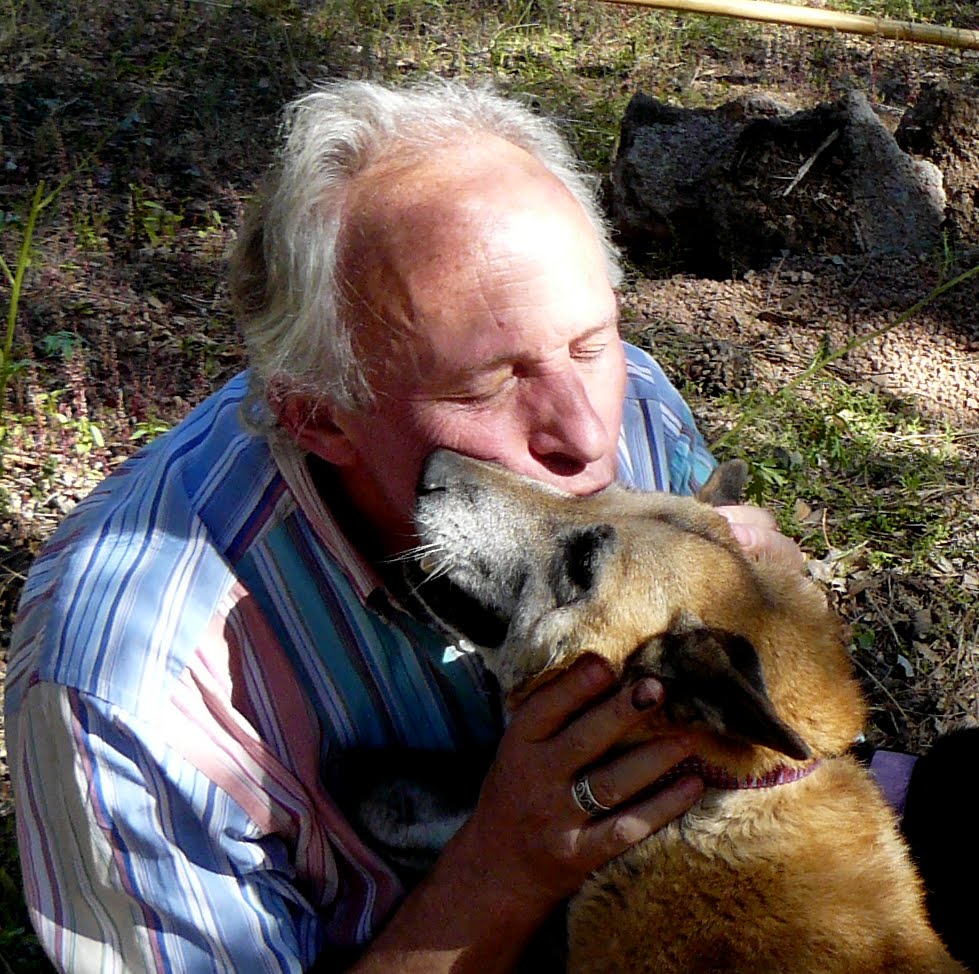
The brown dog with her head nestled against my chest is Loopy.  Like Phoebe, the black dog looking at the camera, they are dogs that Jean originally had rescued in Mexico.

Here’s Loopy’s story.

Loopy and Phoebe

When I first met Jean in December 2007 in San Carlos, Mexico, it was immediately clear that she was an animal lover extraordinaire! There were 13 dogs and 6 cats in her home and many other dogs in a fenced off compound not so far away from the house.

Abandoned and stray dogs in that part of Mexico were numerous, there was no humane society and no real care or interest from the Mexicans for these dogs.  So many years ago, Jean decided to run her own unofficial dog rescue society, supported by more than a few Americans who had winter homes in San Carlos.  Over the years, Jeannie and her team must have rescued and found homes for well over 50 dogs.

In my introduction to the post last Tuesday, Please Help a George, I wrote about how long it had taken for Loopy to bond with me, but Jean’s experience of Loopy goes way back before I entered their lives.

I mentioned above that Jean had a piece of land in San Carlos that she used as a rescue compound for her dogs.  One morning, back in 2003, as usual she had gone to the compound to attend to her dogs.  Jeannie noticed immediately, cowering in one corner, this young female, brown-haired dog, the dog had been tossed over the fence of the compound.  Jean estimated that she was about a year old, hadn’t yet had any pups.  The dog had very cold eyes, growled aggressively as soon as Jean approached her; clearly deeply traumatised.

Jean set out food and water before the dog, hoping that whatever had traumatised the dog would soon abate.  The dog was named: Loopy!

Despite the fact that Loopy wouldn’t mix with the other dogs in the compound, she was not mean.  But the days turned into weeks, the weeks into months, and still Loopy would not allow Jean to get close to her.  One could only imagine the degree of cruelty that must have been metered out to Loopy – or, rather, one couldn’t imagine it!

Then, one day, when Jean went to the compound, Loopy was amongst the other dogs.  Loopy cautiously came up to Jean, sniffed her feet and legs and then, miraculously, allowed Jean to gently stroke her head and back.  Loopy’s cold, angry eyes were now soft and brown; Loopy had melted.  For obvious reasons, Loopy would never be available for adoption and soon moved into the main house.

When I became a permanent part of the Mexican household in 2008, Loopy was deeply suspicious of me.  I was given the cold, hard-eyed stare from Loopy and any attempt by me to touch her was returned with growling, fanged teeth.  There were a number of instances where I collected teeth rips across my hands from Loopy.

The aggression towards me lasted a long time, about a year.  But then one day, quite unexpectedly, Loopy decided that I was friend, not some reminder of a demon foe from her past.  She trusted me, first with strokes and cuddles and then with the most passionate and trusting embraces.  I love her so much.

One could wax lyrical about love, patience and trust, but I won’t.  The photograph below says it all.  We really do have so much to learn from dogs!

Loopy and Paul

After George comes Brutus

Big thanks to Cynthia S. for forwarding this to me.

Before writing about Brutus, did you read yesterday’s item about George, the rescue dog, and the wonderful effort to raise funds for more life-saving efforts?  If not, read it here. Whatever you can spare, please donate to this super cause.

Now to Cynthia’s item, that has been fairly widely spread across the internet.

How to hug a baby

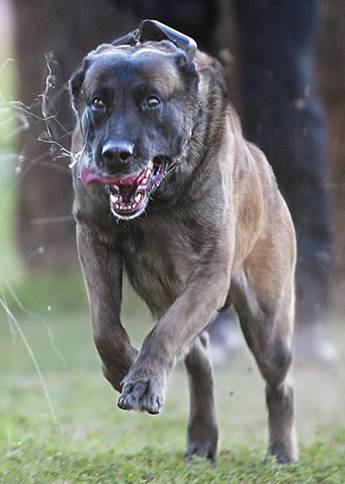
Brutus

Thought you might like to know about this dog and his history, I especially like the ending, Cynthia.

The dog above is Brutus, a military dog at McChord.. . He’s huge, part Boxer and part British Bull Mastiff, and tops the scales at 200 lbs. His handler took the picture and explains, “Brutus is running toward me because he knows I have some Milk Bone treats, so he’s slobbering away! I had to duck around a tree just before he got to me in case he couldn’t stop, but he did.”

Brutus was the recipient of the Congressional Medal of Honor last year from his tour in Iraq.  His handler and four other soldiers were taken hostage by insurgents.  Brutus and his handler communicate by sign language and he gave Brutus the signal that meant ‘go away but come back and find me’.  The Iraqis paid no attention to Brutus.  He came back later and quietly tore the throat out of one guard at one door and another guard at another door.  He then jumped against one of the doors repeatedly (the guys were being held in an
old warehouse) until it opened.  He went in and untied his handler and they all escaped.  Brutus is the first dog to receive this honor, the Congressional Medal of Honor.  If he knows you’re ok, he’s a big old lug and wants to sit in your lap.  Enjoys the company of cats..

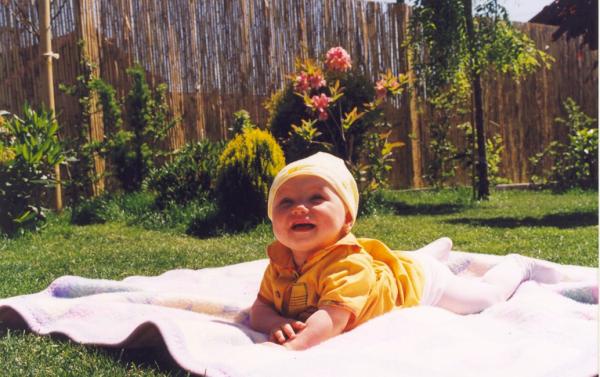
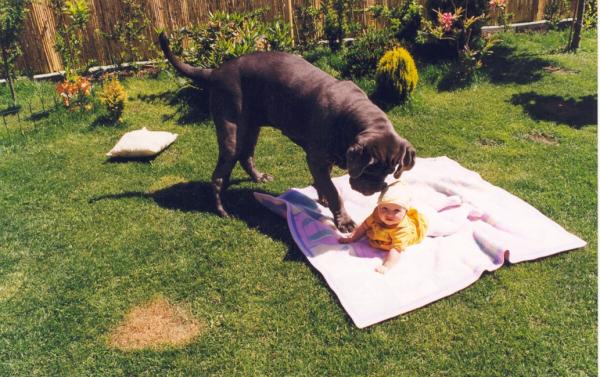
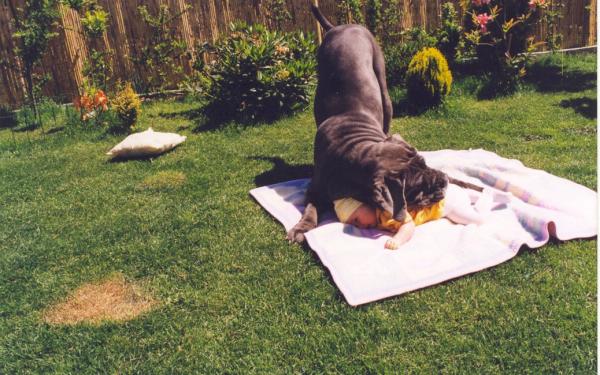
Instructions for properly hugging a baby with Brutus

(A quick Google search found that the words accompanying the same pictures on Daniela’s website, The Daily Tail, were perfect, thus they have been used.)

Step One – Place the baby on a flat, uncluttered surface. Important: Do not attempt this without the assistance of a qualified parent.

Step One

Step Two –  Conduct a sniff test to verify the specimen is actually a baby. The scent of baby powder is usually sufficient evidence.

Step Two

Step Three – Carefully adjust the baby’s position until its head faces the mother’s camera. Note: Babies have two ends. The end covered with a hat or hair is the head. The end covered with a diaper is the butt. Babies do not have tails.

Step Three

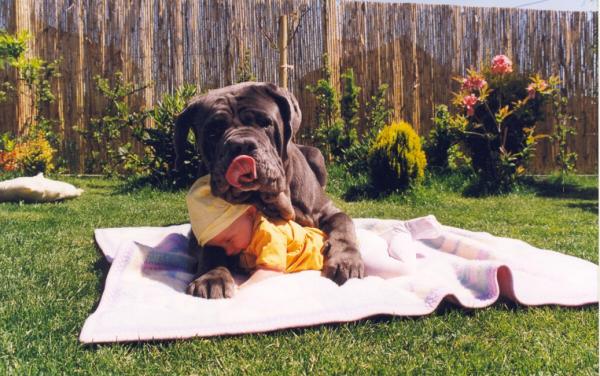
Step Four – Lay your body down over baby. Do not apply pressure. While gently placing your paws around the baby’s body, lick your lips to condition them for the kiss (essential part of the hug).

Step Four

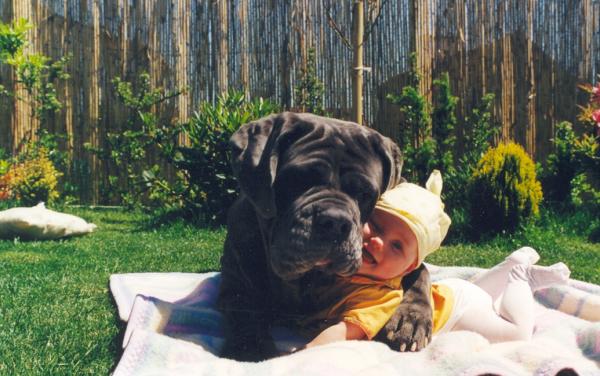
Step Five – Lean in toward the baby and let your heart melt. Repeat as necessary until the parent finds the camera and takes a perfect picture.

Step Five

Thanks Cynthia for this lovely story.

Please Help a George

A canine charitable opportunity that deserves wide support.

The details that follow strike a chord with me, strike a chord in a big way.  When I first came to live with Jean back in 2008 it was clear that this wasn’t going to be a normal relationship.  Why?  Because, at that time Jean had 12 dogs living with her in San Carlos, Mexico and my arrival, together with my Shepherd dog, Pharaoh (see home page for a picture of him), took that number to 13.  Jean’s dogs were all Mexican rescues; she also ran her own local humane society in San Carlos and over the years had found homes for literally dozens of dogs.

One of those Mexican rescues was a dog called Loopy, who had been terribly treated by local Mexicans.  The consequence when I arrived, a stranger in the middle of Loopy’s life with Jean, was that Loopy was very aggressive towards me; my hands have small scars to bear witness to the number of nips Loopy launched in my direction.

It took over a year before I was able to just let my hand ‘accidentally’ brush her side.  Slowly Loopy’s trust in me built up until now I can press my face to her face and cuddle her for ages.  (To underline the love that Loopy bestows on me, I will get Jean to take a picture and publish that before the end of the week.)  So with that in mind, let me turn to the details recently sent to me by friend and colleague, Dapinder Singh, from England.

———————

George and loving owner, Ian.

This is George. He was in an English dog pound and condemned to death.

He had been very badly abused, one eye blinded by what was thought to be a kick, he trusted no-one and had rejected all human contact.  He was desperate and in despair.

After an exhaustive search for anyone who take on the rescue of George, we (as in Doris Banham) took him into our care just a day before he was due to be euthanased.  His veterinary problems were easier to deal with than the mental ones.  His eye was damaged beyond repair causing him constant pain so it had to be removed, teaching George to trust again was much harder.

That journey back to trusting humans was long, George had suffered severe and terrible abuse,  but there was no question of giving up on him and slowly but surely he began to live again as we fought to undo the wrongs that had been done to him. After some months with us, a wonderful family came to the rescue and offered George his ‘forever’ home where he found the love that he so deserved. His family are completely devoted to him.

His story, however, could have been a very different one were it not for the work of the team at Doris Banham’s. Below is an extract written by the lovely family who adopted him and from our fantastic volunteer, Sheila, who helped bring George back to life again.

“Hi, Sheila. Here is a shot of George in his new garden. He is settling down very well and seems to be very happy. I will keep you posted as to his progress. All the best Liz and Ian.”

There were a number of photographs sent to Sheila, however I have taken editor’s liberty and moved them to the foot of the article – I want you to stay with this to the point where you can see how to help.  Here’s Sheila’s reply,

“WELL THESE BOUGHT ME TO TEARS , OUR GEORGE , THIS IS TRUE RESCUE , THIS IS ALL DOWN TO YOU DORIS BANHAM NOTHING ELSE TO SAY …” SHEILA X.

Are there other Georges out there?  You bet! Far too many of them, right across the world.  So let’s all do something to help these special creatures, who show us humans just what unconditionally love feels like.

Friday 4th November, 7.30pm – Come to the Hellaby Hall Hotel, Old Hellaby, Maltby, Yorkshire, S66 8SN

Call for tickets now to the Pound Dog Ball telephone number (UK) 07772 538513 or email pogpublications@yahoo.com  Full details here.

Please help all the Georges out there by supporting this Charity Fundraising Event: Black Tie, Dinner/Dance at Hellaby Hall, Rotherham, 7.30pm, on Friday 4th November. It’s a don’t miss night…..3 course meal, live entertainment all night and dancing ’til late!!!! It’s going to be a great night.

If you can’t make the Ball but would like to send in a donation then please post a cheque, made out to Pound Dog Ball, to the following address:

c/o Jennifer Smith

Clumber Lodge,

50 Hemingfield Road

Wombwell, S73 0LY.

Or if you prefer an electronic donation, further details are:

Pound Dog Ball
A/C 31542265
Sort 40-45-29 (HSBC)

The account is a charity account, set up only for this event.  Once the money has been paid to the charities the account will be closed.

All monies raised will be shared between http://www.dogsos.co.uk/ (Doris Banham) and http://www.barnsleyanimalrescue.org.uk/  (Barnsley Animal Rescue Charity)

I know that Dapinder, and everyone else involved in helping these precious animals, sends you their heartfelt thanks.

Finally, more photos of George enjoying life as all dogs should. What a wonderful story, an honour to be able to publish it, and promote the Ball, on Learning from Dogs.  Please help.

The Power of Joy

Yet another fabulous example from dogs.

This is a guest post from Joelle Jordan.  Let me broadcast my gratitude for this lovely story. For two reasons.  The first is that Joelle is very generous in sharing her fine work and the second is that at the time of me putting this Blog post together, 4pm yesterday, I really needed a helping hand – have been short of time all week-end.  So thank-you Joelle.  Here’s her story.

————————-

Joy is a difficult commodity to come by these days. I don’t mean entertainment, I don’t mean a good laugh, I mean pure joy, where, even just for a single moment, all worries and doubts, frustration and anger are lifted as though by Atlas.

Like so many other humans in our world, I often find myself in a constant state of stress. There always seems to be something to worry about, whether it’s money, job fulfilment, the state of my relationships, getting the house cleaned, finding time to get to the market, and more. If given the chance, I know we all could spend nearly all of our waking hours (and some of our sleeping hours, too) worrying about something. We spend so much time on the many things that inevitably work themselves out, and so little time on things that will create a memory and a crystal moment of joy.

Jordan and Charlie

My little dog Charlie spends his time in the completely opposite fashion; spending his waking hours seeking joy, and committing less time to things that worry him.

Charlie seems to exist normally in three states of being; content, happy and utterly joyful. When I see him in an emotional state other than these, it nearly breaks my heart. I wonder why this little carefree being who brings such happiness to my life should be anything less than blissful at all times.

I notice something about how Charlie handles his stressful moments, however few and far between they may be. A recent example just occurred. My partner and I are teaching him how to behave on a leash. He has generally not given us any problems on a leash and took to the activity rather quickly. My partner can easily walk him to the corner and back, and he happily accompanies her, listening to her commands and responding, exploring his world in the safe company of his mama, creating a nice outing for them both.

However, his behavior closer to the house is less than stellar, barking at people (especially children who are frenetic and loud) and other dogs, generally forgetting that he is neither a big dog nor in charge of everyone, and just acting rather rude. A change in behavior from his human friend and he learned quickly that running after something and barking while on the leash earns him a very sudden and not so gentle stop, all powered by his own momentum, his harness jerking him off his paws and backwards. After the first incident or two, he ran back to me, the little boy that he is, placing his paws on my leg as I squatted down to him, burying his head in my chest. I assured him that he was fine and stroked him, and told him, “You can’t do that, buddy, see what happens?”

Here is where the story could turn into his utter contempt of the harness and leash. Rather, though, after a little stroking and encouragement, he became ready to try again. This time, instead of running and barking after the children at play in the neighbor’s yard, he calmly walked with me to the end of our driveway and then sat quietly and watched them shoot hoops. When it was time to go in, we walked back to the front door, accompanied by the cheering compliments of “Good job!” and pats from my partner. I saw him begin to walk a little taller and prouder, somehow understanding about a job well done and lesson learned. He trotted through the front door in search of his brother, our Chihuahua Jordan. His happy tongue dangled in wait for the promised treat. The stress he’d been seemingly engulfed in was simply released, gone. It was experienced and then just let go.

Perhaps I’m slightly jaded; after all, it was just a simple leash lesson. In truth, this little animal has no responsibilities except to be cute, not to pee in the dining room and not to chew on things. He has no bills to pay; his only worry is probably something vague about his supper. Sometimes, when letting them out of their crates, Charlie is less happy to see me (master, mama, food giver, spoiler) but is nearly bursting to get at and play with his big brother Jordan. Personal feelings (hurt and otherwise) aside, isn’t there a lesson to be learned here? He continues to teach me.

I watch his eyes. I have since I’ve known my little guy; I find them to be fascinating. In Merle’s Door, Ted Kerasote describes Merle as a “four eyed” dog; a dog that seems to have eyebrows (darker fur over his eyes ) that help express his feelings. Charlie is also a four-eyed dog.

Stanley Coren, the astute canine psychologist from the University of British Columbia, has also noted that these “four-eyed” dogs obtained their reputation for psychic powers “because their expressions were easier to read than those of other dogs. The contrasting-colored spots make the movement of the muscles over the eye much more visible.”

Case in point: the other morning Jordan had burrowed under an Indian blanket for it was a little chilly. Charlie, on the other hand, was in simple need of something: play. Jordan, however, was warming and had no interest. Charlie looked up at me, and held a conversation with me with only his eyes: Mom, make him play!

“He doesn’t want to play, bud, I’m sorry.”

He’s under the blanket! That’s the best time to play!

“But he doesn’t want to play right now, Charlie.”

Distraught. His eyebrows were high but off to the side, the classic cartoon expression of distress. If his lip could’ve quivered from holding back tears, it would have. A soft whimper.

How can that be?

It was a less than joyful moment for Charlie, but it was something out of my power to control. All I could do was redirect him. I enlisted him to come help me with the laundry. This is a favorite past-time of his because there are dryer sheets to be rooted out and torn to shreds. As I moved the clothes from the washer to the dryer, I saw that my boy had found his joy again but not in search of dryer sheets: he had jumped into the basket of dirty laundry and discovered a plethora of good and interesting smells, one of my t-shirts now covering his head like a scarf.

He was in heaven for probably the fourth or fifth time that morning.

————————-

Joelle in speaking about joy echoes a part of yesterday’s sermon that I hope to write a little about before the end of the week.

The Grand Re-opening

A guest post from Joelle Jordan

A couple of days ago, out of the blue, in came an email with this article attached.  Was sure that Joelle and I didn’t know each other but so what!  One of the lovely aspects of this wired-up world is the ease with which like-minded people can communicate.  It’s a pleasure to publish Joelle’s story.

Charlie's first day!

I had been resistant to getting a new dog. We couldn’t afford one; we couldn’t afford the time to train a pup, the sleep deprivation, the continual puppy proofing the areas he would reside in, the contingent poop and pee cleanup. We couldn’t financially afford the shots, the toys, the food, the new crate. It was just too much stuff all at once, and we were just getting established as a couple and as a family.

That wasn’t the true reason I didn’t want a dog. I had been resistant because of a dog I’d had before, the dog I left behind. I loved this dog with all my heart, he was my “first.” I did not want to disrespect that dog by replacing him. I always questioned if my decision to leave him behind with my ex was right. My head always said yes, but my heart always said no. This left a war inside of me of enormous proportions that I could only allow to play out as it would, a sort of inner-Vietnam that ended only with withdrawal, but not with surrender.

So I put my foot down for a long time. “No, no dogs.” I would add the caveat the sake of mollification: “Not yet.” Maybe someday. Maybe someday I would be ready. Maybe someday our home situation would be perfect for a puppy. That would be when we could get a puppy: when we were independently wealthy and didn’t have to work and had all the time in the world to train a pup the proper way. Yeah, then.

I added another caveat to my “no dogs” edict: “I’ll know my dog when I see him.” I knew I would know the right dog for us when I saw him. It would be a chemical thing, like falling in love. I would not be swayed by cute fluff balls and wide expressive eyes. I would not be swayed by the tug of puppy teeth and the scent of puppy breath through a cage as we wandered through the aisles of a rescue. I would not be swayed; I would not be swayed until the perfect time when we were independently wealthy. In this way, I could save our money, our time, and my heart. I would just use my intuition (which I heretofore had never had) to know the when and the which one.

My partner continued to try to bend me, showing me pictures on the internet of homeless pups and rescue pups. She tried every breed; I saw terriers and shih tzus, Pomeranians and Pekinese, Maltese and min-pins. I saw every mutt with a happy, drooly, grinning face, and heard every sad story about why the owners could not keep said dog. And my response was always the same: “Oh, yes, he’s so cute, but no, not yet.”

What it came down to was that I was not ready to forgive myself. It’s not as though the dog I left behind wasn’t loved; I knew my ex loved him as much as I did. I didn’t leave him in some rat hole; it’s a two bedroom, one bath with a fenced back yard. But circumstances dictated that I leave, and leave my boy behind. Did that kind of behavior even warrant the luxury of having another dog again? I wondered in silence but responded with “No, not yet.”

Until one day, while trolling the internet for that love match for me yet again, my partner turned the screen towards me and said, “Baby, look.” Two males, pug crossed with dachshund, both auburn with black muzzles. Their mother had died shortly after birth and their father had gone missing.

I looked.

“Wow, they’re really cute,” I said.

I’m sure my partner was shocked that she didn’t receive my standard, “Oh, yes, they’re so cute, but no, not yet.” She could only pause and let me look at the picture.

“They’re only two hours away, and they don’t want a lot of money, just to cover the shots,” she offered.

“Yeah, they’re really cute,” I responded again.

Something in me said that’s your dog. I knew in theory that it would happen like that, but I was surprised that it actually did happen.

Two days later my partner and I were in the very nice home of some very nice people trying to rehome the last two of the surprise litter of their two lost but beloved house dogs. I sat cross-legged on the floor, and the daughter put the pups down about three feet from me. They were barely bigger than hamsters, just eight weeks old to the day. One of them walked right to me, as though he knew me, crawled in my lap, as though my lap were his home. The other had nothing to do with me, had nothing to do with either my partner or me. The first pup explored me, my fingers, tasting, smelling, intent. I looked up at my partner as I cuddled the warm ball of fur to my neck, and our eyes met. She smiled at me and fished through her purse for the nominal rehoming fee.

That little guy rode home most of the way with me, on my chest, staring into my eyes as I stared back into his. He studied me hard, calmly, gazing, as though memorizing. I thought perhaps that he was imprinting me (as I was him) but I think it was more than that, now that I think back on it. I think he was singing The Byrds, as sometimes he still sings, even now, softly, as he lays against my leg as I write this about him, “To everything, turn, turn, turn, there is a season, turn, turn, turn, and a time for every purpose under heaven.”

I’m sure all you lovely readers will agree that is a very moving story.  Thank you Joelle.

Transitions, pt Two

Reflections on these present times, concluding part.

I closed yesterday with, So maybe there’s a blindness with humans, and then set out the characteristics of that blindness.  One of those characteristics being,

Our obsession with how things are now prevents us from reflecting on those signs that indicate changes are under way, even when the likely conclusions are unmistakeable.  The ecological and climatic changes being the most obvious example of this strange blindness that mankind possesses.

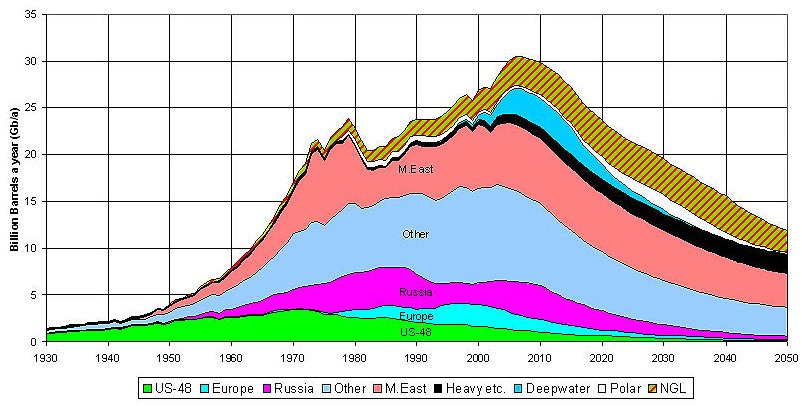
Let’s move this on a little.  The arguments from a wide range of scientists are overwhelmingly in favour of the proposition that mankind is using vastly more resources from the planet than the planet can provide.  Take oil.  This graph show past and projected oil production for the whole Earth out to 2050, less than 40 years away.

Here’s an extract from that website which I encourage you to read in full,

The part before 2007 is historical fact. The part that comes afterward is an ASPO extrapolation.

This graph is worth careful attention as a lot of world history is written into it. Note the steep rise in oil production after World War II. Note that 1971 was the peak in oil production in the United States lower 48. There is a sliver of white labled Arctic oil. That is mostly Alaskan Prudhoe Bay oil, which peaked in 1990. Prudhoe Bay was almost big enough to counteract the lower 48 peak of 1971. The sliver is very narrow now. The OPEC oil embargo of 1973 is very visible. The oil produced by non-OPEC countries stayed nearly constant while OPEC production nearly halved. The embargo caused the world economy to slow. But the high cost of energy spurred the development of energy efficient automobiles and refrigerators and a lot of other things. Note the effect of the collapse of the Russian economy in 1990 on Russian oil production. Note the rapid increase in oil production when the world economy boomed near the end of the twentieth century. Oil was $12 a barrel at that time. Note that European (North Sea) oil peaked in 2000. Note especially what would have happened if the 1973 embargo had not occurred. It is possible that the world would now be on the steep part of the right side of the Hubbert curve.

Take population growth. Here’s a graph that shows that going through seven billion, which is due shortly, is likely to be way short of the eventual peak.  Likely peak might be in the range of  eight to ten billion!  Just take a look at that graph,

Take global warming.  Here’s a graph from NASA, from which I quote,

The five warmest years since the late 1880s, according to NASA scientists, are in descending order 2005, 1998, 2002, 2003 and 2006. (reported in the year 2007!)

No apologies for bashing you around the head with these graphs and figures – most people have a good sense about these aspects of our life on this planet.  But, in a very real sense, that’s the point.

The point that despite powerful and obvious evidence, mankind has great difficulty accepting obvious trends and understanding that whatever ‘today’ feels like, ‘tomorrow’ is almost certainly not going to be more of the same.

At the risk of hammering this point to death, here are two pictures and some text to show how quickly ‘today’ changes and becomes ‘tomorrow’.

Scientist left speechless as vast glacier turns to water

by Helen Turner, Western Mail

THESE images show the astonishing rate of break-up of an enormous glacier in north Greenland – from ice to water in just two years.

The before and after photographs, which left a Welsh scientist who led the 24-month project “speechless”, reveal the worrying effects of climate change in an area previously thought too cold to be much affected.

The Petermann glacier pictured August, 5th, 2009
Petermann glacier, pictured from same position, July 24th, 2011

Dr Alun Hubbard, a reader at Aberystwyth University’s Centre for Glaciology, returned from the Petermann Glacier in north-west Greenland a month ago, but did not see the stark images documenting the changes until this week.

He said: “Although I knew what to expect in terms of ice loss from satellite imagery, I was still completely unprepared for the gob-smacking scale of the break-up, which rendered me speechless.  It was just incredible to see. This glacier is huge, 20km across, 1,000m high.”

“It’s like looking into the Grand Canyon full of ice and coming back two years later to find it’s full of water.”

“It’s quite hard to get your head around the scale of the change.  To be able to see that, everything changed in such a short period of time, I was speechless.”

Do read the full article on the Wales Online website here.

Stay with me a little longer, if you will.

Yves Smith in her wonderfully broad and addictive Blog, Naked Capitalism, had the first part of a powerful interview with Satyajit Das published on the 7th.  Here are a couple of extracts,

 It’s amazing how much money you can make just shuffling paper backwards and forwards. Malcolm Gladwell wrote a piece praising John Paulson who made a killing from the subprime disaster as an entrepreneur. But what did he make? What did he leave behind? Paul Volcker, the former chairman of the Federal Reserve, argued: “I wish someone would give me one shred of neutral evidence that financial innovation has led to economic growth — one shred of evidence. US financial services increased its share of value added from 2% to 6.5% but is that a reflection of your financial innovation, or just a reflection of what you’re paid?”

Just let that quote from Paul Volcker stay with you for a while.  Satyajit goes on to say,

Management and directors of financial institutions cannot really understand what is going on – it’s simply not practical. They cannot be across all the products. For example, Robert Rubin, the former head of Goldman Sachs and Treasury Secretary under President Clinton, encouraged increased risk taking at CitiGroup. He was guided by a consultant’s report and famously stated that risk was the only underpriced asset. He encouraged investment in AAA securities assuming that they were ‘money good’. He seemed not to be aware of the liquidity puts that Citi had written which meant that toxic off-balance sheet assets would come back to the mother ship in the case of a crisis. Now, if he didn’t understand, others would find it near impossible. And I’m talking about executive management.

Non executives are even further removed. Upon joining the Salomon Brothers Board, Henry Kaufman, the original Dr. Doom found that most non-executive directors had little experience or understanding of banking. They relied on board reports that were, “neither comprehensive … nor detailed enough … about the diversity and complexity of our operations.” Non-executive directors were reliant “on the veracity and competency of senior managers, who in turn … are beholden to the veracity of middle managers, who are themselves motivated to take risks through a variety of profit compensation formulas.”

Kaufman later joined the board of Lehman Brothers. Nine out of ten members of the Lehman board were retired, four were 75 years or more in age, only two had banking experience, but in a different era. The octogenarian Kaufman sat on the Lehman Risk Committee with a Broadway producer, a former Navy admiral, a former CEO of a Spanish-language TV station and the former chairman of IBM. The Committee only had two meetings in 2006 and 2007. AIG’s board included several heavyweight diplomats and admirals; even though Richard Breeden, former head of the SEC told a reporter, “AIG, as far as I know, didn’t own any aircraft carriers and didn’t have a seat in the United Nations.”

In other words, there is no shortage of information from all corners of the world to show, with very little doubt, that the last few decades have seen unprecedented mistakes by national governments, mistakes in corporate governance, a lack of understanding of economic fundamentals, poor financial and social management, and on and on and on.

But practically all of us, and I mean all of us, didn’t see it at the time, didn’t see where it was heading and only now, when it is full in our faces, do we get it and see it for what it has really been, a long period of over two decades where the ‘me‘ has been more important than the ‘us‘.

That me versus us even being promoted, if that’s the right word, by a British Prime Minister twenty-five years ago.  That quote from Margaret Thatcher back in 1987,  “And, you know, there is no such thing as society. There are individual men and women, and there are families.” (Margaret Thatcher, talking to Women’s Own magazine, October 31 1987)

Let me draw this all together, yesterday’s part and this concluding part.

There is significant evidence, real hard evidence, that the patterns of mankind’s behaviours of the last few decades cannot continue.  Simply because mankind will go over the edge of self-extinction.  Darwin’s evidence and all that!  We have to accept that humans will see the bleedin’ obvious before it is too late.  We have to keep the faith that our species homo sapiens is capable of huge and rapid change when that tipping point is reached, so eloquently written by Paul Gilding in his book, The Great Disruption, reviewed by me here.  We have to embrace the fact that just because the world and his wife appears to be living in total denial, the seedlings of change, powerful change, are already sprouting, everywhere, all over the world.

So let’s welcome those changes. Let’s nurture those seedlings, encourage them to grow and engulf our society with a new richness, a new fertile landscape.

Let’s embrace the power of now, the beauty of making today much better and letting go of tomorrow.

For today, I am in charge of my life,

Today, I choose my thoughts,

Today, I choose my attitudes,

Today, I choose my actions and behaviours.

With these, I create my life and my destiny.

It’s very difficult to make predictions, especially when they involve the future!

Transitions, pt One

Reflections on these present times.

Want a brilliant idea for tomorrow? Stay in the present!

Dogs do this wonderfully.  I am told that followers of Zen Buddhism discover peace and grace from embracing the present. But is there more to this?  Is there some deeper psychology involved?  Does our species have an intrinsic challenge in terms of staying in the present?

My musings on this arise from a couple of recent conversations.

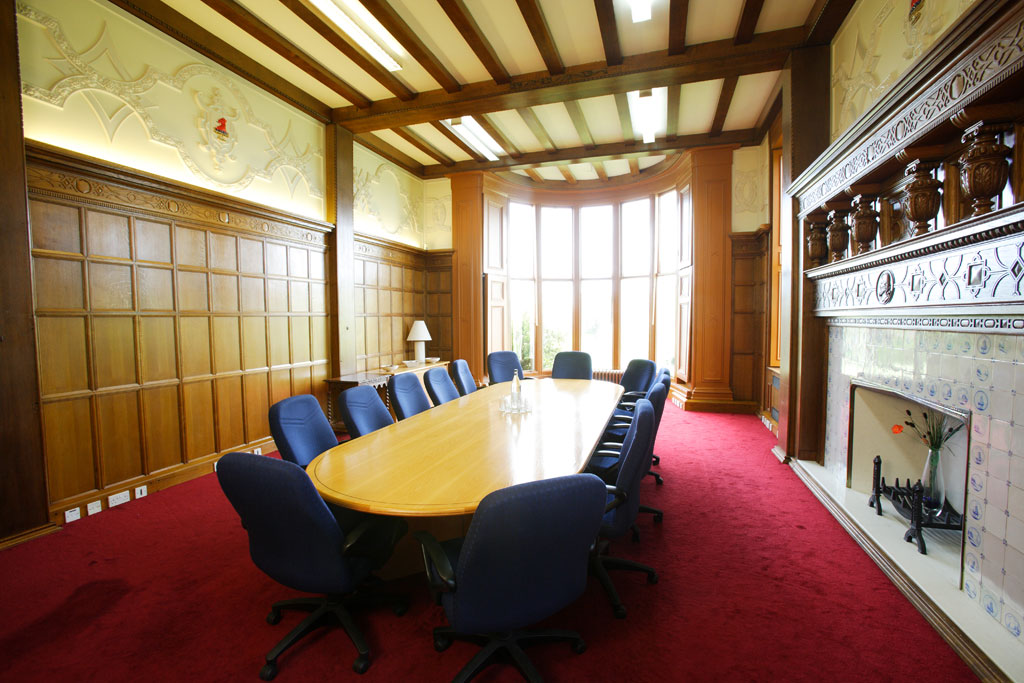
The first was with Peter McCarthy from the Bristol area of West England.  Peter and I go back a few years (at my age, everything goes back a few years!) and at one stage I did some work for Peter’s company, Telecom Potential.  Just a quick aside, Peter’s company was based in the magnificent Clevedon Hall, a mansion built in 1853 as a family home for Conrad William Finzel, a German-born businessman.  Here’s a picture of one of the rooms,

A room at Clevedon Hall

Peter, like me, is sure that the period in which the world now appears to be, is not some cyclical downturn, not some temporary departure from the national growth and employment ambitions promoted by so many countries.  No! This one is different.

Peter is sure that a major transition is under way, as big as any of the great societal upheavals of the past.  And, for me, a fascinating comment from Peter was his belief that the key attitude required for the next years would be innovation.  Peter reminded me that we tend to think of innovation as applying to things physical, scientific and technical.  But Peter sensed that it would be in the area of social innovation where key changes would arise and, from which, these large societal changes would flow.

Then a day later I was chatting with one of the founders of a brilliant new authentication process, Pin Plus. It is a very smart solution to a major global problem, the weaknesses of traditional password user-authentication systems.

On the face of it, Pin Plus is obviously a better and more secure way of authenticating users, and a number of key test customers have borne this out.  Jonathan C was speaking of the challenges of convincing companies to have faith in this new process.  This is what he said,

More than once, indeed many times, I am told by prospects something along the lines that the IT world has been looking so hard and so long for a password solution that a solution can’t possibly exist.

Let’s ponder that for a moment.  Are we saying that a far-sighted approach to the potential for change is not an easy place for some, probably many, human brains?

Indeed, Jonathan and I mused that here we were, both speaking via Skype, an internet telephony service, both of us looking at different web sites in support of many of the points that we were discussing and totally dependent, in terms of our mentoring relationship, on the technology of the internet, a multi-node packet-switched communications system that was a direct result of the American shock of seeing the Russians launch the world’s first artificial satellite, Sputnik 1, into low earth orbit on the 4th October, 1957.

Launch of Sputnik 1

At that time, it would have seemed impossible for anyone on the planet to see that the American response to Sputnik 1 would eventually lead to the vast packet-switched network that is now the modern Internet.

But why do we regard the ability to look into the future so utterly out of reach of the common man?  Look at this, the Internet Timeline here.  Look how quickly the response to Sputnik1 gathered pace.  See how Leonard Kleinrock of MIT way back in May, 1961, presented a paper on the theory of packet-switching in large communications networks.

So maybe there’s a blindness with humans.  A blindess that creates the following bizarre characteristics,

  • Whatever is going on in our lives at present we assume will go on forever.  I.e. the boom times will never end, or the period of doom and gloom is endless.
  • Our obsession with how things are now prevents us from reflecting on those signs that indicate changes are under way, even when the likely conclusions are unmistakeable.  The ecological and climatic changes being the most obvious example of this strange blindness that mankind possesses.
  • Yet, unlike animals and some spiritual groups of humans, truly living in the present appears incredibly difficult for man.
  • However, the history of mankind shows that our species is capable of huge change, practically living in constant change for the last few millennia, and that a very small proportion of a society, see yesterday’s article, is all that is required to create a ‘tipping point’.

I want to continue with this theme but conscious that there is still much to be written.  So, dear reader, I shall pause and pick this up tomorrow.

Just stay in the present for twenty-four hours!