Category: Capitalism

A new world order.

Two very different essays that, nonetheless, do sing to a common tune.

I sit here with a heavy heart. Why, you may ask?

Because I really wish I wasn’t setting the scene to a couple of disturbing essays.  The first from Patrice Ayme.  His essay is called Plutocracy: New World Order with the subtitle of The New World Thinking. The New World Emoting. The second essay is from Mattea Kramer and Jo Comerford under the TomDispatch umbrella.  Their title is How America Became a Third World Country.

That heaviness comes from an emotional conflict.  The conflict between never having been more contented in our beautiful Oregonian home and the tiny voice in my head that says that I shouldn’t throwing darts at the country that has been generous in welcoming me as a resident.

But I justify publishing these two essays in this manner.  Just as Pharaoh leads the barking whenever the dogs sense something threatening their ‘territory’, then too should citizens (I use the term in the broadest sense) start barking when they sense something threatening the integrity of their country.

So today the Patrice Ayme essay and tomorrow the TomDispatch essay.  I’m very grateful to both Patrice and Tom for their permission to republish their essays.

oooOOOooo

PLUTOCRACY: NEW WORLD ORDER

Obama just  nominated Commerce Secretary the billionaire heiress who discovered him, and introduced him to the Rubin-Summers-Goldman-Sachs-Citigroup conspiracy. Penny Priztker was condemned to pay a 460 million dollar fine by the Federal government in 2001, for financial malfeasance. 460 million, that’s more than Mitt Romney’s fortune, that made small rank and file democrats huff and puff, in indignation, a few months ago, just like their mighty masters told them to do.

Now, if the 460 million dollars fine felon becomes chief, that’s fine, as long as the masters of the people don’t ask the People to huff and puff about the fine. The finer the fine, the finer the master, say the little People, and they bleat, satisfied. As Obama put it:”Priztker is one of the most eminent personalities of our country“. When Pluto reigns, down is up.

When Common Decency Is A Hindrance

Plutocracy is the New World Order. The New World Thinking. The New World Emoting.

To get some perspective on this, it’s good to have a retrospective look at the greatest plutocratic realms of the past, and ponder why extremely wealthy fascism rose, increasingly, in the Orient, while clever democracy rose, occasionally, in the West. And sometimes fell, disastrously, for reasons related.

It turns out that, when Rome became fascist and plutocratic, it turned to Oriental despotism, and criminals, indeed, came to command and control.

***

PERSIA REIGNED WITH ALL CRAFTS; YET NOT SMART ENOUGH:

Establishing  giant, metastatic empires in the Orient is nothing new: the Hittites tried it, they proceeded to invade Lebanon and the rich valleys behind, Egyptian territory. However young Pharaoh Ramses II, defeated them at Qadesh, next to present day Damascus. Through courageous combat in that battle which defined his long rule, Ramses rescued victory from the jaws of defeat, somewhat miraculously.

Ramses lost ground, though, and later made a loving peace with his enemies. Then, the Hittites having been destroyed by the mysterious coalition of the Peoples of the Sea, the Assyrians tried to impose their own giant metastatic empire, using the harshest methods. That brought them so many enemies that they got invaded from all quarters, annihilated as a nation first, and an army, later.

Then the union of Medes and Persians, thanks to three remarkable leaders, established a giant fascist empire, from Ethiopia to Central Asia, Libya to India. The third emperor, Darius, besides being excellent at sword-play in the dark, and a great general, proved capable of using a free market economy, switching to so called Keynesianism, and then a command and control economy, as needed. Darius established a giant “Royal” road network (ancestral to the one the Romans would build, four centuries later).

A Persian Pony Express, with posts every five miles, would bring news from distant corners of the empire in a week. Darius went on to invade the Scythians, land of the Amazons, present day Ukraine.

Darius’ Persia was the greatest empire, so far, larger than the present day continental USA. It became so, thanks to a great variety of methods of socio-economic governance. Some of these methods would later be used by the West, massively. Not just the communication network, the free market, the command and control, but also a crafty diplomacy of seduction, cooptation and local autonomy (that’s how the Ionian Greeks and Phoenicians became collaborators of Persia; whereas Alexander would annihilate Tyr).

However, unbelievably, tiny Athens broke the Persian empire, inaugurating the next great event, still on-going, the rise of the West. Again and again, minuscule Greek armies routed the juggernauts of professional giant armies. Again and again, small democracies proved superior to large fascist foes. I claimed that mental superiority entailed military superiority.

***

FREE IN THE WEST, SLAVES IN THE EAST

Herodotus explained the Greeks’ military superiority: free men are more motivated in battle, as they fight for themselves, he said. But it’s not clear that elite Persian soldiers did not feel free.

So I hold something slightly different: free men are, living in an “open society” are not just more motivated, but, simply, more intelligent. Yes, intelligent.

Yet how come that the free men tended to be in the West, and the subjugated ones, in the East? And this for 4,000 years, defining the “West” as anything west of Mount Lebanon. Why did so much of the Mediterranean turn out propitious to freedom and individual initiative? What of the enormous Celto-German forests, from Spain to the Baltics?

Two factors played a role:

1) Trade, with the big man, the leader being the ship owner-captain (Tyr, Phoenicia, Crete, Athens, Carthage, etc.). This required to excel at technology and adaptative intelligence, confronting nature.

2) Small owner-peasants. The West’s agricultural system did better thanks to small, free owner-peasants.  The owner peasant was captain of his own plot of land, and found himself in a situation roughly similar to the ship captain. Such people worked hard, and thought hard about outwitting nature. All of Germany was this way, until the military encroachment of Rome in the beginning of its plutocratic phase, brought, by reaction, a militarization of German society (this is what archeology shows).

A demographic core of owner-peasants was the core of the success of the Roman republic, and its successors, the Imperium Francorum, and France, or anything working along French lines (most of Europe). When enjoying this basic culture, of free, independent peasants, the West did very well. Why so? Because thinking by oneself, for oneself, makes one more intelligent.

***

WHY THE ORIENT IS DUMBER:

The Orient did better when the peasants could cultivate. That meant, when they had water. That was not obvious in the increasingly parched lands, from the Maghreb to India. First, there, one needed to bring water to agricultural lands. Whereas in the West, both water and arable land were in the same place, not so in the East. In the East water was on rocky mountains, arable lands in parts of plains at the bottom of said mountains. To bring the former to the latter, one needed great hydraulic works. Underground canalizations, sometimes fifty feet deep, could extend dozens of miles.

Such extensive works meant armies of workers and maintenance people. And also standing armies to establish and protect the necessary order. Plus a field army to roam around the empire, and keep the static defenses obedient.

In other words, food on the carpet in the parched, basin and range Orient meant a large fascist system to make it possible, and everybody enslaved to it, in a military organization (Christianity and Islam, both oriental religions, kept much of this essential psychological character: fascist god on top, giving absolute, even capricious  orders to its slaves below).

***

ALL TOGETHER NOW, DOWN THE ROMAN ROAD TO HELL?

What consequences today? Western countries do not depend upon small owner-peasants anymore, but upon giant farms, or agribusinesses, for food procurement. Even trade has become unbalanced: production on one end of the Earth, increasing unemployment, at the other end.

Giant agribusinesses, and unbalanced trade became facts of empire in Rome, and lasted centuries. It was a deliberate plot of Roman plutocracy. At some point, six senatorial families owned most of North Africa. Seneca, Nero’s tutor, the plutocratic philosopher of note, used to boast that he had no idea how many giant properties he owned on the various continents.

That delocalization and globalization made Rome, and Italy into an empty shell of its former self. As those who had the power, the senatorial families, wished. What they feared first, was a proud, potent, empowered People.

(Part of) Italy would resurrect as independent republics, more than a millennium later.

What’s the morality of the story? Men have a strong instinct for doing things right. In a plutocratic system, though, men who do things wrong get rewarded, and this goes on, until the situation exponentiates and breaks down. Thus plutocratic systems are intrinsically pathological: they reward criminals. Not just criminal according to the laws of men, but criminals according to the laws of nature.

In the Orient, life is harder, less natural, militarization exploits part of the Dark Side, because human beings, by living there, live in a less optimal situation. In the West, the rise of plutocracy did not have these excuses.

The Romans knew this well. The Roman republic was the product of a revolution against Tarquinus Superbus, the king of Rome, of Etruscan origin. So the founding act of five centuries of Roman republic was an anti-plutocratic revolt. Same for Athens (several times, during the same centuries).

The Romans passed a strong anti-plutocratic law. That law limited, by force the size of a family’s fortune; it fixed an upper bound on how much one could own. The Second Punic war saw the death, on the battlefield, of too many of the best leading Romans. Meanwhile the conspirators of wealth, back behind the walls of the fortified cities, as Hannibal was roaming the countryside, established a New World order of rents.

When Carthage got defeated, those men of greed kept on pushing, and tried to grab control of the state. After several wars of distraction against Macedonia, Carthage, Numantia, Corinth, etc. it became clear that was what was going on to thousands of the best Romans, led by top nobles (in mind and ancestry), the Gracchi.

The Gracchis mostly tried to impose the wealth limitation law. They also succeeded to impose a land redistribution (an unthinkable socialist measure in the post Thatcher-Reagan world!). Yet, the Gracchi and their supporters lost a civil war. All got killed, by the private armies of the plutocrats. By 100 BCE, when Caesar was born, the dice had long been thrown. Only extreme measures could address the situation (extreme measures that Caesar and Cicero, on the good side, would try).

Now what? Losing democracy, means, ultimately, that we will lose not just freedom, but intelligence itself. It is difficult to imagine how the Americans will pull out of their present death spiral into furthering the wealth of the .1%. When bandits are called “philanthropists”, all values have been inverted in a country: gangsters are in control, the mafia has got metastatic. It will go on, all inverted, until it explodes, or get trampled over. The commerce chief will be a certified felon.

The situation in Europe is not as desperate: conditions for a revolt exist. Although Goldman Sachs has its servants in place all over, the Italians threw out one of them, a Goldman Sachs partner, Mario Monti, at the first chance they got.

Some may sneer, as they notice that, once again I used “Orient” and “Occident” according to old Greco-Roman semantics. What of the true Orient, the far-out East, China and company? Well, I will hide behind my usual observation: it’s Western culture that conquered the world. Present day China’s ideology has very little that is specifically Chinese, besides what the West and China had in common, such as the more or less free market. The idea of “People” (Populus) and “Republic” (Respublica) are Roman. So the very title of China, the “People Republic of China” is, well, (Greco-)Roman.

The dangers threatening China, accordingly, like those threatening us, are those that devastated the Roman republic. For the reasons exposed above, the development in the West, of a more advanced civilization was first, thus why everybody adopted it later.  Rome was first to rise as high as it did. But, the greater the rise, the greater the fall. By 700 CE, the fall of Rome had been so great, that China had risen higher, on many indicators. The West, invaded by hordes of savages for more than six hundred years (beyond even 400 CE to 1000 CE) was fighting for survival.

Plutocracy as a New World Order is not just the end of many things. In the fullness of time, plutocracy is the end of everything.

Even the Will to Power. Slave masters are not so masterful. After all, they are enslaved to their slaves.

When Rome went down, Roman plutocrats whined that the “world was getting old“. By this they meant that resources were being exhausted, and that, in its stupidity plutocratic civilization could not find a technology out.

Right now, the world is not getting old, it’s getting killed. And that’s worst.

***

Patrice Ayme
Still musing about love.

Five days of writing about love and none the clearer!

So here I am penning Friday’s post about love.  You will recall that on Monday I wrote:

In last week’s telephone conversation MaryAnne spoke so easily about love that I promised her that I would dedicate a post on Learning from Dogs to her.

In fact, rather than one post, I’m setting myself the challenge of writing about love for the entire week, i.e. Monday to Friday.  I will readily admit that over and beyond today’s post, I don’t have more than the vaguest inkling of how the week will pan out.  You have been warned!

Ironically, up until yesterday things fell into place pretty easily.  But I must confess that today’s post has been a struggle. I read the love quotes over on the Brainy Quote website to find some inspiration.  None found.  Not that there weren’t many, many beautiful sayings but the incredible spread of quotations just magnified the difficulty of pinning down something to write about.

Then I did a web search for ‘love stories’.  Came across the story of The Lost Wallet.  It was moving but seemed too perfect a love story – try it yourself if you want.

Then back to the Brainy Quote website and once more meandered through the love quotes.  Saw this one.

For small creatures such as we the vastness is bearable only through love.Carl Sagan

That struck a chord.  A few hours earlier I had been sorting out my photographs and came across this one.

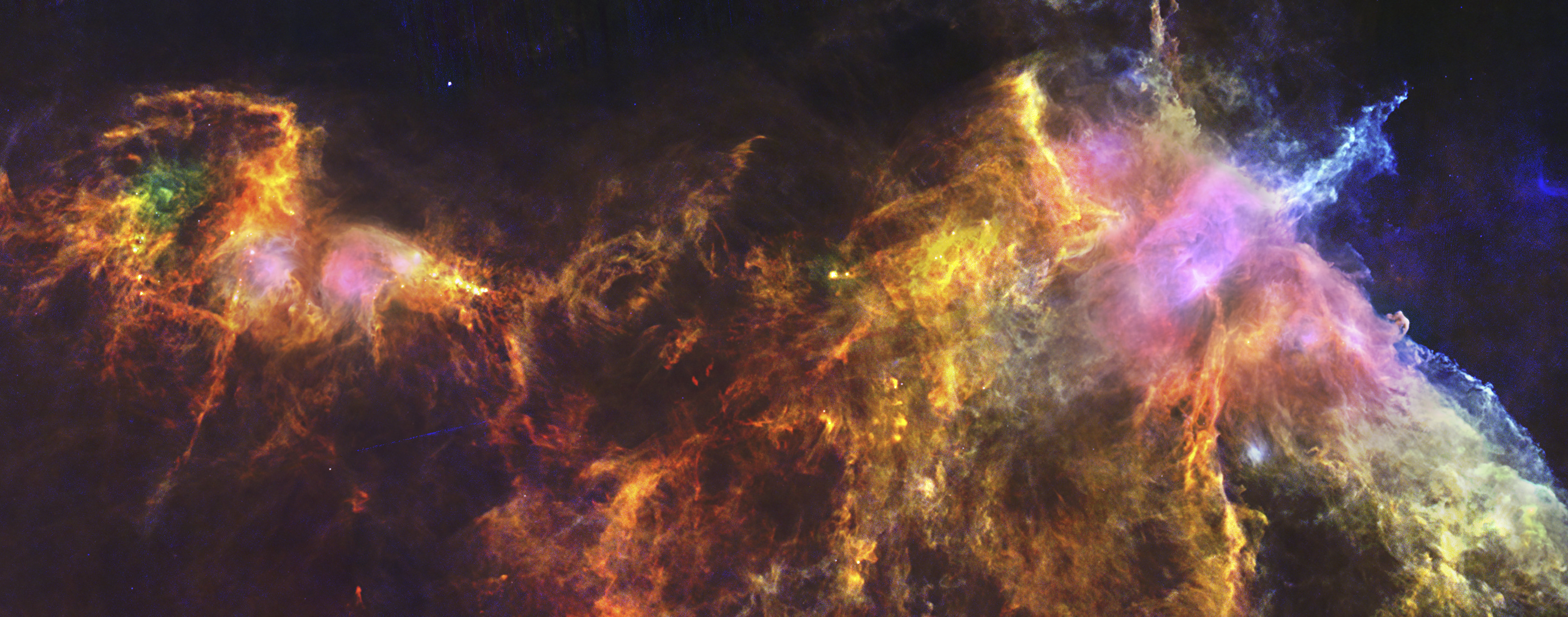
The Herschel Horsehead Nebula.

I had grabbed this image a month ago from the announcement on ESA’s website:

19 April 2013 New views of the Horsehead Nebula and its turbulent environment have been unveiled by ESA’s Herschel space observatory and the NASA/ESA Hubble space telescope.

The Horsehead Nebula lies in the constellation Orion, about 1300 light-years away, and is a popular target for amateur and professional astronomers alike. It sits just to the south of star Alnitak, the easternmost of Orion’s famous three-star belt, and is part of the vast Orion Molecular Cloud complex.

The new far-infrared Herschel view shows in spectacular detail the scene playing out around the Horsehead Nebula at the right-hand side of the image, where it seems to surf like a ‘white horse’ in the waves of turbulent star-forming clouds.

It appears to be riding towards another favourite stopping point for astrophotographers: NGC 2024, also known as the Flame Nebula. This star-forming region appears obscured by dark dust lanes in visible light images, but blazes in full glory in the far-infrared Herschel view.

The image is staggeringly beautiful yet a potent reminder that man, even the totality of our planet, is such an irrelevance in the scheme of things.  We are surrounded by beauty both within and without, yet the fragility of our existance is a ‘vastness’, both literally and psychologically.

Guess what!  Writing that last sentence brought to mind a photograph that I took Wednesday afternoon. As part of the Land Stewardship course Jean and I are taking, the class had gone to the Limpy Creek Botanical area in the Rogue River-Siskiyou National Forest not far from Grants Pass, Oregon.  Here’s that photograph.

P1130363

Reflect on the delicate beauty and vulnerability of that small wild flower. A perfect metaphor for the entire natural world.

So I am going to close this week’s perambulation through love with the thought that if we don’t love our planet with all the ardour and passion of a teenager’s first romance, all those other loves in our lives will ultimately become irrelevant.

Or as Carl Sagan put it:

Our mission is to awaken the broadest possible public to the wonders of nature as revealed by science.

Thank you, MaryAnne.

Deckchairs on the RMS Titanic

A guest post from John Hurlburt.

The trouble with today’s post title is that while the analogy with the loss of the Titanic is accurate, indeed too bloody accurate, the phrase has dissolved into the depths of the barrel of smart, clever-dick sayings.  The brutal consequence of ‘fiddling while Rome burns‘, to use another ‘smart’ saying, is obscured.

So before you read this guest post from regular contributor, John Hurlburt, let me plead for something?

That is that you don’t treat this as just another anecdote in the affairs of man, but a symptom of the blindness of societies right across the world.  As my guest essay tomorrow reveals, waiting for leadership on this planet is a wait that you and I and millions of others just can’t afford.  Each and every one of us has to do something, however minute, to make a difference.  Even just sharing John’s words.

oooOOOooo

It seems that there’s no escaping politics in daily life.

I recently got together one evening with two friends at our local Elks Club.

They are a couple. Two old friends of about ten years who live across the street and around the corner from me during the summer season.  They’ve been together for more than half their lifetimes and spend the fall, winter and early spring in Yuma.

He is a frequent fishing buddy.  Sometimes wears a side arm when we fish the beautiful mountain lakes above Payson. Mountain lakes and related campgrounds that are maintained and supervised by the U.S. Forest Service.  Rather cheekily, I once asked if the plan was to hook trout or shoot them!

Anyhow, this was our first get together of the season.  It was noted that attendance and participation is down in Arizona for such fraternal organizations as the Elks and the Moose.  We had a discussion with club management about the nature of the problem.

Fraternal club management tends to be cautious and well paid. However, it seems that placing discomforting restrictions on people is not popular.  The case in point was a recent club smoking ban. The logic seemed reasonable enough.  Unfortunately, no realistic accommodation was made for the members who chose to smoke.  The reaction was emotional.

For many, it was apparently the last straw.  There were perhaps four other people at the Payson Elks club at 5:30 p.m. that Friday evening. An evening with a moderately priced dinner buffet on hand that had been advertised online, in a newsletter and by word of mouth.

There was a point when a comment seemed appropriate.  I offered the observation that the source of the problem might be political.  No one seemed to register the observation.

We talked a bit about aches and pains; the usual organ recital.  We spoke about what we’ve been doing.  I told them about church and transition town activities.  The conversation turned to our illusion of a stable economy.  An observation was made that the USA was leveraged over twenty-two times above any material foundation.  There was no disagreement.

Despite the clear New York Times warning that morning, climate change never entered the conversation.  A remedy was to note that so far Katrina has cost U.S. taxpayers over sixteen Billion dollars and climbing.   Sandy is expected to cost American taxpayers as much as sixty Billion dollars.

It was a pleasant evening and we plan to get together again soon.

Take care out there.

John.

oooOOOooo

The sound of scraping deckchairs is deafening!

The power in these words.

Day three of recognising the passing of 400 ppm atmospheric CO2.

In nearly four years of writing for Learning from Dogs, I can’t recall devoting three days of posts to a single subject. To put that into context, today’s post is number 1,683 since the first one was published on July 15th, 2009; not all of them from the brain of yours truly by any means you understand!

Today, I’m going to feature a recent essay written by George Monbiot finishing up three days of ‘reporting’ on the deeply disturbing, but fully anticipated, news that the planet’s atmosphere has reached a concentration of 400 ppm CO2.

Last Monday, I published What legacy do we wish to leave for others?

Then yesterday, a post under the title of 400 ppm, as the BBC reported it.  I closed with a reference to a remark made by Professor Sir Brian Hoskins, director of the Grantham Institute for Climate Change at Imperial College London; the remark being “A greater sense of urgency was needed.

I wrote that those wishy-washy words were pathetic.  That we needed the sort of words that George Monbiot penned a few days ago in the Guardian newspaper.  There it was entitled “Climate milestone is a moment of symbolic significance on road of idiocy“.

But I think the title that Mr. Monbiot chose to use on his own blog was far more apt: Via Dolorosa.  (Note that I haven’t formally requested permission to republish the essay but trust that the following is acceptable to both Mr. Monbiot and the Guardian newspaper.)

Here’s how it opened:

Via Dolorosa

May 10, 2013

Corruption and short-termism are pushing us along the path of sorrows.

By George Monbiot, published on the Guardian’s website, 10th May 2013

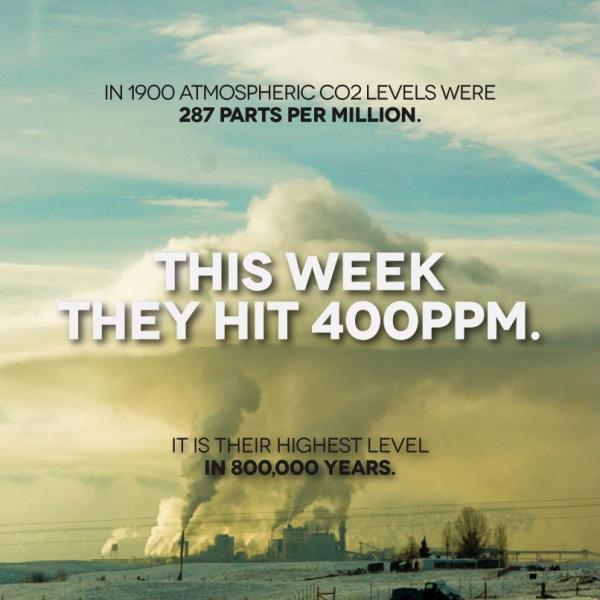
The records go back 800,000 years: that’s the age of the oldest fossil air bubbles extracted from Dome C, an ice-bound summit in the high Antarctic. And throughout that time there has been nothing like this. At no point in the pre-industrial record have concentrations of carbon dioxide in the air risen above 300 parts per million. 400 is a figure that belongs to a different era.

The difference between 399 and 400ppm is small, in terms of its impacts on the world’s living systems. But this is a moment of symbolic significance, a station on the Via Dolorosa of environmental destruction. It is symbolic of our collective failure to put the long term prospects of the natural world and the people it supports above immediate self-interest.

The symbolic significance of the planet’s atmospheric concentrations of CO2 passing 400ppm  is that, I hope, with all the hope that my heart can summon up, it will bring us back from the brink.  Then one ponders about this possibility as Monbiot’s next paragraph unfolds:

The only way forward now is back: to retrace our steps along this road and to seek to return atmospheric concentrations to around 350 parts per million, as the 350.org campaign demands. That requires, above all, that we leave the majority of the fossil fuels which have already been identified in the ground. There is not a government or an energy company which has yet agreed to do so.

“not a government or an energy company … has yet agreed to do so.”

I’m going to repeat that again, with emboldening; “not a government or an energy company … has yet agreed to do so.

In fact, one could reasonable argue that having any hope for a turning back is utterly naive. Look what the essay goes on to say:

Just before the 400-mark was reached, Shell announced that it will go ahead with its plans to drill deeper than any offshore oil operation has gone before: almost three kilometres below the Gulf of Mexico.

A few hours later, Oxford University opened a new laboratory in its department of earth sciences. The lab is funded by Shell. Oxford says that the partnership “is designed to support more effective development of natural resources to meet fast-growing global demand for energy.” Which translates as finding and extracting even more fossil fuel.

The European Emissions Trading Scheme, which was supposed to have capped our consumption, is now, for practical purposes, dead. International climate talks have stalled; governments such as ours now seem quietly to be unpicking their domestic commitments. Practical measures to prevent the growth of global emissions are, by comparison to the scale of the challenge, almost non-existent.

As an example of the scale of the hypocrisy in which we are all immersed, last week’s The Economist magazine carried a full-age advertisement from Chevron on page 5 under the banner of ‘Protecting The Planet Is Everyone’s Job – We agree‘ and going on to explain:

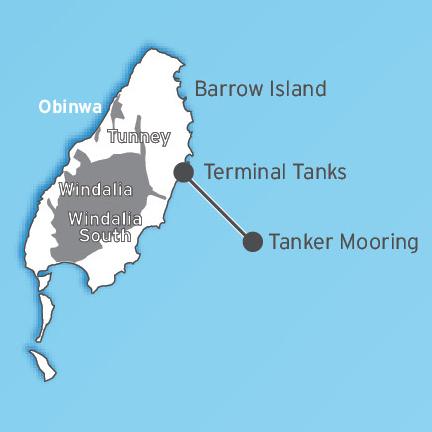
We go to extraordinary lengths to protect the integrity of the places where we operate.  Places all over the world, like Australia’s Barrow Island.  It’s home to hundreds of native species of wildlife, including wallabies, ospreys, and perenties.

We’ve been producing energy on the island for more than 40 years, and it remains a Class A Nature Reserve.

Didn’t take me two moments to find this image:

Barrow Island, Australia.  Taken from the Chevron Australia website.
Barrow Island, Australia. Taken from the Chevron Australia website.

To my mind this advertisement completely misses the point; deliberately or otherwise.  Chevron and all other oil producing companies in the world are endangering the future of the entire planet by continuing to ‘produce energy’, aka oil.  Period. Full stop.

Or to put it in the words of George Monbiot’s essay:

The problem is simply stated: the power of the fossil fuel companies is too great. Among those who seek and obtain high office are people characterised by a complete absence of empathy or scruples, who will take money or instructions from any corporation or billionaire who offers them, and then defend those interests against the current and future prospects of humanity. This new mark reflects a profound failure of politics, worldwide, in which democracy has quietly been supplanted by plutocracy. Without a widespread reform of campaign finance, lobbying and influence-peddling and the systematic corruption they promote, our chances of preventing climate breakdown are close to zero.

Thus the final sentence in GM’s essay carries a deep sadness.

So here we stand at a waystation along the road of idiocy, apparently determined only to complete our journey.

http://www.monbiot.com

Why are we not seeing, hearing and reading words of a similar weight and power from just about every ‘opinion maker’ in the world?

Why not?  Why not?

400 ppm, as the BBC reported it.

Staying with the terrible news that we are now above 400 ppm atmospheric CO2.

If there is anything of comfort to be drawn from the news that we are above 400 ppm CO2 it is that the mainstream media are running with it.  I shall focus on the reportage from the BBC News website.

First, there was the news of the passing of that “symbolic mark”.

Carbon dioxide passes symbolic mark

Key measurements are made on top of the Mauna Loa volcano

Carbon dioxide levels in the atmosphere have broken through a symbolic mark.

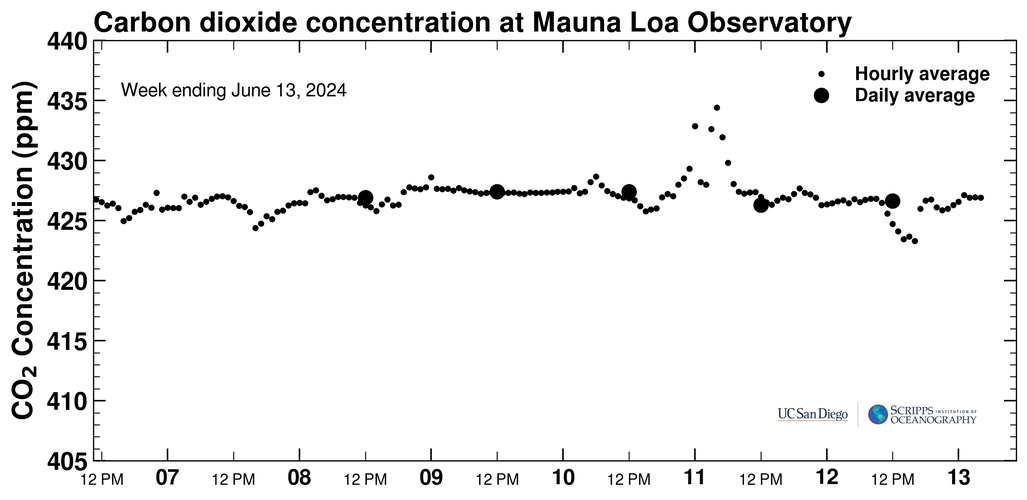
Daily measurements of CO2 at a US government agency lab on Hawaii have topped 400 parts per million for the first time.

The station, which sits on the Mauna Loa volcano, feeds its numbers into a continuous record of the concentration of the gas stretching back to 1958.

The last time CO2 was regularly above 400ppm was three to five million years ago – before modern humans existed.

Scientists say the climate back then was also considerably warmer than it is today.

Carbon dioxide is regarded as the most important of the manmade greenhouse gases blamed for raising the temperature on the planet over recent decades.

Read the rest of the news release here.

Then David Shukman, Science editor BBC News added this further background, that I am going to republish in full:

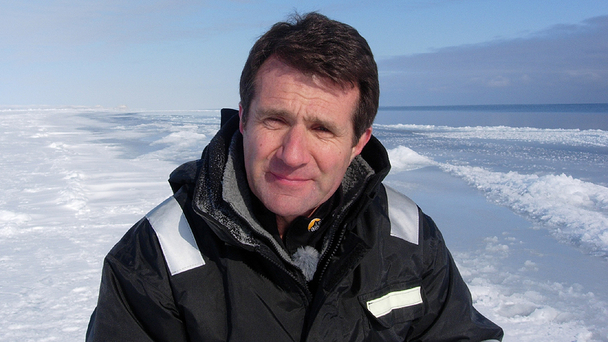
David Shukman
David Shukman

Near the summit of the Mauna Loa volcano, the carbon dioxide monitors stand amid one of the world’s remotest huddles of scientific instruments. To reach them you have to leave the steamy Hawaii coast and climb through barren lava-fields.

At the top, above 11,000ft, the air is thin and the sun piercing. During my visit, I watched rain clouds boiling in the valleys below me. Charles David Keeling chose this otherworldly spot because the air up here is neither industrial nor pristine; it is “well-mixed” which means it can serve as a useful guide to changes in the atmosphere.

Despite their global significance, the devices he installed back in 1958 do not look impressive. But he battled bureaucratic objections to fund them and his legacy is the longest continuous record of a gas, linked to much of global warming, that just keeps rising.

A day later, the BBC released this:

Scientists call for action to tackle CO2 levels

Scientists are calling on world leaders to take action on climate change after carbon dioxide levels in the atmosphere broke through a symbolic threshold.

Daily CO2 readings at a US government agency lab on Hawaii have topped 400 parts per million for the first time.

Sir Brian Hoskins, the head of climate change at the UK-based Royal Society, said the figure should “jolt governments into action”.

China and the US have made a commitment to co-operate on clean technology.

But BBC environment analyst Roger Harrabin said the EU was backing off the issue, and cheap fossil fuels looked attractive to industries.

The laboratory, which sits on the Mauna Loa volcano, feeds its numbers into a continuous record of the concentration of the gas stretching back to 1958.

‘Sense of urgency’

Carbon dioxide is regarded as the most important of the manmade greenhouse gases blamed for raising the temperature on the planet over recent decades.

Human sources come principally from the burning of fossil fuels such as coal, oil and gas.

Ministers in the UK have claimed global leadership in reducing CO2 emissions and urged other nations to follow suit.

But the official Climate Change Committee (CCC) last month said that Britain’s total contribution towards heating the climate had increased, because the UK is importing goods that produce CO2 in other countries.

Rest of that news article is here.  But I can’t resist the picture and quote from Professor Sir Brian Hoskins, director of the Grantham Institute for Climate Change at Imperial College London.

Sir Brian Hoskins said a greater sense of urgency was needed

A greater sense of urgency was needed.”  I’m going to be emotional!  Frankly, those wishy-washy words are pathetic.

We need the sort of words that George Monbiot penned a few days ago.  Those I will share with you tomorrow.

What legacy do we wish to leave others?

What on earth are we all doing!

I started writing this early morning last Friday, 10th May.  It was prompted by a post then just in from Christine’s blog 350 or bust. I didn’t have the heart to republish it for a few days.

Then as the news of the atmospheric CO2 concentration passing 400 parts per million (ppm) moved more and more into mainstream news, I found myself morphing from sadness and puzzlement into anger and then into some form of determination to ‘do something‘, however insignificant that might be.

Because if humanity does not turn back from our carbon-based lifestyle pretty damn soon then those who are, say, 20 years or more younger than me (I’m 68), are in for some very tough, very rough times indeed.

So over the next two or three days, I shall focus on this topic simply from the motivation of wanting to join the numerous others around the world who are also recognising this moment in the history of man.

Ergo, for today that post from Christine. But I make no apologies for staying with the theme for much of this week.

oooOOOooo

Rolling The Dice: CO2 Concentration Hits Record High Amid Global Inaction On Climate Change

2013/05/10

Via The Guardian:

The concentration of carbon dioxide in the atmosphere has reached 399.72 parts per million (ppm) and is likely to pass the symbolically important 400ppm level for the first time in the next few days.

Readings at the US government’s Earth Systems Research laboratory in Hawaii, are not expected to reach their 2013 peak until mid May, but were recorded at a daily average of 399.72ppm on 25 April. The weekly average stood at 398.5 on Monday.

Hourly readings above 400ppm have been recorded six times in the last week, and on occasion, at observatories in the high Arctic. But the Mauna Loa station, sited at 3,400m and far away from major pollution sources in the Pacific Ocean, has been monitoring levels for more than 50 years and is considered the gold standard.

“I wish it weren’t true but it looks like the world is going to blow through the 400ppm level without losing a beat. At this pace we’ll hit 450ppm within a few decades,” said Ralph Keeling, a geologist with the Scripps Institution of Oceanography which operates the Hawaiian observatory.

*

four-hundred-ppm-milestone-reached

*

scripps
Source: Scripps Institute of Oceanography

*

For more on the awful implications of this milestone in human history, check out the links below (hint: it isn’t good news for humans or animals or the ocean).

More links:

As CO2 Concentrations Reach Ominous Benchmark, Daily Updates Begin

The Keeling Curve: A Daily Update of Atmospheric Carbon Dioxide From Scripps Institute of Oceanography At UC San Diego

Greenhouse Gas Levels Near Milestone: Highest in Millions of Years

oooOOOooo

The counter-intuitive aspect of liberty.

How libertarian ideology is holding back our liberty to change.

Martin Lack, he of the popular blog Lack of Environment is taking a small break from his writings.  In his own words,

I am afraid this may be the last post on this blog for a while because – what with the all the willful blindness and ideological prejudice that seems to stop people from recognising what an Eff-ing mess humanity is in – and my as yet unresolved employment situation – I am feeling somewhat emotionally drained. However, please don’t cancel your subscription (as who knows how quickly I may recover).

So what a pleasant surprise when less than a day after those words in came an email that read, “Since I have told readers of my blog that I am taking a rest, I offer you the text appended below to post on your blog instead (or not – as you see fit).

On reading the text I most certainly ‘saw fit‘ to publish it!

It is a very interesting approach to climate science denialism resulting from an analysis of conspiracy theories.

So over to Martin.

oooOOOooo

Professor Stephan Lewandowsky.

Libertarian ideology is the real road block

I have recently been catching up on a bit of reading – focusing on the recent work of Professor Stephan Lewandowsky (and others).  Following in the wake of James Hansen, Ben Santer and Michael Mann, Lewandowsky has recently been the target of hate-mail campaigns by climate change sceptics.  Unlike all the others, however, Lewandowsky (formerly at the University of Western Australia but now at Bristol University in the UK) is not a climate scientist.  This is how Bristol University announced his recent appointment.

Steve is an internationally renowned cognitive scientist who has joined us from the University of Western Australia. His research has already revolutionised our understanding of human memory and cognition, and he now stands poised to build upon his impressive body of work with a project as ambitious as it is timely. In particular, Steve’s intention to improve our understanding of how people choose to acquire information, and to use this understanding to help create a more informed populace, is a unique and much needed undertaking. Thus, this research offers enormous benefits in the fields of experimental psychology, climate research and the wider public engagement with and understanding of scientific research.

I must admit that, until recently, I had not sat down to read either of the papers by Lewandowsky et al (  ‘Motivated Rejection of Science’ [PDF]  or ‘Recursive Fury: Conspiracy Ideation in the Blogosphere’ [PDF] ) – I had only read about them.

However, now that I have read them, the thing that strikes me most forcefully is not the stupidity of conspiracy “ideation”, the invocation of conspiracy theories, it is the fact that, as Lewandowsky et al acknowledge, their work confirms the findings of many previous studies; that climate change scepticism is associated with prejudicial adherence to libertarian ideology.  Also key is that climate change scepticism can be predicted by that prejudicial adherence to libertarian ideology.

Amongst many other things, this explains why EU sceptics are climate sceptics and why the United Kingdom Independence Party (UKIP) do not like Wind Farms.  I had understood this for some time.  However, I had not fully realised its importance; it was just one theme among others.  Anyone who has read my blog recently will probably have noticed my post about New World Order (NWO) conspiracy theory, in which I acknowledged that I had not realised just how significant such thinking is, and how subliminal and subconscious it may be.

Although adherence to free-market economics and libertarian ideology were themes I highlighted in my MA dissertation and in my subsequent book, and mentioned on my blog numerous times, everything I have read in the last few days points to one conclusion:  We will not succeed in communicating the urgency of the need for radical changes in energy policy until we can convince people that climate scientists are not trying to perpetuate their research funding or halt human progress.

Professor Lewandowsky’s research shows that little can be achieved by simply telling people they are wrong.  Far better is pointing out to people that Limits to Growth and Peak Oil have already halted the progress of globalised Capitalism, as recent times prove dramatically. In other words conveying facts to people rather than ideology.

I must admit that this has been a tough pill to swallow.  I am not naturally progressive and certainly not naturally “liberal”.  On the contrary, I am socially and politically conservative.  However, the reality of anthropogenic climate disruption is a game-changer. Therefore, unlike members of the Flat Earth Society or Young Earth Creationists (YECs), I do not refuse to accept what scientists tell me simply because I don’t like the message.

We cannot defeat such obscurantism by telling people they are irrational; we can only defeat it by focusing on the evidence that suggests strongly that they are mistaken.  To this end, I think the words of St Augustine of Hippo are an important consideration; words going back over 1,400 years before anyone started to question the Age of the Earth or the Origin of Species!  Words echoed by Thomas Aquinas, (often quoted to those YECs):

“… since Holy Scripture can be explained in a multiplicity of senses, one should adhere to a particular explanation only in such measure as to be ready to abandon it if it be proved with certainty to be false, lest Holy Scripture be exposed to the ridicule of unbelievers, and obstacles be placed to their believing.”
– Thomas Aquinas, Summa Theologica (1273).

In the last 150 years or so, most Christians have now come to reject conspiracy theory explanations for fossils, for example, and have realised that it is inappropriate to treat the Bible as a scientific text book.  Regretably, the main source of ideological blindness today is not conventional religion; it is adherence to free-market economics.

Therefore, it is important that we acknowledge the ideological nature of the communication problem we face. That is that the research by Prof Lewandowsky and others has discovered a tendency for libertarians to prefer conspiracy theories to reality.  Perhaps, therefore, not surprising that he has been attacked; no-one likes to be told they are deluded.

Roadblocks to policy change will not be cleared by social and political scientists telling libertarians that they are deluded.  All that will do is confirm their suspicions and reinforce their prejudices!  No, what is needed is for climate scientists to be bolder in stating the facts.

The majority of climate scientists seem content to continue to soft-soap the issue; afraid of “telling it to people straight” because it may induce despair.

No, it is not too late to prevent an ecological catastrophe but I am certain that we are now very short of time and, as everyone from the International Energy Agency, the Pentagon and the IMF agree, further delay will not be cost-effective.

At the same time, I think social and political scientists need to focus on debunking the ‘New World Order’ conspiracy myth and pointing out the logical fallacy in the idea that all Greens are Communists in disguise (the so-called ‘Watermelons’).

The environment has become a political football when it is nothing of the kind.  It is our life support system and we have pushed it near to the point of collapse, as E.F. Schumacher once said, by mistaking Nature’s capital for a form of income.  Therefore, if we do not change course, bankruptcy would seem inevitable.

oooOOOooo

Having read and reflected on Martin’s essay, a couple of recollections surface.  The first is Guy McPherson’s book Walking Away from Empire that I reviewed earlier this year then referred to in a recent republication of a George Monbiot essay:

So very difficult to pick out the sentence that carried the most power, for the essay is powerful from start to end.  But this one did hit me in the face, “The impossibility of sustaining this system of endless, pointless consumption without the continued erosion of the living planet and the future prospects of humankind, is the conversation we will not have.

Finally, I can’t resist reminding you, dear reader, of the point made by Prof. Guy McPherson in his book Walking Away from Empire, which I reviewed on March 6th.  particularly in the first paragraph of the first chapter; Reason:

At this late juncture in the era of industry, it seems safe to assume we face one of two futures. If we continue to burn fossil fuels, we face imminent environmental collapse. If we cease burning fossil fuels, the industrial economy will collapse. Industrial humans express these futures as a choice between your money or your life, and tell you that, without money, life isn’t worth living. As should be clear by now, industrial humans — or at least our “leaders” — have chosen not door number one (environmental collapse) and not door number two (economic collapse), but both of the above.

The second recollection comes most recently; from yesterday’s The story of carbon. A story that showed the power of academic, peer-reviewed, properly conducted, rational science!

I will close with a repeat of the closing words from yesterday:

“By my calculation, we have a 5–10 year window to avoid the catastrophe. It won’t be easy — we’re past the point where any transition will be smooth — but we can make the transition and survive as a civilized species, humans in a recognizable world.”

Nothing counter-intuitive about that!

The story of carbon, part one.

Looking back enables us to look clearly ahead.

I struggled for a while to decide what to call this post, the first of three.  Explain why in just a moment.

The post is predominantly from the hand of a professional writer who goes under the name of Gaius Publius.  He is described as contributing editor on AMERICAblog from where one also learns that:

Gaius Publius
Gaius Publius

Gaius Publius is a professional writer living on the West Coast of the United States. Gaius has written in a variety of genres and styles. He’s published short stories and poetry, books on education & technology, and is currently working on two book-length projects, including one novel.

In addition to writing, Gaius has been a professional educator and currently manages a small publishing consultancy. He holds a Bachelors degree in Great Books with a side concentration in physics and math, and a Masters in English and Communication.

A web search soon comes across a blog where there is a collection of the gentleman’s works.

OK, back to the theme.

Five days ago I read an essay on Yves Smith’s Naked Capitalism blog that struck me as a fabulously bold and clear presentation of the climate crisis.  The essay, written by Gaius, also derived a positive message from the boldness and clarity of the argument.  I dropped Yves an email asking for permission to republish on Learning from Dogs and not only did I get a quick reply from Yves, that reply included approval for the reposting from Mr. Publius.  Thank you both.

The essay was called: The climate crisis in three easy charts. However, I was uncomfortable that the word ‘crisis’ might be a turn-off in a blog post title, so opted for The story of carbon.  So with that off my chest, let me go straight to the essay as it appeared on Naked Capitalism.

oooOOOooo

 The Climate Crisis in Three Easy Charts

Yves here. This post is the first in a series by Gaius. It starts by looking at the larger climate picture over larger swathes of time and showing what level of temperature changes led to mass extinction events.

By Gaius Publius, who you can follow at Twitter @Gaius_Publius. Cross posted from AmericaBlog

I’m preparing to pivot back to climate crisis, starting with some reformatting of the earlier Climate Series posts — the transition to WordPress wasn’t kind to them — and the organization of this material into book form. (There’s also a climate-themed novel in the works; thriller fans, stay tuned.)

As a result, I’m doing serious study to refine both the concepts (or rather, the explanation of them) and the dating of coming events (the crisis in its various stages).

The first part of that pivot includes two media appearances this week. I’ll be on Virtually Speaking With Jay Ackroyd this Thursday (May 2) at 9 pm ET to discuss climate crisis for a full hour, followed by a Sunday appearance with Avedon Carol as part of the Virtually Speaking Sundays weekly media panel.

It’s the climate discussion I want to focus on here, and I’d like to do it by focusing on three diagrams and a few references back to my earlier climate pieces.

Climate catastrophe will usher in a new geologic era

Long-scale earth history is divided into Eons, then Eras, then Periods. But in fact, prior to the Cambrian Period, when life on earth exploded in number and variety, earth history is the story of non-life or small single- or multi-celled life. And starting with the Cambrian period, there’s just one “eon” anyway. It’s eras and periods we care about.

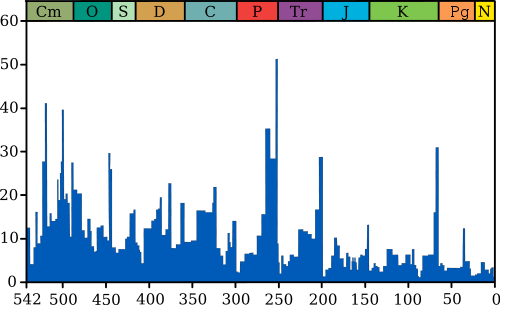
So let’s start there, with the Cambrian Period and the flourishing of life on earth. Consider the chart below:

Mass_Extinction_500px-Extinction_intensity.svg_2

The divisions across the top are geologic periods, starting with the Cambrian (“Cm”), the period of “visible life”‘ — meaning a proliferation of hardshelled species. It’s the big explosion of life on earth. The numbers across the bottom are millions of years ago. The spikes show extinction events, with the percentage of marine species going extinct expressed on the vertical or Y axis.

The chart doesn’t call them out, but starting with the Cambrian period, we’ve had three geologic eras (the larger divisions):

Paleozoic Era — “old life”
Mesozoic Era — “middle life” or the Age of Reptiles (dino days)
Cenozoic Era — “new life” or the Age of Mammals (including us)

The Paleozoic Era runs from the start of the graph to the big spike at 250 million years ago on the X axis. It encompasses six geologic periods and ended in the greatest mass extinction event on the planet — geologists call it the “Great Dying”.

The Mesozoic Era runs from the Great Dying at 250 million years ago to the big spike at 65 million years ago, the event that wiped out the dinosaurs — and every other large species. That cleared the way for mammals to grow big and thrive.

We’re now in the Cenozoic Era. Keep those transitions in mind — when mass extinctions change which groups of species can evolve and rule, it’s the end of an era and the start of another. Now look at the chart again. The whole chart shows 540 million years, and just three geologic eras. The next extinction event on the scale of the one at 250 million years ago, or the one at 65 million years ago, will change the shape of life on earth and usher in a new era. Ready for that?

[Update: For a chart that shows geologic eras, periods and their subdivisions in one place, click here. Opens in a new tab.]

Where does man fit in?

Great question — where does man fit in? Answer: We come in very late.

First, notice the last three geologic “periods” at the top-right in the chart above. The period marked “K” is the Cretaceous, the period at the end of the Mesozoic Era. The next period (“Pg”) is the Paleogene, the one that marks the start of the Cenozoic (new life) Era. The period after that (“N”) is the Neogene, which ended just 2 million years ago. The period after that, not shown, is the Quarternary Period, our current one.

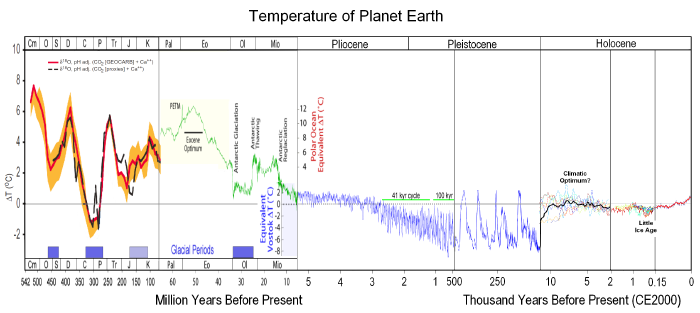
The Neogene-Quarternary boundary is the start of the time of great glaciers, and the best way to show that is with the chart below, showing earth temperatures mapped across the geologic periods (at the left end) and geologic epochs (the rest of the chart).

Earth_tem_All_palaeotemps_700px

Click here to open the full version in another tab. It’s a big, interesting chart. (Source here.)

First, get oriented. On the Y axis is global temperature using change — in °C — from global temperature in the year 1800 as the norm or zero mark. (The global pre–Industrial Revolution temperature is generally the mark from which other global temperatures are measured, unless otherwise noted. To convert from °C to °F, just double the number; you’ll be pretty close.)

On the X axis, the first big division — from 542 million years ago to 65 million years ago — represents the first two geologic eras, the Paleozoic and Mezozoic (which unfortunately aren’t called out on this chart). “K” at the top and bottom is still the Cretaceous Period, and the end of the Cretaceous Period is also the end of the dinos and the end of the Mesozoic Era.

In this respect, both charts are the same. Man hasn’t showed up yet — our mammal ancestors were the equivalent of field mice in that world, small prey with soft shells and hiding skills.

But before we look at the rest of the X axis, notice that in the left-most part of the chart, the Y axis shows a huge change in global temperature relative to pre-Industrial norms. Looks like a monster spike, especially the first one, doesn’t it?

The Cambrian temperature spike is 6–8°C (about 11–14°F) higher than pre-Industrial levels.

It’s also the temperature we’re headed for by 2100.

But let’s not get distracted. Let’s set some markers in this chart in the horizontal (time) dimension. The whole rest of the chart — the part after the period called “K” — shows the Cenozoic Era (“new life” or Age of Mammals). From here to the right, the chart’s subdivisions show Epochs, which are sub-parts of Periods.

[Update: For a chart that shows the relationship between eras, periods and epochs, click here. it will help you stay oriented.]

Jump through the next five divisions — the epochs marked “Pal” through “Pliocene”. That takes you through the Neogene Period (“N” in the first chart) and to the start of the modern Quarternary Period, the one we’re in, and the one we’re interested in.

The epoch of the Pleistocene, which starts the Quarternary Period (again, see the chart), is the great age of glaciers. Homo habilis evolves at this time, a little over 2 million years ago. Homo erectus evolves shortly afterward. Each starts in Africa — now you can probably guess why — and each leaves Africa and spreads across the globe. (Homo erectus, by the way, lasts a long time on this earth. Longer than us by a lot.)

Homo sapiens evolved much later, in the Pleistocene — the age of glaciers, remember — just 250 thousand years ago, almost died out in Africa, but rebuilt our numbers, then spread out of Africa like our cousins. Because that was the glacier age, we’re still hunter-gatherers like the the rest of our cousins. The big beasts of the earth are creatures like woolly mammoths and sabre-tooth tigers, and we’re all alive on a fairly frozen planet with glaciers coming and going.

At the end of the Pleistocene is another extinction event. At the same time that the last glaciers recede (see chart), the big mammoths and tigers (et al) die off. Simultaneous with a noticeable change in climate, what we call “human civilization” begins. You can see that above, around 12–10 thousand years ago as the planetary temperature stabilizes. From then until almost now, planetary temperature is pretty stable. Notice it doesn’t take much of a wobble to mark the “Little Ice Age”.

Just two more points to make in this piece and I’m done.

First the bad news

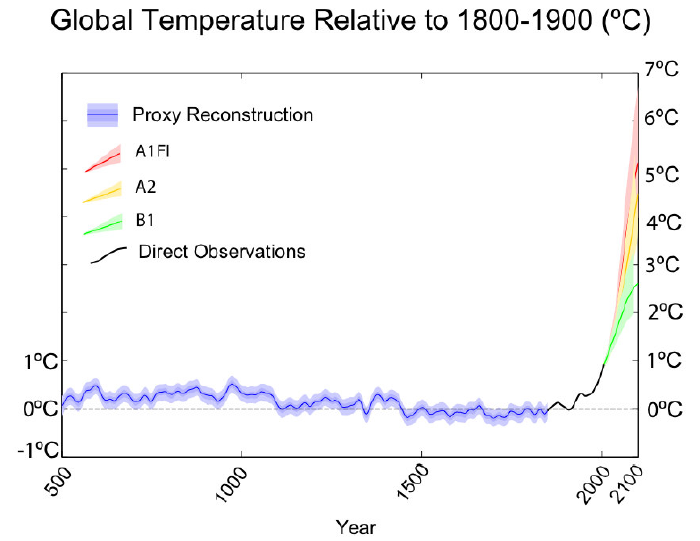
Folks, that little climb in temperature you see near the right end of the graph above is just the beginning. Remember the Cambrian spike at the left end of the graph? Take another look and note the increase — about 7°C. Now here’s Figure 21 from the Copenhagen Diagnosis, a report prepared by … oh … every single one of the world’s top climate scientists for the benefit of our world’s “leaders,” who met in 2009 to discuss how to pass the climate buck one more time:

Copenhagen_Diagnosis_Fig_21_LARGE

What you see is temperatures from 500 AD to about 2000, with a number of prediction scenarios going forward. See the scenario called “A1FI”? It’s the one in red. That’s the one we’re on if we don’t stop spewing carbon. I call it the “do nothing” scenario — otherwise known as the “Keep David Koch Happy” scenario.

All you need to know? We’re on track for about +7°C — the peak temperature in the big Cambrian spike — by the year 2100.

Now the good news

Despite all this doom-and-gloom, it’s not over yet. Truly. By my calculation, we have a 5–10 year window to avoid the catastrophe. It won’t be easy — we’re past the point where any transition will be smooth — but we can make the transition and survive as a civilized species, humans in a recognizable world.

But two things are needed:

  1. This has to be our top priority, which means you and everyone you know has to be fully aware and in full battle gear. (For reference, it’s called “hugging the monster.”)
  2. It’s us vs. David Koch and all of his friends and enablers. Tackling any other enemy is tackling a dummy while the game is being played.

Educate your friends, and put a wrench into the Koch machine. How’s that not a plus?

If the Koch Bros keep getting rich, we move backward. If Barack “Hope & Change” Obama approves Keystone, we move backward. If the U.S. develops “domestic oil” resources, we move backward. For every new car (“carbon-delivery system”) sold, we move backward. People need to know this and think like this. We can stop the crisis, but only if we stop carbon. It’s that simple; and that stark.

But it’s also doable, and we’re the species that’s most equiped for “doable.” It’s what our big brains are for.

I’ll have more in the weeks and months ahead. I haven’t given up, not by a long shot. But you can’t pull out of a tail spin if you don’t admit you’re in one. Me, I think we can pull out.

oooOOOooo

So presumably if you are reading this, you have read the essay above.  I hope so because while at first sight there appears to be much to take in, the story is clear, informed and powerful.  You are unlikely to change the mind of a committed ‘denier’ but if there’s a little part of you that isn’t utterly clear about the risks ahead, then this essay is a fabulous opportunity to embrace clarity – and not to give up hope! Remember those words in the essay:

“By my calculation, we have a 5–10 year window to avoid the catastrophe. It won’t be easy — we’re past the point where any transition will be smooth — but we can make the transition and survive as a civilized species, humans in a recognizable world.”

Oceans and Minds.

How the linking of minds offers us vast horizons!

I subscribe to two blogs: Pendantry’s Wibble and Christine’s 350 or bust. But a temporary lack of quiet reading time has meant that recent posts from each of them were initially only briefly skimmed.  I made a mental note to read the one from Pendantry, Where oceans meet, because I have always had a love affair with the oceans.  When I did read it, I was blown away, to use the modern vernacular.  Why?  Stay with me.

Where oceans meet opened thus:

I’ve recently been introduced to two things that demonstrate (to my satisfaction, anyway) that the universe is much stranger than I first thought. Mind you, my first thought was quite some time ago, now.

Then after showing a wonderful photograph of where the Indian Ocean meets the Southern Ocean, (this one below) …

Twooceansmerging
Even vast oceans come together.

…. Pendantry goes on:

The other one of those ‘strange universe’ things is something that I find even more surprising: after decades of eating meat, an hour watching just one film has persuaded me to reconsider the habits of a lifetime.

That really jumped off the page at me because Jeannie has been a vegetarian for most of her life and I have been flirting with the idea.

That ‘one film’ was Vegucated.  Here’s the rest of that Wibble post republished with Pendantry’s kind permission.

oooOOOooo

A TED talk highlighted yesterday over on 350orbust (well worth watching — thanks, Christine) included a reference to the film Vegucated. Intrigued, was I, so I trundled off to watch it, and returned a changed man. Well, maybe that’s a bit ambitious, but I do now feel motivated to think more about what I eat, why I’m eating it, and to actively seek out vegan alternatives — something that I have never considered before.

vegucated-meat-means-disease-350_zpsc6ef410f
More meat equals more disease.

Vegucated reinforces the betrayal of a society that has sold us all on the idea of having ‘consumer choice’ — but continues to withhold from us the information necessary to make informed choices. And on that point: don’t just take my word for it that this is a film well worth watching: there are many other reviews and quotes about it.

Einstein deliberated, and chose a vegetarian lifestyle

Our world is changing, and, one way or another, we must change with it. I believe that films like Vegucated are essential to help us to choose to move in the direction of a healthier, happier world.

If slaughterhouses had glass walls, everyone would be vegetarian. “— Paul McCartney.

oooOOOooo

As you can see Pendantry referred to Christine’s recent post on 350orbust.  That post was called Are You A Changemaker?

Naturally I was curious and wandered across to that post.  Here are Christine’s own words,

It’s TED Talk Tuesday on 350orbust, and today’s presenter is Zoe Weil who spoke to the young people who gathered at the TEDx Youth symposium held at Cape Elizabeth, Maine, last December. Ms. Weil is the co-founder and president of the Institute for Humane Education. Ms. Weil’s inspiring talk is entitled “How To Be A Solutionary.” Enjoy!

I tell you what!  That 11 minute presentation by Zoe Weil was not just inspirational, it was one of the most inspirational speeches I have ever heard!  That’s EVER!

Take this quote that comes in less than 2 minutes from the start of the speech, “Never before have we had the capacity to cause the breakdown of so many ecological systems that sustain our life.

Now if that doesn’t have you gagging for the rest of what Zoe talks about, nothing will.  So here it is.

Published on Jan 11, 2013

Zoe Weil is the co-founder and president of the Institute for Humane Education and is considered a pioneer in the comprehensive humane education movement, which provides people with the knowledge, tools, and motivation to be conscientious choicemakers and engaged changemakers for a better world. Zoe created the first Master of Education and Certificate Program in Humane Education in the U.S. covering the interconnected issues of human rights, environmental preservation, and animal protection. She has also created acclaimed online programs and leads workshops and speaks at universities, conferences, and events across the U.S. and Canada. She has taught tens of thousands students through her innovative school presentations, and has trained several thousand teachers through her workshops and programs. Zoe’s most recent book, Most Good, Least Harm: A Simple Principle for a Better World and Meaningful Life, won the 2010 Nautilus silver medal in sustainability and green values. She is the author of several other books including Above All, Be Kind: Raising a Humane Child in Challenging Times for parents; The Power and Promise of Humane Education for educators; and Claude and Medea: The Hellburn Dogs, winner of the Moonbeam gold medal in juvenile fiction, which follows the exploits of two seventh graders who become clandestine activists in New York City, righting wrongs where they find them. Zoe received a Master of Theological Studies from Harvard Divinity School and a Master of Arts from the University of Pennsylvania.

So from the meeting of vast oceans to the meeting of minds.

The Great Unmentionable by George Monbiot.

A real pleasure and privilege to republish this article from Mr. Monbiot.

For some time now I have subscribed to the articles published by The Permaculture Research Institute of Australia.  From time to time references have been made to PRI articles here on Learning from Dogs.

Recently, I read a PRI essay that had been penned by George Monbiot.  It was called The Great Unmentionable.  It blew me away.  So I took a deep breath and dropped George M. an email asking if I might republish it here.  George was very gracious in giving me such permission.

Mr. George Monbiot.
Mr. George Monbiot.

First some background to George Monbiot for those who are unfamiliar with his work and his writings.  As his website explains:

I had an unhappy time at university, and I now regret having gone to Oxford, even though the zoology course I took – taught, among others, by Richard Dawkins, Bill Hamilton and John Krebs – was excellent. The culture did not suit me, and when I tried to join in I fell flat on my face, sometimes in a drunken stupor. I enjoyed the holidays more: I worked on farms and as a waterkeeper on the River Kennet. I spent much of the last two years planning my escape. There was only one job I wanted, and it did not yet exist: to make investigative environmental programmes for the BBC.

After hammering on its doors for a year, I received a phone call from the head of the BBC’s natural history unit during my final exams. He told me: “you’re so fucking persistent you’ve got the job.” They took me on, in 1985, as a radio producer, to make wildlife programmes. Thanks to a supportive boss, I was soon able to make the programmes I had wanted to produce. We broke some major stories. Our documentary on the sinking of a bulk carrier off the coast of Cork, uncovering evidence that suggested it had been deliberately scuppered, won a Sony award.

Anyway, to the article in question that was published on the Guardian Newspaper’s website, 12th April 2013.

oooOOOooo

The Great Unmentionable

April 12, 2013

We have offshored both our consumption and our perceptions

By George Monbiot

Every society has topics it does not discuss. These are the issues which challenge its comfortable assumptions. They are the ones that remind us of mortality, which threaten the continuity we anticipate, which expose our various beliefs as irreconcilable.

Among them are the facts which sink the cosy assertion, that (in David Cameron’s words) “there need not be a tension between green and growth.”

At a reception in London recently I met an extremely rich woman, who lives, as most people with similar levels of wealth do, in an almost comically unsustainable fashion: jetting between various homes and resorts in one long turbo-charged holiday. When I told her what I did, she responded, “oh I agree, the environment is so important. I’m crazy about recycling.” But the real problem, she explained, was “people breeding too much”.

I agreed that population is an element of the problem, but argued that consumption is rising much faster and – unlike the growth in the number of people – is showing no signs of levelling off. She found this notion deeply offensive: I mean the notion that human population growth is slowing. When I told her that birth rates are dropping almost everywhere, and that the world is undergoing a slow demographic transition, she disagreed violently: she has seen, on her endless travels, how many children “all those people have”.

As so many in her position do, she was using population as a means of disavowing her own impacts. The issue allowed her to transfer responsibility to other people: people at the opposite end of the economic spectrum. It allowed her to pretend that her shopping and flying and endless refurbishments of multiple homes are not a problem. Recycling and population: these are the amulets people clasp in order not to see the clash between protecting the environment and rising consumption.

In a similar way, we have managed, with the help of a misleading global accounting system, to overlook one of the gravest impacts of our consumption. This too has allowed us to blame foreigners – particularly poorer foreigners – for the problem.

When nations negotiate global cuts in greenhouse gas emissions, they are held responsible only for the gases produced within their own borders. Partly as a result of this convention, these tend to be the only ones that countries count. When these “territorial emissions” fall, they congratulate themselves on reducing their carbon footprints. But as markets of all kinds have been globalised, and as manufacturing migrates from rich nations to poorer ones, territorial accounting bears ever less relationship to our real impacts.

While this is an issue which affects all post-industrial countries, it is especially pertinent in the United Kingdom, where the difference between our domestic and international impacts is greater than that of any other major emitter. The last government boasted that this country cut greenhouse gas emissions by 19% between 1990 and 2008. It positioned itself (as the current government does) as a global leader, on course to meet its own targets, and as an example for other nations to follow.

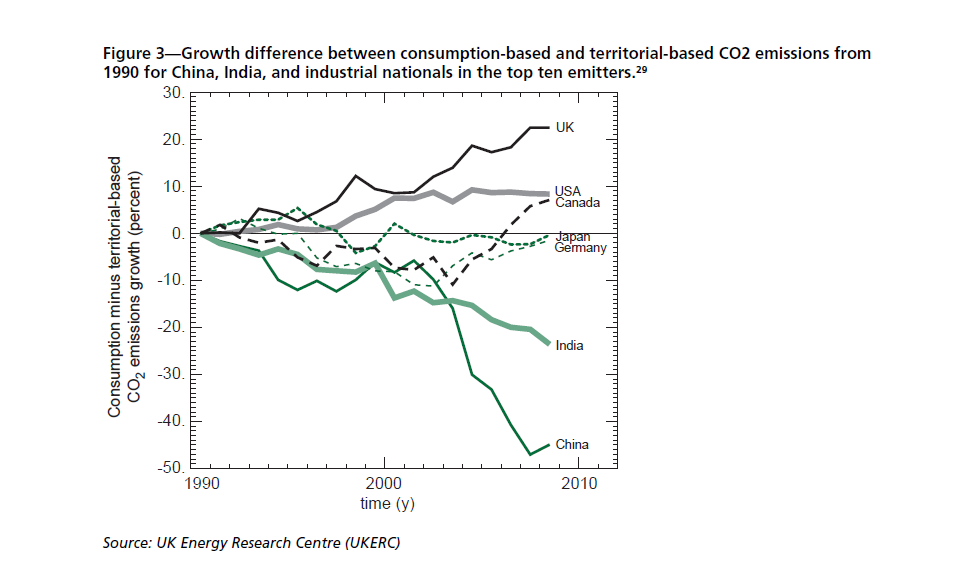
But the cut the UK has celebrated is an artefact of accountancy. When the impact of the goods we buy from other nations is counted, our total greenhouse gases did not fall by 19% between 1990 and 2008. They rose by 20%. This is despite the replacement during that period of many of our coal-fired power stations with natural gas, which produces roughly half as much carbon dioxide for every unit of electricity. When our “consumption emissions”, rather than territorial emissions, are taken into account, our proud record turns into a story of dismal failure.

There are two further impacts of this false accounting. The first is that because many of the goods whose manufacture we commission are now produced in other countries, those places take the blame for our rising consumption. We use China just as we use the population issue: as a means of deflecting responsibility. What’s the point of cutting our own consumption, a thousand voices ask, when China is building a new power station every 10 seconds (or whatever the current rate happens to be)?

But, just as our position is flattered by the way greenhouse gases are counted, China’s is unfairly maligned. A graph published by the House of Commons Energy and Climate Change Committee shows that consumption accounting would reduce China’s emissions by roughly 45%. Many of those power stations and polluting factories have been built to supply our markets, feeding an apparently insatiable demand in the UK, the US and other rich nations for escalating quantities of stuff.

gm1

The second thing the accounting convention has hidden from us is consumerism’s contribution to global warming. Because we consider only our territorial emissions, we tend to emphasise the impact of services – heating, lighting and transport for example – while overlooking the impact of goods. Look at the whole picture, however, and you discover (using the Guardian’s carbon calculator) that manufacturing and consumption is responsible for a remarkable 57% of the greenhouse gas production caused by the UK.

Unsurprisingly, hardly anyone wants to talk about this, as the only meaningful response is a reduction in the volume of stuff we consume. And this is where even the most progressive governments’ climate policies collide with everything else they represent. As Mustapha Mond points out in Brave New World, “industrial civilization is only possible when there’s no self-denial. Self-indulgence up to the very limits imposed by hygiene and economics. Otherwise the wheels stop turning”.

The wheels of the current economic system – which depends on perpetual growth for its survival – certainly. The impossibility of sustaining this system of endless, pointless consumption without the continued erosion of the living planet and the future prospects of humankind, is the conversation we will not have.

By considering only our territorial emissions, we make the impacts of our escalating consumption disappear in a puff of black smoke: we have offshored the problem, and our perceptions of it.

But at least in a couple of places the conjuring trick is beginning to attract some attention.

On April 16th, the Carbon Omissions site will launch a brilliant animation by Leo Murray, neatly sketching out the problem*. The hope is that by explaining the issue simply and engagingly, his animation will reach a much bigger audience than articles like the one you are reading can achieve.

(*Declaration of interest (unpaid): I did the voiceover).

On April 24th, the Committee on Climate Change (a body that advises the UK government) will publish a report on how consumption emissions are likely to rise, and how government policy should respond to the issue.

I hope this is the beginning of a conversation we have been avoiding for much too long. How many of us are prepared fully to consider the implications?

www.monbiot.com

oooOOOooo

So very difficult to pick out the sentence that carried the most power, for the essay is powerful from start to end.  But this one did hit me in the face, “The impossibility of sustaining this system of endless, pointless consumption without the continued erosion of the living planet and the future prospects of humankind, is the conversation we will not have.

Finally, I can’t resist reminding you, dear reader, of the point made by Prof. Guy McPherson in his book Walking Away from Empire, which I reviewed on March 6th.  particularly in the first paragraph of the first chapter; Reason:

At this late juncture in the era of industry, it seems safe to assume we face one of two futures. If we continue to burn fossil fuels, we face imminent environmental collapse. If we cease burning fossil fuels, the industrial economy will collapse. Industrial humans express these futures as a choice between your money or your life, and tell you that, without money, life isn’t worth living. As should be clear by now, industrial humans — or at least our “leaders” — have chosen not door number one (environmental collapse) and not door number two (economic collapse), but both of the above.

Maybe this is why we seem unable to have the conversation because to do so means we have to look at ourselves in the mirror.  Each one of us, you and me, has to address something so deeply personal.  Back to Prof. McPherson and page 177 of his book (my emphasis):

It’s no longer just the living planet we should be concerned about. It’s us. The moral question, then: What are you going to do about it?

For my money, Mr. Monbiot is yet another voice of reason in the wilderness; another voice that deserves to be followed.  I say this because by way of introduction to his philosophy, he opens thus:

My job is to tell people what they don’t want to hear. That is not what I set out to do. I wanted only to cover the subjects I thought were interesting and important. But wherever I turned, I met a brick wall of denial.

Denial is everywhere. I have come to believe that it’s an intrinsic component of our humanity, an essential survival strategy. Unlike other species, we know that we will die. This knowledge could destroy us, were we unable to blot it out. But, unlike other species, we also know how not to know. We employ this unique ability to suppress our knowledge not just of mortality, but of everything we find uncomfortable, until our survival strategy becomes a threat to our survival.

“… until our survival strategy becomes a threat to our survival.”

I sense the growing of this threat to the point where maybe within less than a year the vast majority of open-minded, thinking individuals know the truth of where we are all heading.