Category: Capitalism

Entropia, a review.

A review of the new book by Dr. Samuel Alexander.

Back last November, not long after Jean and I had moved up to Oregon, I saw this on the PRI website: The Sufficiency Economy – Envisioning a Prosperous Way Down. Very quickly I realised the importance of the essay and contacted the author requesting permission to republish on Learning from Dogs.  That author was Dr. Samuel Alexander and permission was quickly given, leading to two essays: The simpler life and Where less is so much more.

Now fast forward to nearly a month ago and in came this email:

Samuel Alexander here, from the Simplicity Institute. I’ve recently published a new book, Entropia: Life Beyond Industrial Civilisation. Was wondering whether you were interested in posting either a review or an excerpt on your website?

I was flattered to have been asked and delighted to review the book.

First, some background. samuelalexanderDr. Alexander is a part-time lecturer with the Office for Environmental Programs, University of Melbourne, Australia. He teaches a course called ‘Consumerism and the Growth Paradigm: Interdisciplinary Perspectives’ in the Masters of Environment.

He is also co-director of the Simplicity Institute and co-founder of Transition Coburg. He writes regularly at the Simplicity Collective and posts most of his academic essays at www.TheSufficiencyEconomy.com.

oooOOOooo

Introduction

After the review was completed, I forwarded it to Sam just to check that I hadn’t made any technical errors.  Within Sam’s reply to that email was his acknowledgement that his book fell into a genre that was not easily classified.  Ergo, the book being fiction yet not a novel.  Sam went on to muse that perhaps he should have been clearer about what the reader was going to get.  He wondered if my review should mention that aspect.  I said that I wouldn’t amend my review but would include an introduction to that effect, as now witnessed!

So to the review.  (Note: For some reason, I was unable to prevent the paragraph spacing from being deleted in the published version.  Hence the insertion of a single ‘-‘ after each paragraph.)

oooOOOooo

Entropia-Cover

Entropia – Life Beyond Industrial Civilisation by Samuel Alexander

A review by Paul Handover

The title of the book didn’t offer this reader any clue about what might be coming. Nevertheless, very soon an experience of an ‘ah-ha’ moment arrived. Right on page one of the Acknowledgements when this sentence jumped off the page: “Henry Thoreau has been by far the greatest influence on my worldview, for it was he who awakened me to the insight that ‘superfluous wealth can buy superfluities only’.” [my emphasis] Wow, what an intriguing turn of phrase about wealth.

I plunged into the Prologue:

After the poets were banished from Plato’s Republic it is said that they set sail into unknown horizons in search of a new place to call home.

Shortly later reading:

But life proceeds in twists and turns, not straight lines. After losing consciousness in the midst of this perfect storm, the lost poets found themselves washed ashore on a small,fertile island, which was uninhabited and isolated entirely from the rest of civilisation. The boundless opportunities presented by this merciful twist of fate were immediately clear to all.

Some people believe this simple living community flourishes peacefully to this day, lost to the world in its own harmonious, aesthetic existence. But like Atlantis, the Isle of Furor Poeticus, as it has come to be known, has never been found.

* * *

The Isle of Furor Poeticus is a utopian romance of course – a myth. But we should remember that human existence has always been shaped and guided by myths and stories, so let us not dismiss the story of the lost poets too quickly or proudly. After all, we may not be so free from superstitions of our own. Modernity’s ‘myth of progress’ might itself just be a story we have been telling ourselves in recent centuries, one in fact that could soon be dismissed as a story no longer worth telling. Indeed, perhaps that book is closing before our very eyes – has already closed – leaving us to reflect on its themes from beyond as we step forth into unknown pages. And yet, it seems we have not found a new story by which to live. We are the generation in-between stories, desperately clinging to yesterday’s story but uncertain of tomorrow’s. Adrift in the cosmos, without a narrative in which to lay down new roots, humanity marches on – lost and directionless. But then again, perhaps the new words we need are already with us. Perhaps we just need to live them into existence.

Beautiful, magical writing right up to the closing sentences of the Prologue:

By choosing to do so we could again become the poets of our own lives and of a new generation, instead of merely reading out a pre-written script to an audience that is no longer listening. So open your mind, gentle reader, for the future is but clay in the hands of our imaginations.

We are being called to make things new. [again, my emphasis]

The novel, for it is a work of fiction, opens in substance with the account of Mortimer Flynn, a wealthy Texas oil magnate and son and only child of a Welsh coal industrialist, who having achieved “everything of which he had ever dreamed” comes to the realisation that he has no idea at all as to the purpose of his life. From this life-changing reassessment of his journey, his profound crisis of conscious, comes the purpose of the book. A story of a group of people who settle down in a remote South Pacific island, the island of Entropia. A “story about a community that became isolated on its small island in the wake of industrial civilisation’s collapse, during the third decade of the twenty-first century.”

Now, it’s fair to say that at this point I was truly hooked on the book. This was going to be the read of my life. Because it reflected my own belief that humanity was at the point, perhaps beyond the point, where the growing threats to our natural world threatened our moral obligations to the generations that follow.

However, somewhere during the second chapter, the style of writing started to intrude into my absorption of the story. At first the intrusion was more like a fly buzzing around; a minor irritation. Then it got to the stage where I had to stop reading and ponder on why I felt so uncomfortable with this reading experience. I was by now well into the third chapter.

Still couldn’t put my finger on what the problem was. Returned to the book but noticed that I was skim reading and had forcibly to focus on fully reading each page. After all, I was reading the book for review purposes!

Then it struck me. There were no characters coming to life off the page. Consequently, there was no dialogue. It didn’t read like a novel, much more like a report. That was the key to me re-establishing my relationship with the story; the book. Because despite the unusual style for a work of fiction, the value inherent in the pages was beyond measure. Here was a book that described in great detail the way a community discovered the reality of a sustainable way of life. How this group of a couple of thousand souls reinvented a society, a sustainable society, out of the ashes of a failed industrial civilisation.

I read on.

Later on the book described how the community looked at the way they governed themselves, how they set up representative systems and then, on page 119, came something that really punched me in the face, figuratively speaking. It was introduced, thus:

Eventually a short constitutional document was drafted by the Advisory Council and put to a referendum by the People’s Council, and this document received 94 per cent support. It is reproduced in its entirety below, as it serves as the best summary of our social, economic and political vision.

And proceeded:

Charter of the Deep Future

ENOUGH, FOR EVERYONE, FOREVER

.

We affirm that providing ‘enough, for everyone, forever’ is

the defining objective of our economy, which we seek to

achieve by working together in free association.

.

We affirm that everyone is free to create as an aesthetic

project the meaning of their own lives, while acknowledging

that this freedom legitimately extends only so far as others

can have the same freedom. Freedom thus implies restraint.

.

We affirm that our inclusive democracy does not

discriminate on such grounds as race, ethnicity, gender,

age, sexuality, politics, or faith.

.

We affirm that generations into the deep future are entitled

to the same freedoms as present generations.

.

We affirm that respecting the deep future requires maintaining

a healthy environment.

.

We affirm that technology can help to protect our

environment only if it is governed by an ethics of sufficiency,

not an ethics of growth. Efficiency without sufficiency is lost.

.

We affirm that maintaining a healthy environment requires

creating a stationary state economy that operates within

environmental and energy limits.

.

We affirm that a stationary state means stabilising

consumption and population, transitioning to renewable

sources of energy, and adapting to reduced energy supply.

.

We affirm that strict limits on material accumulation are

required if a stationary state is to maintain a just distribution

of resources and avoid corrosive inequalities.

.

We affirm that property rights are justifiable only to the

extent they serve the common good, including the overriding

interests of humanitarian and ecological justice.

.

We affirm that a stationary state economy depends on a

culture that embraces lifestyles of material sufficiency and

rejects lifestyles of material affluence.

.

We affirm that material sufficiency in a free society provides

the conditions for an infinite variety of meaningful, happy,

and fulfilling lives.

___________________________

Well that had such an impact on this reader. For this reason. The contrast between the reality of our present 21st Century life and the lives of those souls on Entropia was like night versus day. Enough, For everyone, Forever. If ever we needed a new cry from the heart, a new cry of hope and purpose, it was now and those are the words of that cry.

Entropia is a book you should read. It is a book that offers much hope, much guidance and much direction. As Samuel Alexander wrote on page 148, “Tranquillity and angst are both contagious, so it matters which of them we feed.

Time to feed that tranquillity.

oooOOOooo
People, people, everywhere!

What on earth is going to happen?

Without doubt, President Obama’s recent speech on climate change was very welcome.  I fervently hope this is a genuine commitment to change the course of the biggest and most powerful nation on our planet.  Abandoning the Keystone XL pipeline would be the proof to my mind.  UPDATE: But read this!

But the runaway, exponential growth in CO2 has a brother; huge growth in the world’s population.

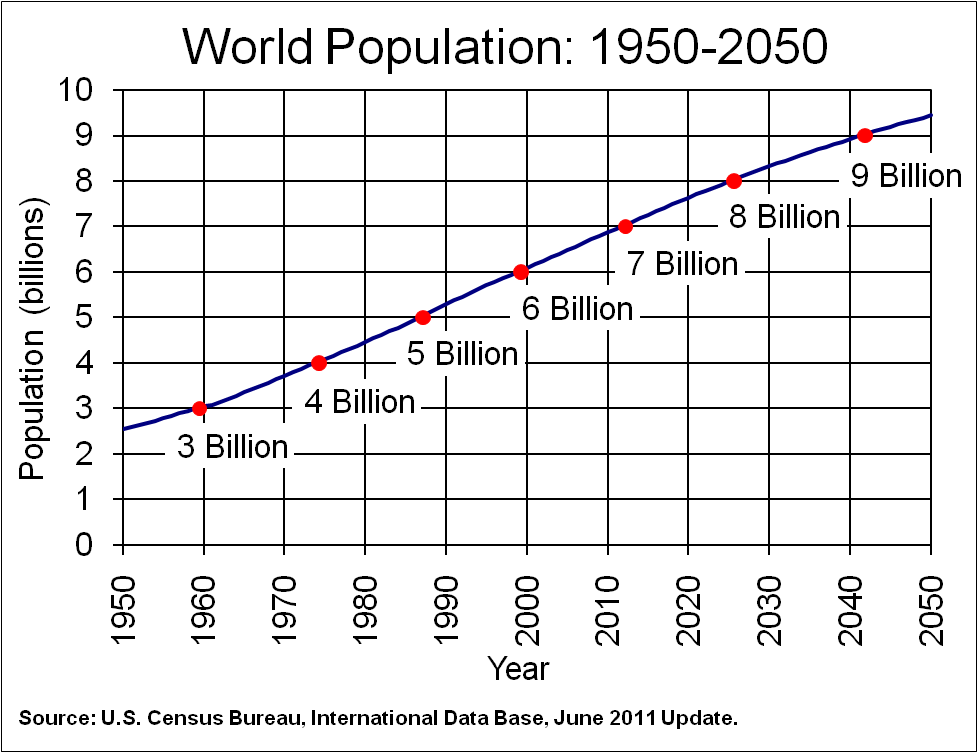
I’m going to ‘smack you in the face‘ with this population chart.

worldpop

To put that into context from a personal perspective, when I was born in 1944 the global population was 2.5 billion persons.  Some 4.7 billion fewer people than today!

But that prediction from the U.S Census Bureau in June, 2011 is already out of date!

Just a couple of weeks ago, the UN released this update:

13 June 2013 – The current world population of 7.2 billion is projected to increase by 1 billion over the next 12 years and reach 9.6 billion by 2050, according to a United Nations report launched today, which points out that growth will be mainly in developing countries, with more than half in Africa.

Now please humour me for a few moments. If the world population is presently 7.2 billion people and by 2050 the prediction is 9.2 billion people, that is an increase of 2,400,000,000 persons.

The end of 2050 is 438 months away. Now do the maths. That growth in population in that time period is the equivalent of an increase in population of 5,479,000 persons every single month!

Need to find a darkened room – I feel a headache coming on!

Returning to Nature

The power of serendipity!

Why the choice of this sub-heading?  Well, just because a number of quite separate articles and essays have come together to offer a powerful, cohesive argument for reconsidering the role of Nature in the future of mankind.

Of course, my use of words in that preceding sentence is completely ludicrous; the suggestion that ‘Nature’ is disconnected from ‘mankind’.  Yet millions of us, to a greater or lesser degree, do behave as if we are the masters of the world.

So let me dip into what has been ‘crossing my desk’ in recent times.

On May 28th, George Monbiot published in The Guardian newspaper an essay entitled A Manifesto for Rewilding the World.  (The link takes you to the article on the Monbiot blogsite.)  Here’s how that essay opened,

Until modern humans arrived, every continent except Antarctica possessed a megafauna. In the Americas, alongside mastodons, mammoths, four-tusked and spiral-tusked elephants, there was a beaver the size of a black bear: eight feet from nose to tail(1). There were giant bison weighing two tonnes, which carried horns seven feet across(2).

The short-faced bear stood thirteen feet in its hind socks(3). One hypothesis maintains that its astonishing size and shocking armoury of teeth and claws are the hallmarks of a specialist scavenger: it specialised in driving giant lions and sabretooth cats off their prey(4). The Argentine roc (Argentavis magnificens) had a wingspan of 26 feet(5). Sabretooth salmon nine feet long migrated up Pacific coast rivers(6).

During the previous interglacial period, Britain and Europe contained much of the megafauna we now associate with the tropics: forest elephants, rhinos, hippos, lions and hyaenas. The elephants, rhinos and hippos were driven into southern Europe by the ice, then exterminated around 40,000 years ago when modern humans arrived(7,8,9). Lions and hyaenas persisted: lions hunted reindeer across the frozen wastes of Britain until 11,000 years ago(10, 11). The distribution of these animals has little to do with temperature: only where they co-evolved with humans and learnt to fear them did they survive.

I’m not going to reproduce the bulk of the article; just hoped that I have tickled your curiousity sufficient for you to read it in full here. But will just show you how it closed:

Despite the best efforts of governments, farmers and conservationists, nature is already beginning to return. One estimate suggests that two thirds of the previously-forested parts of the US have reforested, as farming and logging have retreated, especially from the eastern half of the country(23). Another proposes that by 2030 farmers on the European Continent (though not in Britain, where no major shift is expected) will vacate around 30 million hectares (75 million acres), roughly the size of Poland(24). While the mesofauna is already beginning to spread back across Europe, land areas of this size could perhaps permit the reintroduction of some of our lost megafauna. Why should Europe not have a Serengeti or two?

Above all, rewilding offers a positive environmentalism. Environmentalists have long known what they are against; now we can explain what we are for. It introduces hope where hope seemed absent. It offers us a chance to replace our silent spring with a raucous summer.

Then further research for this post brought to light an interview with David Suzuki in February.  Widely reported, I picked the version published on Straight.com, from which comes:

In December, Canadian specialty TV channel Business News Network interviewed me about the climate summit in Copenhagen. My six-minute interview followed a five-minute live report from Copenhagen, about poor countries demanding more money to address climate change and rich countries pleading a lack of resources. Before and after those spots were all kinds of reports on the Dow Jones Industrial Average, the price of gold and the loonie, and the implications of some new phone technology.

For me, this brought into sharp focus the inevitable failure of our negotiating efforts on climate change. BNN, like the New York-based Bloomberg channel, is a 24-hour-a-day network focused completely on business. These networks indicate that the economy is our top priority. And at Copenhagen, money dominated the discussions and the outcome.

But where is the 24-hour network dealing with the biosphere? As biological creatures, we depend on clean air, clean water, clean soil, clean energy, and biodiversity for our well-being and survival. Surely protecting those fundamental needs should be our top priority and should dominate our thinking and the way we live. After all, we are animals and our biological dependence on the biosphere for our most basic needs should be obvious.

The economy is a human construct, not a force of nature like entropy, gravity, or the speed of light or our biological makeup. It makes no sense to elevate the economy above the things that keep us alive. But that’s what our prime minister does when he claims we can’t even try to meet the Kyoto targets because that might have a detrimental effect on the economy.

This economic system is built on exploiting raw materials from the biosphere and dumping the waste back into the biosphere. And conventional economics dismisses all the “services” that nature performs to keep the planet habitable for animals like us as “externalities”. As long as economic considerations trump all other factors in our decisions, we will never work our way out of the problems we’ve created.

Concluding:

Nature is our home. Nature provides our most fundamental needs. Nature dictates limits. If we are striving for a truly sustainable future, we have to subordinate our activities to the limits that come from nature. We know how much carbon dioxide can be reabsorbed by all the green things in the oceans and on land, and we know we are exceeding those limits. That’s why carbon is building up in the atmosphere. So our goal is clear. All of humanity must find a way to keep emissions below the limits imposed by the biosphere.

The only equitable course is to determine the acceptable level of emissions on a global per capita basis. Those who fall below the line should be compensated for their small carbon footprint while those who are far above should be assessed accordingly. But the economy must be aligned with the limits imposed by the biosphere, not above them.

Quite clearly, if we continue to turn our backs on Nature, the consequences won’t be long in tapping us on the shoulder.

So, going to close it today with this, seen nearly a month ago on the PRI website:

oooo

Plant a Tree

Trees — by Kristof Nordin May 27, 2013

angel-tree

Imagine the type of world we could see
If instead of saying ‘pray,’ we said, ‘plant a tree’.
With this one little change so much more could be done
To protect all living things found under the sun.

We could ‘plant a tree’ for our troops sent away into war
So when they return they’d come home to find more.
We could ‘plant a tree’ at our churches with our husband or wife
To praise the Creator through a celebration of life.

We could ‘plant a tree’ for the needy and for those with no food
We could even plant in public without seeming rude.
The government would not have to introduce rules,
And most likely we could ‘plant a tree’ at our schools.

If we took it to task to ‘plant trees’ for the poorest,
We would all soon be reaping the wealth of a forest.
We could plant freely with those of all religions and creeds,
The improvement of earth would be based on these deeds.

We could plant with our neighbours, our family, and friends,
And ‘plant a tree’ with our enemies to help make amends.
If we ‘plant a tree’ for the sick to show them we care,
We would also be healing the soil, water, and air.

We could ‘plant a tree’ to observe when two people wed,
And plant one with our kids each night before bed.
Throughout the history of the whole human race
We find respect for the ‘tree’ has always had a place.

The great Ash of the Norse was their tree of the World,
And on a tree in the Garden is where the serpent once curled.
It was in groves of Oaks that the Druid priests wandered,
And under the Bodhi where the great Buddha pondered.

In the Bible it’s clear that we have all that we need:
‘All the trees with their fruits and plants yielding seed’.
Despite all these lessons that the past has taught
Now days, it seems, we cut our trees without thought.

This is confirmed by the Koran, for in it we read:
‘Many are the marvels of earth, yet we pay them no heed’.
We all have a duty, no matter what nation
To perform our part in protecting Creation.

Just think what we’d have if we had picked up a spade
Every time each one of us bowed our heads and prayed.

Further Reading:

oooOOOooo

The theme continues tomorrow.

AGW – summing up.

“If there’s any doubt, there’s no doubt!”

I opened the first post on Monday with the sub-heading: “Certainty is perfect knowledge secure from error or doubt.” going on to write that, “Whatever your views on the effect of man’s behaviours on our planet’s climate, it’s a long way from the logical idea of ‘2 + 2‘!”

Within that very strict definition, I remain unmoved.  The argument that mankind is the cause of the present change in the climate of Planet Earth is not certain!

However, if only life was that simple! The change in our planet’s atmosphere is possibly the most emotionally-laden topic of all time.  For some reason that quotation attributed to Hiram Johnson comes to mind, “The first casualty when war comes is truth.” because the supporters and deniers of AGW are engaged in what amounts to a verbal war.

Each side can draw on much information.

For example, a very recent article in The New York Times by their Justin Gillis offered this:

The rise in the surface temperature of earth has been markedly slower over the last 15 years than in the 20 years before that. And that lull in warming has occurred even as greenhouse gases have accumulated in the atmosphere at a record pace.

The slowdown is a bit of a mystery to climate scientists. True, the basic theory that predicts a warming of the planet in response to human emissions does not suggest that warming should be smooth and continuous. To the contrary, in a climate system still dominated by natural variability, there is every reason to think the warming will proceed in fits and starts.

But given how much is riding on the scientific forecast, the practitioners of climate science would like to understand exactly what is going on. They admit that they do not, even though some potential mechanisms of the slowdown have been suggested. The situation highlights important gaps in our knowledge of the climate system, some of which cannot be closed until we get better measurements from high in space and from deep in the ocean.

As you might imagine, those dismissive of climate-change concerns have made much of this warming plateau. They typically argue that “global warming stopped 15 years ago” or some similar statement, and then assert that this disproves the whole notion that greenhouse gases are causing warming.

Rarely do they mention that most of the warmest years in the historical record have occurred recently. Moreover, their claim depends on careful selection of the starting and ending points. The starting point is almost always 1998, a particularly warm year because of a strong El Niño weather pattern.

Dan Gomez, a long-time friend of over 40 years and a regular contributor to items on Learning from Dogs, wrote in a recent email,

I’m not sure what is meant by “believer”, Paul.  The Universe unfolds as it should.  Because many have been led to “believe” that AGW is inevitable and that all the facts are the ‘Truth”, we’ve created a religious substitute, almost a new “industry” with significant “tithing” obligations, etc. (e.g. Cap and Trade). Presumptions and facts are being manipulated to fulfill the prophecy.

Interesting to note in our daily lives, that weather prediction is very good 24-36 hrs out.  This drops precipitously just a few days out.  More than 7-10 days is nearly impossible. Even though both Europe and the USA have decreased CO2 levels by multiple percentage points over the last 20 years, the rest of the world does not care and the impact is very problematic.  Recently, CO2 gas has increased overall but heat has not. In the past, warming has occurred followed by CO2 levels increasing. Global politics and redistribution of wealth schemes continue to interfere with common sense.

Let’s just deal with the facts as Science reveals its secrets. New information is discovered every day about the interaction of the  Earth/Sun/Atmosphere/Lithosphere/Hydrosphere. New information is learned every day about the Universe.  These are not closed subjects. Climatology, meteorology, geology and solar system dynamics will continue to shape the Earth’s future for millennia to come whether Man is involved or not.

There is much in what Dan writes that has me nodding my head; stimulates my recollection of what Luther Haave and Derek Alker wrote in 2009:

With the explosion of knowledge, particularly in the past 100 years, each of us has found it a requirement for being successful, and to being able to earn a living, to concentrate our knowledge in an ever increasingly narrow field. Just as we have come to expect others to defer to our expertise in our narrow area, we have come to assume that we need to defer to others who have a deeper comprehension of seemingly complex topics such as the science related to climate change. [Apologies, can’t find the web link for this.]

However, if we broaden the perspective from that tight definition of certainty to an analysis of probabilities, then it all changes for me and I can embrace the views so strongly put forward by Martin Lack.

For example, Martin left a comment on Monday, “ACD is not a matter of opinion or belief; it is a matter of probability. As such, all that matters now is the extremely high probability that the scientific consensus is real, reasonable and reliable.”  That comment included a link to a discussion on the website Skeptical Science, Is the science settled? Let me quote from that:

Some aspects of the science of AGW are known with near 100% certainty. The greenhouse effect itself is as established a phenomenon as any: it was discovered in the 1820s and the basic physics was essentially understood by the 1950s. There is no reasonable doubt that the global climate is warming. And there is also a clear trail of evidence leading to the conclusion that it’s caused by our greenhouse gas emissions. Some aspects are less certain; for example, the net effect of aerosol pollution is known to be negative, but the exact value needs to be better constrained.

What about the remaining uncertainties? Shouldn’t we wait for 100% certainty before taking action? Outside of logic and mathematics, we do not live in a world of certainties. Science comes to tentative conclusions based on the balance of evidence. The more independent lines of evidence are found to support a scientific theory, the closer it is likely to be to the truth. Just because some details are still not well understood should not cast into doubt our understanding of the big picture: humans are causing global warming.

In most aspects of our lives, we think it rational to make decisions based on incomplete information. We will take out insurance when there is even a slight probability that we will need it. Why should our planet’s climate be any different?

That, ultimately, delivers for me what truly counts.

I am not a scientist; just a Brit living in Southern Oregon trying to make sense of the world while I still have a functioning head and body – time is not on my side! 😉  The powerful common-sense in the sentence, “Outside of logic and mathematics, we do not live in a world of certainties.” is beyond argument.

In the year 2012, the total number of passengers carried by US Airlines and other carriers in and out of the USA was a staggering 815 million people. 815,000,000 people!

Remember the sub-heading from the start of this post!  “If there’s any doubt, there’s no doubt!” Years ago I heard that from Bob Derham, a long-time friend and a commercial airline Captain since the time God was a boy!  It’s that cautious, safety-focused attitude that has made airline transport such an amazing mode of transport for all those millions of passengers.

Should we not travel with the same cautious, safety-focused attitude on the ‘vehicle’ that carries every man, woman and child; every animal, plant and living thing: Planet Earth!

The answer is obvious – more than obvious!

AGW certainty, Part Two

Continuing the examination of two views on AGW.

Readers will recall that this post opened yesterday.  That Part One closed with Martin writing this:

Martin Lack

Much of what Oakwood writes is an attack upon the Hockey Stick graph of palaeoclimatic temperature reconstructions first produced in 1998 (MBH98).

However, the fatal flaws in Oakwood’s scepticism regarding MBH98 are as follows:

  1. MBH98 has been validated by at least 14 other reconstructions (as cited in IPCC AR4 in 2007) using a wide variety of other proxy data(see Wikipedia for relevant links)
  2. Hockey Stick-shaped graphs turn up in reconstructions of CO2 levels and temperature – now going back over thousands of years – because they are not ‘statistical noise’ –
  3. Arguments about splicing instrumental data onto proxy data only serve to challenge the extent to which the speed of late 20th Century warming is unprecedented.
  4. Such arguments do not invalidate the conclusion that it is now almost certainly warmer than it has been at any time since the last Ice Age (i.e. a period of relative climate and sea level stability that has made agriculture, urbanisation and civilisation possible).

However, this is no reason for us to be complacent because, as Oakwood must know, the 50 to 100 metres of sea level rise that will be caused by the melting of terrestrial ice sheets will necessitate the mass migration of millions of people. This makes his concerns about current poverty and starvation (i.e. the main reason he eventually cites for not believing action is yet necessary) look very trivial indeed.

So continuing ….

Oakwood

The argument that the ‘divergence problem’ does not bring into question proxy studies is just one example of supposed ‘settled’ evidence in the case for AGW. There are others which collectively bring down the case to one of opinion.

Martin Lack

After a lengthy attempt to assert that the “hide the decline” controversy was or is significant, Oakwood eventually moves onto attack the significance of MBH98; and to claim that ACD is no more than a matter of opinion. It is only possible to reach this conclusion by dismissing the majority of climate scientists as being stupid, sloppy, or sinister.

Oakwood

Here are a few others:

  • Mann et al’s original hockey stick (1998) (as well as a number of other studies) shows an unprecedented temperature rise in the first half of the 20th century, a temperature change that most climate scientists believe can be explained by natural phenomena, such as the Sun (while failing to reproduce the man-made rise in the 2nd half of the century, due to the divergence problem explained above).

Martin Lack

However, Climategate and, more especially Climategate 2.0 merely served to demonstrate how deliberate and organised are the attempts to discredit climate science and derail international attempts to tackle the ACD problem.

Oakwood

Thus, we are expected to believe there was both an unprecedented NATURAL temperature rise and unprecedented MAN-MADE rise in the same century. Not impossible, but statistically highly unlikely.

Martin Lack

Oakwood suggests that assertions about early 20th Century warming are statistically highly unlikely (i.e. that climate scientists are stupid to make them). However, the real statistically highly unlikely suggestion is that 30 years of monthly average temperatures exceeding their long-term average values could be a consequence of natural variation. Unlike early 20th Century warming, this is definitely not capable of being explained by natural causes (such as cyclical solar activity or random volcanic eruptions).

Oakwood

  • The ‘record’ (in just 35 years) of minimum summer ice in the Arctic is repeatedly presented as evidence for impending doom. However, the record MAXIMUM ice cover in the ANTarctic, at the same time, is dismissed with ‘we have another explanation for that’.

Martin Lack

Trying to shift the focus away from the accelerating rate of ice loss in the Arctic is very lame indeed. The Arctic is surrounded by land and (now) increasing amounts of warming water. The reasons for the ice loss are well understood and it is happening faster than was predicted even 5 years ago. The Antarctic is surrounded by a huge expanse of cold ocean and is also being kept cold by the human caused hole in the ozone layer. The reasons why its ice is not melting so fast are therefore also well understood. In addition, it should be noted that the Antarctic Peninsula is the fastest warming place in the southern hemisphere.

Oakwood

  • Whatever the weather, blame global warming. A few years ago, milder winters and earlier springs in the UK were hailed as evidence of AGW. But now we get lots of snow, and appalling spring, cooler summers, etc, and guess what, its due to global warming.
  • Hot/dry weather and floods around the world are routinely highlighted as ‘more evidence’ whereas as cold weather extremes and records are dismissed as ‘just natural variation’ – again, and again and again.

Martin Lack

Oakwood‘s remarks about extreme events are also very misleading. The number of records being broken for hot and/or dry events is many times greater than the number of records being broken for cold and/or wet events. As Hansen et al explained last year, in their review of historical data for the last five decades, natural variability does not explain the steady shift in average temperatures and the broadening of the range of conditions experienced in any one place.

I really can’t believe that Oakwood is so parochial in his outlook that he dares to mention the cold weather the UK has experienced recently. We may have had the coldest Spring for 50 years, but, that does not change the fact that global average temperatures are still the highest ever in recorded history. Furthermore, it does not change the fact that the analysis of Hansen et al (2012) continues to be validated by events such as those in Central Europe at the moment – where 1 in 100 year flood events have recurred after only 10 years. Not impossible – just statistically highly unlikely.

Oakwood

Those who highlight the lack of rising temperature for the past 10-15 years are routinely dismissed as deniers and liars. We’re told, ‘but the last decade is the warmest in a 100 years’. No-one disputes that. Given the world warmed by 0.8 degC in 100 years, that’s perfectly reasonable, and is not a defence against the fact that warming has at least paused.

  • We’re told: ‘but the heat is going into the ice caps and the deep oceans and atmospheric heat is just a small percentage of the total’, How convenient. In the 1980s and 1990s, atmospheric temperature was enough for ‘proof’ of serious AGW. We didn’t hear anything about ocean heat then. No-one suggested that perhaps the warming was due to a release of previously ‘hidden’ ocean heat. Or that we shouldn’t read too much into a small atmospheric temperature rise.
  • We see again and again, whatever happens, whatever the data show, the theory is revised to ‘show’ that nothing has changed. This is simply not plausible science.
  • We’re told, the physics of CO2-induced global warming is just that, ‘physics’, and we can’t change that however much we dispute it. No-one disputes the physics. But, the atmosphere (believe it or not) is very complicated. We have the physics that says aerosols reflect the Sun’s heat, that clouds may increase and also reflect more heat. We now hear the relationships with the oceans is very important (which we didn’t hear before). Thus the debate is not about the reality of the CO2-global warming physics. Its about the sensitivity of the system and which physical phenomena will dominate.

Martin Lack

Given the massive inertia in the climate system (which guarantees decades of future temperature rise even if CO2 emissions were completely halted today), there is no reason for us to be complacent about the fact that we have only seen a rise of 0.8C since the Industrial Revolution. The scientific consensus remains that equilibrium climate sensitivity is somewhere in excess of 2C and that such a rise in temperature will not be good for the vast majority of life on Earth. On the evidence of the ACD that we are already experiencing, I think there is very good reason to agree with that conclusion.

Again, I am astonished that Oakwood even dares to mention the ‘global warming has stopped’ canard. This misconception has been debunked so many times; there are even debates about who has written written the best rebuttals.  Here is a summary: Whilst surface warming may have paused, the warming of the ocean (which is driving the increased frequency of extreme weather events of all kinds) has continued. Given that oceans cover two thirds of the Earth’s surface, is this something really worth arguing about?

Climate scientists are therefore not changing their story to accommodate inconvenient new data. Only climate change sceptics do that. The only implausible science on offer today is that which seeks to explain all the data without acknowledging that CO2 is the main driver. Sure, CO2 does not explain everything but, you cannot explain all the data unless the primacy of CO2 is accepted.

Oakwood

Some will respond: ‘but all of these arguments have been debunked many times’. All they really mean is another opinion or speculation has been given by an AGW believer. Nothing wrong with these, but don’t claim they represent settled science.

Martin Lack

However, I should like to re-iterate the importance of the recently-published results of investigations at a lake in the NE of Arctic Russia. What this new 3.6 million year continuous palaeoclimatic record tells us is that current warmth is not unprecedented (if you go back to an era in which humans did not exist – 400 or 1,100 thousand years ago). This demonstrates that good scientists do not change their story when they get unexpected results.

Oakwood

I have no problem with scientists believing in AGW and believing it a serious threat. But when so much of their case is based on weak arguments, I do have a problem with claiming the case is ‘settled’ and that anyone who questions or challenges it is a liar, denier, conspiracy theorist, etc.

Both sides of the debate have their extremists and nutters. My interest is in the rational middle ground. To suggest an ‘eccentric’ like Christopher Monckton is ‘typical’ of all AGW-sceptics is just like claiming all Conservative voters are fascist and all Labour voters communist. It has no place in informed and educated debate.

Martin Lack

Oakwood claims arguments for concern over ACD are “weak” but, in making this assertion, the only information he has referred to is very much out-of-date (such as IPCC AR4 in 2007). Oakwood moves on to discuss unhelpful labels such as “liar” and “denier”.

I do not think I have ever suggested that anyone who professes to be ‘sceptical’ is lying. However, I do think that, just like the tobacco executives whose ‘modus operandi’ they are copying, the executives of fossil fuel companies know more than they care to admit. There is also a great deal of evidence to indicate that climate change ‘scepticism’ is in fact being driven by unscientific economists aided in their anti-science cause by a handful of friendly scientists who tell them what they want to hear. This is not scepticism, it is ideological prejudice.

Oakwood

The term “denier” was introduced with the intention of associating AGW-sceptics with Holocaust Deniers. That is to say, AGW-sceptics are putting millions of lives at risk through their lies and ignorance. Given the weakness of the AGW case, the use of the labels ‘denier’, ‘deny’, denial’ seems to represent an insult to every victim of the Holocaust.

Martin Lack

I agree that use of the term ‘denier’ is generally not helpful, but, given all the evidence that conflicts with their position, I do think that those who remain ‘sceptical’ about the primary cause of ongoing climate change are being irrational. If your beliefs require you to dismiss any and all evidence that conflicts with them, that is not scepticism, it is wilful blindness; it is what Young Earth Creationists have to do in order to protect themselves from wicked and ungodly scientific ideas.

Therefore, even if Oakwood does not do it, many who are ‘sceptical’ do rely upon conspiracy theories to dismiss all the evidence that conflicts with their beliefs. This includes dismissing most scientists as stupid, sloppy or sinister.

Oakwood

And why is it not time to act now? I am an environmentalist and see many environmental and social problems that need addressing. In particular, the need for ‘sustainability’ in all we do. There remain millions dying each year from such things as malnutrition, lack of safe drinking water, malaria, etc.

These are hard facts with zero room for any doubt. Given the weakness in the AGW-case, it is not a priority. I see some benefits in acting. For example, in many cases a reduction in CO2 emissions leads to much improved energy-efficiency, and less pollution. However, the case is not made for diverting money and effort from the more immediate priorities, covering pristine countryside in wind farms to satisfy urban energy demands, or using more biofuels at the expense of more hunger.

Martin Lack

Having wasted so much time trying to falsify MBH98, Oakwood finally gets round to the important bit of my question: Why does he think the time to act has not yet arrived?

Failing to address the point that a wide range of industrial, political and economic organisations now agree that it is time to act, Oakwood opts instead to simply re-state his belief that attempts to mitigate the ACD problem will do more harm than good. All the evidence I have seen suggests that he is mistaken. To-date, I think the most compelling evidence is that contained in the IIED’s 2009 report , ‘Assessing the costs of Adaptation to Climate Change: A review of UNFCCC and other recent estimates’ (PDF available here), which begins with the following very sobering executive summary:

Several recent studies have reported adaptation costs for climate change, including for developing countries. They have similar-sized estimates and have been influential in discussions on this issue.

However, the studies have a number of deficiencies which need to be transparent and addressed more systematically in the future. A re-assessment of the UNFCCC estimates for 2030 suggests that they are likely to be substantial under-estimates. The purpose of this report is to illustrate the uncertainties in these estimates rather than to develop new cost estimates, which is a much larger task than can be accomplished here.

The main reasons for under-estimation are that: (i) some sectors have not been included in an assessment of cost (e.g. ecosystems, energy, manufacturing, retailing, and tourism); (ii) some of those sectors which have been included have been only partially covered; and (iii) the additional costs of adaptation have sometimes been calculated as ‘climate mark-ups’ against low levels of assumed investment. In some parts of the world low levels of investment have led to a current adaptation deficit, and this deficit will need to be made good by full funding of development, without which the funding for adaptation will be insufficient. Residual damages also need to be evaluated and reported because not all damages can be avoided due to technical and economic constraints.

There is an urgent need for more detailed assessments of these costs, including case studies of costs of adaptation in specific places and sectors.

Oakwood

Thus, belief in AGW is not a simple moral argument which some would want to believe – good vs evil, or capitalist vs environmentalist, etc.

Martin Lack

Oakwood says he does not think this is a good-vs- evil or a capitalist-vs- environmentalist issue. I would agree. However:

  • I am not the one who is allowing my political beliefs to prejudice my approach to the science;
  • I am not the one who is accusing most scientists of being stupid, sloppy or sinister in order to dismiss what they are telling me; and
  • I am not the one changing my story or my preferred argument whenever something I have formerly relied upon is shown to be unreasonable.

Although it is a shame that he is part of a minority within the UK’s current Coalition Government, I will conclude by quoting from a recent speech by the Secretary of State for Energy and Climate Change, Edward Davey:

Of course there will always be uncertainties within climate science and the need for research to continue… We make progress by building on what we know, and questioning what we don’t. But some sections of the press are giving an uncritical campaigning platform to individuals and lobby groups who reject outright the fact that climate change is a result of human activity. Some who even deny the reality of climate change itself… By selectively misreading the evidence, they seek to suggest that climate change has stopped so we can all relax and burn all the dirty fuel we want without a care…

Oakwood says he opposes action to curb ACD because there are bigger problems we need to solve. If this were likely to be true, it would be an admirable position to take. Unfortunately, the bulk of the evidence suggests that ACD is a problem unlike any other and, unless we make serious attempts to minimise it, its consequences will dwarf all other problems we face.

This is because basic physics tells us that allowing the Earth to warm up will cause terrestrial ice to melt and sea levels to rise. It was predicted and it is now happening. The time to act to stop it is now. Millions of people cannot and will not adapt to having their land and their cities submerged under water.

oooOOOooo

Well I think that the agreement of Oakwood and Martin to set out their positions is fabulous and very worthy.

If readers will forgive me, tomorrow I will offer my own personal reflections on what has been offered by Martin and Oakwood today and yesterday.

Exploring the certainty of AGW!

“Certainty is perfect knowledge secure from error or doubt.”

You may wonder what this post is all about opening, as it does, with a definition of ‘certainty’.

What that definition might imply is that ‘certainty’ is a tantalising ‘will of the wisp’ creature.  Excepting for pure mathematics, of course! “Pure mathematics is, in its way, the poetry of logical ideas.” – Einstein quotation.

Whatever your views on the effect of man’s behaviours on our planet’s climate, it’s a long way from the logical idea of ‘2 + 2‘!  So when Oakwood, a reader of Learning from Dogs, submitted a long, carefully written comment rejecting Anthropogenic Global Warming (AGW), the idea came to me that perhaps this comment should stand on its own two feet, so to speak, as a separate post.  I asked Martin Lack, a passionate believer in AGW, to counter the points set out by Oakwood.  Both Martin and Oakwood are scientists; both hydrogeologists.

Now please take a moment to read and assimilate the next few sentences.  The length of the ‘dialogue’ runs to two posts.  Making it without question the longest post that has ever been published on Learning from Dogs.  It is also the most important!  If there is one question above all others for these times, it is the question of whether or not mankind is changing the climate of this planet; the only one we have.

These posts are not an easy read.  They can’t be skim read. They don’t have pictures! But I hope with all my heart that you will settle down today and tomorrow and read each post carefully to the end.

Now to some background information on the two gentlemen.  ‘Oakwood’ is a nom-de-plume.  However, he and I have exchanged emails and I support his need for anonymity. This is how Oakwood describes himself:

  • I am an Earth systems scientist
  • I have followed the AGW scientific arguments on both sides for many years
  • Hydrogeology (my field) and climate science have quite a lot in common, the main one being they require some knowledge and expertise in a wide range of disciplines. It’s not a simple case of saying ‘you are an expert or not’.
  • For example, I need to know quite a bit about chemistry, although I am not an ‘expert chemist’.
  • I am experienced in studying long-time period data, and judging its credibility (this also in common with climate science). Many of the key AGW arguments are based on data and statistics.
  • There are many reasons for being an AGW-sceptic, needing many pages. I give one main example: The ‘divergence problem’ applies to tree ring proxy temperature graphs. Most (perhaps all), proxy graphs cannot reproduce modern temperature data from about the 1980s onwards (in fact the very period of detectable man-made global warming). Because of this, we cannot rely on proxy graphs to conclude now is warmer than the past. Although climate scientists claim the divergence problem is only a modern thing, and does not affect historic data, this is purely a statement or belief. There is no convincing science to back that view.
  • For that reason, I am sceptical of the value of proxy graphs to show current temperatures are unprecedented.
  • I list a number of other brief examples.
  • I do not believe in conspiracy theories and have no problem with climate scientists believing in AGW. But in view of the examples I give, I do have a problem in them saying ‘the science is settled’.
  • There are some benefits from acting on the AGW scare now, such as improved energy efficiency and reduced pollution. There are also negatives, such as wind-farms on pristine countryside and biofuels causing increased hunger.
  • Too much focus on the AGW threat (based on relatively weak scientific arguments) diverts effort and money from more immediate and certain problems.
  • I am an environmentalist who cares about the future of our planet and sustainability. My views on AGW are based purely on the science.

Martin‘s background is encapsulated on his Blog, from which I extract:

I have 25 years of professional work experience, as a geologist and hydrogeologist, in both public and private sectors.

Education:
St Albans School, Hertfordshire, 1976-1983.
BSc (Hons) in Geology (Portsmouth), 1983-1986.
MSc in Hydrogeology (Birmingham), 1989-1990.
Postgrad. Cert. in Education (Keele), 1998-1999.
MA in Environmental Politics (Keele), 2010-2011.

Professional Qualifications:
Fellow of the Geological Society (FGS) since 1992.
Chartered Geologist (CGeol) since 1998.
Member of Chartered Institution of Water and Environmental Management (MCIWEM) since 2000.

Martin’s MA dissertation topic was “A Discourse Analysis of Climate Change Scepticism in the UK“  An abstract of that dissertation may be read here.

So two highly professional persons with diametrically different views.  Here’s the ‘debate’.

oooOOOooo

Oakwood

I have been posed a couple of questions [by Martin Lack, Ed.] which Paul has invited me to respond to.

  1. Why do you think the vast majority of relevantly-qualified and active researchers in earth systems science have reached the conclusion that we need to stop pumping CO2 into the atmosphere as fast as we possibly can because it will get harder to avoid excessive climate change the longer we take to do so?
  2.  Explain why you think the time to act has not yet arrived?

If I may, I’m going to treat those questions more like this:

  1. Why do the majority of climate scientists claim to believe man-made climate change (AGW)  is significant and serious?
  2. Why am I an AGW-sceptic?

Martin Lack

I am grateful to Paul for inviting me to respond to Oakwood’s thesis.

My carefully constructed question was:

Why do you think the vast majority of relevantly-qualified and active researchers in earth systems science have reached the conclusion that we need to stop pumping CO2 into the atmosphere as fast as we possibly can because it will get harder to avoid excessive climate change the longer we take to do so?

I am very pleased to see that Oakwood does not dispute the reality of a scientific consensus regarding AGW although I prefer – because it is more accurate – to call it anthropogenic climate disruption (ACD). Sadly, however, he does not appear to accept its validity. Although I asked Oakwood not to deconstruct the question, he clearly felt it necessary to both deconstruct it and re-word it (emphasis here is mine):

  1. Why do the majority of climate scientists claim to believe man-made climate change is significant and serious?
  2. Why am I an AGW-sceptic?

Right from the start, therefore, Oakwood appears to suggest that the majority of climate scientists are either being stupid, unprofessional, or deceitful. I say this because, by replacing my “have reached the conclusion” with his “claim to believe”, Oakwood would appear to think that the majority of climate scientists have reached a conclusion that is:

  1. Reasonable when it is in fact unreasonable; or
  2. Highly-probable when it is highly-improbable; or
  3. Near-certain when they know it is very uncertain.

Bearing this in mind, let us look at the arguments Oakwood then uses to justify his ‘scepticism’.

Oakwood

I am an ‘earth-systems’ scientist with degrees in Geophysics and Hydrogeology and around 25 years working experience in both those fields, but mostly hydrogeology.

Note: working scientists are every bit as important to our advancement as academics and researchers. Academia is a career choice available to the better scientists. (Though a few ‘duds’ manage to survive by playing the right games.) But many excellent scientists and engineers choose to work in the ‘real world’ where science is applied which often includes active research, written up in reports, but not necessarily in peer-reviewed journals. Those scientists and engineers often have a far more immediate level of responsibility in terms of the quality and implications of their work.

If an academic ‘gets it wrong’, the worst things that may happen are embarrassment, loss of research grant or even loss of job. If a working scientist or engineer gets it wrong, then bridges may collapse, planes may crash, people may be poisoned, etc. Also ‘peer review’ doesn’t mean its right, but just that it adds to the debate.

I have followed the scientific debate for many years, reading much that is written on both sides, including a big proportion of the IPCC reports.

Martin Lack

Oakwood starts by attacking academics for being detached from the real world and suggesting that some  may be “duds” that are just playing games, (although he does not say whom exactly)!

He then attacks the peer review process but fails to provide any reasonable explanation as to why only 24 out of nearly 14 thousand articles about ongoing climate change do not consider human activity to be its primary cause (unless the science is of course near certain).

Oakwood claims to have read a big proportion of IPCC reports (more than me I suspect) but, even so, fails to address the reality that IPCC reports have consistently under-reported the scale and urgency of the problems we face. The AR5 report due out later this year will also do this because it still does not include positive feedback mechanisms causing current rates of change to accelerate.

Oakwood

Very much like hydrogeology, climate science is a multi-disciplinary science dependent on a level of knowledge and expertise in a whole range of disciplines. For example, I need to understand quite a lot about chemistry, although I don’t have a degree in chemistry.

I have to keep learning; by reading, researching, learning from expert colleagues, etc. I also need to know something of maths, statistics, fluid mechanics, weather patterns, computer modelling, microbiology, water treatment, etc.

There are better experts in each one of those subject areas, but that’s their focus and they would not normally be able to pull things together to develop a ‘conceptual model’ of a hydrogeological system.

Martin Lack

Oakwood highlights the similarities between hydrogeology and climate science but fails to mention that both make extensive use of probabilistic computer models (of the kind used by climate scientists). These are models that deal with uncertainty in modelled parameters by being run hundreds if not thousands of times using parameter values picked at random from within user-defined ranges. This produces a range of modelled outcomes with accompanying probabilities of being realised.

Oakwood

There is much overlap between scientific disciplines, especially in ‘Earth systems’. Therefore, to suggest you must be a ‘climate scientist’ to understand all of the scientific and statistical arguments, is incorrect. For example, the hockey stick tree ring studies are principally statistical exercises rather than ‘climate science’, and require an understanding of how the Earth’s climate has changed in the past, which geologists are only too aware of.

As a hydrogeologist, I am very experienced in studying time-series data, and judging whether conclusions drawn from them are plausible and reliable. Of course, my conclusions may not always be correct. Others may disagree with me. But that’s how science develops.

It would take me pages to explain all my reasons for being an AGW-sceptic, so instead I will focus on one key example of where I find a key conclusion unreliable.

THE DIVERGENCE PROBLEM IN TREE-RING TEMPERATURE PROXY STUDIES

I will refer to a ‘typical’ paper by Michael Mann et al, 2008, Proxy-based reconstructions of hemispheric and global surface temperature variations over the past two millennia, Proceedings of the National Academy of Sciences of the United States of America – PNAS.

Its main conclusions are:

Recent warmth appears anomalous for at least the past 1,300 years whether or not tree-ring data are used. If tree-ring data are used, the conclusion can be extended to at least the past 1,700 years, but with additional strong caveats. The reconstructed amplitude of change over past centuries is greater than hitherto reported, with somewhat greater Medieval warmth in the Northern Hemisphere, albeit still not reaching recent levels.

Thus, they claim their work shows current temperatures are unprecedented in at least the past 1,300 years, including the Medieval Warm Period (MWP). This is extremely important. If current temperatures are not warmer than the MWP, then there is far less reason for alarm about the current climate. For example, we don’t have records of such things as droughts, hurricanes, tornadoes, etc.,  being noticeably worse or more common during the MWP. (I know, some will respond: ‘regardless of whether its warmer now, predictions are it will get much worse’. But that is a separate argument). Thus, it seems to be very important to the AGW-case that current temperatures are unprecedented, and changing more quickly than in the past 1,000 to 2,000 years.

Despite, their stated conclusions, their work does not show that now is warmer than the MWP. On their graphs in their Figure 3, current temperatures show as warmer. But the proxy data themselves do not show this. The only data that do are the instrumental data. So if proxy data do not align with instrumental data since the 1980’s onwards, how can we rely on them to show us the MWP was cooler than now? We can’t.

They try to address this with the following statement:

The observed warming rises above the error bounds [ie., the highest possible temperature indicated by proxy data – my words] of the estimates during the 1980s decade, consistent with the known ‘‘divergence problem’’, wherein the temperature sensitivity of some temperature-sensitive tree-ring data appears to have declined in the most recent decades. Interestingly, although the elimination of all tree-ring data from the proxy dataset yields a substantially smaller divergence bias, it does not eliminate the problem altogether. This latter finding suggests that the divergence problem is not limited purely to tree-ring data, but instead may extend to other proxy records.

If you look around at other literature, despite what we hear about ‘settled science’ nobody knows the cause of the ‘divergence’ problem. There is only speculation that it might be something to do with modern air pollution or perhaps CO2 itself.

Here’s what SkepticalScience says:

The divergence problem is a physical phenomenon – tree growth has slowed or declined in the last few decades, mostly in high northern latitudes. The divergence problem is unprecedented, unique to the last few decades, indicating its cause may be anthropogenic. The cause is likely to be a combination of local and global factors such as warming-induced drought and global dimming. Tree-ring proxy reconstructions are reliable before 1960, tracking closely with the instrumental record and other independent proxies.

So, the proxies are “reliable before 1960’s”. But back until when? Around 1880, when temperatures were cooler. There is no evidence whatsoever that the proxies were reliable at other periods of higher temperatures. And we are expected to accept this as ‘settled science’.

In fact, it is possible the divergence problem happens every time it’s warmer. They certainly don’t know this is not the case. The real answer is from very basic statistics:

If the proxy data cannot reproduce the higher temperatures of today, we cannot rely on them to compare with other warmer periods in the past. I don’t care if 99.9% of climate scientists tell me this is acceptable science, I will not agree with them, unless they can produce convincing scientific evidence (not just speculation) to back it up.

(I’ve seen one very comical response more than once: ‘We don’t need recent proxy data to be accurate because we have instrumental data to tell us the temperature.’ For example, a John Havery Samuel says: “A technical concern with one proxy since 1960, when we have perfectly good temperature records already, is an irrelevance.” This COMPLETELY misses the point (and I don’t know whether through ignorance or deliberate distortion). Accurate proxy data today are needed, not to tell us the temperature, but to demonstrate that proxy data are reliable for understanding historical temperatures. That’s simple, basic science. )

Martin Lack

Much of what Oakwood writes is an attack upon the Hockey Stick graph of palaeoclimatic temperature reconstructions first produced in 1998 (MBH98).

However, the fatal flaws in Oakwood’s scepticism regarding MBH98 are as follows:

  1. MBH98 has been validated by at least 14 other reconstructions (as cited in IPCC AR4 in 2007) using a wide variety of other proxy data(see Wikipedia for relevant links)
  2. Hockey Stick-shaped graphs turn up in reconstructions of CO2 levels and temperature – now going back over thousands of years – because they are not ‘statistical noise’ –
  3. Arguments about splicing instrumental data onto proxy data only serve to challenge the extent to which the speed of late 20th Century warming is unprecedented.
  4. Such arguments do not invalidate the conclusion that it is now almost certainly warmer than it has been at any time since the last Ice Age (i.e. a period of relative climate and sea level stability that has made agriculture, urbanisation and civilisation possible).

However, this is no reason for us to be complacent because, as Oakwood must know, the 50 to 100 metres of sea level rise that will be caused by the melting of terrestrial ice sheets will necessitate the mass migration of millions of people. This makes his concerns about current poverty and starvation (i.e. the main reason he eventually cites for not believing action is yet necessary) look very trivial indeed.

oooOOOooo

Part two continues tomorrow.

G8 madness!

If it wasn’t so serious, it would be so funny!

I read a recent article posted by Rob Hopkins on the Transition Culture blogsite, a blog that I subscribe to.  Those who are unfamiliar with Rob, the Transition Culture site has his background, from which I quote this snippet:

Rob Hopkins, with a familiar Totnes building in the background.

Rob Hopkins brings humour, imagination and vision to the great challenges of our time, and argues that what is needed, above all else, at this time in history, is “engaged optimism”.  The rapidly-spreading Transition movement which he was pivotal in establishing, is an embodiment of that.  Nicholas Crane, presenter of BBC2’s recent ‘Town’ series, recently referred to Transition as “the biggest urban brainwave of the century”.

He is the co-founder of Transition Town Totnes and of the Transition Network. This grew out of many years experience in education, teaching permaculture and natural building, and setting up the first 2 year full-time permaculture course in the world, at Kinsale Further Education College in Ireland, as well as co-ordinating the first eco-village development in Ireland to be granted planning permission.

Anyway, back to the article.  It struck me as so absurd that I tried my hand at asking Rob for permission to republish.  Back, almost immediately, came his positive reply. Thank you, Rob.

Oh, and before going to Rob’s article, for those that, like me, are a bit rusty on the composition of the G8, here’s a Wikipedia extract:

The Group of Eight (G8) is a forum for the governments of the world’s eight wealthiest countries. The forum originated with a 1975 summit hosted by France that brought together representatives of six governments: France, West Germany, Italy, Japan, the United Kingdom, and the United States, thus leading to the name Group of Six or G6. The summit became known as the Group of Seven or G7 the following year with the addition of Canada. The G7, that is active even after the creation of the G8, is composed by 7 of 8 of the wealthiest countries on Earth (as net wealth and not GDP). In 1997, Russia was added to the group which then became known as the G8. The European Union is represented within the G8 but cannot host or chair summits.

Now without any further ado, here is that article.

oooOOOooo

12 Jun 2013

Why even the G8 prefer vibrant, diverse local economies really …

shop

If there was one picture that captured the times we are living through it is this.  It appeared on the BBC website recently with the following caption:

Kevin McGuire walks his dog past a vacant shop in Belcoo, Northern Ireland.  The empty shop is one of a number that have had graphics placed on the windows to make them look like working shops ahead of the G8 summit which takes place nearby later this month.  

Let’s take that a bit more slowly.  Here is a shop, one of many that has gone out of business due, among other things, to the growth-fixated policies of the G8, situated in a place G8 ministers will be driven past en route to their summit.  Rather than their being able to see how things are actually unfolding in the real world, the division and misery being caused by their approach to the economy, the windows have been plastered with stickers that present it as a fully-stocked, thriving shop.  As singer/comic Mitch Benn put it on BBC Radio 4′s The Now Show on Friday,  ”the last thing you’d want would be for a bunch of people meeting to fix the economy to see how bad the economy’s got”.

The BBC reported the story, giving a bit more information about it:

County Fermanagh’s district council sanctioned the fake retail units as part of a £1m makeover before it hosts the G8 summit. The event takes place on 17 and 18 June at the Lough Erne golf resort near Enniskillen.  The chief executive of Fermanagh District Council has defended the optical illusion.

“It was aimed at undeveloped sites at the entrance to the town and then right throughout the county in terms of the other towns and villages, looking at those vacant properties and really just trying to make them look better and more aesthetically pleasing,” says Brendan Hegarty

Here’s the thing that fascinated me most though.  It’s the kind of shop they chose to portray it as.  They didn’t print up large stickers that would present the shop as being a Tesco Metro, a Sainsbury’s Local, an Aldi perhaps, or even branch of one of the banks that contributed significantly to our getting into this mess in the first place.  They didn’t make one huge sticker, one false façade, that showed a new shopping precinct, glittering with all the usual chain stores that dominate every such precinct.  Or a Travelodge perhaps.  Rather they set out deliberately and in considerable detail to portray the kind of vibrant, local, independent business that has either become extinct, or which survives in spite of, rather than because of, the policies of the G8.  Here’s another one…

_68047523_oldladies

The windows are hung with delicious-looking hams, the display features meats and a whole range of delicious local produce, beautifully arranged.  Although the cut-and-paste nature of the graphic design rather gives the game away (the same arrangements of hams appear two or three times), what they are trying to portray here is that most endangered of species, the local, independent butcher.

In the mid-1990s there were 22,000 butchers in the UK, by 2010 there were just 6,553.  The independent butcher is making something of a spirited fightback though, although certainly not aided, in any sense, by the G8.  The butcher that would have occupied that shop no longer exists, most likely because a supermarket opened nearby and completely shifted the balance of the Belcoo economy (any readers from Belcoo who might like to write in and tell us what led to this shop’s demise would be most welcome).

The other day I spoke to Nick Sherwood of REconomy Herefordshire, who has co-ordinated the Herefordshire Economic Evaluation (the second such piece of work, the Totnes one already being published, and Brixton’s coming soon).  Our conversation will be published here soon, but one of the things that really struck me was the following:

We estimate that the top five major supermarkets in Herefordshire account for between 71% – 83% of all household expenditure on ‘brought home’ food and drink, or up to £180m annually. In addition, around £30m per year is spent in the smaller ‘chain’ supermarkets.

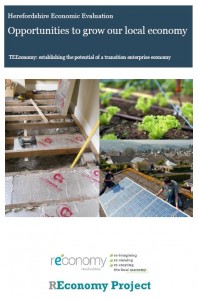
Herefordshire-EB-cover-198x300Their conclusion is that the true ‘local spend’ figure, i.e through local, independent businesses in Herefordshire, could be around 16% of the total.  In terms of a national version of that figure, the best I can find is the figure from the Portas Review that states that 8,000 supermarkets now account for over 97% of all UK grocery sales.  Although clearly other smaller supermarkets account for some of the remaining sales, let’s assume, for argument’s sake, that nationally, 3% of what we spend on groceries goes out through local and independent businesses.

I would imagine that everyone seeks an economy that is able to provide jobs, economic activity, stronger and happier communities and community resilience, while also skilfully reducing its carbon emissions on the scale required.  The question of our times though, as far as I’m concerned, is whether that is best achieved by expanding the 97% of our economy currently dominated by huge supermarkets, the kinds of enterprise that the UK government and the G8 see as leading the push for growth, or protecting and enhancing the 3%?

It’s a vital question, because at the moment the push to eradicate the 3% altogether, or at least squeeze it a lot harder, continues apace.  Yet that 3% is better suited to meeting those core needs of ours.  As the recent report by Localise West Midlands on ‘community economic development’ states:

Our research has found strong evidence that local economies with higher levels of SMEs and local ownership perform better in terms of employment growth (especially disadvantaged and peripheral areas), the local multiplier effect, social and economic inclusion, income redistribution, health, civic engagement and well-being than places heavily reliant on inward investment where there are fewer, larger, remotely owned employers.

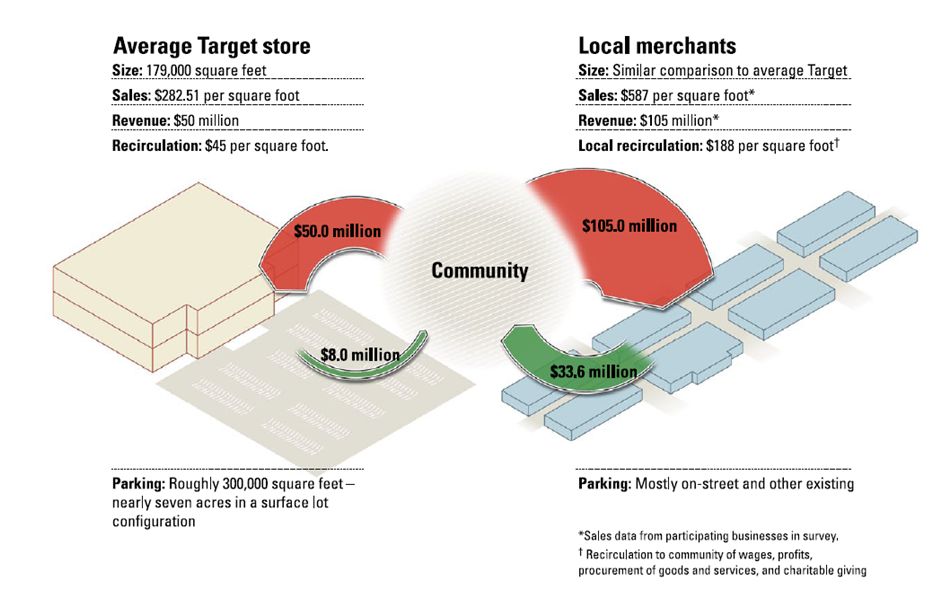
A study focusing on New Orleans compared 179,000 square feet of retail space that is home to 100 independent businesses to the same-sized space that is home to a single supermarket. The former generated $105 million in sales with $34 million staying in the local economy, while the latter generated $50 million in sales with just $8 million staying locally, and necessitated 300,000 square feet of parking space (see graphic below).

shops

Santander’s ‘Market of Hope’ which I wrote about here last year is a great example of how a city can be fed by looking at large retail spaces in such a way that they boost and support the local independent economy rather than undermine it. When Sir Terry Leahy, CEO of Tesco, was asked whether there was any alternative to supermarkets, replied:

“… queueing at one store than trudging down Watford High Street in the rain to another shop … is this what people actually want to go back to?”

But no, it’s not about “going back”, rather about going forward in a way that meets our needs rather than those of the City of London.  What we now know is that even G8 ministers would rather pass through High Streets populated with small, independent butchers, bakers, grocers, would rather see shop windows overflowing with delicious food,  trusting that the relationship they have built up with the shopkeeper over many years will mean that he/she stocks the best produce they can find.  It feels right.  It’s human scale.  It makes sense.  It’s an economy that is ours, it belongs to local people, to the local economy.  Even G8 ministers would now appear to prefer a shopping experience that actually involves interacting with other human beings rather than wandering anonymously around a superstore and then cashing yourself out at the end.

The core argument of The Power of Just Doing Stuff, published on Friday, is that if we really want to achieve our goals of jobs, economic activity, stronger and happier communities and community resilience, while also skilfully reducing our carbon emissions on the scale required, we’d be better off focusing on growing the 3% rather than the 97%.  It’s a pretty simple idea, and, to me at least, a blindingly obvious one, but that doesn’t mean it’s easy.

However, the experience is that this fightback has already begun.  The explosion of new bakeries, pop-up shops, community renewable energy projects, craft breweries, independent record shops, complementary currencies and communities acquiring their own assets is already happening around us, but it needs us to get behind it, to put our shoulders, our spending power, our sheer bloody will, to making it 10%, 30% 70%.  If we want a stable climate, reduced energy vulnerability, economic stability, and a healthy human culture, we really have no choice.  As Maria van der Hoeven of the IEA said recently at the launch of a World Energy Outlook Special Report, Redrawing the Energy-Climate Map, ”the path we are currently on is more likely to result in a temperature increase of between 3.6 °C and 5.3 °C”.

Fortunately, it’s a push that is life-enhancing, thrill-generating and in which we discover a resourcefulness, a kindness and a passion in ourselves that we may have forgotten was there.  I’ll leave you with a quote from the book, from Helen Cunningham of DE4 Food, a social enterprise food hub in Derbyshire that grew out of Transition Matlock.  The project grew from helping a local farmer with lambing and has grown into an innovative new business:

“Never in my life did I imagine that I’d be able to bring lambs into the world! It wasn’t a skill I ever expected to have. It was such a different thing from what we were doing in the rest of our lives, and I think from then we’ve all thought “OK, we can learn these new skills, we can learn how to lamb, we can learn how to grow vegetables and learn how to do Excel Profit and Loss sheets and whatever.” I think we all just really wanted to change the way we live, and change our own personal lives and to change things and live different lives ourselves as well as a different life in our community”.

You can pre-order your copy of The Power of Just Doing Stuff here.

oooOOOooo

As has been said before, and undoubtedly will be said many times more, it really is a very strange world we live in!

Common-sense from HRH The Prince of Wales

Reinforcing my long-time respect for Prince Charles.

HRH The Prince of Wales, more familiarly known as Prince Charles, is a man I have longed admired and respected.

Many years ago, I worked as a volunteer teacher/mentor with what was then known as The Prince’s Youth Business Trust (PYBT).  Later, it became incorporated into The Prince’s Trust.  The PYBT enjoyed passionate and active support from HRH, and with good cause.  Essentially, the PYBT offered socially-disadvantaged youngsters, who had very little chance of getting a job, the opportunity to be mentored on the skills of being an entrepreneur.  Many of those youngsters went on to get decent jobs and many others started their own businesses, some with considerable success.  Simply because thinking like an entrepreneur is impossible if you don’t have faith in your own abilities.  That self-confidence shows in so many walks of life, especially when one is going through a job interview!

The Prince has also long been known for his concerns over the way we treat our planet, going right back to the days when it was regarded rather quaint by the mainstream media.  But as Wikipedia reveals, “He has long championed organic farming and sought to raise world awareness of the dangers facing the natural environment, such as climate change. As an environmentalist, he has received numerous awards and recognition from environmental groups around the world.”

So it was lovely, but no great surprise, to see how well a recent speech was received on the subject of Regional Food Security given at Langenburg Castle in Baden-Wurttenberg, Germany.  The full text is available on The Prince of Wales website.  Let me give you a taste (whoops, pun unintended!) of what The Prince said,

Prinz Charles Langenburg

Ladies and Gentlemen, if I may say so, this is a very important conference. I am sure what you have heard so far about the problems we face and the obstacles to tackling them has given you a clear context in which to be able to consider what comes next this afternoon.

The aim here is to think through how we might create a much more local model of food production and distribution. But also, how that might fit with producing healthy food using far more sustainable methods and how we might do all of this without damaging business. Indeed, how this could improve business.

As you have heard, the urgency for this comes from the fact that there is not sufficient resilience in the system as it currently stands. It may appear that things are well. Big global corporations may appear to be prospering out of operating on a global monocultural scale but, as I hope you have seen, if you drill down into what is actually happening, things are not so healthy. Our present approach is rapidly mining resilience out of our food system and threatening to leave it ever more vulnerable to the various external shocks that are becoming more varied, extreme and frequent.

Some of the stories about food that have been making the news are simply disgraceful, if not downright madness.  Take this one: Meat scrap leftovers now being reprocessed into ice cream: The dismal future of food!

Or try this one: GMO feed turns pig stomachs to mush! Shocking photos reveal severe damage caused by GM soy and corn.

So see the relevance of The Prince’s speech as he continued:

The drive to make food cheaper for consumers and to earn companies bigger profits is sucking real value out of the food production system – value that is critical to its sustainability. I am talking here about obvious things like the vitality of the soil and local eco-systems, the quality and availability of fresh water and so on, but also about less obvious things, like local employment and people’s health. It is, as I fear you know only too well, a complex business.

The aggressive search for cheaper food has been described as a “drive to the bottom”, which I am afraid is taking the farmers with it. They are being driven into the ground by the prices they are forced to expect for their produce and this has led to some very worrying short cuts. The recent horsemeat scandals are surely just one example, revealing a disturbing situation where even the biggest retailers seem not to know where their supplies are coming from. And it has also led to a very destructive effect on farming. We are losing farmers fast. Young people do not want to go into such an unrewarding profession. In the U.K., I have been warning of this for some time and recently set up apprenticeship schemes to try to alleviate the problem; but the fact remains that at the moment the average age of British farmers is fifty-eight, and rising.

One more extract from the speech:

In the U.K., as elsewhere – but particularly I think in the U.S. – the consequences of this are ever more apparent in the deteriorating state of our public health. We all know that Type 2 Diabetes and other obesity-related conditions are rapidly on the increase. The public bill for dealing with these is already massive and I am told it could become completely unaffordable if we do not see a shift in emphasis. And, of course, it will be cities that carry the heaviest part of that burden. It is a peculiar trend.

Am I alone, ladies and gentlemen, in wondering how it is that those who are farming according to organic, or agro-ecological principles – in other words, sustainably, for the long-term, by operating in a way that reduces pollution and contamination of the natural environment to a minimum and maximizes the health of soil, biodiverse ecosystems and humanity – are then penalized? They find that their produce is considered too expensive and too “niche market” to be available to everyone. How is it, then, that systems of farming which do precisely the opposite – with increasingly dire and damaging effects on both the terrestrial and marine environments, not to mention long-term human health – are able to sell their products in mass markets at prices that in no way reflect the immense and damaging cost to the environment and human health? A cost that then has to be paid for over and over again elsewhere – chiefly, in all probability, by our unfortunate children and grandchildren, whose welfare I happen to care about. Surely this is a truly perverse situation which, you would have thought, could be turned on its head to make genuinely sustainably-produced food accessible to everyone, and the polluter to pay the real costs for the side effects of industrialized food? It is to be wondered at how this state of affairs persists – and yet to suggest standing it on its head and transforming the situation is to invite the predictable chorus of vitriolic accusations that you are anti-science, anti-progress, out of touch with commercial pressures and not living in the “real world.”

The full speech may be read here, and please do!

Well done, Sir!  As someone once said, “We are what we eat!

Looking into self.

Rounding off the week.

Starting with Monday’s video of Carl Sagan reminding us all that Planet Earth is just a grain of sand in the vast cosmos right through to yesterday’s Dealing with madness post, much of the week has been reminding us all of one very fundamental truth.  No better expressed than in a comment from Patrice Ayme [my emphasis]:

… there is no healthy man without a healthy world.

Regulars will have noted the high levels of debate this week.  Thank you all for those comments.

I have also received a couple of emails with feedback and comments, sent to me on a personal basis.  One of those emails had such a powerful message that I begged for permission to publish it on Learning from Dogs.  I was asked to keep the author’s identity private but, trust me, it is from someone I know well who subscribes to ideas of integrity and honesty in spades.

The author also strongly recommended publishing in association with his personal essay an extract from Chris Hedges’ book “Death of the Liberal Class”.  That extract follows straight on from the essay.

oooOOOooo

Reflections from a Vietnam Combat Veteran

War is an unnatural dichotomy.  Both sides are morally and materially diminished.  A future World War would most probably finish us as the self-appointed predominant intelligent species on planet earth.  It seems worth noting that German industrialists coordinated fundamentalist propaganda to foster the bigotry, hatred and fear which fueled their profitable war engines prior to World War II.

United States commercial media today reflects a financially dominated military-industrial culture with liberty and justice for sale.  The results are divisive and lead to both a declared international war against nebulous assailants we have been taught to dislike and an internal political war that has polarized our once fair nation.

We’ve stopped investing in the future in response to radicals who want to destroy government, human rights and what remains of the earth’s surface resources.  There is an emerging police state mentality on display with a variety of candidates for local dictator.

It’s well past time for moderate republicans to ignore their uber-conservative brethren.  It’s well past time for moderate democrats to renounce their corporate ties.  This will only happen when our financial and political leaders awaken to the reality of what is in the best long-term interests for all life on this planet rather than our present unsustainable global economy.

To complicate the problem, our planet is under attack by a swarm of vociferous human locusts seeking profit without regard to the consequences.  Meanwhile, despite human denial, the universe continues to emerge.  Species which do not adapt to change do not survive.

It’s important to remember that we’re in the midst of a battle that’s as old as the conscious awareness of the human species.  We generally have very little idea of the inclusive nature of our being; let alone the nature of our collective being as a species. We have as yet to learn how to surrender to reality.  The battle is with our own species.

Committing collective suicide for quarterly profit is not a sane way of life.  What we’ve created is a neo-feudal global economy without any foundation that feeds on an empire of consumption.  When we combine a neo-feudal economy with neo-fascist politics we arrive at a moral and biological dead end.

The coup d’état of the current Corporate State is the Citizen’s United ruling that makes money a form of free speech.  Money has no DNA.  In case anyone missed how the “occupy” movement was crushed, there’s no question that we’re rapidly criminalizing all forms of dissent.  These actions are being taking under the 1917 Espionage Act and related state secrets acts.  No discernment of moral value is considered and no public hearings are conducted.  People who speak up are locked up.  We’ve become a fearful and secretive population.

Our self-appointed elite power structure is completely irrational in its belief that human reason is our ultimate power and money is its servant.  We are made of the stuff of the stars.  At best, we’re in our adolescence as a species.  We think we know the answers rather than admitting our ignorance.  What little we know is vastly less than what we have as yet to learn.  We are often unaware of being unaware.

The lives we presently lead can not be sustained in ways that we have become accustomed to; ways we take for granted.  What’s going to need to change?  The simple answer is everything.  Our species has systemically corrupted the small part of the cosmos which sustains our being.  Nature has no sense of humor, no patience for human squabbles and no financial interest.

Fortunately, we already know what we need to do to adapt.  We know how nature works through the wisdom of our earth sciences.  The answer is simple.  Love the earth.  Love life.  Share compassion.  Educate, naturally energize, and transform.  The resulting process of change will help re-establish a realistic world economic foundation.

oooOOOooo

‘Death of the Liberal Class’

By Chris Hedges

From the book “Death of the Liberal Class,” by Chris Hedges.  Excerpted by arrangement with Nation Books, a member of the Perseus Books Group.  Copyright © 2010.

The following selection is taken from the first chapter of the book, published in October 201 by Nation Books.

In a traditional democracy, the liberal class functions as a safety valve. It makes piecemeal and incremental reform possible. It offers hope for change and proposes gradual steps toward greater equality. It endows the state and the mechanisms of power with virtue. It also serves as an attack dog that discredits radical social movements, making the liberal class a useful component within the power elite.

But the assault by the corporate state on the democratic state has claimed the liberal class as one of its victims. Corporate power forgot that the liberal class, when it functions, gives legitimacy to the power elite. And reducing the liberal class to courtiers or mandarins, who have nothing to offer but empty rhetoric, shuts off this safety valve and forces discontent to find other outlets that often end in violence. The inability of the liberal class to acknowledge that corporations have wrested power from the hands of citizens, that the Constitution and its guarantees of personal liberty have become irrelevant, and that the phrase consent of the governed is meaningless, has left it speaking and acting in ways that no longer correspond to reality. It has lent its voice to hollow acts of political theater, and the pretense that democratic debate and choice continue to exist.

The liberal class refuses to recognize the obvious because it does not want to lose its comfortable and often well-paid perch. Churches and universities—in elite schools such as Princeton, professors can earn $180,000 a year—enjoy tax-exempt status as long as they refrain from overt political critiques. Labor leaders make lavish salaries and are considered junior partners within corporate capitalism as long as they do not speak in the language of class struggle. Politicians, like generals, are loyal to the demands of the corporate state in power and retire to become millionaires as lobbyists or corporate managers. Artists who use their talents to foster the myths and illusions that bombard our society live comfortably in the Hollywood Hills.

The media, the church, the university, the Democratic Party, the arts, and labor unions—the pillars of the liberal class—have been bought off with corporate money and promises of scraps tossed to them by the narrow circles of power. Journalists, who prize access to the powerful more than they prize truth, report lies and propaganda to propel us into a war in Iraq. Many of these same journalists assured us it was prudent to entrust our life savings to a financial system run by speculators and thieves. Those life savings were gutted. The media, catering to corporate advertisers and sponsors, at the same time renders invisible whole sections of the population whose misery, poverty, and grievances should be the principal focus of journalism.

In the name of tolerance—a word the Rev. Dr. Martin Luther King Jr., never used—the liberal church and the synagogue refuse to denounce Christian heretics who acculturate the Christian religion with the worst aspects of consumerism, nationalism, greed, imperial hubris, violence, and bigotry. These institutions accept globalization and unfettered capitalism as natural law. Liberal religious institutions, which should concern themselves with justice, embrace a cloying personal piety expressed in a how-is-it-with-me kind of spirituality and small, self-righteous acts of publicly conspicuous charity. Years spent in seminary or rabbinical schools, years devoted to the study of ethics, justice, and morality, prove useless when it comes time to stand up to corporate forces that usurp religious and moral language for financial and political gain.

Universities no longer train students to think critically, to examine and critique systems of power and cultural and political assumptions, to ask the broad questions of meaning and morality once sustained by the humanities. These institutions have transformed themselves into vocational schools. They have become breeding grounds for systems managers trained to serve the corporate state. In a Faustian bargain with corporate power, many of these universities have swelled their endowments and the budgets of many of their departments with billions in corporate and government dollars. College presidents, paid enormous salaries as if they were the heads of corporations, are judged almost solely on their ability to raise money. In return, these universities, like the media and religious institutions, not only remain silent about corporate power but also condemn as “political” all within their walls who question corporate malfeasance and the excesses of unfettered capitalism.

Unions, organizations formerly steeped in the doctrine of class struggle and filled with members who sought broad social and political rights for the working class, have been transformed into domesticated negotiators with the capitalist class. Cars rolling off the Ford plants in Michigan were said to be made by UAW Ford. But where unions still exist, they have been reduced to simple bartering tools, if that. The social demands of unions in the early twentieth century that gave the working class weekends off, the right to strike, the eight-hour workday, and Social Security, have been abandoned. Universities, especially in political science and economics departments, parrot the discredited ideology of unregulated capitalism and have no new ideas. The arts, just as hungry as the media or the academy for corporate money and sponsorship, refuse to address the social and economic disparities that create suffering for tens of millions of citizens. Commercial artists peddle the mythical narrative, one propagated by corporations, self-help gurus, Oprah and the Christian Right, that if we dig deep enough within ourselves, focus on happiness, find our inner strength, or believe in miracles, we can have everything we desire.

Such magical thinking, a staple of the entertainment industry, blinds citizens to corporate structures that have made it impossible for families to lift themselves out of poverty or live with dignity. But perhaps the worst offender within the liberal class is the Democratic Party.

The party consciously sold out the working class for corporate money. Bill Clinton, who argued that labor had nowhere else to go, in 1994 passed the North American Free Trade Agreement (NAFTA), which betrayed the working class. He went on to destroy welfare and in 1999 ripped down the firewalls between commercial and investment banks to turn the banking system over to speculators. Barack Obama, who raised more than $600 million to run for president, most of it from corporations, has served corporate interests as assiduously as his party. He has continued the looting of the U.S. Treasury by corporations, refused to help the millions of Americans who have lost their homes because of bank repossessions or foreclosures, and has failed to address the misery of our permanent class of unemployed.

Populations will endure the repression of tyrants, as long as these rulers continue to manage and wield power effectively. But human history has demonstrated that once those in positions of power become redundant and impotent, yet insist on retaining the trappings and privileges of power, their subject populations will brutally discard them. Such a fate awaits the liberal class, which insists on clinging to its positions of privilege while at the same time refusing to play its traditional role within the democratic state. The liberal class has become a useless and despised appendage of corporate power. And as corporate power pollutes and poisons the ecosystem and propels us into a world where there will be only masters and serfs, the liberal class, which serves no purpose in the new configuration, is being abandoned and discarded. The death of the liberal class means there is no check to a corporate apparatus designed to enrich a tiny elite and plunder the nation. An ineffectual liberal class means there is no hope, however remote, of a correction or a reversal. It ensures that the frustration and anger among the working and middle classes will find expression outside the confines of democratic institutions and the civilities of a liberal democracy.

Our unsustainable way of life

The second of two essays reflecting the ‘New World Order’.

Yesterday, I introduced the first essay from Patrice Ayme.  Today, the second essay is a complete ‘copy and paste‘ as it appeared on TomDispatch.  The importance of such writers as Patrice Ayme, the authors that are published on TomDispatch, and many more besides, is beyond measure.  As the old saying goes, “The only thing required for evil to triumph is for good men to do nothing“.

So without further ado, here is that TomDispatch essay.

oooOOOooo

Tomgram: Mattea Kramer and Jo Comerford, Congress Tweeted While America Burned

Posted by Mattea Kramer and Jo Comerford at 10:11am, May 21, 2013.
Follow TomDispatch on Twitter @TomDispatch.

[Note for TomDispatch Readers: Those of you who were struck by the recent TD piece “You Are a Guinea Pig: How Americans Became Exposed to Biohazards in the Greatest Uncontrolled Experiment Ever Launched” shouldn’t miss last Sunday’s fascinating Bill Moyers interview with its authors, David Rosner and Gerald Markowitz, who have written the new book Lead Wars: The Politics of Science and the Fate of America’s Children. Tom]

Three days after the terrorist attacks of September 11, 2001, Congress passed a joint resolution called an Authorization for Use of Military Force (AUMF). You might remember it. In layman’s terms, it was a carte blanche for the Bush administration to go to war wherever it wanted, whenever it wanted, however it wanted, under the guise of fighting anyone who “planned, authorized, committed, or aided” the September 11th attackers, or “harbored” any terrorists or terror organizations connected to the attacks. That document, more than any other, launched the Global War on Terror or GWOT. President Obama long ago ditched the name and acronym, but he kept the global war.

And don’t expect that to change. On Thursday, Assistant Secretary of Defense Michael Sheehan went before Congress and insisted that the Defense Department couldn’t be more “comfortable” with AUMF, as it was written, and that not a word should be altered or amended for changed circumstances. The Pentagon was so comfortable, in fact, that its officials foresee using that resolution to continue its drone-powered “dirty wars” in the Greater Middle East and Africa for years to come. “In my judgment,” Sheehan said, “this is going to go on for quite a while, yes, beyond the second term of the president… I think it’s at least 10 to 20 years.”

So there you have it. The military got its blank check for overseas wars, for sending out the drones and the special operations forces, and has no plans to change that before 2023, if not 2033. In other words, for at least the next decade, the GWOT, whatever label it’s given, will continue to be the central fixture of American foreign policy.  It’s not going anywhere. Today, TomDispatch regulars Mattea Kramer and Jo Comerford of the invaluable National Priorities Project look at the “homeland” a decade into the future, as the effects of Congress’s austerity policies sink in. Put the two together and what a grim scene you have: a country investing in war in distant lands as it crumbles here at home. Andy Kroll

How America Became a Third World Country 
2013-2023 
By Mattea Kramer and Jo Comerford

The streets are so much darker now, since money for streetlights is rarely available to municipal governments. The national parks began closing down years ago. Some are already being subdivided and sold to the highest bidder. Reports on bridges crumbling or even collapsing are commonplace. The air in city after city hangs brown and heavy (and rates of childhood asthma and other lung diseases have shot up), because funding that would allow the enforcement of clean air standards by the Environmental Protection Agency is a distant memory. Public education has been cut to the bone, making good schools a luxury and, according to the Department of Education, two of every five students won’t graduate from high school.

It’s 2023 — and this is America 10 years after the first across-the-board federal budget cuts known as sequestration went into effect.  They went on for a decade, making no exception for effective programs vital to America’s economic health that were already underfunded, like job training and infrastructure repairs. It wasn’t supposed to be this way.

Traveling back in time to 2013 — at the moment the sequester cuts began — no one knew what their impact would be, although nearly everyone across the political spectrum agreed that it would be bad. As it happened, the first signs of the unraveling which would, a decade later, leave the United States a third-world country, could be detected surprisingly quickly, only three months after the cuts began. In that brief time, a few government agencies, like the Federal Aviation Administration (FAA), after an uproar over flight delays, requested — and won — special relief.  Naturally, the Department of Defense, with a mere $568 billion to burn in its 2013 budget, also joined this elite list. On the other hand, critical spending for education, environmental protection, and scientific research was not spared, and in many communities the effect was felt remarkably soon.

Robust public investment had been a key to U.S. prosperity in the previous century. It was then considered a basic part of the social contract as well as of Economics 101. As just about everyone knew in those days, citizens paid taxes to fund worthy initiatives that the private sector wouldn’t adequately or efficiently supply. Roadways and scientific research were examples. In the post-World War II years, the country invested great sums of money in its interstate highways and what were widely considered the best education systems in the world, while research in well-funded government labs led to inventions like the Internet. The resulting world-class infrastructure, educated workforce, and technological revolution fed a robust private sector.

Austerity Fever

In the early years of the twenty-first century, however, a set of manufactured arguments for “austerity,” which had been gaining traction for decades, captured the national imagination. In 2011-2012, a Congress that seemed capable of doing little else passed trillions of dollars of what was then called “deficit reduction.” Sequestration was a strange and special case of this particular disease.  These across-the-board cuts, instituted in August 2011 and set to kick in on January 2, 2013, were meant to be a storm cloud hanging over Congress. Sequestration was never intended to take effect, but only to force lawmakers to listen to reason — to craft a less terrible plan to reduce deficits by a wholly arbitrary $1.2 trillion over 10 years. As is now common knowledge, they didn’t come to their senses and sequestration did go into effect. Then, although Congress could have cancelled the cuts at any moment, the country never turned back.

It wasn’t that cutting federal spending at those levels would necessarily have been devastating in 2013, though in an already weakened economy any cutbacks would have hurt. Rather, sequestration proved particularly corrosive from the start because all types of public spending — from grants for renewable energy research and disadvantaged public schools to HIV testing — were to be gutted equally, as if all of it were just fat to be trimmed. Even monitoring systems for possible natural disasters like river flooding or an imminent volcanic eruption began to be shut down.  Over time the cuts would be vast: $85 billion in the first year and $110 billion in each year after that, for more than $1 trillion in cuts over a decade on top of other reductions already in place.

Once lawmakers wrote sequestration into law they had more than a year to wise up. Yet they did nothing to draft an alternate plan and didn’t even start pointing out the havoc-to-come until just weeks before the deadline. Then they gave themselves a couple more months — until March 1, 2013 — to work out a deal, which they didn’t.  All this is, of course, ancient history, but even a decade later, the record of folly is worth reviewing.

If you remember, they tweeted while Rome burned. Speaker of the House John Boehner, for instance, sent out dozens of tweets to say Democrats were responsible: “The president proposed sequester, had 18 mo. to prioritize cuts, and did nothing,” he typically wrote, while he no less typically did nothing. For his part, Senate Majority Leader Harry Reid tweeted back: “It’s not too late to avert the damaging #sequester cuts, for which an overwhelming majority of Republicans voted.” And that became the pattern for a decade of American political gridlock, still not broken today.

Destruction Begins

March 1st came and went, so the budgetary axe began to fall.

At first, it didn’t seem so bad. Yes, the cuts weren’t quite as across the board as expected. The meat industry, for example, protested because health inspector furloughs would slow its production lines, so Congress patched the problem and spared those inspectors. But meat production aside, there was a sense that the cuts might not be so bad after all.

They were to be doled out based on a formula for meeting the arbitrary target of $85 billion in reductions in 2013, and no one knew precisely what would happen to any given program. In April, more than a month after the cuts had begun, the White House issued the president’s budget proposal for the following year, an annual milestone that typically included detailed information about federal spending in the current year. But across thousands of pages of documents and tables, the new budget ignored sequestration, and so reported meaningless 2013 numbers, because even the White House couldn’t say exactly what impact these cuts would have on programs and public investment across the country.

As it happened, they didn’t have to wait long to find out. The first ripples of impact began to spread quickly indeed. Losing some government funding, cancer clinics in New Mexico and Connecticut turned away patients. In Kentucky, Oregon, and Montana, shelters for victims of domestic violence cut services. In New York, Maryland, and Alabama, public defenders were furloughed, limiting access to justice for low-income people. In Illinois and Minnesota, public school teachers were laid off. In Florida, Michigan, and Mississippi, Head Start shortened the school year, while in Kansas and Indiana, some low-income children simply lost access to the program entirely. In Alaska, a substance abuse clinic shut down. Across the country, Meals on Wheels cut four million meals for seniors in need.

Only when the FAA imposed furloughs on its air traffic controllers did public irritation threaten to boil over. Long lines and airport delays ensued, and people were angry. And not just any people — people who had access to members of Congress.  In a Washington that has gridlocked the most routine business, lawmakers moved at a breakneck pace, taking just five days to pass special legislation to solve the problem. To avoid furloughs and shorten waits for airline passengers, they allowed the FAA to spend funds that had been intended for long-term airport repairs and improvements.

Flights would leave on time — at least until runways cracked and crumbled.  (You undoubtedly remember the scandal of 2019 at Cincinnati International Airport, when a bright young candidate for Senate met her demise in a tragic landing mishap.)

And then, of course, the Pentagon asked for an exemption, too. We’re talking about the military behemoth of planet Earth, which in 2013 accounted for 40% of military spending globally, its outlays exceeding the next 10 largest militaries combined.  It, too wanted a special exemption for some of its share of the cutbacks.

Meat inspectors, the FAA, and the Department of Defense enjoyed special treatment, but the rest of the nation was, as the history books recount, not so lucky. Children from middle-class and low-income families saw ever fewer resources at school, closing doors of opportunity. The young, old, and infirm found themselves with dwindling access to basic resources such as health care or even a hot dinner. Federal grants to the states dried up, and there was less money in state budgets for local priorities, from police officers to lowly streetlights.

And remember that, just as the sequestration cuts began, carbon concentration in the atmosphere breached 400 parts per million.  (Climate scientists had long been warning that the level should be kept below 350 for human security.) Unfortunately, as with the groundbreaking research that led to the Internet, it takes money to do big things, and the long-term effects of cutting environmental protection, general research, and basic infrastructure meant that the U.S. government would do little to stem the extreme weather that has, in 2023, become such a part of our world and our lives.

Looking back from a country now eternally in crisis, it’s clear that a Rubicon was crossed back in 2013. There was then still a chance to reject across-the-board budget cuts that would undermine a nation built on sound public investment and shared prosperity. At that crossroads, some fought against austerity. Losing that battle, others argued for a smarter approach: close tax loopholes to raise new revenue, or reduce waste in health care, or place a tax on carbon, or cut excessive spending at the Pentagon. But too few Americans — with too little influence — spoke up, and Washington didn’t listen.  The rest of the story, as you well know, is history.

Mattea Kramer is Research Director at National Priorities Project, where Jo Comerford is Executive Director. Both are TomDispatch regulars.  They wrote A People’s Guide to the Federal Budget.

Follow TomDispatch on Twitter and join us on Facebook or Tumblr. Check out the newest Dispatch book, Nick Turse’s The Changing Face of Empire: Special Ops, Drones, Proxy Fighters, Secret Bases, and Cyberwarfare.

Copyright 2013 Mattea Kramer and Jo Comerford

oooOOOooo

If it strikes you as utter, complete madness trust me, you are not alone.