Category: Animal rescue

Story time – Paloma

Something new for the New Year – stories about dogs!

Preface.

Before I met Jean in December 2007, she had been rescuing feral dogs in the Mexican beach town of San Carlos for many, many years. Over those years, Jean must have rescued and found homes for 60 dogs or more.  In the month that I met Jean, she had 12 dogs and 6 cats at her home.  Ten months later, September 2008, I flew out to be permanently with Jean with my German Shepherd, Pharaoh – that’s him on the home page of Learning from Dogs – taking the total up to 13 dogs.

When we moved up to Payson, Arizona in February, 2010 we brought all 13 dogs and 6 cats with us, much to the amazement of the US Immigration officers at the US-Mexican border town of Nogales!  Indeed, our particular officer left his booth excitedly to explain to his colleagues that our dogs and cats represented a border crossing record!

So many of the dogs that have passed through Jean’s loving arms have stories to tell.  Thus over the coming months, Jean and I will offer you, dear reader, those stories.

Here’s the first, written by ‘Dog Lady’ Jean about gorgeous, sweet Paloma who, despite her age (Paloma that is!), is alive and well here in Payson.

* * * * * * * * * * *

Paloma, December 29th 2011

Paloma

The old white dog padded down the dusty pavement. Sway-backed and dull-eyed, her teats, heavy with milk, grazed the ground. An anonymous creature in a cruel world. The pavement sizzled in the afternoon Mexican summer sun blistering her tired feet, but she could not hurry. She had to conserve her energy. Her pups were soon coming and finding a safe place to give birth to them was her priority. The beach that had been her home was not a good place. .. needed cool shelter. She would find it.

She was alone among a sea of human legs in this scruffy Mexican beach town. No-one noticed her plight. No-one cared. She was used to it. She had long been adept at finding dried fish, discarded tortillas, sometimes a tasty morsel thrown by a tourist sunning in front of the big hotel.

This would be her eighth litter and she was very tired. As a puppy she belonged to a family with small children. There were plenty of leftovers. But when she became pregnant they drove her to the beach, threw her out and left her to fend for herself.

Her babies were always beautiful. She had Labrador in her genes donating a coat that was pure white. Humans always took her pups; she could only ever hope their fate was always a better one than hers.

Anonymity. She had perfected the art; never make eye contact, move low to the ground, escape the stray kick with a quick sideways leap.

She remembered at the very end of the long beach there was a house with a pool. Plenty of water. Onward she padded.

The lawn surrounding the pool was moist with sprinklers and the hibiscus hedge close to the house made a safe nest. Soon she had dug into the damp earth a big enough hole to curl into; it was cool under the canopy of red flowers.

A human voiced shouted, “Carlos, get that dog out of the hedge.” Then the long hose filling that tempting pool was turned on her and a burst of water hit her in the face. She uttered a low growl. Carlos, the gardener, backed away, “Señor, the dog, she is having babies.”

The owner of the house turned abruptly and went inside. He picked up his phone, made a call to the local English lady who over the years had acquired the nickname ‘Dog Lady’. He practically shouted down the phone, “I have a dog in my hedge having pups. You had better do something about it or I shall dispose of them, and I won’t be pretty about it!”

‘Dog Lady’ was used to this. Had been many years since she took on the practically impossible task of rescuing Mexican feral dogs and she was well-known for never turning a dog away. In less than 15 minutes, she had walked to the fine house overlooking the beach and quietly looked under the hedge. As anticipated, the dog was incapable of being moved, her focus entirely now on the safe birth of her pups. With appropriate feminine wiles, the white dog’s human saviour persuaded the disgruntled owner to allow the mother dog a stay of a few days. ‘Dog Lady’ promised that she would take them away as soon as possible.

“She’s a mean and wild dog, you’ll never tame her,” came the angry response from the house owner.

‘Dog Lady’ just smiled and said nothing.

But every day she took food to the white dog then sat quietly close by on the grass reading her book. The white dog had just the one pup, which ‘Dog Lady’ called Solovino, the Spanish for ‘comes alone’. The mother dog she called Paloma, Spanish for ‘Dove’. Many white dogs in Mexico were called Paloma and maybe years earlier that was what the children named her as the name did seem to resonate with this gentle dog.

Patiently, ‘Dog Lady’ moved closer and closer until Paloma would take meat from her hand, rapidly followed by allowing her ears to be caressed. Ten days later, while Paloma was eating, ‘Dog Lady’ picked up the little Solovino and put him into her car. Paloma’s response was immediate; she frantically ran to her child, her mothering instinct so great that she leapt without hesitation into this strange vehicle. Paloma and Solovino were safe.

The house owner graciously admitted that he had been taught a lesson in empathy and how sorry he was for being so rude and cruel.

Back at ‘Dog Lady’s’ home, a quiet sanctuary for so many dogs over the past years, Paloma and Solovino were quickly settled into a cool room. Paloma soon utterly trusted her ‘Dog Lady’ human companion and became the tame and loving dog she always wanted to be. Her shining eyes embraced her new world and she even regained her figure! Solovino grew quickly and found a wonderful family home in Tucson, Arizona.

Now some 6 years after ‘Dog Lady’ rescued Paloma from under that hedge, she is a beloved part of the Handover family. Indeed, she travelled in peace in February 2009 with her twelve dog friends from her sanctuary in San Carlos, Mexico to this dog paradise in the Arizonan forest just outside Payson.

Paloma will never want again.

Copyright © 2011, Jean Handover
Dog treats – possible harm for your dog!

This important information came to hand an hour ago.

Stephanie from our local Payson Humane Society Thrift Shop sent me and Jean an email a short while ago.  While the potential issue goes back to 2007 that is no reason not to keep this in mind when it comes to what commercial treats you give your dog.  Indeed, the US FDA updated their recall information only last November.

Please circulate this to all dog owners that you know.

Here’s a full copy of the release made by the American Veterinary Medical Association,

Jerky treats from China could be causing illness in pets

The AVMA staff has been in communication with veterinarians who believe certain brands of jerky treats from China could be causing illness in pets. Signs of illness have included vomiting, lethargy, and anorexia.

The Food and Drug Administration is aware of consumer complaints relevant to chicken jerky for dogs. Laura Alvey, director of the communications staff at the FDA Center for Veterinary Medicine, said the agency is actively investigating the situation.

Alvey said the FDA has analyzed products for multiple microbiologic and chemical contaminants, but the agency had not detected any contaminants as of Sept. 14.

Wal-Mart pulled a type of chicken jerky for pets off store shelves July 26 after receiving complaints about the product, manufactured by both Import-Pingyang Pet Product Co. and Shanghai Bestro Trading. A laboratory that tested the jerky product reported finding low concentrations of melamine, one of the contaminants that led to massive recalls of pet food earlier this year.

Alvey said the FDA has reviewed the laboratory report, which found 20 ppm of melamine in one sample. The agency has not been able to verify the finding. Alvey added that the FDA would not expect the low concentration of melamine to result in any illness.

Dr. Richard Goldstein, an associate professor of small animal medicine at Cornell University College of Veterinary Medicine, has been collecting data on cases of pets that became ill after ingesting jerky treats from China. He is the primary author of an informational document available on the Web site of the American College of Veterinary Internal Medicine, www.acvim.org.

According to the document, ACVIM diplomates who work in nephrology and urology became aware of an unusual number of dogs with similar presenting complaints and clinicopathologic testing results in association with the ingestion of various brands of jerky treats, mostly chicken jerky. The dogs are typically small and have a history of vomiting, lethargy, and anorexia.

Blood chemistry in many cases has revealed hypokalemia and a mild increase in liver enzymes. Blood gas analysis indicates acidosis. Urinalysis has consistently shown glucosuria and granular casts. The findings suggest an acquired Fanconi syndrome, according to ACVIM diplomates, and Fanconi screens on urine have been positive.

The ACVIM document recommends treatment consisting of supportive care, electrolyte supplementation, and blood gas monitoring. These cases appear to warrant liberal potassium supplementation. In some cases, veterinarians should consider long-term bicarbonate supplementation.

Most of the dogs have recovered from their acute disease and have not required long-term treatment. Dr. Goldstein at Cornell asks veterinarians who can contribute data on these cases to e-mail him at rg225@cornell.edu. The AVMA will provide updates about the situation at www.avma.org as new information becomes available.

Veterinarians who see any illnesses that they suspect might relate to a pet food should contact an FDA consumer complaint coordinator and the manufacturer or retailer. A list of phone numbers for FDA complaint coordinators in each state is available at www.fda.gov/opacom/backgrounders/complain.html.

As I mentioned, the US. Food and Drug Administration website updated their recall information on November 15th, 2011.  The link is here, from which is reproduced,

List of recalls for Pet Food Products from Jerky Treats

Information current as of noon November 15, 2011
1065 entries in list

Recalls & Withdrawals for Animal & Veterinary Products
Melamine Pet Food Recall of 2007: Main Page

The recalls on this list are primarily Class I. Definitions of Class I, II, and III recalls. Additional information about how recalls are conducted can be found at FDA 101: Product Recalls – From First Alert to Effectiveness Checks.

Note: This compiled list represents all pet food recalled since March 2007. If and when new information is received, this list will be updated. The “Information Current as of” date provided above indicates when this Web page was updated; it does not indicate the date when the pet food recalls listed below were initiated. Once listed, each of the recalled pet food products remains listed, even if there are no new recalls associated with that product. Although we have taken care to make sure the information is accurate, if we learn that any information is not accurate we will revise the list as soon as possible. For initiation dates of specific recalls, click on the brand name and then product description links that appear on these pages. For recalls that occurred before September 1, 2008, a date range might appear in the initiation date field. The date range indicates the timeframe within which multiple recalls of this product were initiated. For recalls that occur September 1, 2008 and after, the actual initiation date of each recall event is provided for each product. If a new recall is initiated for a product that had previously been recalled before September 1, 2008, the food product will be listed again, with the new recall initiation date. If a new recall is initiated for a product that had previously been recalled after September, 1, 2008, the initiation date of the new recall event will be added to the previous date listed.

The recall number is V-095-2007  The Trade Name is Jerky Treats

The Product Description is: Jerky Treats Beef Flavor Dog Snacks. The product is sold in 3.75 oz bags and shipped in cases containing 12 bags; sold in 7.5 oz bags shipped in cases containing 6 bags & 12 bags; sold in 11.25 oz bags shipped in cases containing 8 bags; sold in 15 oz bags (which is buy one get one free of the 7.5 oz size) shipped in cases containing 12 bags; sold in 170 g bags shipped in cases containing 12 bags (Canadian only); and sold in 567 g canisters shipped in cases containing 8 canisters (Canadian only).

Finally, I reproduce an item on the Animal Health Foundation website about Treats for Dogs.

Treats for Dogs are Potentially Dangerous

Check the label for country of origin, and be observant if you give your dog chicken jerky treats. The American Veterinary Medical Association was notified last week by the Canadian VMA that several Canadian veterinarians have seen dogs with a condition that resembles Fanconi syndrome, and it may be associated with the consumption of chicken jerky treats manufactured in China. Similar incidents were reported in the United States in 2007 and investigated by the U.S. Food and Drug Administration, which issued a further warning in 2008.

It’s unknown if the problem is limited to Canada. The AVMA reports that it has not received any recent reports from U.S. veterinarians about pets with illness that may be related to chicken jerky treats, and there have been no recalls of any chicken jerky treat products associated with the Canadian complaints. Brand names of the products involved are not available.

Fanconi syndrome affects the kidney tubes and can be heritable or acquired. The heritable form is rare and usually is seen only in certain breeds, including basenjis and Norwegian elkhounds. The acquired form can be caused by heavy metal poisoning or certain chemicals. Dogs affected with the acquired syndrome usually have signs that include vomiting, listlessness and lack of appetite. According to the FDA’s 2008 report, extensive chemical and microbial testing did not turn up any contaminant or a definitive cause for the reported illness. Most dogs recover, but some reports to the FDA involved dogs that died.

After checking the information on the Veterinary Information Network, Lake Forest veterinarian Scott Weldy of Serrano Animal and Bird Hospital said that so far, the reports have been anecdotal, with no evidence tying the problems to the chicken jerky treats.

“Right now they’re basically not blaming anything,” he says. “They’re saying it might be from chicken treats, but they don’t know yet.”

According to the comments on VIN, Weldy says, veterinarians are reporting cases infrequently, “maybe one case every week or two or three.” Some cases have a reasonably suspicious history.

“Right now it is speculation,” he says. “Everybody wants to jump on a cause for everything that happens, and they’ll look for some common link. Cheap treats and cheap foods are by far more popular than more expensive things because people are trying to save money. A lot more people are using cheaper products or are being sold products that are marketed better, so they’re more common in the market. Sometimes those get blamed first when they have nothing to do with anything.”

Nonetheless, it doesn’t hurt to be cautious.

“I would be skeptical to put a cause-and-effect relationship on the chicken treats right now, but I also wouldn’t feed my dog a chicken jerky treat right now,” he says. “It’s an easy thing to avoid.”

Limit the amount of jerky treats you give to a small dog. If you give your dog chicken jerky treats, pay attention if the dog’s appetite or activity level decreases, if it vomits or has diarrhea, or starts to drink more water and urinate more frequently. Signs can occur within hours to days of giving the treats.

Stop giving the jerky if your dog shows any of these signs, and take him to the veterinarian if the signs are severe or continue for more than a day. Blood tests should be run to check for kidney failure or an increase in liver enzymes and urine tests to check for increased glucose levels. Treatment involves supportive care, such as fluids and electrolyte supplements.


For the love of a dog

An astounding account of saving a dog’s life.

I can’t recall how I came across this story but I’m so glad I did.  Just watch this video and be very moved.

September 2010 Ellen welcomed Zak & Michelle Anderegg to the show to talk about Zak’s amazing rescue of an abandoned puppy. He saved the young pup, Riley, from 350 feet down a canyon — and then brought him here to meet Ellen!

The event being over a year ago doesn’t change anything – it was, is, and forever will be a wonderful example of what dogs bring out in us.

Here’s an account from KSDK dated July 2nd, 2010

NBC — A puppy rescued from the bowels of a deep Utah canyon is now recovering in Salt Lake City.

The man who rescued him documented much of the incredible story with his own video camera.  They don’t know his real name, so they just call him Puppy.

He’s now a temporary shop-dog at The Wrench-It Center, owned by Zak & Michelle Anderegg.

He was completely starved,” Zak Anderegg said. “He was, my best guess, 24 to 48 hours from being dead.

That was last week in a slot canyon near the Utah-Arizona border.It’s so deep and narrow and twisted, some sections are dark in the middle of the day.

Zak was rappelling when he suddenly saw a dog, starving and dehydrated.  “I cannot believe I found this guy down in this frickin’ pothole in this canyon,” he said.

He climbed out to get water.  On the way back down he wondered how the puppy got there. “The rim of the canyon is 350 feet above us, so falling from the rim would have killed him,” Zak said. “Every single time I work it through my head, I come up with the same answer: someone put him there  —  left, abandoned“.

He climbed out again and drove to Page, Arizona to recruit a rescue team.  “They told me flat-out, ‘We’re certainly not going to send out the fire department or the sheriff’s department to help you.‘  So I said, ‘All right, I’ll manage on my own.'”

The next morning he was back with a cat carrier and a plan, using ropes in a one-man rescue operation.

I took risks,” Zak said, “but none above what I do anyway.”

He rigged up a system to attach the cat carrier to his ropes and stabilize it.  Then he climbed back out.

The Page Animal Hospital saved Puppy’s life.  Most of the costs were covered by the hospital’s Angel Fund.  “The rate of improvement is just incredible,” Zak said. “I’d say within two weeks he’ll be at his weight.”

Michelle and Zak still haven’t decided whether to keep him, since they’re already a pet-heavy family.  They’re welcoming inquiries from qualified people who can give him a good home, and they’re encouraging contributions to the Angel Fund for future emergencies.  (Website is here.)

Well, Michelle and Zak did decide to keep Puppy, indeed Puppy has his own Facebook page here – http://www.facebook.com/canyonpuppy  from which this photograph was taken.

A very happy and lucky Puppy!

Finally, I took the liberty of calling the Wrench-It Center and to my great pleasure the call was answered by Michelle.  So if you are ever within reach of the Wrench-It Center 1245 South 700 West, Salt Lake City, Utah 84104, Tel :  801-977-7500, give them your business.

The fabulous, loyal ‘seeing-eye’ dog

A beautiful story of dog loyalty – to another dog, to another blind dog.

I first received this lovely story last Sunday from Dan G., dear friend of over 30 years.  As is my want, did some research to discover the source of the story.  It appeared on the website of Ross Parry Agency on the 22nd October, 2011 (note the pics are copyright rossparry.co.uk)  But I have taken the liberty of reproducing the story as it appeared in the UK Daily Mail online site, on the same date.  Enjoy.

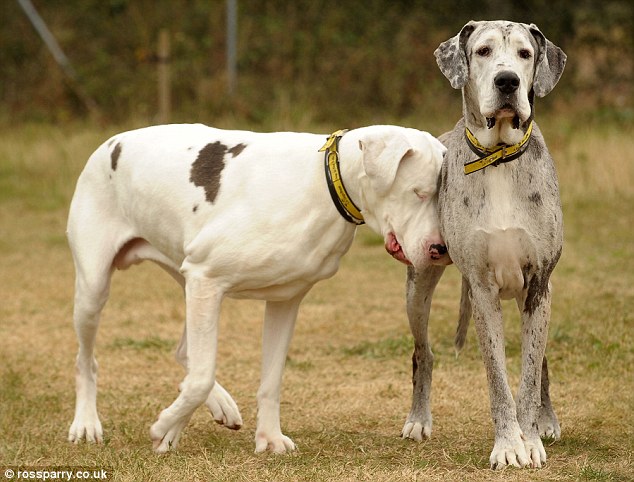
Meet the blind Great Dane in need of a home (but you’ll need to make space for HER huge guide dog)

By NADIA GILANI

Last updated at 1:01 PM on 22nd October 2011

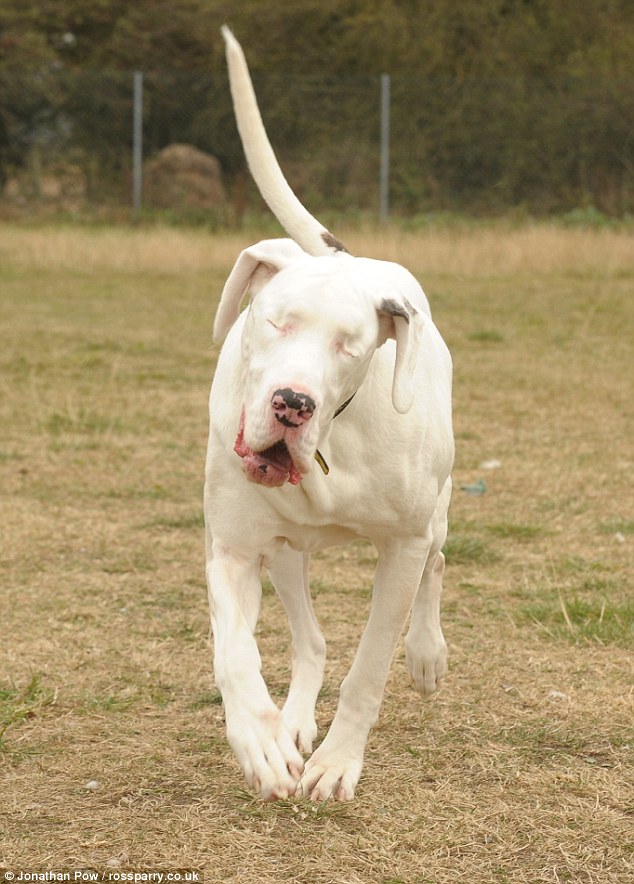
When illness forced vets to remove Great Dane Lily’s eyes, the prospects of a fulfilling life didn’t look good.

But then no one had reckoned on her pal Maddison stepping in to turn guide dog.

The pair have been inseparable for years but now find themselves looking for a new home because their owner could no longer cope.

The catch for anyone interested is that the Great Danes come as a package. They have been waiting at the Dogs Trust re-homing centre in Shrewsbury since July.

Homeless: Blind Great Dane Lily and her kind-hearted canine carer Maddison
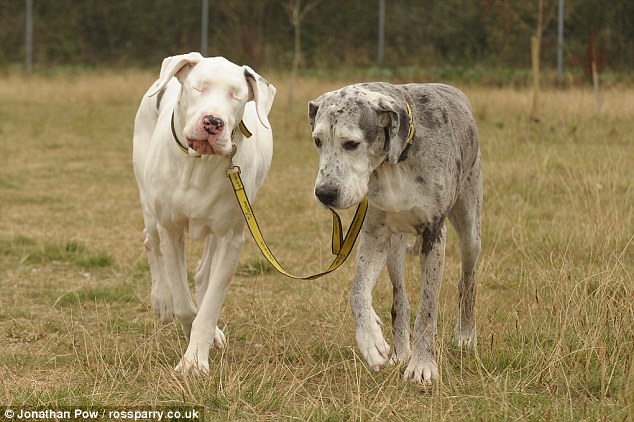
Forever friends: Lily, left, being guided while walking with Maddison right. The pair have been inseparable since Lily lost her sight

Manager Louise Campbell said: ‘Maddison is Lily’s guide dog. If they are out and about, for the majority of the time Maddison will lead and Lily will walk nearly touching her so she knows where to go. It’s lovely to watch. Maddison is always looking out for her.

Lily, six, was barely a puppy when she was struck down by a condition that caused her eyelashes to grown into her eyeballs, damaging them beyond repair.

It was after this traumatic event that her relationship with seven-year-old Maddison developed as she took her under her wing.

The best buddies lived together until their owners decided they couldn’t look after them any more.

Miss Campbell said: ‘With her lack of sight, Lily’s other senses have heightened so although we don’t split them up often she can tell if Maddison is nearby.

They curl up together to go to sleep and they are very vocal with each other.

We haven’t analysed their different barks but if Lily wants to go forward and Maddison is in her way, the bark will have a different pitch.

‘They are very close to one another and enjoy each other’s company‘.

Playful: Lily's lack of sight has heightened her other senses so she can often tell if Maddison is nearby without the pair touching

Miss Campbell said that Lily does all the things normal dogs do and if you saw her from a distance you wouldn’t realise she had anything wrong with her eyes.

She added: ‘They are really happy with life, the glass is always half full with these two.

They have been with us for a considerable amount of time but they are quite happy and go about their daily routine – they are very affectionate.’

She believes the dogs’ size and advancing years, as well as the fact they have to come in a pair, may have put off potential owners and she warned that anyone contemplating taking the dogs in should look at their lifestyle and think of the responsibility involved.

They are not gigantic when you see them outside. These are two lovely big girls who deserve to live out the rest of their lives together in comfort‘, she said.

Dogs Trust cares for around 16,000 stray and abandoned dogs every year through a network of 17 re-homing centres.

The Great Dane is seeking an owner who would be willing to give both her and best friend Maddison a new home

Back to me.  Must say that it was just fortuitous that Dan’s email came in to me a little while after I posted yesterday’s article by Robert Holden, The Gift of Happiness.  Indeed, shortly after I had written, “Perhaps the art of happiness is yet another thing we can learn from dogs!

Anyone in the UK who wants to contact the Dogs Trust click here.

A dog called Loopy

A powerful lesson in patience and trust.

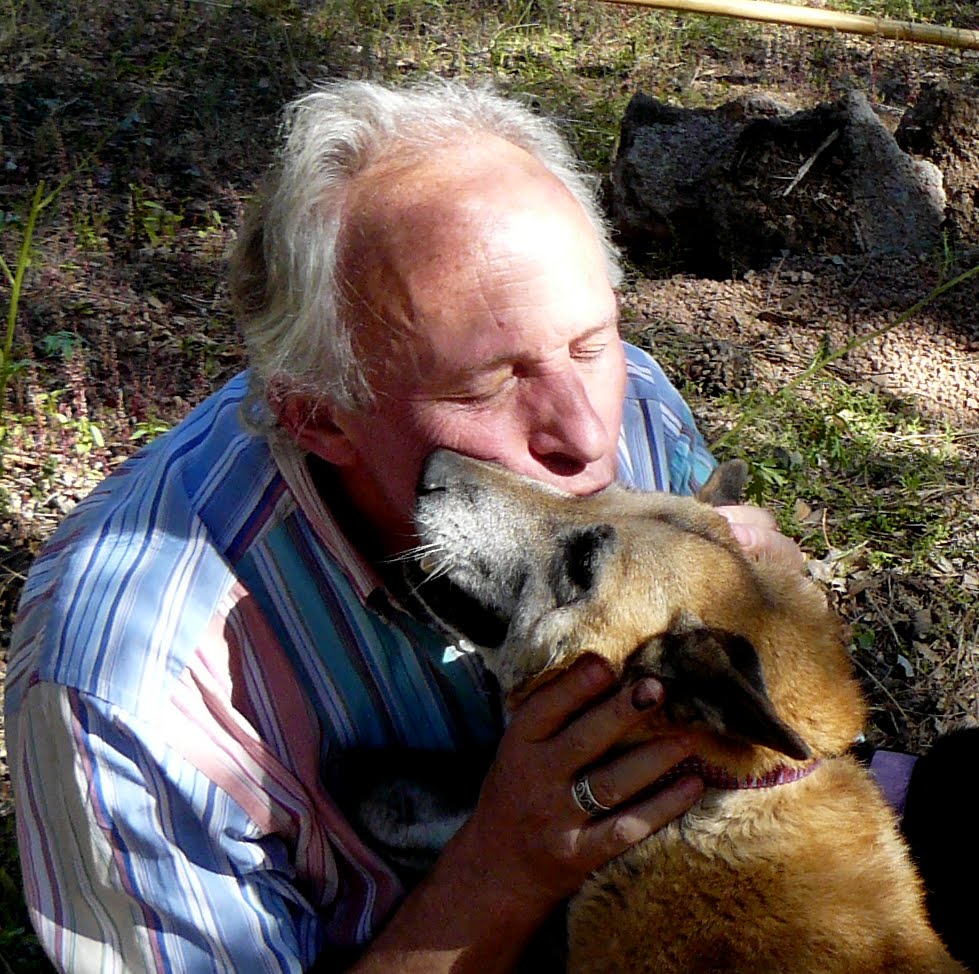
The brown dog with her head nestled against my chest is Loopy.  Like Phoebe, the black dog looking at the camera, they are dogs that Jean originally had rescued in Mexico.

Here’s Loopy’s story.

Loopy and Phoebe

When I first met Jean in December 2007 in San Carlos, Mexico, it was immediately clear that she was an animal lover extraordinaire! There were 13 dogs and 6 cats in her home and many other dogs in a fenced off compound not so far away from the house.

Abandoned and stray dogs in that part of Mexico were numerous, there was no humane society and no real care or interest from the Mexicans for these dogs.  So many years ago, Jean decided to run her own unofficial dog rescue society, supported by more than a few Americans who had winter homes in San Carlos.  Over the years, Jeannie and her team must have rescued and found homes for well over 50 dogs.

In my introduction to the post last Tuesday, Please Help a George, I wrote about how long it had taken for Loopy to bond with me, but Jean’s experience of Loopy goes way back before I entered their lives.

I mentioned above that Jean had a piece of land in San Carlos that she used as a rescue compound for her dogs.  One morning, back in 2003, as usual she had gone to the compound to attend to her dogs.  Jeannie noticed immediately, cowering in one corner, this young female, brown-haired dog, the dog had been tossed over the fence of the compound.  Jean estimated that she was about a year old, hadn’t yet had any pups.  The dog had very cold eyes, growled aggressively as soon as Jean approached her; clearly deeply traumatised.

Jean set out food and water before the dog, hoping that whatever had traumatised the dog would soon abate.  The dog was named: Loopy!

Despite the fact that Loopy wouldn’t mix with the other dogs in the compound, she was not mean.  But the days turned into weeks, the weeks into months, and still Loopy would not allow Jean to get close to her.  One could only imagine the degree of cruelty that must have been metered out to Loopy – or, rather, one couldn’t imagine it!

Then, one day, when Jean went to the compound, Loopy was amongst the other dogs.  Loopy cautiously came up to Jean, sniffed her feet and legs and then, miraculously, allowed Jean to gently stroke her head and back.  Loopy’s cold, angry eyes were now soft and brown; Loopy had melted.  For obvious reasons, Loopy would never be available for adoption and soon moved into the main house.

When I became a permanent part of the Mexican household in 2008, Loopy was deeply suspicious of me.  I was given the cold, hard-eyed stare from Loopy and any attempt by me to touch her was returned with growling, fanged teeth.  There were a number of instances where I collected teeth rips across my hands from Loopy.

The aggression towards me lasted a long time, about a year.  But then one day, quite unexpectedly, Loopy decided that I was friend, not some reminder of a demon foe from her past.  She trusted me, first with strokes and cuddles and then with the most passionate and trusting embraces.  I love her so much.

One could wax lyrical about love, patience and trust, but I won’t.  The photograph below says it all.  We really do have so much to learn from dogs!

Loopy and Paul

Please help Milly

This is such a beautiful dog, and so many ways to help her.
Milly

On the 11th October, I published a story, a story with a very happy ending, about George, a lovely dog who was rescued from the Dog Pound the day before he was due to be killed.  The underlying request was to help, in any way that you could, raise funds in conjunction with the Dog Pound Ball being held in Yorkshire.

As I wrote, and as we all know full too well, there are many other dogs that require our help.  This is the story of Milly, 9 years old and sadly has spent almost 3 years in rescue.
Little Milly

Milly was handed in from a local home when her owners felt they could no longer keep her.  She is an affectionate dog once she learns to trusts, but does growl at strangers and doesn’t present well in kennels.  As a result of these issues Milly has been at the rescue kennels for almost three years now, which is a long time for any dog to have to tolerate.

As time goes on it becomes increasingly unlikely that we will succeed in finding her a home.  Barnsley Animal Rescue Centre (BARC) does not give up on its rescue animals and has been working with this lovely dog to overcome her problems.  Sadly we feel we have done all we can here.

It would be heartbreaking to think she would live out the rest of her life here with us instead of being loved and surrounded by her own family.  So we have decided on a way of helping Milly, but it comes at a cost.

Specialist rehabilitation has been arranged but it is going to cost BARC about £50 per week.  It’s unclear how long the treatment will take and how effective it will be, but we feel Milly deserves this chance, and know that you will agree with us.

So let’s all do something to help these special creatures, the Georges and the Millys of this world, who offer us humans such unconditionally love and loyalty.

Friday 4th November, 7.30pm – Come to the Hellaby Hall Hotel, Old Hellaby, Maltby, Yorkshire, S66 8SN

Call for tickets now to the Pound Dog Ball telephone number (UK) 07772 538513 or email pogpublications@yahoo.com  Full details here.

Please help by supporting this Charity Fundraising Event: Black Tie, Dinner/Dance at Hellaby Hall, Rotherham, 7.30pm, on Friday 4th November. It’s a don’t miss night…..3 course meal, live entertainment all night and dancing ’til late!!!! It’s going to be a great night.

If you can’t make the Ball but would like to send in a donation then please post a cheque, made out to Pound Dog Ball, to the following address:

c/o Jennifer Smith

Clumber Lodge,

50 Hemingfield Road

Wombwell, S73 0LY.

Or if you prefer an electronic donation, further details are:

Pound Dog Ball
A/C 31542265
Sort 40-45-29 (HSBC)

The account is a charity account, set up only for this event.  Once the money has been paid to the charities the account will be closed.

All monies raised will be shared between http://www.dogsos.co.uk/ (Doris Banham) and http://www.barnsleyanimalrescue.org.uk/  (Barnsley Animal Rescue Charity)

Everyone involved in helping these precious animals sends you their heartfelt thanks.


Please Help a George

A canine charitable opportunity that deserves wide support.

The details that follow strike a chord with me, strike a chord in a big way.  When I first came to live with Jean back in 2008 it was clear that this wasn’t going to be a normal relationship.  Why?  Because, at that time Jean had 12 dogs living with her in San Carlos, Mexico and my arrival, together with my Shepherd dog, Pharaoh (see home page for a picture of him), took that number to 13.  Jean’s dogs were all Mexican rescues; she also ran her own local humane society in San Carlos and over the years had found homes for literally dozens of dogs.

One of those Mexican rescues was a dog called Loopy, who had been terribly treated by local Mexicans.  The consequence when I arrived, a stranger in the middle of Loopy’s life with Jean, was that Loopy was very aggressive towards me; my hands have small scars to bear witness to the number of nips Loopy launched in my direction.

It took over a year before I was able to just let my hand ‘accidentally’ brush her side.  Slowly Loopy’s trust in me built up until now I can press my face to her face and cuddle her for ages.  (To underline the love that Loopy bestows on me, I will get Jean to take a picture and publish that before the end of the week.)  So with that in mind, let me turn to the details recently sent to me by friend and colleague, Dapinder Singh, from England.

———————

George and loving owner, Ian.

This is George. He was in an English dog pound and condemned to death.

He had been very badly abused, one eye blinded by what was thought to be a kick, he trusted no-one and had rejected all human contact.  He was desperate and in despair.

After an exhaustive search for anyone who take on the rescue of George, we (as in Doris Banham) took him into our care just a day before he was due to be euthanased.  His veterinary problems were easier to deal with than the mental ones.  His eye was damaged beyond repair causing him constant pain so it had to be removed, teaching George to trust again was much harder.

That journey back to trusting humans was long, George had suffered severe and terrible abuse,  but there was no question of giving up on him and slowly but surely he began to live again as we fought to undo the wrongs that had been done to him. After some months with us, a wonderful family came to the rescue and offered George his ‘forever’ home where he found the love that he so deserved. His family are completely devoted to him.

His story, however, could have been a very different one were it not for the work of the team at Doris Banham’s. Below is an extract written by the lovely family who adopted him and from our fantastic volunteer, Sheila, who helped bring George back to life again.

“Hi, Sheila. Here is a shot of George in his new garden. He is settling down very well and seems to be very happy. I will keep you posted as to his progress. All the best Liz and Ian.”

There were a number of photographs sent to Sheila, however I have taken editor’s liberty and moved them to the foot of the article – I want you to stay with this to the point where you can see how to help.  Here’s Sheila’s reply,

“WELL THESE BOUGHT ME TO TEARS , OUR GEORGE , THIS IS TRUE RESCUE , THIS IS ALL DOWN TO YOU DORIS BANHAM NOTHING ELSE TO SAY …” SHEILA X.

Are there other Georges out there?  You bet! Far too many of them, right across the world.  So let’s all do something to help these special creatures, who show us humans just what unconditionally love feels like.

Friday 4th November, 7.30pm – Come to the Hellaby Hall Hotel, Old Hellaby, Maltby, Yorkshire, S66 8SN

Call for tickets now to the Pound Dog Ball telephone number (UK) 07772 538513 or email pogpublications@yahoo.com  Full details here.

Please help all the Georges out there by supporting this Charity Fundraising Event: Black Tie, Dinner/Dance at Hellaby Hall, Rotherham, 7.30pm, on Friday 4th November. It’s a don’t miss night…..3 course meal, live entertainment all night and dancing ’til late!!!! It’s going to be a great night.

If you can’t make the Ball but would like to send in a donation then please post a cheque, made out to Pound Dog Ball, to the following address:

c/o Jennifer Smith

Clumber Lodge,

50 Hemingfield Road

Wombwell, S73 0LY.

Or if you prefer an electronic donation, further details are:

Pound Dog Ball
A/C 31542265
Sort 40-45-29 (HSBC)

The account is a charity account, set up only for this event.  Once the money has been paid to the charities the account will be closed.

All monies raised will be shared between http://www.dogsos.co.uk/ (Doris Banham) and http://www.barnsleyanimalrescue.org.uk/  (Barnsley Animal Rescue Charity)

I know that Dapinder, and everyone else involved in helping these precious animals, sends you their heartfelt thanks.

Finally, more photos of George enjoying life as all dogs should. What a wonderful story, an honour to be able to publish it, and promote the Ball, on Learning from Dogs.  Please help.

Behaving like animals

A fascinating point of view of the relationship between humans and animals.

Jean and I were at our regular gardening college class yesterday.  It was all about the growing of vegetables.  OK, I can hear you thinking, what on earth does that have to do with today’s topic?  Simply because the tutor, Cayci V., mused at the start of her lesson how gardeners were great animal lovers and then proceeded to list all the animals she and her husband kept at their home in Globe, about an hour from Payson, Arizona.  Cayci admitted to having 5 dogs, 15 cats, 2 emus, 2 llamas, numerous chickens.  She also had 2 bison that recently died having been poisoned by Oleander cuttings.  Anyway, to the article.

recent article on the BBC News Magazine was about the need for humans to have contact with animals.  It was presented by John Gray who is a political philosopher and author of the book False Dawn: The Delusions of Global Capitalism which  argues that free market globalization is unstable and is in the process of collapsing!  H’mmm.  John is also the author of the book Straw Dogs: Thoughts on Humans and Other Animals, a book that was described by the British Observer newspaper thus,

There is unlikely to be a more provocative or more compelling book published this year than Straw Dogs. A long-time scourge of the delusions of global capitalism, John Gray is one of the most consistently interesting and unpredictable thinkers in Britain. He is unpredictable because, unlike most political commentators, he never ceases to question the underlying assumptions of his own beliefs and prejudices.

Anyway, I’m at risk of digressing, as many of you will regularly notice!  The article by John Gray on the BBC News website was published over a couple of weeks ago and, therefore, I feel it not too great a copyright sin to reproduce it in full on Learning from Dogs.  It’s a fascinating article.

Why does the human animal need contact with something other than itself, asks John Gray.

Many years ago an eminent philosopher told me he’d persuaded his cat to become a vegan. To begin with I thought he was joking. Knowing a bit about cats, I couldn’t take seriously the idea that they’d give up their predatory ways.

“You must have provided the cat with some pretty powerful arguments,” I said jokingly. “It wasn’t as difficult as you may think,” he replied rather sternly.

He never explained exactly how the transformation was achieved. Was his cat presented with other cats that had converted to veganism – feline role models, so to speak? Had he prepared special delicacies for his cat – snacks that looked like mice but were made of soya, perhaps?

Beginning to suspect that the philosopher might after all be serious, I asked if the cat went out. He told me it did. That answered a part of my puzzlement. Evidently the cat was supplementing its vegan diet by hunting, natural behaviour for cats after all.

I was still a little perplexed though. Cats tend to bring their hunting trophies back home and I wondered how the philosopher had missed seeing them. Had the cat hidden them out of sight? Or were the cat’s trophies prominently displayed but disregarded by the philosopher, marks of atavistic feline behaviour that would eventually disappear as the cat progressed towards a new kind of meat-free life?

The conversation tapered off and I never did get to the bottom of the mystery. The dialogue did set me thinking. Evidently the philosopher thought of the cat as a less evolved version of himself that, with a lot of help, could eventually share his values. But the idea that animals are inferior versions of humans is fundamentally misguided.

Each of the millions of species that evolution has thrown up is different and particular, and the animals with which we share the planet aren’t stages on the way to something else – ourselves. There’s no evolutionary hierarchy with humans perched at the top. The value of animals – or as I’d prefer to say other animals – comes from being what they are. And it’s the fact that they are so different from humans that makes contact with them so valuable to us.

Human qualities

Some philosophers – not many it must be admitted – have in the past understood this. The 16th Century French essayist, Michel de Montaigne, loved cats because he knew he would never be able to enter their minds. “When I play with my cat,” he asked, “how do I know she is not amusing herself with me rather than I with her?”

Montaigne didn’t want his animal companions to be mirrors of himself, he wanted them to be a window from which he could look out from himself and from the human world.

Never more than partly domesticated, cats are never fundamentally humanised. Montaigne found them lovable for precisely this reason, it wasn’t that he was suggesting we should emulate cats. Wiser than the philosopher who believed he’d converted his cat to veganism, he understood that the good life means different things for animals with different natures. What he questioned was the idea that one kind of life, the kind humans alone can live, is always best.

It’s true that cats don’t have some of the capacities we associate with morality. They seem to lack empathy, the capacity of identifying with the emotions of others. This may explain what has often been described as cruelty in their behaviour, toying with captured mice for example. Attributing cruelty to cats seems a clear case of anthropomorphism – the error of projecting distinctively human qualities onto other species.

Cats are not known to display compassion, but neither do they inflict pain and death on each other in order to gratify some impulse or ideal of their own. There are no feline inquisitors or suicide bombers. Pedants will say that this is because cats lack the intellectual equipment that is required to formulate an idea of truth or justice. I prefer to think that they simply decline to be enrolled in fanaticism, another peculiarly human trait.

Dogs seem to be capable of showing human-like emotions of shame, but though they are more domesticated they still remain different from us. And I think it’s their differences from us, as much as their similarities, that makes them such good companions.

Whatever you feel about cats and dogs, it seems clear that the human animal needs contact with something other than itself. For religious people this need may be satisfied by God, even if the God with whom they commune seems too often all-too-human. For many landscape gives a sense of release from the human world, even if the land has been groomed and combed by humans for generations, as it has in England.

The contemplation of field, wood and water intermingling with wind and sky still has the power to liberate the spirit from an unhealthy obsession with human affairs. Poets such as Edward Thomas and Ted Hughes have turned to the natural world in an attempt to escape a purely human view of things. Since they remained human and used human language in the attempt, it’s obvious that they couldn’t altogether succeed. It’s also obvious that searching for a way of looking at the world that’s not simply human expresses a powerful human impulse.

The most intense example of this search I know is that recorded by John Baker in his book The Peregrine. First published in 1967 and recently reissued, the book is seemingly a piece of nature writing which slowly reveals itself as the testament of someone struggling to shed the point of view of a human observer.

Renewed humanity

Baker records his pursuit of two pairs of peregrines, which had arrived to hunt in the part of East Anglia where he lived. Alone he followed the birds for over 10 years. Concentrating the decade-long quest into a single year in order to recount it in the book, he writes of the peregrine: “Wherever he goes, this winter, I will follow him. I will share the fear, and the exaltation, and the boredom of the hunting life.”

He tells us that he came late to the love of birds. “For years I saw them only as a tremor on the edge of vision. They know suffering and joy in simple states not possible for us. Their lives quicken and warm to a pulse our hearts can never reach. They race to oblivion.”

In time the human observer seemed to be transmuted into the inhuman hawk. “In a lair of shadow,” Baker writes, “the peregrine was crouching, watching me… We live, in these days in the open, the same ecstatic fearful life. We shun men.”

Note how Baker switches suddenly from describing the hawk watching him to describing how “we” flee from humans. Baker found a sensation of freedom in the feeling that he and the hawk were fused into one. Sharing in the “exaltation and serenity” of the birds’ life he could imagine that he’d shed his human identity, at least for a time, and could view the world through hawks’ eyes.

Of course he didn’t take this to be literal truth. He knew he couldn’t in the end be anything other than human. Yet he still found the pursuit of the peregrine deeply rewarding, for it opened up a temporary exit from the introspective human world.

John Baker’s devotion to the peregrine hadn’t enabled him to see things as birds see them. What it had done was to enable him to see the world through his own eyes, but in a different way. His descriptions of the landscape of East Anglia are exact and faithful to fact. But they reveal that long-familiar countryside in a light in which it looks as strange and exotically beautiful as anything in Africa or the Himalayas. The pursuit of a bird had revitalised his human perceptions.

What birds and animals offer us is not confirmation of our sense of having an exalted place in some sort of cosmic hierarchy, it’s admission into a larger scheme of things, where our minds are no longer turned in on themselves. Unless it has contact with something other than itself, the human animal soon becomes stale and mad. By giving us the freedom to see the world afresh, birds and animals renew our humanity.

A fascinating, beautiful and incredibly thought-provoking essay.

The Grand Re-opening

A guest post from Joelle Jordan

A couple of days ago, out of the blue, in came an email with this article attached.  Was sure that Joelle and I didn’t know each other but so what!  One of the lovely aspects of this wired-up world is the ease with which like-minded people can communicate.  It’s a pleasure to publish Joelle’s story.

Charlie's first day!

I had been resistant to getting a new dog. We couldn’t afford one; we couldn’t afford the time to train a pup, the sleep deprivation, the continual puppy proofing the areas he would reside in, the contingent poop and pee cleanup. We couldn’t financially afford the shots, the toys, the food, the new crate. It was just too much stuff all at once, and we were just getting established as a couple and as a family.

That wasn’t the true reason I didn’t want a dog. I had been resistant because of a dog I’d had before, the dog I left behind. I loved this dog with all my heart, he was my “first.” I did not want to disrespect that dog by replacing him. I always questioned if my decision to leave him behind with my ex was right. My head always said yes, but my heart always said no. This left a war inside of me of enormous proportions that I could only allow to play out as it would, a sort of inner-Vietnam that ended only with withdrawal, but not with surrender.

So I put my foot down for a long time. “No, no dogs.” I would add the caveat the sake of mollification: “Not yet.” Maybe someday. Maybe someday I would be ready. Maybe someday our home situation would be perfect for a puppy. That would be when we could get a puppy: when we were independently wealthy and didn’t have to work and had all the time in the world to train a pup the proper way. Yeah, then.

I added another caveat to my “no dogs” edict: “I’ll know my dog when I see him.” I knew I would know the right dog for us when I saw him. It would be a chemical thing, like falling in love. I would not be swayed by cute fluff balls and wide expressive eyes. I would not be swayed by the tug of puppy teeth and the scent of puppy breath through a cage as we wandered through the aisles of a rescue. I would not be swayed; I would not be swayed until the perfect time when we were independently wealthy. In this way, I could save our money, our time, and my heart. I would just use my intuition (which I heretofore had never had) to know the when and the which one.

My partner continued to try to bend me, showing me pictures on the internet of homeless pups and rescue pups. She tried every breed; I saw terriers and shih tzus, Pomeranians and Pekinese, Maltese and min-pins. I saw every mutt with a happy, drooly, grinning face, and heard every sad story about why the owners could not keep said dog. And my response was always the same: “Oh, yes, he’s so cute, but no, not yet.”

What it came down to was that I was not ready to forgive myself. It’s not as though the dog I left behind wasn’t loved; I knew my ex loved him as much as I did. I didn’t leave him in some rat hole; it’s a two bedroom, one bath with a fenced back yard. But circumstances dictated that I leave, and leave my boy behind. Did that kind of behavior even warrant the luxury of having another dog again? I wondered in silence but responded with “No, not yet.”

Until one day, while trolling the internet for that love match for me yet again, my partner turned the screen towards me and said, “Baby, look.” Two males, pug crossed with dachshund, both auburn with black muzzles. Their mother had died shortly after birth and their father had gone missing.

I looked.

“Wow, they’re really cute,” I said.

I’m sure my partner was shocked that she didn’t receive my standard, “Oh, yes, they’re so cute, but no, not yet.” She could only pause and let me look at the picture.

“They’re only two hours away, and they don’t want a lot of money, just to cover the shots,” she offered.

“Yeah, they’re really cute,” I responded again.

Something in me said that’s your dog. I knew in theory that it would happen like that, but I was surprised that it actually did happen.

Two days later my partner and I were in the very nice home of some very nice people trying to rehome the last two of the surprise litter of their two lost but beloved house dogs. I sat cross-legged on the floor, and the daughter put the pups down about three feet from me. They were barely bigger than hamsters, just eight weeks old to the day. One of them walked right to me, as though he knew me, crawled in my lap, as though my lap were his home. The other had nothing to do with me, had nothing to do with either my partner or me. The first pup explored me, my fingers, tasting, smelling, intent. I looked up at my partner as I cuddled the warm ball of fur to my neck, and our eyes met. She smiled at me and fished through her purse for the nominal rehoming fee.

That little guy rode home most of the way with me, on my chest, staring into my eyes as I stared back into his. He studied me hard, calmly, gazing, as though memorizing. I thought perhaps that he was imprinting me (as I was him) but I think it was more than that, now that I think back on it. I think he was singing The Byrds, as sometimes he still sings, even now, softly, as he lays against my leg as I write this about him, “To everything, turn, turn, turn, there is a season, turn, turn, turn, and a time for every purpose under heaven.”

I’m sure all you lovely readers will agree that is a very moving story.  Thank you Joelle.

The sustainable dog.

Looking for sustainability?  Try this!

Sustainable is an overused word these days.  All for the right reasons, of course!  But how often is the word used in the context of relationships?  Of the relationships between the domesticated dog and man?  I suspect rarely.

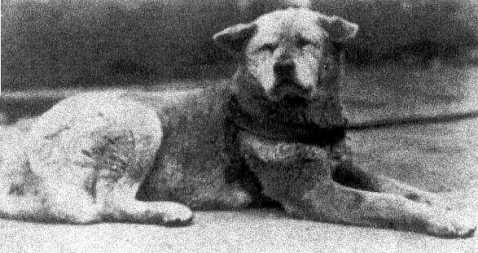
Take the example of the Japanese Akita dog called Hachi, (Hachikō in Japanese) that I wrote about almost a year ago.

In 1924, Hidesaburō Ueno, a professor in the agriculture department at theUniversity of Tokyo took in Hachikō as a pet. During his owner’s life Hachikō saw him out from the front door and greeted him at the end of the day at the nearby Shibuya Station. The pair continued their daily routine until May 1925, when Professor Ueno did not return on the usual train one evening. The professor had suffered from a cerebral hemorrhage at the university that day. He died and never returned to the train station where his friend was waiting. Hachikō was loyal and every day for the next nine years he waited sitting there amongst the town’s folk.

Hachikō 1925

“…. every day for the next nine years he waited sitting there amongst the town’s folk” Truly a sustainable relationship.

Now to something closer to home; literally.

The Payson Roundup is our local newspaper. Last Tuesday’s edition had the following story which Tom Brossart, Editor, has kindly given me written permission to reproduce here on Learning from Dogs.  Thank you, Tom.

Best friends help save man’s life

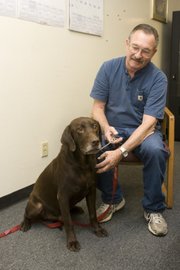
Both Logger and Harold Green are a little gray around the muzzle, but they have lots of good days ahead after Logger helped save Green’s life back on July 1.Photo by Andy Towle

By Teresa McQuerrey

August 30, 2011

Logger is Harold Green’s best friend. Logger isn’t a flannel-wearing, tattooed burly woodsman; he is a sweet-tempered chocolate Labrador retriever. And this best friend saved Green’s life.

Green makes his home up in Happy Jack. Recently he and Logger drove into the woods and went for a walk, and then Green had a heart attack. He didn’t have a history of heart disease, but all of a sudden his chest became tight. He collapsed and on his way to the ground, he hit a fallen log and wound up hitting his forehead and nose, tearing his bottom lip away from his gums, cutting his chin and breaking a rib.

“Right before I had the heart attack I had a page there was a fire, and that’s the last thing I remember,” he said. Green is an emergency medical technician with the Blue Ridge Fire Department.

He said the next thing he remembers was waking up and trying to call 911. “There was so much blood in my eyes I couldn’t see at first, but Logger licked the blood away.”

Green was conscious long enough to dial 911 and try to explain where he was. He heard the sirens go past him and with that information; the emergency responders had a place to start looking for him.

At that point, Logger left Green’s side to go to the rescue personnel.

“From what they told me, he was like Lassie. He came running to them, barking, and started running back to me, stopped and made sure they were following,” Green said.

The first person on the scene with him was a law enforcement officer with the Forest Service. Green said he told him his nose was bleeding so much he thought it was broken.

Next to arrive was a deputy sheriff. Green said he later learned the guy was off duty, but came to help anyway.

The Blue Ridge ambulance crew arrived next.

“Logger did the same with all of them as he had with the first one on the scene. They told me, without Logger’s help they would have had to search for me a lot longer.”

Green said when they first reached him his heart rate was in the mid-40s and he had no blood pressure. The rescue team stabilized him and carried him out to the ambulance to take him to the fire station where a helicopter could land.

“They said Logger tried to get into the ambulance with me,” Green said.

He said he has little or no memory of everything that took place, when he woke up he was in the hospital in Flagstaff.

Logger couldn’t ride in the ambulance with Green and couldn’t come see him in the hospital, but since he has been out, the dog has not been more than three feet from him for three weeks.

“It is really humbling to have so many friends there to help you out,” Green said.

The people who came to his rescue were all friends and, just like Logger, they did what best friends do, except it was something they do every day, for friends and strangers alike.

Logger has been part of Green’s family for seven years, joining it when he was just a puppy.

Green is the son of longtime Rim Country Realtor Bea Baxter, who has been in the community for around 40 years.

So dear, lovely Logger also demonstrated the same, deep sustainability of relationship that Hachikō did back in 1925.  There is so much that we can learn from dogs.  Think about sustainability, as it relates to the relationship between dogs and man.  It goes back at least 30,000 years.  It’s an unimaginable length of time.

In this context, sustainability is an underused word!