Author: Sherry Jarrell

The US Federal Government and poverty

Welcome Elliot Engstrom

Learning from Dogs has been publishing on a daily basis since July 15th, 2009.  That’s over 460 posts and is a great tribute to the commitment of all the authors of this Blog.  We are grateful that our regular readership is also measured in the hundreds and is growing steadily.

Elliot Engstrom

It seemed time to make a small change.  We have decided to include articles from Guest Authors on a regular basis.  Our first guest is Elliot Engstrom.

Elliot Engstrom is a senior French major at Wake Forest University, and aside from his schoolwork blogs for Young Americans for Liberty and writes at his own Web site, Rethinking the State

Elliot first post for Learning from Dogs is about the US Federal Government and Poverty.  This also appeared in The Daily Caller.

————–oooOOOooo—————-

The federal government, which claims to be the greatest supporter of those in need, is anything but a friend of the impoverished.

Often times when conservatives speak of the government treating the rich differently than the poor, the discussion is framed around taxes and welfare, with the argument being made that the government forces the highest earners to pay a massive percentage of all taxes, both punishing success and stifling overall economic productivity and making it all the more difficult for anyone not in the upper echelons to accumulate wealth for themselves. I sincerely hope that I have not constructed a straw man version of this common conservative argument, as I certainly think it has a great deal of credibility. However, I also would like to draw attention to the fact that while government loots the rich through the direct means of taxation, it likewise loots the poor, albeit through a different set of means that is much more difficult to recognize, and thus much more difficult to counteract.

While looting the wealthy can often be construed as some kind of humanitarian effort to aid the poor, looting the impoverished is a much more difficult enterprise to disguise as a moral good. Thus we will find that the government’s means of taking money from the poor are much more difficult to detect, comprehend, and eliminate than the means of direct taxation that is used to extract money from the wealthier members of society.

The dollar in which the majority of Americans receive their wages or salary has no absolute, set value. We see this in the fact that the value of the dollar is constantly fluctuating when compared to gold, silver, or the currencies of other nations (which are all constantly fluctuating in value themselves). “Value” is determined by a wide range of factors, but is based in the fact that human beings are all rational maximizers who are all trying to get what they want while expending the least amount of resources possible to do so. The occurrence of this phenomenon in the mind of every single individual economic actor coordinates the price system in a free market economy.

A given worker making $10.50/hour may see himself as bringing home a constant source of income. However, this is not the case at all due to the constantly shifting value of the dollar. Even in a free and unhindered market, the value of the dollars that this worker takes home each day would fluctuate based on factors like how much liquid currency was actually in existence in the market, how many resources had been invested in banks or stocks, and what amount of resources had been converted into physical capital or products. In the end, the dollar itself has all the value of a flimsy piece of cotton paper – it derives its true value from the productive activities of economic actors who use it as a medium of exchange. In other words, the dollar is a widely accepted “I.O.U.” This would be the case even in the freest of economies. Values of commodities and currencies are always changing based on the effectual demand and effectual supply of the moment.

But, as we all know, we live in anything but a free and unhindered economy. Our supposed “free market” is criss-crossed with a Federal Reserve System that manipulates the value of the dollar at will, a corporate welfare system that socializes the losses of corporations at the expense of the rest of society, and law enforcement policies that weigh the heaviest on those who do not have the time or resources to easily deal with court and lawyer fees, jury duty, and detainments prior to trial, not to mention the fact that the War on Drugs does substantially greater damage to the lower classes of American society than it does good, particularly when speaking of poor African-Americans.

And here’s the scary part – this was all the case before the bailouts and stimulus package that George Bush began and Barack Obama continued and amplified. Not only do these bailouts threaten to massively inflate our currency, spelling disaster for those whose livelihood is based in hourly wages paid in dollars, but it also directly took from all of society, not just the rich or the poor, and gave to a few select corporate entities such as Goldman-Sachs and Wells Fargo. We know this because every new dollar created by the government in the stimulus plan detracted from the value of every dollar already existing in the pre-stimulus economy (or will do so when released into the economy).

Does this sound confusing? It should, because it is, and that’s exactly how the federal government likes it.

While the federal government would tell us that they protect the poor from the exploitation of the rich, economics would tell us that it is in fact the federal government itself that is the greatest exploiter of our nation’s impoverished, and it is this institution that in fact facilitates much of the disparity in wealth between wealthy national corporations and impoverished local communities.

Those of the small government mindset who wish to rally more people to their cause should not go about proclaiming that we should be immediately getting rid of affirmative action and welfare for the poor, but instead should be putting forth a rallying cry against corporate welfare, an inflation-minded Federal Reserve System, and a law enforcement system whose economic penalties weigh heaviest on those with the least money in their savings accounts. It does not have to be out of selfishness that we advocate for a reduction of the federal nanny-state. It can, and should, instead be out of a concern for the poverty and destruction of wealth that is directly generated by this institution’s misguided policies.

By Elliot Engstrom

The Fed’s Exit Strategy

The Federal Reserve finally addresses how it plans to unwind trillions in toxic assets

Finally, we hear from the Federal Reserve about how they plan to unwind the billions of dollars of toxic assets they purchased over the last 18 months or so without creating further distortions in the U.S. and world financial markets (Fed lays out exit detail). This after the Fed barely acknowledged one of the most dramatic runups in the money supply in U.S. history.

Brian Sack, EVP Markets Group, Federal Reserve
The announcement came in a speech by Brian P. Sack, the executive Vice President of the Markets Group at the Fed.  I am impressed by this guy. He seems to know what he’s talking about and seems to understand how markets and fed policy interact.

In earlier posts I wondered aloud how the Fed might accomplish this tricky task. It is a very delicate balance between reducing the money supply too quickly, which would spike short term rates, and too slowly, which would increase long-term rates due to worries about inflation (which occurs when money growth is higher than the economy’s real growth, even if money growth is falling).

The Fed, the article explains, apparently intends to let $200 billion of the estimated $1.25 trillion in new money supply simply “mature” by the end of 2011 without replacing it. This represents largely toxic assets. The Fed might let another $140 billion of Treasuries it purchased during normal open market operations mature at the end of 2011, but they aren’t committing to that.  So that’s about $340/$1,250 or about 35% of the historic increase in money supply that may be vaporized over the next 21 months. What about the rest?  It would be nice to know but….

The Fed is doing the right thing by explaining its policy intentions — ANY of its policy intentions — to the markets.  Markets want, need, and deserve information from our officials, something that has been sorely lacking of late. With information, lenders and borrowers can plan, they can optimize. Without information, guessing, withdrawing from the market, and fear rule the day. Not a good environment for economic recovery.

by Sherry Jarrell

Should you invest in U.S. bonds? Part 2

Sources and types of risk in U.S. and other bonds.

This is part 2 of a multipart [Part One is here, Ed.] series on the factors that drive U.S. and foreign bond prices and yields.

Recall that a bond’s price is the present value of its coupons (if any) and face value (or principal or par value).  Let’s keep things simple for now and assume a zero-coupon or “discount” bond.

One thing of interest to note first: As we move forward in time from the issue date toward the maturity date, and the number of periods between now and the maturity date falls, the price of a discount bond rises toward the face value of the bond, even with no changes in the interest rate.  At maturity, the price of the bond equals the face value. Only unexpected changes in the effective return on a bond can change the natural upward progression of its price toward face value between the issue and maturity dates.

This example makes clear that the (annual) yield on a bond, simply put, is driven by the difference between the price paid for the bond and the cash flows it generates, that is, the difference between “dollars out” today and “dollars in” later.

The “dollars out” are known because we pay a given price for the bond today.  The “dollars in,” consisting of coupons (if any) and the face value of the bond, are also “known” in that they are specified in a contract at the time the bond is issued.  The realized value of these dollar returns is, however, subject to many different sources of uncertainty or risk. A short list includes:

Interest rate risk: how sensitive the price of the bond is to changes in interest rates over the life of the bond.  Interest rate risk is higher for bonds with a longer maturity (more time for the unexpected to happen), a lower coupon (more of the value of the bond is tied up in the principal), and a lower initial yield (a 1 percentage point change in interest rates represents a higher relative change in low yields).  Floating-rate notes and bonds have much lower, though not zero, interest rate risk.

Reinvestment rate risk.  Bondholders may reinvest their coupons at the then-prevailing rate of interest. As those market rates of interest change, the return on reinvested coupons becomes more uncertain. The higher the coupons, the more frequently they are paid, and the longer the maturity of the bond, the higher reinvestment rate risk.

Bankruptcy Court: Destination for issuers in default

Credit or default risk:  the risk that the issuer will default on the payments of the bond, which reduces the amount and value of “dollars in” relative to price paid, lowering the earned yield on the bond.   Credit risk is frequently measured as the credit spread over like Treasuries, which are assumed to have zero credit risk.  Credit risk includes downgrade risk, where a credit rating agency lowers the rating on an issuer as their ability to repay the debt is brought into question.

Call risk:  the risk that a callable bond will be called by the issuer. Since a bond is typically called only when it’s in the best interest of the issuer, the call feature is systematically harmful to the bondholder.  Prepayment risk reverses these risks:  prepayment is good for the bondholder, and bad for the issuer.

Exchange rate risk (that the value of the repaid currency will be lower), inflation risk (that the value of the repaid dollar will be lower), and event risk (natural disasters, corporate restructurings, regulatory changes, sovereign or political changes) round out the list of broad types of risks that drive bond yields.

Next time: why the types and level of risks are so difficult to measure and predict.

by Sherry Jarrell

Lessons of a Government Intern

When lending is motivated by politics, losses are not far behind.

Years ago, in the summer of 1980, I worked as an intern in the Federal Home Loan Bank Board at the Department of Agriculture.  I was a senior in college majoring in business and had been accepted to the University of Chicago doctoral program.  I didn’t want to take the internship because I wanted to take more courses over the summer to help prepare me for the rigors of grad school, but my college advisor had openly worried that I was far too serious for a young person.  He strongly encouraged me to accept the internship and take a break from academics before I immersed myself in graduate school, and buried myself once again in all things economics!

The U.S. Department of Agriculture was a major lender

I agreed, but only after I had arranged to take 6 credits of independent study in D.C.  I chose to examine the Negative Income Tax program, one of the largest social experiments in U.S. history. More on that at another time. Today, I want to talk about what I learned from being an employee of the U.S. federal government.

The first thing I learned was that the “problem” with government work is not the people; well, not all the people.  There was one man who spent his entire day going back and forth to feed quarters to the parking meter rather than pay for public transportation or do his work.  He represented the worst in government employees.  Most all of the others I met were hard-working and honest people, trying to do a good job and make a difference.

President George H. W. Bush

No, I learned that the real problem was the way the “work” was done in government. I worked for the Federal Home Loan Bank Board (FHLBB) that summer, which was one of the largest lenders in the world.  The FHLBB was responsible for small business, rural, agricultural, and economic development lending. My job was to review loan applications from community groups, fairs, farmers’ markets, and various municipal organizations to make sure that they were complete.

We did not analyze the applicants for creditworthiness.  Instead, if the application was correct and complete, and satisfied the application process, it was approved.  The FHLBB, which was publicly trashed by the first President Bush as being largely responsible for the savings and loan crisis, was abolished and replaced by the Office of Thrift Supervision (OTS) under the Department of the Treasury in 1989.

The OTS eventually expanded its oversight to companies that were not banks, including Washington Mutual, American International Group (AIG),  and IndyMac,  all implicated in the current U.S. financial crisis.

AIG

Little did I know back in 1980 that I was witnessing, from the inside, a government lending process that would lead to the most significant financial crisis since the Great Depression. Looking back, the outcome was perfectly predictable: when politics replaces profits as the motivation of the lender, it should be no surprise that losses result.

By Sherry Jarrell

Scuba Diving

The greatest danger in scuba diving? You may be surprised!

I learned to scuba dive about 20 years ago.  I was certified by NAUI (the National Association of Underwater Instructors) in Chicago, Illinois, and did my check-out dive in a quarry in Wisconsin.  It was dreary and raining.  The water was cold and the scenery sorely lacking:  we dove down to the top of an abandoned school bus!   I did just fine as long as I had air; strap a tank on me and I can dive for hours.

But take away the air, and make me go underwater, and I want to surface immediately.  It was a huge accomplishment for me to complete my surface dive (where you go fairly deep with no air, just a snorkel, then surface and clear out your snorkel to continue breathing on the surface) although I bit through at least one snorkel before I was through! I blamed it on the cold but the truth is that I was very tense.

Scuba Diving can be fun!

I did a fair amount of diving before I had children and hung up my fins.  I dove the Blue Hole, going down 120 feet and getting “narced” (nitrogen narcosis, where you feel “drunk” underwater). I did open water diving with hammerhead sharks off CoCos Island.

My buddy and I were swept away in a current in the middle of the ocean, but so was the dive master and the rest of the dive team, so the boat followed us and we were just fine.   I dove with sea turtles, manta rays, eels, and sea horses.  I’ve done night diving, which was surprisingly noisy as the fish nipped the coral as they fed.  I loved scuba diving.  It was a magical, liberating, beautiful experience. But I never forgot how dangerous it was and that it could kill you if you weren’t careful and aware.

I tend to be fairly risk averse so I did a lot of nerdy research as I prepared for my first real diving trip.  I wanted to know all I could about how to avoid a scuba diving accident.   I learned something that I thought others might find very interesting:  that diving as a threesome is the single most dangerous thing you can do when scuba diving!    More dangerous than cave diving, ice diving, open water diving, or diving alone!  (If my memory serves me right, this result is based on Canadian data on scuba diving accidents, injuries, and deaths. )

It seems hard to believe at first but I think I’ve got it figured out. For one, it happens fairly often.  I’ve seen it on many diving trips: someone comes alone or their buddy can’t dive, so they join up with a buddy team.  Dive instructors suggest that people join up in threes rather than dive alone.  Or the dive instructor joins a pair.

Two, I think people feel safer in a bigger group.  Three, I think that when you are diving alone, or cave or ice diving, you are very aware of the risks and take extra precautions to avoid the dangers.  But diving in threes doesn’t “seem” risky, so everyone relaxes.  And people tend not to clearly lay out ahead of time who is watching whom at the bottom of the ocean where seconds can make the difference between life and death. And that is likely where the danger lives:  with a buddy system, there is no question about who is responsible for whom.  I am watching out for my buddy, and he is watching out for me.  Period. But when diving in threes, the pairing gets muddled.  Are you watching out for two people?  Are they watching out for you, or for each other?  And inevitably someone gets overlooked.  And accidents happen.

So, if you ever take up scuba diving, have a blast! But don’t ever dive in threes!

by Sherry Jarrell

Econned, by Yves Smith

Learning from Dogs muses the new book from Yves Smith

ECONned, by Yves Smith

In Econned, Yves Smith, founder of Naked Capitalism, argues that the economy was doing just fine in the regulated environment up to the 1970s.  Then began the work of the Chicago economists who challenged Keynesian economics and touted the benefits of deregulation which eventually led to the financial crisis we have today.

Yves argument is internally consistent and well researched, but ignores some factors that I think would change the conclusions drawn from her work.

Yves Smith, author and founder of Naked Capitalism

First, Yves notes that the primary reason that economists are not useful to the real world is that economic research presumes equilibrium.  Smith misses the point here, but it is understandable. It took me years of study and contemplation to fully appreciate that an equilibrium simply gives economists a point of reference, a common base, from which to study shocks and movements. In and of itself, equilibrium is not interesting or important.   But movements to and from equilibrium are of real interest because they enable us to study and try to predict how individuals will react to incentives and changes in market conditions.

Second, we have to put the contributions of the Chicago economists of the 1970s into context.  Up until that time, the only real school of thought in macroeconomics was based on Keynes, who presumed that markets fail and that the government must play an active and large role – primarily through government spending and taxes — for the economy to perform well.  Keynes’ work was a reaction to the Great Depression.

Friedman’s monetarism also sought to explain the Great Depression, but focused on the role of monetary policy on the economy. This work showed that the missteps of the Federal Reserve was the primary cause of the depth and length of the Great Depression, and that long-term accommodative monetary policy causes inflation.  This body of work did not stress deregulation, although it did lean more heavily on enabling private market solutions than on replacing them with government solutions.  Neither theory is complete; Keynes focused on the short run (“In the long run, we are all dead” is a rather famous Keynes quip) and Monetarism focused on the long run.

There was a second large body of work that came out of the University of Chicago during the late 1960s and 1970s.  This research documented the tremendous costs of regulation. I know this literature personally and believe that its conclusions are very sound:  it shows that any effective regulation limits either the quantity or price of a good or service away from what it would have been without the regulation.  In fact, in my view, it was the passage of regulations requiring certain lending behavior that set off the series of events that led to the crisis, which is the exact opposite argument from what Ms. Smith makes.

By Sherry Jarrell

Shame on you, President Obama

President Obama’s lack of grace.

Shame on you, President Obama.

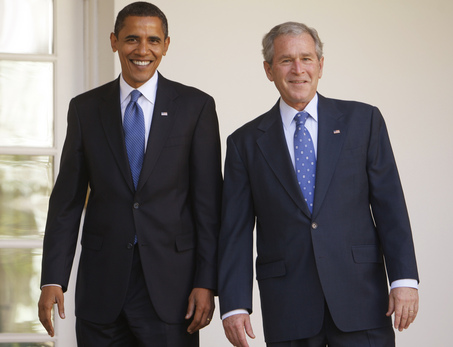
Presidents Obama and Bush

To publicly comment on the singular importance of the Iraqi elections without crediting President Bush for having the courage and fortitude to free those people from a tyrannical leader who threatened the security of the free world – shameful.

Of course, you also failed to acknowledge President Bush’s role in enabling the historic Afghanistan elections of 2009. I just hoped you would have matured a little since then.

The media is not doing much better on this issue.  But then we expect less of our media than our President.

by Sherry Jarrell

The Hypocrisy of Cutting Waste

Cut Waste Later?  How about now?

I honestly cannot understand how President Obama can look the American people in the eye and tell them that Health Care reform will be paid for, in part, by finding savings and reducing fraud in Medicare over the next several years.

President Obama on Health Care Reform

If it is possible to operate Medicare more efficiently, why have we not done it already?  Why must doing it right wait for new programs and new legislation?  Why doesn’t Congress first prove to the American people that it can operate a program efficiently and then come back and ask for more?

Because it can’t, that’s why not.   The plain and simple truth is that it cannot do so now, and will not do so in the future.  So why are we letting our elected officials get away with such a charade?

I just don’t understand it.

By Sherry Jarrell

Kucinich’s Early Retirement Idea is Nuts!

Save a job – retire earlier! Duh!

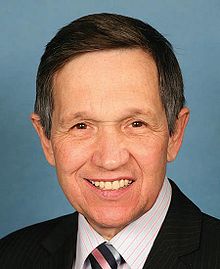
Democratic U.S. Senator Dennis Kucinich

Representative Dennis Kucinich (Democrat – Ohio) is on the media circuit promoting his rather novel idea on how to “create” jobs for younger people who are trying to enter the work force but can’t because of the recession.

The Congressman has proposed legislation that would allow people to take voluntary early retirement at age 60 instead of age 62, as the law now stands.

Kucinich, who ran for the Democratic nomination for President in both 2004 and 2008, estimates that about 25% of those eligible to retire at age 62, or about 1 million people, would choose to take early retirement under his plan. He claims that this is a conservative estimate, since about 70% of those who can retire at 62 do so now.

These early retirees would, of course, collect social security earlier, after having worked fewer years and contributed less to Social Security. And then we’d have to assume that these workers would be replaced by the younger people now looking.  And that they would generate the same tax revenues for the government that the early retirees did.

What a plan!  Lock in higher costs, with no guarantee of any benefits.  This is the kind of logic that put the U.S. into this pickle in the first place.

How does Mr.  Kucinich propose to pay for this plan?  Why, with government funds, of course!  Specifically, with the “extra” unspent stimulus and TARP funds.  This, despite the fact that he has spoken repeatedly about voting against the TARP funds because he opposes government interference in the private economy. But, hey, he goes on to say, “Since the money is lying around anyway, let’s use it!”  You’d think tax revenues fall out of the sky!

I do not know which is worse, the hypocrisy or the ignorance.  What folly! This man has absolutely no business talking about how to create jobs when he has no idea how the economy actually works.

Here’s an idea that is guaranteed to help the economy recover.  Why doesn’tMr. Kucinich take voluntary early retirement!

By Sherry Jarrell

Latest US GDP Figures

Growth in final GDP hides disturbing weaknesses in economy

The U.S. GDP grew at an annual rate of 5.9% in the last quarter of 2009 which may look good at first glance, but when we dig a little deeper, we find some concerns about the implications for sustainable growth.  A large fraction of this reported growth came from businesses selling off accumulated inventories, which has more to say about past production than current. Exports were also a significant source of fourth quarter growth, driven in large part by a weak dollar.

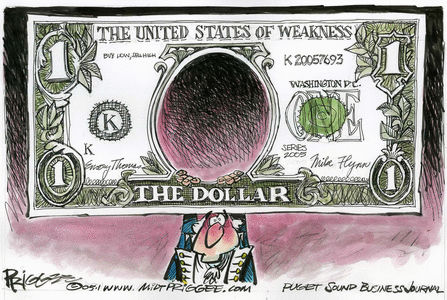
Weak dollar both helps and hurts the economy

Of course, a weak dollar is a very mixed blessing for the economy, and is hardly a sign of a strong or recovering economy.

Real residential fixed investment increased 5.0 percent, helped along by the extension of the home purchase tax credits from the federal government.

New housing helps spur growth in GDP

Real nonresidential fixed investment increased 6.5 percent. This figure nets out nonresidential structures, which decreased at a troubling rate of 13.9 percent, and equipment and software, which increased 18.2 percent. Investment in equipment and software consists of capital account purchases of new machinery, equipment, furniture, vehicles, and computer software; dealers’ margins on sales of used equipment; and net purchases of used equipment from government agencies, persons, and the rest of the world. Own-account production of computer software is also included, which is production performed by a businesses or government for its own use.

Again, the underlying figures show that those variables most associated with building a sustainable productive capital base for the economy – nonresidential fixed investment –are declining at an alarming rate. This, combined with a 9.7% unemployment rate and the specter of rising debt levels, energy prices, and taxes, paints a picture of a slow to non-existent recovery to a robust economy any time in the next year.

http://www.bea.gov/newsreleases/national/gdp/gdpnewsrelease.htm

by Sherry Jarrell