Author: Chris Snuggs

The Magic Solution

A Magic Pill for Everything?

I am always struck by Man’s desperate groping for a Magic Solution to each and every problem. It is a bit pathetic but also of course rather funny, especially if one tries to see things from the perspective of a visiting alien from outer space.

Looking for a Magic Pill?

Let’s take “The Fat Pill”. What we really want is not to eat properly and cut down our vast consumption of just about everything but especially burgers, chips, popcorn swamped in sugar, honey or chocolate, giant steaks and pizzas, crisps, candy, and of course alcohol and simultaneously combine this with a healthy lifestyle involving regular exercise that makes us pant (to get the heart going – nothing to do with sex, though Tiger Woods is clearly pretty fit)!

No, what we prefer is to keep on stuffing ourselves and then take a FAT PILL! Whoever invents this is going to make Bill Gates look like a starving rickshaw- puller in India.

Then there is the ALCOPILL. Rather than drink in moderation to the benefit of all and sundry many of us prefer to binge ourselves to the point of death and then, just before hitting the sack (if we make it that far), grope for the magic pill. I believe pharmaceutical companies worldwide are working furiously on this in the hope of hitting the jackpot. Much more profitable than boring old stuff with malaria, which kills millions every year.

It may be cynical old age, but I’m currently off magic solutions. As a language teacher, I saw the desperate scrambling for nirvana when language laboratories came in. Every school had to have one; every timetable was hacked about; teachers would become redundant ….. Oh dear … most language labs are now broken-down, dusty and abandoned piles of junk at the bottom of some rubbish tip somewhere.  Are wind-turbines in the same category?

dot.com? This was the magic pill of the late 1990s! The new paradigm. Everything would be different; billions could be made without doing any real work. Oh, and does this remind us of the banker’s world? Of course, they are an exception because DESPITE everything they can STILL make billions for doing no real work.

As for government finance (a quite different animal), the current British magic pill is to print money and bung it into the economy in the hope of stimulating “growth”. None of this “living within our means”, taking “a bit of strong medicine” stuff. No, we’ll go for the magic pill so we can get back to normal levels of debt and spending. Patience, virtue, moderation and commonsense are much less fun than the magic pill of printing money.

And there is a VERY GOOD reason for this of course: the GENERAL ELECTION is around the corner and we don’t want any pain BEFORE then, do we? After, of course – if we get the right result – we will have a bit of commonsense back. Not that we want to, but it’ll be forced on us by the markets … but then we can blame it all on someone else. In Britain’s case, Mrs. Thatcher will probably still come in for considerable stick, even though she left power nearly twenty years ago.

Magic? Sadly, one can see the same desperate groping for the easy solution in religion. We are metaphysically, morally, spiritually and practically lost, so let’s look for some magic to provide a solution, even if there is not the slightest proof of the existence of God that would stand up in court.

Our epitaph may well be: Homo Sapiens – the Magic Species. Unfortunately, magic is best left to conjurors; it is not a recipe for managing society.

by Chris Snuggs

In or out of recession?

A friend on another site just posed this question.

Why is it that a recession is described as two or more successive quarters of “negative growth”, but being out of recession is just one quarter of (estimated) growth?

I felt emboldened to pen an answer as follows ….

In Britain, the definition of recession-emergence is from the same school of economics as growth predictions for next year (any year), which are always about 5 zillion% more than actually turns out to  be the case.

Recession in Britain

The cunning  idea is that future growth will be vast enough to cover the even vaster existing debts and commitments. And, of course, by the time we KNOW what the growth actually turned out to be, most people will have forgotten the predictions on growth from the financial and economic wizards running the country. That’s also one of the great things about a new mess or crisis; it always takes the mind off previous crises, which are likely to be ongoing but less in the media and therefore not to be bothered about too much.

This is, of course, in addition to the fact that growth in itself is incompatible with reducing global warming, but here we are getting a bit too technical.

Well, that’s how we do it in Britain anyway. How do you manage it over there?

by Chris Snuggs

A reply from a U.S. economist.

Hello there Chris!

Recession in the U.S. is also defined as two successive quarters of negative GDP growth.  At least, that’s how its officially defined.  And to add my answer to your friend’s question — either the economy is either in a recession — i.e., two or more consecutive quarters of negative GDP growth — or it isn’t, which means that the string of negative GDP growth rates is broken.  And that only takes one quarter of positive growth.

Most of the economists I know personally tend to look at a bigger picture than the stated GDP figures, however.   I focus on capital and labor utilization rates as I believe that they are more important measures of a well-functioning economy.  The final GDP figures in both of our countries are national income accounting figures, and have all the weaknesses of any income statement variable.   They are flow variables, which ignore the stock of economic wealth.   For example, if you invest $100 this year in the stock market, and it grows in value by $20, only the $100 is counted. The increase in wealth is never captured in measures of GDP.

Another problem with current measures of GDP and GDP growth is that government spending is considered on par with private spending, which brings into question the sustainability of growth measures based on GDP, although President Obama and perhaps Prime Minister Brown are both fine with growth rates being fueled by large increases in government spending.  Finally, a significant fraction of economic activity, like the value of work in the home — is not measured.

So, yes, the official measurement of GDP is all wrapped up in technicalities.  But most economists I know pay little attention to it.  They are more concerned with how well the economy is functioning, whether the growth is sustainable, and whether people who want to work can find work.  If you are unemployed, the economy is in a recession, regardless of what the GDP figures say!

by Sherry Jarrell

The Toyota Fiasco

Toyota – How not to do business!

Learning from Dogs was created by a few people who felt compelled to promote the values of “integrity”, which is often in short supply in the modern world, though perhaps it always has been to some extent in all civilisations. Is dishonesty an eternal part of Human Nature? We like to think not …..

Well, “Integrity” includes being honest, open and dedicated to the truth, even if this is personally inconvenient. It may seem a somewhat forlorn hope to promote something that for an important minority of people is and will probably remain an alien concept, these being people who put self above group. However, the recent Toyota fiasco reminds me that perhaps integrity’s time has indeed arrived, for this is THE INFORMATION AGE. It is NO LONGER easy to hide the truth, which tends to come out now with greater frequency due to a variety of factors including most importantly the Internet. But there are other reasons, too. To take Britain, for example, we now have the “Freedom of Information Act”, which – despite some limitations – has done wonders in allowing the free press (another essential ingredient of course, and sadly lacking in so many countries) to reveal wrong-doing, principally by appallingly-incompetent governments.

Toyota chief Akio Toyoda

As for Toyota, what has staggered me is that the company KNEW of these accelerator & brake problems several years ago. Indeed, people began having crashes as far back as 2006. Yet only recently has it done anything serious about putting things right.  One has to wonder what on earth possessed the Toyota bosses to think that they could get away with it, which on the face of it seems to be exactly what they were trying to do. Who was advising them? It seems to me to have been INEVITABLE that the truth about their cars’ problems  would come out, so even from a cynical and selfish point of view they should have recalled the defective cars at least two years ago. But quite APART from the wisdom of doing that in practical, business terms (the result of delay being to devastate the company’s image to a far greater extent than would otherwise have been the case) there was a MORAL aspect to the problem, too. By ALLOWING the problems to go unresolved they put people at risk. And not just ANY people, but their customers! As has been said before, but sadly with all too much frequency, “You couldn’t make this up.”

How could the world’s number one car manufacturer get it so utterly and totally wrong, both from a moral and practical point of view? I am wondering if Toyota can recover from this. Yes, I know they are big, but there are PLENTY OF CHOICES for people seeking to buy a vehicle. Who in their right mind is now going to buy a car from a company which A) made defective cars (and MILLIONS of them) and B) HID THE TRUTH while people were dying in crashes?

One reason may again be the Japanese obsession with “face”. It was probably difficult for the world’s number one company, which seemed capable of nothing but success, to admit publicly that it had got things badly wrong. The Chairman is now admitting this, but to be frank it reminds me of the old expression about getting blood out of a stone, or being dragged kicking and screaming to the confessional.  And from what I read today he seems to be blaming the troubles on the fact that “the company may have grown too quickly.” I could describe this utterance with an extremely rude word or two but as this is a family site I will refrain. Let’s just say that the company WASN’T HONEST.

I remember as a kid growing up in the shattered London of the1950s the lessons I got from teachers and parents. One of those which stuck in my mind was “Honesty is the best policy.” This has never been more true as it is now. For the Brave New World we dream of honesty is a sine qua non. We must be honest with ourselves, our friends, families, companies and the public. There is no other way to happiness. Will Toyota’s disaster be a lesson for other companies?  NOBODY can get it right all the time and there is no dishonour in the occasional failure, only in the lies involved in trying to cover it up. How many times has this been demonstrated? Had Nixon come clean at once about Watergate he might have survived, but the cover-up was worse than the deed.

On a practical note, I sincerely hope that the families of those killed or maimed in Toyota accidents will sting the company for every yen they can; that is no more than the company deserves.

By Chris Snuggs

[BBC News had an item on the 24th that makes interesting watching. Ed.]

The Planet’s Resources

Who do the Earth’s raw materials really “belong” to?

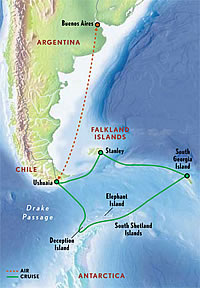
So once again the Falkland Islands have hit the headlines, and as usual for the wrong reasons. The British have given the green light for oil exploration around the islands and Argentina has resisted by imposing restrictions on shipping movements, if not (yet) an all-out blockade.

Who knows where this one will end? It could either fizzle out or erupt into another full-scale confrontation, since big issues are involved, and none bigger than nationalism, for Argentina claims the islands as “its own”.

The history of the Falkland Islands is long and complex, but the idea that Argentina has any fundamental right to these islands is surreally silly. Argentina is owned and ruled by descendants of the Spanish, who took over the land that now forms Argentina (a state in its own right only since the early 19th c) as part of the European colonisation of the world. By all means let us return the Falklands to their original owners, except that the first people to settle there were French for a start. And if you are going to adopt the principle of returning land to its original owners, then we can look forward to most of the population of Argentina returning to Spain and returning the land to the Indians, can we?

The other argument often advanced is that “the islands are near Argentina”. Well, I don’t know when these people last looked at a map but 300 miles isn’t exactly “near”. But in any case, if we are to adopt nearness as a criteria for the reapportioning of land then I look forward to England once again reclaiming France, a mere 21 miles away. And what on earth is Corsica doing as part of France? But of course France must have the Channel Islands, as they are very near – and so on. “Continental shelf”? “We own the land under the sea?” Go down this route and we’ll need a whole new generation of map-makers.

When all the idiotic, overblown, childish and nationalistic guff (which sadly  led to many hundreds of dead in the 1972 war) is stripped away from this debate, we are left with two fundamentals:

  • the right of self-determination
  • the way the Earth’s resources are used

As for the first, there have been British people living on the islands since at least 1833. They have – as I believe all people have – the right to determine their own fate.  This is called self-determination. Unfortunately, it is a noble principle to which the world all too often pays only lip-service. The nation state has become an entrenched, solidified system, mostly because it confers great power on the leaders of each state, who – especially when democracy has not taken root – use the statehood to advance their own power and megalomania. Statism has for centuries run roughshod over people’s fundamental rights. Iraq was a “state”, but one where the Kurds (denied their own state by British cynicism) suffered cruelly under the jackboot of a fascist psychopath. That the British eventually helped to remove this monster (suffering enormous criticism from in particular the country that inspired the world with its own Revolution in 1789) is only a tiny compensation for the original injustice done to the Kurds. They are by no means alone; minorities all over the world suffer in different degrees from arrogant statism: Tibetans; Basques,; American Indians and Australian aborigines among many others. Yes, injustices were done centuries ago, but you cannot wind back history, or where would it end?  How would Europe cope with all those Yanks for a start if they gave the USA back to Sitting Bull’s descendants? Apparently, we all came originally from Africa. Should we all return there and leave our countries empty?

Well, on the Falklands are Brits, and Britain did them the honour of allowing them freely to choose whether they want to be annexed to Argentina. This would in fact give them innumerable advantages, plus of course potentially-disastrous disadvantages. As trust is in short supply, these people prefer not to take the risk and so remain British. That is their right. In refusing to discuss “sovereignty”, Britian is doing no more than strike a blow for self-determination. To give Britain its due, it has pursued the same policy – albeit modestly – towards the (in the eyes of some of them) oppressed Welch, Scots and Irish.

So much for fundamental 1. The Argentinian case is pathetic.

What about the RESOURCES question?

Well, resources are another area where the state jackboot falls with great weight. We all breathe the same air, share the same sun, the same water; but where the stuff under the ground is concerned, it’s every state for itself. Yet casting aside state arrogance, isn’t it ridiculous that state A can derive vast wealth from “its” oil, gold or whatever, while state B alongside it is mired in poverty and misery? So much for “share-and-share” alike. Even belonging to the same race is no help; while some Arabs built extraordinary palaces and Audi Quattros made of solid silver, poor Somalis, Yemenis, and even Egyptians are mired in abject poverty. (Check out this Arab Palace in Dubai, and Mugabe’s presidential palace in Zimbabwe, which is by no means untypical of poverty-stricken Africa)

One day, in a joined-up world which recognizes that we are all brothers, we will share resources “fairly”. Britain could show the way by offering to share any oil resources with – not only Argentina – but all of Latin America (though we could leave out Venezuela …) What a blow for brotherhood that would be!

By Chris Snuggs

Laughing Latins

Mr Sepp Blatter demonstrating how a foot may be placed in a mouth!

John Terry

Sepp Blatter, or Blabber as he is more affectionately known, is never at a loss for words, and generally good entertainment value.  However, this week he surpassed himself with a pontification of pretty unsurpassing silliness about the moral values of South-Western Europe.

For those who do not follow the minutiae of British football, John Terry, Captain of the English football team, was unfortunate enough to have his name dragged through the media in connection with his adultery, or as some alleged, serial adultery. Now the question of whether it is anyone else’s business what the Captain of England does in his “private”  life is an interesting one, but  I am today more concerned with Blabber’s response, and two things struck me about it in particular.

Here’s a quote from a piece in the UK newspaper The Guardian.

Fifa president Sepp Blatter has claimed that in some countries, John Terry would have been applauded rather than sacked as national team captain for having an alleged affair.

First of all, I am puzzled as to why Blabber feels he can elect himself as spokesperson for the whole of “latin” Europe? He is a football functionary, not a moralist. I must say that had I been latin I would have found his remarks offensive. As an Italian lady was quoted as saying: “If my husband slept with my sister I would not find it in the least amusing or applaudworthy.”

Secondly, let us suppose – for the sake of argument – he was right to say that

Sepp Blatter, FIFA

latins would have applauded Terry’s behaviour.  This would mean that the vast majority of European Catholics were totally and utterly hypocritical. After all, “Christians”, nominal or otherwise, still go in vast numbers to churches for weddings, baptisms and funerals, don’t they? Here in Bavaria, whenever you pass someone in the street you say “Gruss Gott.” Is Blabber really saying that all these people just take the easy bits of Christianity and laugh at the tricky stuff, like adultery, rich people and eyes of needles, treating their neighbour as thy brother and so on?

And that IS in effect what he said. Insults don’t come a lot grosser, do they? In fact, this was a DOUBLE WHAMMY. First he insulted all of Catholic Europe and simultaneously he insulted all the Anglo-Saxons by describing the furore over Terry’s philanderings as “Anglo-Saxon in nature”. And of course, the term “Anglo-Saxon” is one of fairly strong abuse, especially among the French elite.  This by the way has always amused me, since most of the Germans started off as Saxons, and the Germans are very PC, whereas the British certainly are not PC, even if half of us originally CAME from Saxony!

As for adultery, well, let’s be clear, it isn’t “good”, is it? OK, “There but for the grace of God go I.” , “Let no man cast the first stone”, “Forgive and Forget” and so on, but for society it isn’t really desirable that people should treat their marriage vows as casually as Blabber seems to think half of Europe does, is it?

In Britain for a start (but we are not alone)  there is the lowest level of marriages for over 100 years and very high levels of divorce, This isn’t “good” for society, is it? And of course, I’m thinking especially of the children involved.

And when you marry, you make vows. Do these now mean nothing to people like Blabber, who thinks that Catholic latin Europe would laugh at Terry’s adultery?

Well, people in positions of power and responsibility should reflect more before they speak, because many lesser mortals may make the mistake of giving their remarks a credibility they do not deserve.

And of course, the Captain of England is a role model, and – possibly unfairly – not only on the field.

By Chris Snuggs

Tax, Law, Crime and Morality in Banking

More holes than in a Swiss Cheese!

There is currently a merry old ding-dong spat going on between the German and Swiss governments. Basically, someone has got hold of information about German citizens with bank accounts in Switzerland where they are hiding large sums on which they should pay German taxes.

This or these enterprising whistleblower(s) are offering to sell this data to the German government for a hefty fee. The German government is on the point of accepting to buy this “illegally-obtained” information from the (from the Swiss point of view) criminals who have stolen their secret bank data.

This story raises a large number of fascinating questions. It has long been common knowledge that Switzerland offers banking facilities with few questions asked. Any self-respecting criminal or tax evader has or had a secret, numbered Swiss account.

What has always amazed me is how they have got away with this for so long, stuck as they are in the centre of Europe. How is it possible that other countries have allowed Switzerland to become a haven for money obtained illegally in other countries?

For it is clearly immoral to profit from the illegal activities of foreign nationals, isn’t it? What exactly is the difference between this behaviour and “receiving stolen goods”? Worse, we have to remember that the largest sums come from drugs. Anyone willing to look after (or launder) drug  money is complicit in the misery and deaths of millions of drug addicts worldwide. Yet the Swiss have pulled off this trick for decades. The Swiss banking (and government) fraternity has never shied away from shady dealings, being until the end of WWII covert supporters of the Nazis.

Well, Angela Merkel is going to do a deal with presumably Swiss “criminals” (according to the Swiss government) in order to recoup money it is owed by German criminals (according to Germany). What a merry old moral maze we have here. But in truth, the world is now too small and inter-connected to allow either tax evasion on a vast scale  or the safeguarding of criminal funds.

Switzerland has to decide whether to remain as a supporter of tax evaders and gangsters (including of course African Presidents who have ripped their countries off in a big way) OR to join the real, civil, honest and inter-connected world.

The rest of us should stop tolerating this connivance with crime. “Client secrecy” is no excuse for condoning and profiting from crime.

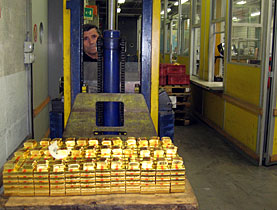
More on the whole  Nazi gold in Switzerland story is here.

By Chris Snuggs

More Trouble Ahead?

This is clear! Clear as mud!

Help!! Is there a financial Wizard out there somewhere? I need your input! My bank, the Société Générale, is advising

Société Générale

its customers that “a global economic collapse” is very possible within the next two years and that we should make “defensive preparations” for it.

Is this a sign of the bank losing its mind (and they did lose £5 billion a few years ago at the hands of a rogue trader) or do they know something that other pundits don’t?

Where is the Guru that can tell me where I should put my money now? Under the mattress? And in which form? Shirt buttons?

They say gold will skyrocket as the only thing buyable worth buying! And there’s me having just sold all mine at what I thought was the top of the market!!!! Oh Dear …..

By Chris Snuggs

The Wobbling Euro

Europe puts on a grand farce for the rest of the world to watch and wonder at.

The “Greece scuppers the euro” soap opera is steaming along at top speed and the iceberg ahead is more than big enough to sink the Euro, the flagship of those seeking a United States of Europe.

The Euro coin

Several very interesting things are becoming clearer about all this:

A) Greece (and for that matter some other countries) was NOT “ready” for the straitjacket of a single currency in the same bed as Germany, Holland and other serious (well, sort of ) countries, particularly in the North ….

B) The EU hierarchy set some stiff rules for entry to the Euro, which Greece LIED about to gain entry.

C) I firmly believe the EU leaders KNEW that Greece’s figures were the delusional fruits of fraudulent pretention, but they PRESSED ON regardless.

The question is, WHY did they let Greece in? And the reason was – I maintain – their GREED. Not directly for money (though that is ever in the background) but for POWER. The more countries in the Euro the bigger the organism and all organisms seek to grow to their maximum.

The bigger the Eurozone the more unstoppable the momentum would appear (and “appear” is certainly the right word) and the more power would accrue to Brussels and Frankfurt. POLITICAL GREED overcame economic and financial logic.

But the chickens always come home to roost and the result could now be the OPPOSITE of what they wanted to achieve.

Coming back to the roost

Instead of a tight core of financially-stable and righteous Eurocountries that could have thrived as a model for others to emulate and join, Euroland has become a haphazard bodge of totally-disparate economies that has every chance of unravelling in chaos.

I have no desire to see the Greeks or anyone else in economic trouble, but we cannot build a new Europe – let alone world – on lies and a lack of realism. A touch of hubris is direly needed. More practically, we need more long-term planning and less short-term political greed and cowardice.

If this Greek crisis had happened when the EU was flush with funds then it could perhaps – temporarily – have been bodged over as usual. Now we are still on a financial knife edge, and it could go either way. There is some talk that this crisis could accelerate political and monetary union, but I can’t see individual countries giving up their financial independence to Frankfurt and Brussels …. what is true is that we are in dangerous waters out of control and maybe heading towards the rapids … (or the iceberg …) Most EU countries are already in serious trouble; the last thing they need is a further drain on scarce resources. The Greek patient could well bring down the German doctor …….

One of the funniest things (if you like black humour) was soon after the EU bigwigs fixed a ceiling of 3% above GDP for countries’ budget deficits. In other words, countries joining the Euro had to guarantee to take steps to ensure this ceiling would not be breached, and this in the interests of Euroland as a whole; a sort of collective responsibility.

Yet as soon as FRANCE found it could not apply the self-discipline to keep to this promise (do promises matter at all in politics?) then some French government spokesperson said when challenged on this that “the rule could not be applied to big countries.

You couldn’t make it up!!!

By Chris Snuggs

Rationing – the New Paradigm?

A World War II practice may reappear.

Some little time ago I wrote about the word “fair”, which I tongue-in-cheek referred to as a Word of Mass Destruction (WOMD) insofar as if one REALLY put into place practices that were truly “fair” then western capitalism would break down completely. (The story of the CEO of Goldsmiths and his $100,000,000 bonus is for another day ….)

Well, my OTHER WOMD is “rationing”.

I was drawn to this topic by the words of a British minister about the desirability of introducing rationing into AIR TRAVEL.  The thinking goes (and to be honest it is in fact obvious, isn’t it?) that IF we are serious about reducing climate change (a VERY BIG IF!!) then we cannot continue to hope to fly where and when we want to as in the past. For aviation is a growth industry despite the current crisis, and as people in developing economies in Asia in particular grow more prosperous they will want to travel more and more. I have seen estimates to suggest that within a decade ONE HUNDRED MILLION Chinese will be travelling to Europe EVERY YEAR.

This is of course totally incompatible with any hope of doing anything serious about climate change. The logical conclusion is that (until some boffin invents an emission-free jet) we MUST reduce flying. This is likely for most adults to be about as palatable as denying burgers and chips to British teenagers, but I really cannot see the alternative IF Global Warming is to be taken seriously (which it probably won’t be until it’s too late).

But let’s for the moment remain positive …. supposing it is decided by some courageous government (are there any?) that we must reduce flying then there are two ways to do it.

A) TAX it so highly that only the rich can afford it

B) RATION it – everyone has a quota of air miles per annum.

Now option A is the usual free-market/capitalist way. After all, Ferraris are rationed by their price; otherwise all males over 18 would have one, or in my case several. But – much as I recognize what the free market has done in terms of wealth creation – we are in a new scenario, aren’t we? Can we really hope to say that only the rich can fly? I think not, and therefore rationing is the only way to do this.

Now, there is a minority of people that abuse anything, and no doubt rationing would be abused by some, somewhere, somehow. But it is the only FAIR way to go about it, isn’t it?

In London and other big cities we are now seeing a TAX imposed on driving into the city centres. Yes, very sensible, but of course, the RICH aren’t bothered. In effect, schemes like London’s are simply a way of excluding the masses from the city centre. The same idiocy is seen on French motorways, which are becoming increasingly expensive. The rich are not bothered by the tolls but the less well-off certainly ARE and so drive on other roads which are less safe; survival of the richest …….

No, the free-market is not going to work in the Brave New World which we are entering. If you have a birthday party for your kids then EVERYONE gets an equal share of the cake. This principle is going to have to be applied in other areas of life, otherwise we are going to get serious social unrest. Besides, any other way is just not FAIR, is it?

Of course, once you concede the point on AIR TRAVEL there is – in a world of increasing populations and diminishing resources – no way of limiting the concept purely to air travel, is there?

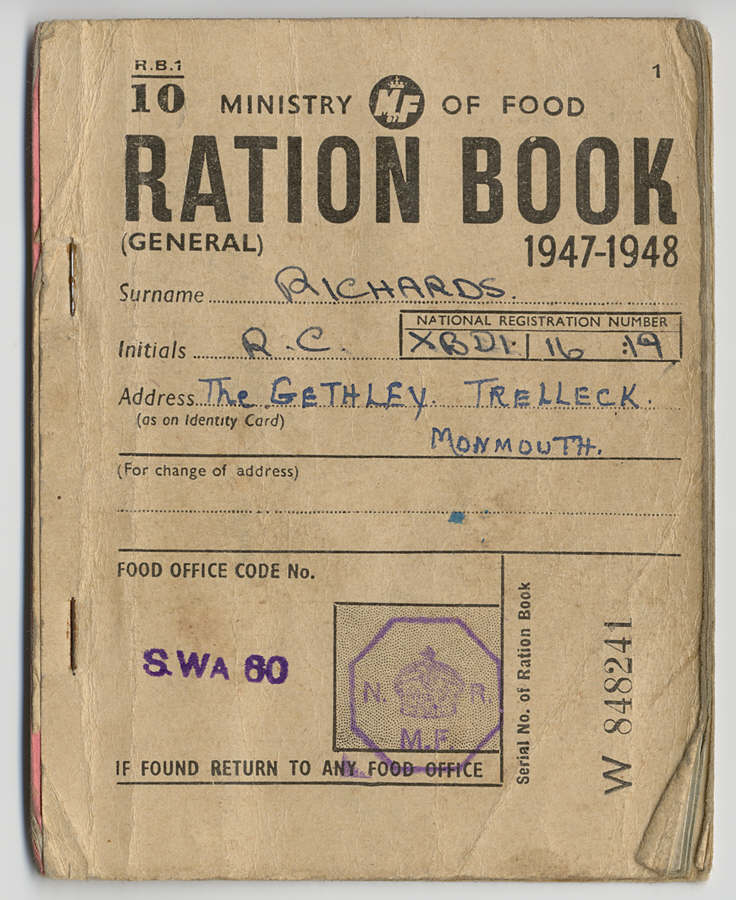
I am just old enough to remember my Mother’s WWII ration card, which she used up to the very early 50s I believe. Will we soon start to see a modern reincarnation, and not only in carbon credits?

By Chris Snuggs

WWII Ration Card - UK

Growth is BAD for us

Growth is good for us?  Sorry, wrong!

An interesting story on the BBC recently. It seems that growth is now “bad” and incompatible with reducing global warming.

I have to say that this always seemed obvious to me (and despite appearances  – or indeed pretentions – I am not that clever) since IF industrial production and emissions are creating too much CO2 then it is surely obvious that more of the former will produce more of the latter. Any flaws in this argument will surely be pointed out to me pdq, but I won’t be losing any sleep – or indeed I suspect – the argument!

Well, the theory that growth is bad has now been confirmed by a scientific study …..  of course, we have learned to take some of these studies with a pinch of salt, and it doesn’t help when scientists on the “we are doomed” side sex up their findings to make their case, as was revealed just recently. I found this hilarious!! Once again, a dishonest intention to achieve ONE kind of result (boost the doomsayers’ cause) actually achieved the OPPOSITE!!! When will they ever learn?

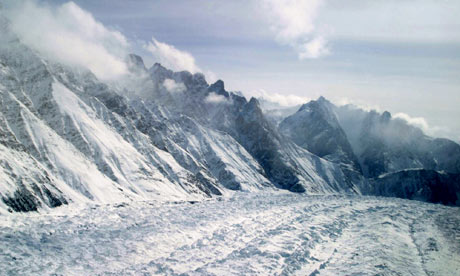
An aerial view of the Siachen Glacier, which traverses the Himalayan region dividing India and Pakistan. Photograph: Channi Anand/AP

As for the evils of growth, I am wondering if the British Prime Minister has been informed? His entire strategy (if that is not too noble a word to use in this context) has for well over a decade been based on growth (indeed growth triumphantly trumpeted in advance as likely to be at a level far higher than it actually turns out to be) bringing in enough money to pay for his humungous over-spending.

He must be urgently rearranging his matchsticks in an effort to cook the books once again ….

And there is another side of the “no-growth” movement. YOU may very well decide that in the cause of saving the planet you will keep your consumption where it is, but – logically – that also means people in the developing world who are incredibly poor keeping THEIR consumption where IT is.  That is one hard sell. Of course, YOU may then decide to REDUCE your consumption down until it meets theirs coming up ….. No? Oh well …..

The way I see it, growth is inevitable, whether it is good for the planet or not. Which is a bit of a poser if growth is going to doom us. Still, I remain an optimist – some genius will find a way out of this enigma …. but please make it soon before we grow too much!!

By Chris Snuggs