In Alex’s own words, “My main camera is the OM system OM-1 mkii with the 150-400 TCPro lens and had an external 2x teleconverter on the lens giving me over 2000mm effective reach.“
The video is fascinating.
If for any reason you cannot watch the embedded YouTube video above, then try this:
How to Capture Stunning Photos and Videos of Your Dog With Ease
For beginner dog owners who want Instagram dog photos without stressing their pup, the hardest part is how quickly dogs move and how fast those perfect moments disappear. One second brings a head tilt, a goofy grin, or a soulful look, and the next second it’s gone, leaving blurry shots that don’t match the bond dog owners feel in real life. The good news is that pet photography basics don’t require fancy gear to start capturing dog expressions with more consistency. With a little patience and a creative pet photography mindset, everyday walks and couch cuddles can turn into photos and videos that feel true to a dog’s personality.
Quick Summary: Better Dog Photos and Videos
Use natural, soft lighting to flatter your dog and avoid harsh shadows.
Choose calm, comfortable locations so your dog stays relaxed and camera-ready.
Get down to your dog’s eye level and try simple angle changes for more engaging shots.
Use treats or toys to guide attention and capture alert, happy expressions.
Keep edits light with basic photo editing software to enhance, not overhaul, your results.
Set Up the Shot: Light, Gear, Angle, and Composition
A few small setup choices can turn a “cute but blurry” pet photo into something you’re proud to frame or share. Use these quick, beginner-friendly tweaks to make your dog’s expressions look crisp and natural.
Start with gentle natural light: Put your dog near an open doorway, a bright window with indirect light, or outside in open shade (like under a tree or porch). You’ll get softer shadows and truer fur colors, natural light improves photo quality in ways harsh indoor bulbs often can’t. If the sun is strong, turn your dog so the light hits from the side, not straight overhead.
Choose a pet-friendly spot that sets your dog up to succeed: Pick a location where your dog can relax and move safely, your living room rug, a fenced yard, or a quiet park corner away from busy paths. Avoid slippery floors, crowded dog areas, or places with tempting trash and food smells that pull attention. The more comfortable your dog feels, the easier it is to capture genuine expressions without pushing them past their stress threshold.
Stabilize with an adjustable tripod (even for phones): Set an adjustable tripod low for “dog-level” photos, or raise it slightly for a clean, simple background. Stability helps both photos and video look instantly more polished, especially indoors where shutter speeds drop. For extra flexibility, try a wide stance for the tripod legs so it won’t tip if your dog bumps it.
Use a remote shutter or timer to free up your hands: A remote shutter lets you keep your attention on your dog instead of hovering over the screen, which often leads to better eye contact and calmer behavior. If you don’t have a remote, use a 3–10 second timer and cue a simple “sit” or “touch” right as it counts down. This also helps with ethical handling, you can reward quickly and keep sessions short and positive.
Shoot from your dog’s eye level for more personality: Kneel, sit, or even lie on the floor so the camera is level with your dog’s eyes. This angle makes faces look more expressive and avoids the “tiny dog on a huge floor” effect you often get from standing height. For videos, hold that low angle steady for 5–10 seconds at a time so you can capture a full expression or head tilt.
Use simple composition rules to spotlight the face: Put your dog’s eyes near the top third of the frame, and leave a little space in front of their nose in the direction they’re looking. Scan the background for distractions, bright laundry, trash bins, tangled leashes, and shift a step left or right to clean it up. If your dog is dark-coated, place them against a lighter, uncluttered background so their features don’t disappear.
Common Questions About Easy Dog Photos & Videos
Q: What lighting conditions work best for taking Instagram-worthy photos of my dog? A: Aim for soft, even light so fur texture and eye sparkle show up naturally. Bad light, you have bad video, so step near a bright window indoors or choose open shade outside to avoid squinting and harsh contrast. If your dog seems restless, keep it short and try again later rather than forcing the moment.
Q: How can I get my dog to look directly at the camera for photos and videos? A: Make the camera “predict good things” by rewarding calm glances with a tiny treat or gentle praise. Hold a treat near the lens, cue an easy behavior your dog enjoys, then release quickly so it stays fun. If your dog turns away, respect that and capture a candid moment instead.
Q: What types of equipment are worth investing in to improve my dog photography? A: Prioritize stability and speed: a simple tripod or phone clamp and a remote shutter reduce blur and let you focus on your dog. If you shoot lots of video, a small light or reflector can help in dim rooms without startling your pup. Upgrade only when your current setup feels limiting.
Q: How can I edit my dog photos to make them more engaging without overdoing it? A: Start with gentle tweaks: crop to emphasize eyes, brighten slightly, and lower highlights to keep fur detail. Keep colors realistic so your dog still looks like your dog, and avoid heavy smoothing that erases whiskers and texture. Save a “natural” preset so your style stays consistent.
Q: What should I consider if I want to create and share a dedicated Instagram account for my dog? A: Let your dog’s comfort set the pace, not a posting schedule, and skip anything that stresses them for the sake of content. Share moments that reflect your values, like enrichment, consent-based handling, and everyday joy. Use short clips, then optionally clean them up with a web-based video creator to trim, stabilize, and add simple captions.
In early April 2026, the Artemis II mission captivated me and millions of people watching from across the world. The crew’s courage, skill and infectious wonder served as tangible proof of human persistence and technological achievement, all against the mysterious backdrop of space.
People back on Earth got to witness the mission through remarkable photos of space captured by astronauts. Images created and shared by astronauts underscore how photography builds a powerful, authentic connection that goes beyond what technology alone can capture.
As a photographer and the director of the Rochester Institute of Technology’s School of Photographic Arts and Sciences, I am especially drawn to how these photographs have been at the center of the public’s collective experience of this mission.
In an era when image authenticity is often questioned and with the capabilities of autonomous, AI-driven imaging, NASA’s choice to train astronauts in photography has placed meaning over convenience and prioritized their human perspectives and creativity.
Capturing space from the crew’s perspective
Photography was not originally placed as a high priority in NASA’s Apollo era. The astronauts only took photographs if they had the chance and all their other tasks were complete.
‘The Blue Marble’ view of the Earth as seen by the Apollo 17 crew in 1972. NASA
This excitement could be explained by the novelty of photos from space, but these images also distinguish themselves as products of astronauts experiencing these sights and interpreting them through their photographs. These differences require an important distinction around where technology ends and humanity begins.
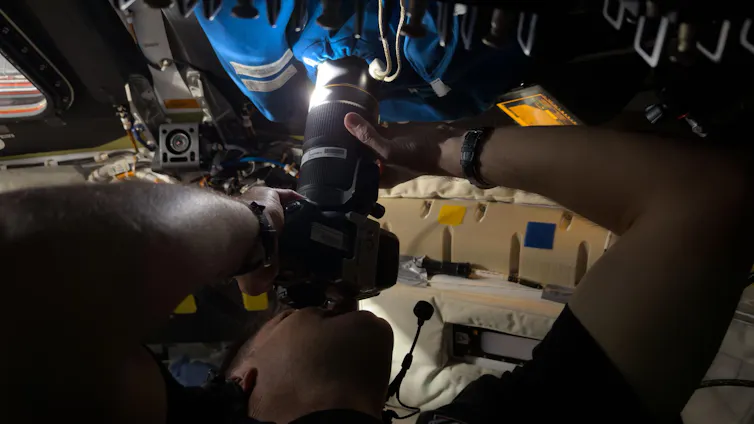
NASA astronaut Reid Wiseman watches the Moon from one of the Orion spacecraft’s windows. NASA
Human perspective versus AI tools
Photography has long integrated AI-powered software and data-driven tools in a variety of ways: to process raw images, fill in missing color information, drive precise focus and guide image editing, among others. These modern technological assists help human photographers realize their vision.
And AI can generate convincing, realistic images and videos from nothing more than a text prompt, using readily available tools.
Researchers train AI to mimic patterns informed by millions of sample images, and the algorithm can then either take or create a photograph based on what it predicts would be the most likely version of a successful, believable image.
Human-created photos are rooted in direct observation, intent and lived experience, while AI images – or choices made by AI-driven tools – are not. While both can produce compelling and believable visuals, the human photographs carry emotional power because the photographer is drawing from their experiences and perspective in that moment to tell an authentic story.
Artemis II photographs resonate, not only because they are historic, but because they reflect the deliberate choices and intent of a human being in that specific moment and context. The exposure, camera setting, lens choice and composition are all dictated by the astronaut’s vision, skill, perspective and experience. Each image is unique in comparison with the others. These choices give the images narrative power, anchoring them in human perspective.
NASA’s ‘Earthset’ photo captured by the Artemis II crew. NASA
Images to tell a story
Photographers choose what to include in the final version of their image to tell a story. In the Artemis II images, this human perspective comes out. In the “Earthset” photo, you see a striking juxtaposition of the Moon’s monochromatic, textured surface in the foreground against a slivered, bright Earth.
The choice to include both in the frame contrasts these objects literally and figuratively, inviting comparison. It creates a narrative where Earth is contrasted against the Moon – life is contrasted against the absence of it.
Another photo shows the nightside of the whole Earth, featuring the Sun’s halo, auroras and city lights. The choice to include the subtle framing of the window of the capsule in the lower left corner reminds the viewer where and how this image was captured: by a human, inside a capsule, hurtling through space. That detail grounds the photograph in the human perspective.
Both photos are reminiscent of Earthrise and the Blue Marble. These past images hold a place in the global collective consciousness, shaped by a shared historical moment.
The Artemis II photographs are anchored in this collective moment of lived human experience, yet also shaped by each astronaut’s viewpoint. The crew’s unique perspectives exemplify photography’s transformative power by inviting viewers to engage emotionally and intellectually with their journey. These photographs share the astronauts’ awe and wonder and affirm the value of human creativity and its ability to connect us in a captured moment.
I am going to repeat a sentence towards the end of the article: “These past images hold a place in the global collective consciousness, shaped by a shared historical moment.”
Amazingly, Jean and I were being run recently in to somewhere local and Trevor, our driver, was listening to a talk by David Eagleman. I was captivated.
In that talk David Eagleman spoke about Roger Penrose and his research into consciousness. Here’s an AI summary:
Roger Penrose proposes that human consciousness is non-computational and originates from quantum processes within brain neurons, rather than just neural connections. Together with anesthesiologist Stuart Hameroff, he developed the “Orchestrated Objective Reduction” (Orch OR) theory, which suggests consciousness arises from quantum computations in microtubules.
Roger Penrose is the author of The Emperers New Mind.
Thus, beyond the eighty-six billion neurons that make up the brain, there are also the microtubals. These are very small and the diameter of several thousand of them are less than the diameter of the human hair. See WikiPedia.
“The brain has deep purpose” was one of the sayings Eagleman spoke of. “Why do we have experience” was another.
There was much more that I did not really understand. But it was still fascinating.
Then we discovered that what Trevor was listening to was also a video. The video is Inner Cosmos. It runs for 75 wonderful minutes.
Here is that video.
To say that this has absolutely updated my mind to a newer level is an understatement; big time!



 Learning from Dogs