Category: Politics

Breaches of trust.

A riveting article from George Monbiot.

George Monbiot published an article in The Guardian recently that was as hard-hitting as I have ever read from him.

I found it very powerful even though I have not been living in England since 2008. Mr Monbiot has previously given me permission to republish his articles and here it is.

ooOOoo

Four-Year Plan

Posted on 3rd June 2025

Keir Starmer has accidentally given us four years in which to build a new political system. We should seize the chance.

By George Monbiot, published in the Guardian 27th May 2025

This feels terminal. The breaches of trust have been so frequent, so vast and so decisive that the voters Labour has already lost are unlikely to return. In one forum after another, I hear the same sentiments: “I voted for change, not the same or worse.” “I’ve voted Labour all my life, but that’s it for me.” “I feel I’ve been had.”

It’s not dissatisfaction. It’s not disillusionment. It’s revulsion: visceral fury, anger on a level I’ve seldom seen before, even towards Tory cruelties. Why? Because these are Tory cruelties, delivered by a party that claimed to be the only alternative, in our first-past-the-post electoral system.

Everyone can name at least some of the betrayals:

 cutting disability benefitssupplying weapons and, allegedly, intelligence to the Israeli government as it pursues genocide in Gaza; channelling Reform UK and Enoch Powell in maligning immigrants; slashing international aidtrashing wildlife and habitats while insulting and abusing people who want to protect them; announcing yet another draconian anti-protest law; leaving trans people in legal limbo; rigidly adhering to outdated and socially destructive fiscal rules; imposing further austerity on government departments and public services. Once the great hope of the oppressed, Labour has become the oppressor.

Like many people, I was wary of Keir Starmer. I had limited expectations, but I willed Labour to succeed. So I’ve watched aghast as he and his inner circle have squandered one of the greatest opportunities the party has ever been granted. They seem to despise people who voted for them, while courting and flattering those who didn’t and won’t.

The results? Last week, the polling company Thinks Insight & Strategy found that 52% of those who voted Labour in the 2024 general election are considering switching to the Liberal Democrats or the Greens. That’s more than twice as many as might migrate to Reform UK. The research group Persuasion UK estimates that Labour could lose 250 seatsas a result of this flight to more progressive parties (again, more than twice as many as it could lose through voters shifting to Reform). Figures compiled by the progressive thinktank Compass show that Labour would lose its majority on just a 6% swing. Already, while it won a massive majority on a measly 34% vote at the election, it now polls at just 22%.

Labour’s strategy is incomprehensible. Experience from the rest of Europe shows that when centrist parties adopt far-right rhetoric and policies, they empower the far right while shedding their own supporters.

What explains this idiocy? Labour has succumbed, quickly and hard, to the defining sickness of our undemocratic political system: the sofa cabinet system of close advisers. Opaque and unaccountable government favours opaque and unaccountable power. Ever receptive to the demands of rentiersoligarchsnon-doms and corporations, Labour’s oh-so-clever strategists are moronically giftwrapping the country for Nigel Farage.

Governments don’t start conservative and turn radical. The cruelty will set like concrete. The likely result is annihilation in 2029. On this trajectory, it might not be surprising if Labour were left with seats in only double figures.

Perhaps it’s a blessing that Starmer has shown his hand so soon, as we now have four years in which to prepare. I’m not a party person: for me, it’s a question of what works. And now we can clearly see the shape of it.

The Compass analysis, published in December, reveals extreme electoral volatility. This is caused by a combination of public fury towards austerity, exclusion, rip-off rents and startlingly low rates of wellbeing, and the “democratic mayhem” resulting from a first-past-the-post system in which five parties are now polling at 10% or more. Small vote shifts in this situation can cause wild fluctuations in the allocation of seats.

The report points out that the UK is an overwhelmingly progressive nation: in all but one election since 1979 most voters have supported left or centre-left parties. Of 15 nations surveyed, the UK has the extraordinary distinction of being both the furthest to the left and the most consistent elector of rightwing governments. Why? Because of our first-past-the-post system, which is grossly unfair not by accident but by design. Labour refuses to change it, as it wants to rule alone. The result is that most of the time it doesn’t rule at all.

The thinktank was hoping to mobilise the progressive majority around a revitalised Labour party, but that moment has passed. What the figures show, however, is massive potential for more radical change. A YouGov survey reveals that almost twice as many people want proportional representation in this country as those who wish to preserve the current system. So let’s build a government of parties that will introduce it.

Here’s the strategy. Join the Lib Dems, Greens, SNP or Plaid Cymru. As their numbers rise, other voters will see the tide turning. Encourage troubled Labour MPs to defect. Most importantly, begin the process in each constituency of bringing alienated voters together around a single candidate. This is what we did before the last election in South Devon, where polls had shown the anti-Tory vote evenly split between Labour and the Lib Dems. Through the People’s Primary designed by locals, the constituency decided to back the Lib Dems. The proof of the method can be seen less in the spectacular routing of the Conservatives (as similar upsets occurred elsewhere) than in the collapse in Labour’s numbers, which fell from 17% in 2019, and 26% in a poll before the primary began, to 6% in the 2024 election. The voters took back control, with startling results.

Whether you fully support any of these parties is beside the point. This coalition would break for ever the lesser-of-two-evils choice that Starmer has so cruelly abused, and which has for so long poisoned politics in this country. Game the system once and we’ll never have to game it again.

No longer will we be held hostage, no longer represented by people who hate us. It will be a tragedy if, as seems likely, Keir Starmer has destroyed the Labour party as a major political force. But it will be a blessing if he has also destroyed the two-party system.

http://www.monbiot.com

ooOOoo

Proportional representation is explained in detail here. There is also an explanation on WikiPedia here. From which I quote a small section:

Proportional representation (PR) refers to any electoral system under which subgroups of an electorate are reflected proportionately in the elected body. The concept applies mainly to political divisions (political parties) among voters. The aim of such systems is that all votes cast contribute to the result so that each representative in an assembly is mandated by a roughly equal number of voters, and therefore all votes have equal weight. Under other election systems, a bare plurality or a scant majority in a district are all that are used to elect a member or group of members. PR systems provide balanced representation to different factions, usually defined by parties, reflecting how votes were cast. Where only a choice of parties is allowed, the seats are allocated to parties in proportion to the vote tally or vote share each party receives.

That is a timely and powerful article from George Monbiot.
Improving equality

An extremely powerful new essay from George Monbiot.

While this post from G. Monbiot is about politics, I think it goes far beyond that. Hence my reason for republishing this essay, with George Monbiot’s permission. When I will die is not known but surely I will in the next ten years or so. I really want to leave this world seeing everything improving, from the lessening of the change in our climate, to a reduction in world fighting, to a greater equality for all.

Please, please be wrong, Mr. Monbiot.

ooOOoo

The Urge to Destroy

Posted on14th April 2025

It’s a cast-iron relationship: the more unequal a society becomes, the better the far right does. Here’s why. 

By George Monbiot, published in the Guardian  13th April 2025

“He’s really gone and done it this time. Now everyone can see what a disaster he is.” How many times have we heard this about Donald Trump? And how many times has it been proved wrong? Well, maybe this time he really has overstepped. After all, his clowning around with tariffs, sparking trade wars, then suddenly reversing his position, could provoke a global recession, perhaps even a depression. Surely his supporters will disown him? But I’m not banking on it, and this is why.

Already, Trump has waged war on everything that builds prosperity and wellbeing: democracy, healthy ecosystems, education, healthcare, science, the arts. Yet, amid the wreckage, and despite some slippage, his approval ratings still hold between 43 and 48%: far higher than those of many other leaders. Why? I believe part of the answer lies in a fundamental aspect of our humanity: the urge to destroy that from which you feel excluded.

This urge, I think, is crucial to understanding politics. Yet hardly anyone seems to recognise it. Hardly anyone, that is, except the far right, who see it all too well.

In many parts of the world, and the US in particular, inequality has risen sharply since the late 1970s. (The UK tracks this trend.) The world’s billionaires became $2tn richer last year, while the number of people living below the global poverty line is more or less unchanged since 1990.

There is strong evidence of a causal association between growing inequality and the rise of populist authoritarian movements. A paper in the Journal of European Public Policy found that a one-unit rise in the Gini coefficient (a standard measure of inequality) increases support for demagogues by 1%.

Why might this be? There are various, related explanations: feelings of marginalisationstatus anxiety and social threat, insecurity triggering an authoritarian reflex and a loss of trust in other social groups. At the root of some of these explanations, I feel, is something deeply embedded in the human psyche: if you can’t get even, get mean.

In the US, a high proportion of the population is excluded from many of the benefits I’ve listed. Science might lead to medical breakthroughs, but not, perhaps, for people who can’t afford health insurance. A university education might open doors, but only if you’re prepared to carry tens or hundreds of thousands of dollars of debt. Art and theatre and music improve our lives: good for those who can buy the tickets. So do national parks, but only if you can afford to visit them.

Democracy, we are told, allows people a voice in politics. But only, it seems, if they have a few million to give to a political party. As the political scientist Prof Martin Gilens notes in his book Affluence and Influence: “Under most circumstances, the preferences of the vast majority of Americans appear to have essentially no impact on which policies the government does or doesn’t adopt.” GDP growth was strong under Joe Biden, but as the economics professor Jason Furman points out: “From 2019 to 2023, inflation-adjusted household income fell, and the poverty rate rose.” GDP and social improvement are no longer connected.

All those good things? Sorry, they’re not for you. If you feel an urge to tear it all down, to burn the whole stinking, hypocritical, exclusive system to the ground, Trump is your man. Or so he claims. In reality his entire performance is both a distraction from and an accelerant of spiralling inequality. He can hardly lose: the more he exacerbates inequality, the more he triggers an urge for revenge against his scapegoats: immigrants, trans people, scientists, teachers, China.

But such killer clowns can’t pull this off by themselves. Their most effective recruiters are centrist parties paralysed in the face of economic power. In hock to rich funders, terrified of the billionaire media, for decades they have been unable even to name the problem, let alone address it. Hence the spectacular uselessness of the Democrats’ response to Trump. As the US journalist Hamilton Nolan remarks: “One party is out to kill, and the other is waiting for its leaders to die.”

In the UK, Labour, like the Democrats, has long assured itself that it doesn’t matter how wide economic disparities are, as long as the poorest are raised up. Now it has abandoned even that caveat: we can cut benefits, so long as GDP grows. But it does matter. It matters very much. A vast array of evidence, brought together in 2009 in The Spirit Level by Richard Wilkinson and Kate Pickett and updated in 2024, shows that inequality exerts a massive influence on social, economic, environmental and political outcomes, regardless of people’s absolute positions.

If there is a such a thing as Starmerism, it collapses in the face of a paper published by the political scientists Leonardo Baccini and Thomas Sattler last year, which finds that austerity increases support for the radical right in economically vulnerable regions. (My emboldening. PH) Austerity, they found, is the key variable: without it, less-educated people are no more likely to vote for rightwing demagogues than highly educated people are. In other words, Keir Starmer and Rachel Reeves are busily handing their core constituencies to Nigel Farage.

Of course, they deny they’re imposing austerity, using a technical definition that means nothing to those on the sharp end. Austerity is what the poor experience, while they must watch the rich and upper middle classes, under a Labour government, enjoy ever greater abundance.

Starmer and his minions suggest there’s nothing they can do: wealthy people are already taxed to the max. As private jets and helicopters cross the skies, anyone can see this is nonsense. Of all the remarkable things I stumbled across while researching this column, the following is perhaps the most jaw-dropping. On the most recent (2022) figures, once benefits have been paid, the Gini coefficient for gross income in the UK scarcely differs from the Gini coefficient for post-tax income. In other words, the gap between the rich and the poor is rougly the same after taxes are levied, suggesting that taxation has no further significant effect on income distribution. How could this possibly be true, when the rich pay higher rates of income tax? It’s because the poor surrender a much higher proportion of their income in sales taxes, such as VAT. So much for no further options. So much for Labour “realism”.

The one thing that can stop the rise of the far right is the one thing mainstream parties are currently not prepared to deliver: greater equality. The rich should be taxed more, and the revenue used to improve the lives of the poor. However frantically centrist parties avoid the issue, there is no other way.

www.monbiot.com

ooOOoo

George writes about Britain but my judgement is that this issue is not limited to that country; I suspect it is a far wider problem. Did you know that Finland is the world’s happiest country?

An extract of that article: “Finland has been ranked as the world’s happiest country for the eighth successive year, with experts citing access to nature and a strong welfare system as factors.

It came ahead of three other Nordic countries in this year’s UN-sponsored World Happiness Report, while Latin America’s Costa Rica and Mexico entered the top 10 for the first time.

Both the UK and the US slipped down the list to 23rd and 24th respectively – the lowest-ever position for the latter.”

Scamming

It is becoming very large!

Early on last Wednesday, February 26th, the BBC Radio 4 programme World at One, had a major item on scamming. Here are the details of that programme:

Released On: 26 Feb 2025

Back in September we revealed the knitted cardigan scam. Millions have been taken in by social media ads of expensive looking knitwear for a reasonable price. Victims hear nothing until something cheap and nasty arrives in the post months later. But it’s more than a simple con. Shari Vahl reveals what its really about. Sales of stout show no sign of stopping as more young women are turning to it. Guinness blames increased demand with supply chain issues for a recent shortage. Its rivals in the dark beer world are jumping on the opportunity with some success. Will it work? Finally, a listener tells us how his energy company gave his mobile number to a criminal who went on to steal £40,000. We find out how you can prevent this happening to you. Presenter: Shari Vahl Producer: Kevin Mousle.

Then later on that morning, I watched the video below, produced by the American Social Administration

Then there was this list of scams and frauds produced by the USA Government

Read it – that link is here: https://www.usa.gov/scams-and-fraud

Be carefully everybody!

My stray into British politics

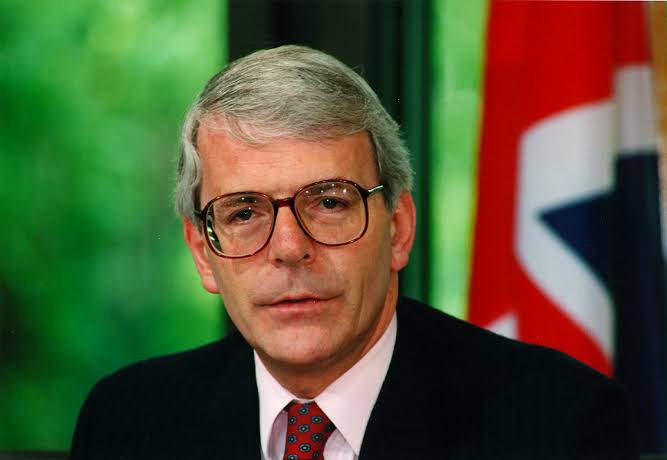
A riveting talk by Sir John Major.

(Images may be subject to copyright. If I am emailed that I am infringing the copyright of the New Statesman this photograph will be removed.)

Wikipedia speak of Sir John as follows:

Sir John Major (born 29 March 1943) is a British retired politician who served as Prime Minister of the United Kingdom and Leader of the Conservative Party from 1990 to 1997. He previously held Cabinet positions under Prime Minister Margaret Thatcher, his last as Chancellor of the Exchequer from 1989 to 1990. Major was Member of Parliament (MP) for Huntingdon, formerly Huntingdonshire, from 1979 to 2001. Since stepping down as an MP in 2001, Major has focused on writing and his business, sporting, and charity work, and has occasionally commented on political developments in the role of an elder statesman.

(More of the Wikipedia article is here.)

On yesterday’s World This Weekend the programme was entirely devoted to a speech that John Major gave on February 16th. His theme was: “We are moving into a more dangerous world

BBC Sounds have a recording of that speech that will stay available for 29 days. That link is here: https://www.bbc.co.uk/sounds/play/m00282l8

I sincerely hope you can listen to it, for I found the talk riveting!

Ancient times

This attracted me very much, and I wanted to share it with you.

The opening paragraph of this article caught my eye so I read it fully. As it was published in The Conversation then that meant I could republish it.

ooOOoo

Centuries ago, the Maya storm god Huracán taught that when we damage nature, we damage ourselves

James L. Fitzsimmons, Middlebury

The ancient Maya believed that everything in the universe, from the natural world to everyday experiences, was part of a single, powerful spiritual force. They were not polytheists who worshipped distinct gods but pantheists who believed that various gods were just manifestations of that force.

Some of the best evidence for this comes from the behavior of two of the most powerful beings of the Maya world: The first is a creator god whose name is still spoken by millions of people every fall – Huracán, or “Hurricane.” The second is a god of lightning, K’awiil, from the early first millennium C.E.

As a scholar of the Indigenous religions of the Americas, I recognize that these beings, though separated by over 1,000 years, are related and can teach us something about our relationship to the natural world.

Huracán, the ‘Heart of Sky’

Huracán was once a god of the K’iche’, one of the Maya peoples who today live in the southern highlands of Guatemala. He was one of the main characters of the Popol Vuh, a religious text from the 16th century. His name probably originated in the Caribbean, where other cultures used it to describe the destructive power of storms.

The K’iche’ associated Huracán, which means “one leg” in the K’iche’ language, with weather. He was also their primary god of creation and was responsible for all life on earth, including humans.

Because of this, he was sometimes known as U K’ux K’aj, or “Heart of Sky.” In the K’iche’ language, k’ux was not only the heart but also the spark of life, the source of all thought and imagination.

Yet, Huracán was not perfect. He made mistakes and occasionally destroyed his creations. He was also a jealous god who damaged humans so they would not be his equal. In one such episode, he is believed to have clouded their vision, thus preventing them from being able to see the universe as he saw it.

Huracán was one being who existed as three distinct persons: Thunderbolt Huracán, Youngest Thunderbolt and Sudden Thunderbolt. Each of them embodied different types of lightning, ranging from enormous bolts to small or sudden flashes of light.

Despite the fact that he was a god of lightning, there were no strict boundaries between his powers and the powers of other gods. Any of them might wield lightning, or create humanity, or destroy the Earth.

Another storm god

The Popol Vuh implies that gods could mix and match their powers at will, but other religious texts are more explicit. One thousand years before the Popol Vuh was written, there was a different version of Huracán called K’awiil. During the first millennium, people from southern Mexico to western Honduras venerated him as a god of agriculture, lightning and royalty.

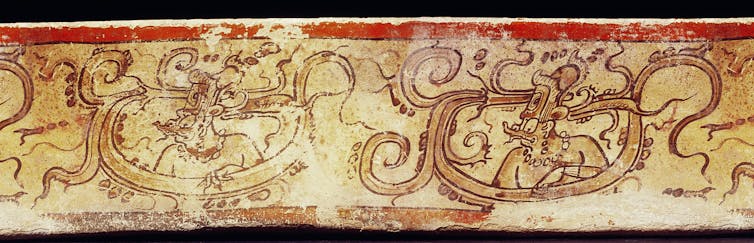
A drawing showing a reclining god-like figure with a large snake around him.
The ancient Maya god K’awiil, left, had an ax or torch in his forehead as well as a snake in place of his right leg. K5164 from the Justin Kerr Maya archive, Dumbarton Oaks, Trustees for Harvard University, Washington, D.C.

Illustrations of K’awiil can be found everywhere on Maya pottery and sculpture. He is almost human in many depictions: He has two arms, two legs and a head. But his forehead is the spark of life – and so it usually has something that produces sparks sticking out of it, such as a flint ax or a flaming torch. And one of his legs does not end in a foot. In its place is a snake with an open mouth, from which another being often emerges.

Indeed, rulers, and even gods, once performed ceremonies to K’awiil in order to try and summon other supernatural beings. As personified lightning, he was believed to create portals to other worlds, through which ancestors and gods might travel.

Representation of power

For the ancient Maya, lightning was raw power. It was basic to all creation and destruction. Because of this, the ancient Maya carved and painted many images of K’awiil. Scribes wrote about him as a kind of energy – as a god with “many faces,” or even as part of a triad similar to Huracán.

He was everywhere in ancient Maya art. But he was also never the focus. As raw power, he was used by others to achieve their ends.

Rain gods, for example, wielded him like an ax, creating sparks in seeds for agriculture. Conjurers summoned him, but mostly because they believed he could help them communicate with other creatures from other worlds. Rulers even carried scepters fashioned in his image during dances and processions.

Moreover, Maya artists always had K’awiil doing something or being used to make something happen. They believed that power was something you did, not something you had. Like a bolt of lightning, power was always shifting, always in motion.

An interdependent world

Because of this, the ancient Maya thought that reality was not static but ever-changing. There were no strict boundaries between space and time, the forces of nature or the animate and inanimate worlds.

People walking through knee-deep water on a flooded street with building on either side and electric wires overhead.
Residents wade through a street flooded by Hurricane Helene, in Batabano, Mayabeque province, Cuba, on Sept. 26, 2024. AP Photo/Ramon Espinosa

Everything was malleable and interdependent. Theoretically, anything could become anything else – and everything was potentially a living being. Rulers could ritually turn themselves into gods. Sculptures could be hacked to death. Even natural features such as mountains were believed to be alive.

These ideas – common in pantheist societies – persist today in some communities in the Americas.

They were once mainstream, however, and were a part of K’iche’ religion 1,000 years later, in the time of Huracán. One of the lessons of the Popol Vuh, told during the episode where Huracán clouds human vision, is that the human perception of reality is an illusion.

The illusion is not that different things exist. Rather it is that they exist independent from one another. Huracán, in this sense, damaged himself by damaging his creations.

Hurricane season every year should remind us that human beings are not independent from nature but part of it. And like Hurácan, when we damage nature, we damage ourselves.

James L. Fitzsimmons, Professor of Anthropology, Middlebury

This article is republished from The Conversation under a Creative Commons license. Read the original article.

ooOOoo

It is such a powerful message, that when we damage nature, we damage ourselves.

But I am unaware, no we are both unaware of a solution, and there doesn’t appear to be a government desire to make this the number one topic.

Please, if there is anyone who reads this post and has a more positive message then we would be very keen to hear from you.

The Heart Wall in London

I love this!

I am writing this having listened to a programme on BBC Radio 4. (Was broadcast on Radio 4 on Tuesday, August 13th.) It shows how many, many people can have a really positive response to a dastardly negative occurrence such as the Covid outbreak or a pandemic.

ooOOoo

Photo by Nick Fewings on Unsplash

Why are those lost to COVID not formally memorialised? How politics shapes what we remember

Mark Honigsbaum, City, University of London

Every Friday, volunteers gather on the Albert Embankment at the River Thames in London to lovingly retouch thousands of red hearts inscribed on a Portland stone wall directly opposite the Houses of Parliament. Each heart is dedicated to a British victim of COVID. It is a deeply social space – a place where the COVID bereaved come together to honour their dead and share memories.

The so-called National Covid Memorial Wall is not, however, officially sanctioned. In fact, ever since activists from COVID-19 Bereaved Families for Justice (CBFFJ) daubed the first hearts on the wall in March 2021 it has been a thorn in the side of the authorities.

Featured in the media whenever there is a new revelation about partygate, the wall is a symbol of the government’s blundering response to the pandemic and an implicit rebuke to former prime minister Boris Johnson and other government staff who breached coronavirus restrictions.

As one writer put it, viewed from parliament the hearts resemble “a reproachful smear of blood”. Little wonder that the only time Johnson visited the wall was under the cover of darkness to avoid the TV cameras. His successor Rishi Sunak has been similarly reluctant to acknowledge the wall or say what might take its place as a more formal memorial to those lost in the pandemic.

Though in April the UK Commission on COVID Commemoration presented Sunak with a report on how the pandemic should be remembered, Sunak has yet to reveal the commission’s recommendations.

Lady Heather Hallett, the former high court judge who chairs the public inquiry into COVID, has attempted to acknowledge the trauma of the bereaved by commissioning a tapestry to capture the experiences of people who “suffered hardship and loss” during the pandemic. Yet such initiatives are no substitute for state-sponsored memorials.

What is remembered and what is forgotten?

This political vacuum is odd when you consider that the United Kingdom, like other countries, engages in many other commemorative activities central to national identity. The fallen of the first world war and other military conflicts are commemorated in a Remembrance Sunday ceremony held every November at the Cenotaph in London, for example.

But while wars lend themselves to compelling moral narratives, it is difficult to locate meaning in the random mutations of a virus. And while wars draw on a familiar repertoire of symbols and rituals, pandemics have few templates.

For instance, despite killing more than 50 million globally, there are virtually no memorials to the 1918-1919 “Spanish” influenza pandemic. Nor does the UK have a memorial to victims of HIV/AIDS. As the memory studies scholar Astrid Erll puts it, pandemics have not been sufficiently “mediated” in collective memory.

As a rule, they do not feature in famous paintings, novels or films or in the oral histories passed down as part of family lore. Nor are they able to draw on familiar cultural materials such as poppies, gun carriages, catafalques and royal salutes. Without such symbols and schemata, Erll argues, we struggle to incorporate pandemics into our collective remembering systems.

This lacuna was brought home to me last September when tens of thousands of Britons flocked to the south bank of the Thames to pay their respects to Britain’s longest serving monarch. By coincidence, the police directed the queue for the late Queen’s lying-in-state in Westminster Hall over Lambeth Bridge and along Albert Embankment.

But few of the people I spoke to in the queue seemed to realise what the hearts signified. It was as if the spectacle of a royal death had eclipsed the suffering of the COVID bereaved, rendering the wall all but invisible.

Waiting for answers

Another place where the pandemic could be embedded in collective memory is at the public inquiry. Opening the preliminary hearing last October into the UK’s resilience and preparedness for a pandemic, Lady Hallett promised to put the estimated 6.8 million Britons mourning the death of a family member or friend to COVID at the heart of the legal process. “I am listening to them; their loss will be recognised,” she said.

But though Lady Hallett has strategically placed photographs of the hearts throughout the inquiry’s offices in Bayswater and has invited the bereaved to relate their experiences to “Every Story Matters”, the hearing room is dominated by ranks of lawyers. And except when a prominent minister or official is called to testify, the proceedings rarely make the news.

This is partly the fault of the inquiry process itself. The hearings are due to last until 2025, with the report on the first stage of the process not expected until the summer of 2024. As Lucy Easthope, an emergency planner and veteran of several disasters, puts it: “one of the most painful frustrations of the inquiry will be temporal. It will simply take too long.”

The inquiry has also been beset by bureaucratic obfuscation, not least by the Cabinet Office which attempted (unsuccessfully in the end) to block the release of WhatsApp messages relating to discussions between ministers and Downing Street officials in the run-up to lockdown.

To the inquiry’s critics, the obvious parallel is with the Grenfell inquiry, which promised to “learn lessons” from the devastating fire that engulfed the west London tower in 2017 but has so far ended up blurring the lines of corporate responsibility and forestalling a political reckoning.

The real work of holding the government to account and making memories takes place every Friday at the wall and the other places where people come together to spontaneously mourn and remember absent loved ones. These are the lives that demand to be “seen”. They are the ghosts that haunt our amnesic political culture.

Mark Honigsbaum, Senior Lecturer in Journalism, City, University of London

This article is republished from The Conversation under a Creative Commons license. Read the original article.

plus Wikipedia have a long article on the National Covid Memorial Wall. That then takes us to the website for the wall.

ooOOoo

As was written in the last sentence of the article; ‘They are the ghosts that haunt our amnesic political culture.

Humans are a strange lot and I most certainly count myself in!

The weather conundrum!

We are in an era of unknown weather, across the world!

Niccolò Ubalducci Photographer
Photo by Niccolò Ubalducci

ooOOoo

The climate is changing so fast that we haven’t seen how bad extreme weather could get

Simon H. Lee, University of St Andrews; Hayley J. Fowler, Newcastle University, and Paul Davies, Newcastle University

Published: July 30, 2024

Extreme weather is by definition rare on our planet. Ferocious storms, searing heatwaves and biting cold snaps illustrate what the climate is capable of at its worst. However, since Earth’s climate is rapidly warming, predominantly due to fossil fuel burning, the range of possible weather conditions, including extremes, is changing.

Scientists define “climate” as the distribution of possible weather events observed over a length of time, such as the range of temperatures, rainfall totals or hours of sunshine. From this they construct statistical measures, such as the average (or normal) temperature. Weather varies on several timescales – from seconds to decades – so the longer the period over which the climate is analysed, the more accurately these analyses capture the infinite range of possible configurations of the atmosphere.

Typically, meteorologists and climate scientists use a 30-year period to represent the climate, which is updated every ten years. The most recent climate period is 1991-2020. The difference between each successive 30-year climate period serves as a very literal record of climate change.

This way of thinking about the climate falls short when the climate itself is rapidly changing. Global average temperatures have increased at around 0.2°C per decade over the past 30 years, meaning that the global climate of 1991 was around 0.6°C cooler than that in 2020 (when accounting for other year-to-year fluctuations), and even more so than the present day.

A moving target for climate modellers

If the climate is a range of possible weather events, then this rapid change has two implications. First, it means that part of the distribution of weather events comprising a 30-year climate period occurred in a very different background global climate: for example, northerly winds in the 1990s were much colder than those in the 2020s in north-west Europe, thanks to the Arctic warming nearly four times faster than the global average. Statistics from three decades ago no longer represent what is possible in the present day.

Second, the rapidly changing climate means we have not necessarily experienced the extremes that modern-day atmospheric and oceanic warmth can produce. In a stable climate, scientists would have multiple decades for the atmosphere to get into its various configurations and drive extreme events, such as heatwaves, floods or droughts. We could then use these observations to build up an understanding of what the climate is capable of. But in our rapidly changing climate, we effectively have only a few years – not enough to experience everything the climate has to offer.

Extreme weather events require what meteorologists might call a “perfect storm”. For example, extreme heat in the UK typically requires the northward movement of an air mass from Africa combined with clear skies, dry soils and a stable atmosphere to prevent thunderstorms forming which tend to dissipate heat.

Such “perfect” conditions are intrinsically unlikely, and many years can pass without them occurring – all while the climate continues to change in the background. Based on an understanding of observations alone, this can leave us woefully underprepared for what the climate can now do, should the right weather conditions all come together at once.

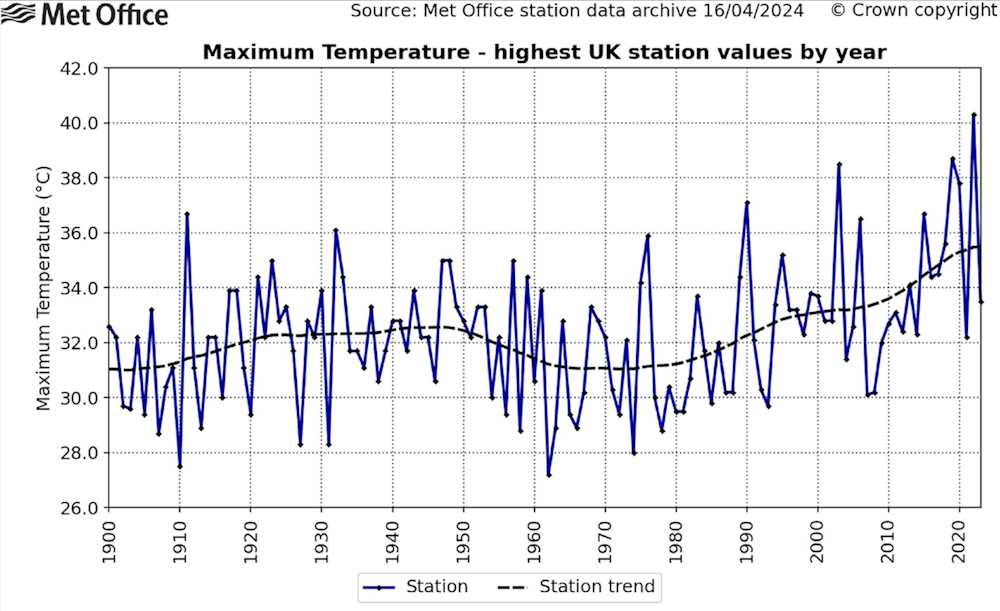
Startling recent examples include the extreme heatwave in the Pacific north-west of North America in 2021, in which temperatures exceeded the previous Canadian record maximum by 4.6°C. Another is the occurrence of 40°C in the UK in summer 2022, which exceeded the previous UK record maximum set only three years earlier by 1.6°C. This is part of the reason why the true impact of a fixed amount of global warming is only evident after several decades, but of course – since the climate is changing rapidly – we cannot use this method anymore.

Playing with fire

To better understand these extremes, scientists can use ensembles: many runs of the same weather or climate model that each slightly differ to show a range of plausible outcomes. Ensembles are routinely used in weather prediction, but can also be used to assess extreme events which could happen even if they do not actually happen at the time.

When 40°C first appeared in ensemble forecasts for the UK before the July 2022 heatwave, it revealed the kind of extreme weather that is possible in the current climate. Even if it had not come to fruition, its mere appearance in the models showed that the previously unthinkable was now possible. In the event, several naturally occurring atmospheric factors combined with background climate warming to generate the record-shattering heat on July 19 that year.

The highest observed temperature each year in the UK, from 1900 to 2023

A graph showing the highest observed temperature in the UK between 1900 and 2023.
The hottest days are getting hotter in the UK. Met Office/Kendon et al. 2024

Later in summer 2022, after the first occurrence of 40°C, some ensemble weather forecasts for the UK showed a situation in which 40°C could be reached on multiple consecutive days. This would have posed an unprecedented threat to public health and infrastructure in the UK. Unlike the previous month, this event did not come to pass, and was quickly forgotten – but it shouldn’t have been.

It is not certain whether these model simulations correctly represent the processes involved in producing extreme heat. Even so, we must heed the warning signs.

Despite a record-warm planet, summer 2024 in the UK has been relatively cool so far. The past two years have seen global temperatures far above anything previously observed, and so potential extremes have probably shifted even further from what we have so far experienced.

Just as was the case in August 2022, we’ve got away with it for now – but we might not be so lucky next time.

Simon H. Lee, Lecturer in Atmospheric Science, University of St Andrews; Hayley J. Fowler, Professor of Climate Change Impacts, Newcastle University, and Paul Davies, Chief Meteorologist, Met Office and Visiting Professor, Newcastle University

This article is republished from The Conversation under a Creative Commons license. Read the original article.

ooOOoo

That last sentence says it all: “Just as was the case in August 2022, we’ve got away with it for now – but we might not be so lucky next time.”

I am giving a talk, The Next Ten Years, next Saturday to our local Freethinkers group in Grants Pass. Close to the start of the presentation I say: “The Global Temperature anomaly, as of last year, 2023, is 1.17 C, 2.11 F, above the long-term average from 1951 to 1980. The 10 most recent years are the warmest years on record.

Finally, I am getting on in age and part of me wants to die, hopefully naturally, before more climate extremes are reached, but then another part of me would like to experience it!

An article on ageing

Musings on getting older and older!

I shall be 80 in November; I was born in London some six months before the end of World War II in Europe. I was the result of an affair between my father, Frederick, and my mother, Elizabeth. My father died in December, 1956 when I had recently become twelve years old.

I think that age spans have their own characteristics. So, for example, a person in their 20’s or their 40’s cannot sense what it is like to be in their 70’s or 80’s. Just a theory of mine and I have no evidence that this is a fact.

But as an introduction to today’s post it serves the task perfectly. And today’s post comes from The Conversation.

(And when I was writing this on the 11th July Biden was still the US President. My hunch is that he will not be by the 16th!)

ooOOoo

‘The immortal Gods alone have neither age nor death’

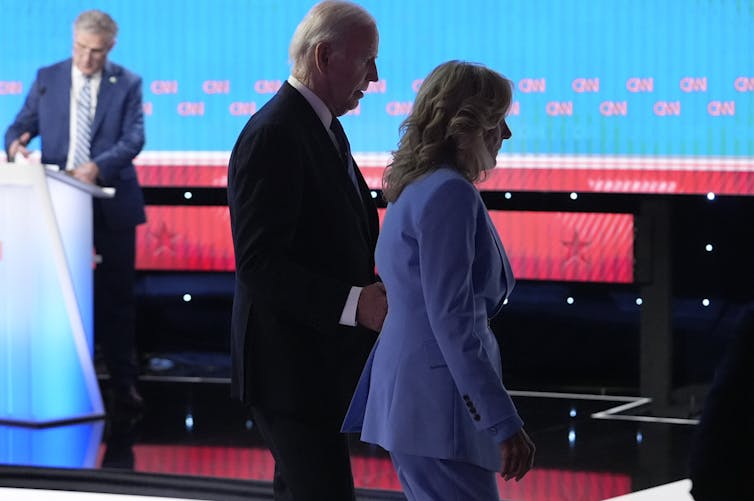
President Joe Biden, left, and first lady Jill Biden depart following a presidential debate with Donald Trump on June 27, 2024, in Atlanta. AP Photo/Gerald Herbert

Rachel Hadas, Rutgers University – Newark

President Joe Biden’s current fraught situation, showcasing both his weakness and his determination, is dramatic because it touches upon more than the political moment and more than one man’s character.

After his disastrous debate performance sparked calls for him to step aside as the Democratic presidential candidate, Biden’s position is not only inextricably entangled with issues of temperament and family dynamics. There’s also the challenge of making a crucial decision swiftly, at a moment when no decision is easy or clearly right.

And that’s not all. Biden has come to symbolize both the biological challenges and the existential poignancy of aging – of aging in power, certainly, but also just the unrelenting wear and tear of growing old.

The pressure of all these factors makes Biden a tragic figure.

Others reluctant to step down

To see this clamorous moment in the light of the past doesn’t make living in the present easier, but it does widen the perspective. Biden is far from the first person in a position of power who has been reluctant to step down – even when common sense or sheer weariness might dictate otherwise. In recent history, Supreme Court Justice Ruth Bader Ginsburg is often cited as an unfortunate example, and there are many other figures historians can cite.

Literature has always been concerned not only with people in power but also with the life cycle and the complexities of family relationships. Myths stay fresh and timeless; as we age, our understanding of a myth may change.

As the poet Eavan Boland writes in “The Pomegranate:”

“And the best thing about the legend is I can enter it anywhere. And have.”

The immense cohort of aging baby boomers, of whom I am one, is likely to sympathize with Biden because he has come to symbolize the vulnerability of aging – vulnerability to humiliation and, more subtly, to isolation.

A woman sitting in a room puts her face in her hands, covering her eyes.
Tonya Morris reacts at Tillie’s Lounge in Cincinnati during the presidential debate between President Joe Biden and the Republican candidate, former President Donald Trump, on June 27, 2024. AP Photo/Carolyn Kaster

Age ‘is not protection against suffering’

Greek poets like Homer and Sophocles present old age realistically.

In Homer’s “Iliad,” the elderly Nestor endlessly reminisces. Although listened to respectfully, he is a figure from an earlier generation whose role in war has dwindled to that of counselor.

Priam, the old king of Troy, heartbroken after the death of his son Hector, still finds the energy to berate his surviving sons as they clumsily hitch the mules that will draw the cart loaded with ransom so Priam can redeem his dead son’s body from the warrior who killed him, Achilles.

The subsequent moment of recognition between Priam and Achilles is one of the most poignant in literature, not least because the sight of old Priam reminds Achilles of his own aged father. Achilles might be expected to be enraged, but seeing Priam turns his anger to grief. Achilles knows he won’t see his father, Peleus, again. Being old is no protection against suffering; the aged Priam, mourning his son Hector, is assailed by the same desolate grief as Achilles.

In Shakespeare’s “Henry IV,” the once jovial and resilient Falstaff, publicly rejected and insulted by Prince Hal, is old, vulnerable – and alone. Macbeth, widowed and isolated, seems to have aged decades in the course of the play; he thinks forlornly of the comforts old age might be expected to provide: “honor, love, obedience, troops of friends.”

King Lear opens the tragedy named for him by ostensibly retiring. He announces his “intent/To shake all cares and business from our age,/Committing them to younger strengths, while we/Unburdened crawl toward death.”

But Lear refuses to cede control. Finally, as he sinks into confusion, he discovers humility and compassion – too late. Lear is reunited in prison with his loyal daughter Cordelia, who hasn’t been afraid to speak truth to power but who also has never ceased to love him – but she is summarily executed, and Lear, heartbroken, dies.

Decision requires ‘rare detachment’

Political commentator Bill Maher has called ageism the last respectable prejudice. It’s as if age and its accompanying disabilities create a force field keeping others at a distance. Or perhaps age bestows a universally recognized vulnerability on people who seemed powerful.

Either way, old people can seem somehow separated from the rest of us.

It’s hard even to imagine President Biden alone; on the contrary, he is apparently surrounded by loyal family and advisers. But the vulnerability of old age was on full display in the first presidential debate. News reports convey how hard it has become for anyone outside Biden’s tight circle to really see or know him.

One of the countless contrasts between Biden and Donald Trump is Biden’s almost sphinxlike unknowability, especially now. With Trump, as has frequently been noted, what you see is what you get. For better or for worse, his qualities are consistently on full display.

Age has been traditionally associated with wisdom, yet the wisdom old age can bestow seems out of reach for a figure still in the thick of politics. Lear’s “all-licensed” Fool rebukes the king: “Thou shouldst not have been old till thou had been wise.”

Only withdrawing from the fray might bestow some tranquility. But the vision to make the difficult decision to withdraw requires a kind of detachment that seems to be very rare in history, and not common in literature either.

An old man being comforted by two women, with a soldier in front of him.
The aged and blind Oedipus at Colonus, in an 1800 drawing by Bertel Thorvaldsen, says, ‘The immortal Gods alone have neither age nor death! All other things almighty Time disquiets.’ Sepia Times/Universal Images Group via Getty Images

‘Almighty time disquiets’

Greek tragedy does offer an eloquent example of just such wisdom.

Sophocles’s “Oedipus at Colonus” is a play about an old man written by an old man – Sophocles was in his 90s when the drama was presented.

The aged, self-blinded and self-exiled former king Oedipus, guided by his loyal daughter, finds himself in Colonus, a holy district outside Athens. When Theseus, the ruler of Athens, arrives on the scene, Oedipus’s words to him transcend both the immediate situation and Oedipus’s dire backstory.

“The immortal
Gods alone have neither age nor death!
All other things almighty Time disquiets.
Earth wastes away; the body wastes away;
Faith dies, distrust is born.
And imperceptibly the spirit changes
Between a man and his friend, or between two cities ….
… but time goes on,
Unmeasured Time, fathering numberless
Nights, unnumbered days ….”

By touching upon the shared human condition of mortality, as well as another universal, the inevitability of change, this speech bestows a stark tranquility on the situation.

Oedipus knows that he has come to Colonus to die, and his words convey a vision that seems to issue from beyond the grave. His detachment has an authority that now seems almost out of the reach of any of us, let alone a politician. But it’s good to remember that such qualities exist.

Of course this is a different moment. The looming juggernaut that Trump represents makes it hard for Biden’s supporters, or any Democrats, to be calm. Nevertheless, it’s useful to think about the potential strengths, as well as the vulnerabilities, of age.

The widespread anxiety now rampant among Biden’s supporters is sometimes mocked as unjustified panic. Time, as Oedipus might remind us, will tell. I personally find this anxiety touching and heartening for its humanity; there’s widespread compassion for Biden’s vulnerability.

In the ugly spectacle of American politics, it’s hard to keep humanity in sight. Literature can remind us of what we already know about growing old, about change, and about mortality.

Rachel Hadas, Professor of English, Rutgers University – Newark

This article is republished from The Conversation under a Creative Commons license. Read the original article.

ooOOoo

I cannot add anything to this first-class post!

Picture Parade Four Hundred and Forty

Memories of July 4th!

This was seen online in the afternoon of July 4th.

Dogs have appeared at U.K. polling stations wearing bows, rosettes and colourful leads as the public go to vote in the British General Election. The hashtag #dogsatpollingstations has become a highlight of election days for animal lovers on social media as people share photos of themselves exercising their pets and democratic rights at the same time. This year did not disappoint, with dogs on X, formerly known as Twitter, photographed in badges, bows and colourful leashes.

It is an alternative to the normal Picture Parade.

Introspection.

A recent article by George Monbiot gets me thinking.

George Monbiot is 61; his birthday is on January 27th. Thus he is 14 years younger than me. He is an experienced writer for The Guardian newspaper. Plus he has authored quite a few books and founded a charity, and given TED Talks, and I am sure more than this.

I read all of the articles that are published by him. His website is widely read. Please read his biography. Some of his many articles really get me thinking.

Some time ago I asked Mr. Monbiot for permission to republish his articles and that was granted. A small number of them have been republished on Learning from Dogs.

Today I want to republish an article that was presented on July 3rd.

ooOOoo

The Fight Against Oligarchy

Oligarchy is the default state of politics, and it is surging back. How do we stop it?

By George Monbiot, published in the Guardian  27th June 2024

We are about to return to normal politics. After 14 years of Tory corruption and misrule, a Labour government will put this country back on track. Justice and decency will resume, public services will be rebuilt, our global standing will be restored, we will revert to a familiar state. Or so the story goes.

What is the “normal” envisaged by pundits and politicians of the left and centre? It is the most anomalous politics in the history of the world. Consciously or otherwise, they hark back to a remarkable period, roughly 1945 to 1975, in which, in certain rich nations, wealth and power were distributed, almost everyone could aspire to decent housing, wages and conditions, public services were ambitious and well-funded and a robust economic safety net prevented destitution. There had never been a period like it in the prior history of the world, and there has not been one since. Even during that period, general prosperity in the rich nations was supported by extreme exploitation, coups and violence imposed on the poor nations. We lived in a bubble, limited in time and space, in which extraordinary things happened. Yet somehow we think of it as normal.

Those “normal” politics were the result of something known to economic historians as the “great compression”: a drastic reduction in inequality caused by two world wars. In many powerful countries, a combination of the physical destruction of assets, the loss of colonial and overseas possessions, inflation, very high taxes, wage and price controls, requisitioning and nationalisation required by the wartime economy, as well as the effects of rising democracy and labour organisation, greatly reduced the income and assets of the rich. It also greatly improved, once the wars had ended, the position of the poor. For several decades, we benefited from the aftermath of these great shocks. Now the effect has faded. We are returning to true “normality”.

The history of many centuries, including our own, shows that the default state of politics is not redistribution and general welfare, but a spiral of accumulation by the very rich, the extreme exploitation of labour, the seizure of common resources and exaction of rent for their use, extortion, coercion and violence. Normal is a society in which might is right. Normal is oligarchy.

In his magisterial book The Great Leveler, published in 2017, the historian Walter Scheidel explains that only four forces have ever significantly reversed inequality: mass-mobilisation warfare (such as the two world wars), total and violent revolution, state collapse and devastating plagues. Decisions, decisions.

He shows how warfare economies were turned into welfare economies, sometimes by force. For example, following the defeat of Japan, the US occupation government, led by General Douglas MacArthur, sought what it called “the democratization of Japanese economic institutions” to ensure “a wide distribution of income and ownership of the means of production and trade”. To this end, it imposed high property taxes, with a top marginal rate of 90%; broke up business conglomerates; demanded a labour union law enabling the right to organise and strike, and higher wages for workers; organised comprehensive land reform, which dissolved large holdings and distributed them to peasants; and introduced fiscal reform that led eventually to taxes on the highest incomes of 75% and an inheritance tax on the largest estates of 70%. These programmes resulted in the near-total destruction of income from capital and the creation in Japan of a political and economic democracy, almost from scratch.

All the major combatants were similarly transformed. In the US, the top rate of estate (inheritance) tax rose to 71% in 1941, and income tax to 94% in 1944. The National War Labor Board raised workers’ pay while holding down executive pay. Union membership soared. In the UK, the top rate of income tax was held at 98% from 1941 to 1952. It took decades to decline to current levels. A purchase tax on luxury goods was introduced in 1940, with rates that later rose to 100%. The share of incomes captured by the richest 0.1% fell from 7% in 1937 to just over 1% in 1975.

In the absence of one of the four great catastrophes, income and capital inexorably accumulate in the hands of the few, and oligarchy returns. Oligarchs are people who translate their inordinate economic power into inordinate political power. They build a politics that suits them. Scheidel shows that as inequality rises, so does polarisation and political dysfunction, both of which favour the very rich, as a competent, proactive state is a threat to their interests. Dysfunction is what the Tories delivered and Donald Trump promises.

Oligarchs seek the destruction of oversight, which is why UK bodies such as the Environment Agency and the Health and Safety Executive have been comprehensively gutted. The same desire was the driving force behind Brexit. They want the cessation of protest. They want a failing NHS, to justify privatisation. They want malleable politiciansand a tame BBC. They get what they want, distorting every aspect of national life. They pour money into neoliberal and far-right political movements, which help capital to solve its perennial problem: democracy. The arc of history bends towards injustice. But every so often it is broken over the knee of catastrophe.

If you want a return to the rich nations’ “normality” of 1945 to 1975 – in other words, to redistribution, a shared sense of national purpose, robust public services and a strong economic safety net, high employment and good wages – and I think most people would, you need a politics that is not just abnormal, but unprecedented. Snapping the arc of injustice would mean going way beyond Jeremy Corbyn’s 2019 manifesto, let alone Keir Starmer’s limp offering, which treads so carefully around the interests of the rich. We would need to do what the world wars did, without the violence and physical destruction: a peacetime MacArthur programme for overthrowing the oligarchs.

Political parties would need to overcome their fear of economic power: of the newspaper barons, the property developers, the fossil fuel companies, hedge funds, private equity bosses and assorted oligarchs who now fund and influence our politics. The longer we leave this confrontation, the more extreme and entrenched oligarchic power becomes. If we want even a modicum of democracy, equality, fairness and a functioning state, we need not the accommodation with economic power that Starmer seeks, but the mother of all battles with it.

ooOOoo

Let me repeat a sentence from the article: “Oligarchs are people who translate their inordinate economic power into inordinate political power.”

I am towards the end of my life. Whether or not things will change politically, as Monbiot suggests above, I do not know. But if asked to guess I would say probably not.

I would love to see a different, as in a better way, of us humans running things. I can’t put it better than how George Monbiot expressed it in that last sentence: “If we want even a modicum of democracy, equality, fairness and a functioning state, we need not the accommodation with economic power that Starmer seeks, but the mother of all battles with it.”

Finally, George Monbiot has a saying on his website: “I love not man the less, but Nature more.” I wish that were not the case, I wish oligarchy was a dead word, but Nature is so beautiful.

Photo by Daniel Beilinson on Unsplash