Archive for 2009
It’s strange being human!
Ten things we don’t understand about being human, from New Scientist magazine.
Thanks to Naked Capitalism for pointing me towards this fascinating piece in New Scientist. The article discusses 10 outwardly frivolous behaviours and attributes that have scientists scratching their head. They are:
- Blushing
- Laughter
- Pubic hair
- Teenagers’ behaviours

- Dreams
- Altruism
- Art
- Superstition
- Kissing, and
- Nose-picking
The article links each of the above to a further examination of why it is so strange. It’s a good read and the accompanying photograph heading up the article, reproduced across, is rather clever.
Reminds me of that lovely English ditty:
The whole world is rather queer,
except thee and me,
and I have my doubts about thee!
By Paul Handover
California – not so free anymore!
It now costs more to insure California’s debt than Russia’s
There’s a rather technical piece published recently on Bloomberg.com about the cost of insuring debt in a number of countries.
Eleven years after Russia defaulted, investors want less to insure its debt than California’s. “This would have been impossible to imagine a year ago,” said Dimitry Sentchoukov, an emerging-market credit strategist at Dresdner Kleinwort in London.
Will the last person leaving the sunshine State, please close the door!
By Paul Handover
Economics ought to make sense?
Why economists seems just as confused as me.
We live in a world where finance and money play a hugely more important role in our everyday lives than, say, 25 years ago. Well that’s how it seems. Our energy costs don’t seem to be connected to supply and demand but more in the hands of the speculators. Our house values have been greatly influenced, perhaps misaligned is a better word, by the availability of too easy money, resulting from exotic financial leveraging. Commodities are, like energy, traded for their own sake rather than to provide an efficient process of linking the grower with the consumer. And more.
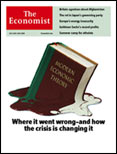
So it comes as a bit of a shock to read in a recent copy of The Economist that most of the theories and economic models are being ‘re-examined’ in the light of the current global crisis. These theories and models are not esoteric ideas kept

The Economist July 18th 2009
within the scholarly walls of universities but used by Governments, investment institutions and banks so they affect you and I in the real world, big time!
They ought to work a great deal better than they do because they have the capability to harm, as millions have found out in the last 2 years.
Selling, what is it?
When starting a new journey it’s better to start at the beginning!
The response to the recent Post on the topic of selling has been very gratifying and if that is an indicator of what you, the reader, is looking for then there is plenty more to offer. By the way, these posts will be grouped within a separate link under Archived Posts on the right-hand side of the home page of the Blog.
Let’s go right back to basics with a very simple question. What is selling?
Full moons and ghostie things.
Man’s continuing fascination in unworldly ideas.
When the bedroom light was turned out last night, the full moon was brilliant through the window. Inevitably, we pondered about that massive universe out there. My wish was expressed that before I die, I wanted to know that there
was life on another planet. This one piece of information would be the most thrilling and challenging fact ever presented to mankind.
So it was rather serendipitous to come across a small clip on BBC Television purporting to show a ‘UFO’ being caught by a live web cam.
However, the BBC also had in their archives another clip that did rather bring things down to earth. Towards the end the reporter interviews the man responsible for crop circles, a better example of an eccentric Englishman would be hard to find!
Bet we still privately hope there is something ‘out there’, don’t we?
By Paul Handover
This is surely going to end in tears!
US and UK Stock markets continue to defy gravity and common sense.
Those of you regularly reading the Blog (and Thank You!) will notice that Karl Denninger of Market Ticker is frequently referred to by this author.
My own view is that the fundamentals do not support what is happening but that’s amateur talk compared to the research and detail that Denninger puts into his Blog.
So here’s another very rational view of why small investors could be heading for burnt fingers, yet again. Private investors: always the last in and the last ones out!
UPDATE: And yet another convincing piece of information from Dave Rosenberg of Gluskin Sheff.
August 6, 2009
Some bad news for the long-range housing outlook
The home ownership rate surged to nearly 70% during the bubble and has since fallen back to 67.4%, but still well above pre-bubble norms. A just-released study by the University of Utah shows that the rate of home ownership in the U.S.A. is poised to decline to 63.5% by 2020 (where it was in 1985). At a time when there are still some 800,000 units in excess that are vacant AND for sale, this secular decline in demand spells one thing and one thing only, a secular deflation in residential real estate. The periodic months of “green shoot” stability will very likely prove to be little more than noise along a fundamental down-trend in pricing.
By Paul Handover
(Written on the 4th for publication at 9.00 am MT on the 6th. Markets at the time of writing are: Dow Jones 9295, S&P 500 1,001, NASDAQ 2002, FTSE 100 (now closed) 4671.)
Disclosure: No market investments, neither long or short on the indexes, heavily invested in US Treasuries.
Pattern matching.
How we attract ideas that support our behaviours
The problem in the way that some stories are selected for this Blog, mainly the financial and economic ones, is that one tends to be attracted to those news items that support one’s own hypothesis. Anyone who has followed the Posts on this Blog will know that this author thinks that the recession is not over, that a sustainable recovery is a long way off and that anything other than extremely risk-averse investments is, well, risky!